

Casino platform backoffice software is the operational control center behind an online casino. Players never see it, but almost every important business process depends on it: registrations, KYC reviews, deposits, withdrawals, bonus rules, affiliate payouts, game availability, fraud checks, reporting, and compliance evidence.
For founders and operators, the backoffice is not just an admin panel. It is where strategy becomes execution. A weak backoffice forces teams into spreadsheets, Slack approvals, manual exports, and delayed decisions. A strong one gives operations, payments, compliance, CRM, and leadership teams one reliable place to run the business.
Casino platform backoffice software, in plain English
Casino platform backoffice software is the set of internal tools used to manage an online gambling platform. It connects to the player database, wallet, payment gateway, game aggregator, bonus engine, KYC and AML tools, fraud systems, analytics, and support workflows.
Think of it as the cockpit for an iGaming platform. The frontend is what players use to register, deposit, claim offers, and play games. The backoffice is what your team uses to configure, monitor, approve, block, investigate, and optimize those same activities.
A modern backoffice should help operators answer questions like:
- Who is this player, and what has happened across their full account history?
- Was this deposit credited correctly and reconciled against the payment provider?
- Should this withdrawal be auto-paid, reviewed, or blocked?
- Is this bonus campaign profitable, or is it being abused?
- Are we compliant with KYC, AML, responsible gambling, and jurisdictional rules?
- Which games, affiliates, payment methods, and currencies are driving revenue?
In a white label casino platform, backoffice software is usually included as part of the platform. In a custom build, it may be assembled from multiple internal tools, vendor portals, dashboards, and databases. The more fragmented the setup, the more operational risk the casino takes on.
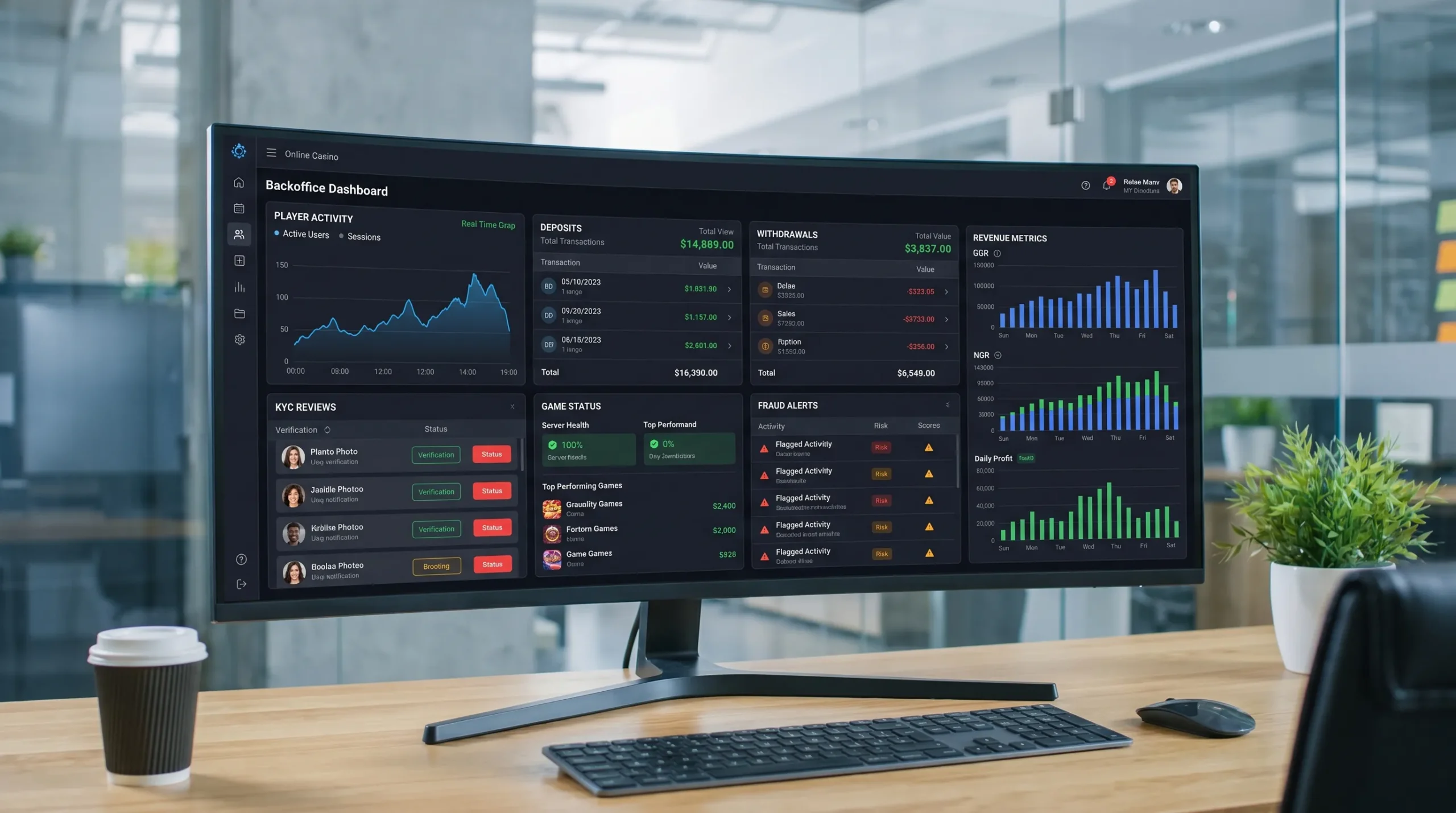
What a casino backoffice controls
The exact feature set varies by provider, but most serious casino backoffice systems cover the same core areas. The difference is how deeply each area is integrated, how fast the data updates, and how safely non-technical teams can make changes.
| Backoffice area | What it controls | Why it matters |
|---|---|---|
| Player management | Profiles, status, documents, account history, risk notes | Gives support, compliance, and risk teams a single player view |
| Wallet and payments | Deposits, withdrawals, balances, refunds, reversals, reconciliation | Protects the ledger and reduces payment disputes |
| KYC and AML | Identity checks, screening, monitoring, case queues, evidence | Helps operators meet regulatory obligations and reduce financial crime risk |
| Game operations | Game availability, providers, jurisdictions, categories, metadata | Keeps the casino lobby compliant, localized, and commercially optimized |
| Bonus and affiliate tools | Offers, wagering rules, eligibility, promo costs, partner tracking | Controls acquisition and retention spend |
| Fraud prevention | Device signals, payment risk, bonus abuse, multi-accounting, reviews | Reduces losses without blocking good players unnecessarily |
| Analytics and reporting | GGR, NGR, deposits, withdrawals, conversion, retention, player value | Turns live data into commercial decisions |
| Roles and audit logs | Admin permissions, approvals, change history, exports | Creates accountability and audit-ready evidence |
The best systems do not treat these as separate silos. If a player requests a withdrawal, the backoffice should show their KYC status, payment history, bonus obligations, gameplay behavior, risk signals, responsible gambling limits, and previous support tickets in one workflow.
Why backoffice software matters more as you scale
At launch, it is tempting to think backoffice software is just a convenience. A small team can manually approve withdrawals, export PSP reports, update bonus rules, and check KYC queues. That approach breaks quickly.
As player volume grows, the number of operational decisions increases faster than revenue. Every extra payment method adds reconciliation work. Every new country adds localization and compliance complexity. Every new affiliate increases fraud and attribution risk. Every new game provider adds content, certification, and reporting overhead.
A strong backoffice protects the operator in four ways.
First, it reduces manual work. Teams should not need developers for routine changes such as updating bonus rules, disabling a game in one market, reviewing a flagged withdrawal, or checking a player timeline.
Second, it improves speed. If deposits, KYC checks, and withdrawals are visible in real time, teams can act before small issues become support spikes or revenue leaks.
Third, it improves control. Role-based access, approval workflows, audit logs, and configurable limits make it harder for internal mistakes or unauthorized actions to damage the business.
Fourth, it improves decision-making. When backoffice data connects payments, games, bonuses, affiliates, and player behavior, operators can see profit quality, not just top-line activity.
For a deeper look at the operator experience, Spinlab has a dedicated guide on casino backoffice UX and admin tools.
The workflows a good backoffice should make simple
Withdrawal review and payout decisions
Withdrawals are one of the most sensitive parts of casino operations. Players expect speed, while operators need to prevent fraud, bonus abuse, chargebacks, sanctions issues, and AML exposure.
A good backoffice should show the full decision context before an operator clicks approve. That includes player identity status, payment method, previous deposits, wagering completion, game history, device or IP risk, transaction velocity, and notes from previous reviews.
The system should also support clear decision paths: auto-pay low-risk withdrawals, step up medium-risk cases, and send high-risk cases to manual review with reason codes. This makes the process faster for legitimate players and more defensible for compliance teams.
Bonus campaign management
Bonuses are powerful, but they can become expensive if rules are unclear or enforcement is weak. Backoffice software should let operators configure eligibility, wagering requirements, game contribution rules, max bet rules, expiry dates, country restrictions, and player segment targeting.
The backoffice should also show promo performance after launch. Useful views include claimed bonuses, active wagering, bonus cost, abuse flags, conversion to deposit, and NGR impact. If your team cannot see whether a campaign is profitable, it is not really controlled.
For vendor evaluation, Spinlab’s guide to casino bonus engine requirements explains the bonus controls operators should demand.
Payment monitoring and reconciliation
Payments are where player experience, finance, risk, and compliance collide. Casino backoffice software should make payment status visible from intent to settlement.
Operators need to see whether a deposit was initiated, authorized, captured, credited, reversed, charged back, or failed. For withdrawals, they need visibility into approval, payout initiation, provider status, settlement, and exceptions.
The backoffice should also support reconciliation between the casino ledger, payment gateway reports, and bank or crypto settlement records. Without that, finance teams end up chasing missing transactions manually. Spinlab covers this process in detail in its guide to casino payments reconciliation.
Fraud and risk investigations
Fraud prevention in iGaming is not one feature. It is a workflow across identity, device, payment, bonus, gameplay, affiliate, and withdrawal signals.
The backoffice should help teams triage alerts, open cases, attach evidence, apply actions, and record outcomes. Actions might include requesting additional KYC, blocking a bonus, holding a withdrawal, limiting a payment rail, suspending an account, or escalating to compliance.
Fraud controls can also extend beyond player accounts. Finance teams may need to validate supplier invoices, affiliate expenses, or operational payment documents. Tools such as AI invoice and receipt fraud detection can complement casino risk systems by identifying manipulated, photoshopped, or AI-generated documents before they enter approval or payment workflows.
Game and content operations
A casino backoffice should let teams manage the game lobby without constantly relying on developers. That includes enabling or disabling games, filtering by jurisdiction, tagging slot games or live casino games, managing categories, checking provider status, and preparing localized lobbies for different markets.
This becomes especially important when the casino uses a game aggregator. The backoffice must normalize provider data into a usable operating view, while still enforcing compliance and availability rules by country, currency, license, and player segment.
Backoffice software vs CMS, CRM, and BI tools
Backoffice software overlaps with other systems, but it is not the same thing.
A casino CMS manages content such as landing pages, game descriptions, promotion pages, SEO category pages, and localized copy. The backoffice manages operational state: player status, wallet events, risk actions, bonus eligibility, and admin workflows.
A CRM manages communication and lifecycle marketing. It uses segments, triggers, and campaigns to send emails, SMS, push notifications, or onsite messages. The backoffice is where operators often define the underlying player facts and controls that CRM campaigns must respect.
A BI tool visualizes data for analysis. It helps teams explore trends, cohorts, and financial performance. A backoffice should include reporting, but its main value is actionability. It is not only showing that withdrawal reviews are delayed, it should let authorized users process the queue.
In practice, the strongest iGaming platforms connect all of these layers through events, APIs, permissions, and audit logs.
What modern casino platform backoffice software should include in 2026
Casino operations are becoming more real-time, more global, and more compliance-heavy. A backoffice that worked for a single-market card-only casino may not be enough for a crypto-ready, multi-currency, multi-brand operator.
| Requirement | What to look for | Red flag |
|---|---|---|
| Real-time visibility | Live player, payment, wallet, game, and risk events | Dashboards update only once per day |
| Configurable operations | Non-technical users can manage bonuses, limits, and content safely | Every change requires a developer ticket |
| Audit-grade controls | Role permissions, approval flows, immutable logs, exportable evidence | Admin actions are hard to trace |
| Integrated payments | Fiat and crypto payment visibility, ledger events, reconciliation support | PSP data lives only in vendor portals |
| Compliance workflows | KYC, AML, sanctions, responsible gambling, and case management support | Compliance teams work from spreadsheets |
| Fraud prevention | Player, device, payment, bonus, and affiliate risk signals in one view | Fraud checks happen after losses occur |
| Open APIs | Integration with CRMs, data warehouses, KYC vendors, PSPs, and custom tools | Vendor lock-in with limited exports |
| Multi-currency support | Currency-level reporting, FX visibility, wallet controls | Finance cannot explain margin leakage |
For many operators, the ideal backoffice feels closer to a Shopify admin than an enterprise ERP: easy enough for business teams to use daily, but strong enough for regulated financial workflows.
How to evaluate a casino backoffice before choosing a platform
A polished demo can hide operational gaps. Before selecting a white label casino platform or turnkey casino solution, ask the vendor to walk through realistic scenarios rather than static screens.
Useful demo questions include:
- Can you show a full player timeline from registration to latest withdrawal?
- Can an operator see KYC, AML, bonus, payment, and gameplay context in one view?
- Can we configure a bonus without developer support and preview the cost rules?
- Can we disable a game provider or payment method for one jurisdiction only?
- Can we export audit logs for a regulator, payment partner, or internal review?
- Can support teams see payment status without accessing sensitive admin controls?
- Can the backoffice handle fiat, crypto, and multi-currency reporting in one place?
- Can we integrate external tools through APIs or webhooks?
The key is to test the backoffice against daily operating reality. If the demo requires five browser tabs, multiple vendor portals, manual CSV exports, and developer intervention, the platform may look cheaper than it really is.
Common backoffice mistakes operators should avoid
| Mistake | Why it hurts | Better approach |
|---|---|---|
| Giving all admins broad permissions | Increases internal risk and audit exposure | Use role-based access and least privilege |
| Treating analytics as separate from operations | Delays action when live issues appear | Connect dashboards to queues and workflows |
| Managing bonuses outside the platform | Creates enforcement gaps and support disputes | Use a rules-based bonus engine with logs |
| Ignoring reconciliation until finance complains | Causes unexplained balances and settlement gaps | Build ledger and PSP matching into daily operations |
| Reviewing fraud only after withdrawals | Lets abuse accumulate before detection | Use real-time scoring and early risk signals |
| Relying on vendor portals for core work | Fragments evidence and slows teams down | Centralize operational views in one backoffice |
These mistakes usually come from underestimating backoffice complexity. The backoffice is not a secondary module. It is the operating system of the casino business.
Where Spinlab fits
Spinlab offers an all-in-one, modular iGaming platform for building, launching, and scaling online casinos. Its platform is designed to combine the systems operators need most: crypto and fiat payments, seamless game aggregation, real-time analytics, advanced fraud prevention, KYC and AML compliance, multi-currency support, affiliate and bonus tools, open API integration, crypto onramp solutions, merchant custodial wallets, and a customizable backoffice admin panel.
For teams that want the flexibility of a modular casino software provider without the overhead of building every tool from scratch, Spinlab is built around fast onboarding and a Shopify-like operating experience. That matters because the best backoffice is not the one with the most buttons. It is the one your team can actually use to launch faster, control risk, and scale profitably.
Frequently Asked Questions
Is casino backoffice software the same as a white label casino platform? No. Backoffice software is one part of a white label casino platform. A full platform also includes the player frontend, wallet, payment integrations, game aggregation, compliance tooling, hosting, APIs, and other infrastructure.
Do new online casinos need backoffice software from day one? Yes. Even small casinos need to manage players, payments, KYC, withdrawals, bonuses, and admin permissions. Starting with a proper backoffice helps avoid messy manual processes that become hard to replace later.
What is the most important feature in casino platform backoffice software? The most important feature is a unified operational view. Teams should be able to see player, wallet, payment, KYC, bonus, fraud, and game activity in one controlled workflow rather than switching between disconnected systems.
Can casino backoffice software support crypto operations? It can if the platform is built for crypto-ready workflows. Look for multi-currency wallet visibility, crypto onramp support, custodial wallet controls, transaction monitoring, AML screening, and clear reconciliation between blockchain, ledger, and player balances.
How do you know if a backoffice is scalable? Test whether it supports role-based permissions, audit logs, real-time data, queues, APIs, configurable rules, multi-currency reporting, and high-volume payment and player workflows. Scalability is not just server capacity, it is operational capacity.
Build your casino operations on a stronger backoffice
The backoffice is where an online casino either stays controlled or becomes chaotic. If your team wants to launch with integrated payments, game aggregation, compliance workflows, real-time analytics, fraud prevention, and a customizable admin panel, Spinlab can help you move faster without stitching together a fragmented stack.
Explore Spinlab’s modular iGaming platform at spinlab.studio and see how a Shopify-like backoffice experience can support a faster, safer casino launch.