

Merchant wallets sit at the center of a casino’s money movement. They are not as visible as the cashier, the game lobby, or the bonus engine, but they decide whether deposits credit instantly, withdrawals settle cleanly, reconciliation stays audit-ready, and treasury risk remains under control.
For online casino operators, a merchant wallet is the operational wallet or account used to receive, hold, move, and settle funds on behalf of the business. In fiat environments, it may be a PSP merchant account, settlement account, or pooled balance. In crypto environments, it may be a custodial wallet, MPC wallet, omnibus wallet, or platform-managed merchant wallet used for deposits, withdrawals, liquidity, and safekeeping.
The key point is simple: your merchant wallet is not just a storage location. It is part of your payments, compliance, treasury, and player experience stack. If it is designed poorly, every other system suffers.
What Is a Merchant Wallet in an Online Casino?
A merchant wallet is the operator-side wallet or account that sits behind player-facing balances. Players may see a balance in EUR, USDT, BTC, BRL, or another supported currency, but the casino needs an internal structure to receive deposits, hold operational funds, fund withdrawals, manage liquidity, and reconcile every movement.
In practice, merchant wallets can include several layers:
- Cashier receiving wallets for incoming crypto deposits or fiat payment settlements.
- Operational hot wallets for fast player withdrawals and day-to-day liquidity.
- Safekeeping wallets or custodial accounts for funds not needed for instant payouts.
- Treasury wallets for liquidity management, FX conversion, stablecoin reserves, and settlement.
- Platform ledger accounts that track the casino’s internal view of all player and operator balances.
This distinction matters because the blockchain, PSP, bank statement, and casino ledger are not the same thing. A player’s casino balance is an internal ledger entry. A merchant wallet is where real funds are held or moved. Operators need both to match, every time.
Merchant Wallet vs Player Wallet vs Treasury Wallet
Many casino teams use the word “wallet” too broadly. That creates confusion between product, payments, and finance teams. A better approach is to define the wallet model clearly.
| Wallet type | Who it serves | Main purpose | Key risk |
|---|---|---|---|
| Player wallet | Player-facing casino account | Shows playable and withdrawable balance | Incorrect credits, bonus leakage, disputes |
| Merchant wallet | Operator-controlled funds account | Receives deposits, funds withdrawals, holds operational liquidity | Custody, reconciliation, liquidity shortfalls |
| Treasury wallet | Finance and operations | Manages reserves, FX, stablecoins, cold storage, settlement | Mispriced FX, overexposed hot funds, audit gaps |
| Bonus wallet | CRM and promotions | Separates promotional value from cash balance | Abuse, incorrect wagering enforcement |
A mature online casino platform should let these layers work together without mixing their responsibilities. The player wallet should be fast and intuitive. The merchant wallet should be secure and reconciled. The treasury wallet should be controlled and governed. The bonus wallet should enforce terms automatically.
Why Merchant Wallets Matter More in 2026
Casino payments are more fragmented than they were even a few years ago. Operators may accept cards, open banking, local APMs, stablecoins, direct crypto deposits, and crypto onramp flows in the same cashier. That flexibility improves conversion, but it also creates new operational complexity.
A casino merchant wallet now has to support:
- Multiple currencies and assets.
- Fast deposits and withdrawals.
- PSP and blockchain reconciliation.
- AML, sanctions, and Travel Rule workflows.
- Chargeback and dispute evidence.
- Hot, warm, and cold liquidity policies.
- Audit-grade reporting for regulators and accountants.
This is where many low-cost casino stacks fail. They add payment logos on the front end, but behind the scenes the operator still has to stitch together PSP reports, blockchain explorers, spreadsheets, and manual backoffice notes. That may work for a small test brand, but it breaks when volumes grow.
The operational lesson is similar across high-stakes industries: anything involving money, logistics, and public trust needs clear controls before scale. Even outside iGaming, large-scale event companies such as Luuk Broos Events succeed by coordinating many moving parts behind the scenes before the audience ever sees the final result. Casino payments require the same discipline, only with stricter compliance and real-time financial consequences.
The Core Requirements Operators Should Demand
A merchant wallet setup should be evaluated like critical infrastructure, not an optional payment feature. These are the requirements that matter most.
1. Segregated Balances and Clear Ledger Mapping
The first requirement is a proper ledger model. Operators should be able to separate player liabilities, operator funds, bonus balances, pending withdrawals, unsettled deposits, fees, and treasury reserves.
Without this, finance teams cannot answer basic questions quickly:
- How much player money is currently owed?
- Which funds are available for withdrawals?
- Which deposits are credited but not yet settled?
- Which balances are promotional rather than cash?
- Which crypto funds are exposed in hot wallets?
A strong ledger should be append-only, idempotent, and traceable. Every balance change should have a reason, source event, timestamp, currency, and correlation ID. This is especially important when a casino supports both fiat and crypto payment flows.
For a deeper look at ledger matching, Spinlab’s guide to casino payments reconciliation explains how ledger, PSP, and bank records should align.
2. Hot, Warm, and Cold Wallet Policies
For crypto-ready casinos, not all funds should sit in the same wallet. A hot wallet can support instant payouts, but it should not carry unnecessary exposure. A cold or safekeeping wallet improves security, but it cannot serve every real-time withdrawal request.
A practical model is to define wallet tiers by purpose.
| Tier | Typical use | Operational goal |
|---|---|---|
| Hot wallet | Small, frequent withdrawals | Speed and availability |
| Warm wallet | Rebalancing and larger routine payouts | Controlled liquidity |
| Cold or safekeeping wallet | Excess reserves and long-term storage | Risk reduction |
| Fiat settlement account | PSP and bank settlement | Accounting and reconciliation |
Operators should define thresholds for each tier, automate alerts when balances fall outside policy, and require approvals for large movements. The policy should also specify who can initiate transfers, who can approve them, and how emergency replenishment works during peak traffic.
3. Multi-Currency and Stablecoin Support
Global casinos rarely operate in one currency. A player may deposit in EUR, receive a bonus in USD equivalent, play games priced in another currency, and withdraw in USDT. That can create hidden FX leakage if the wallet model is not precise.
Merchant wallets should support currency-specific balances, transparent conversion rules, and a clear rate authority. Operators should avoid vague “best available rate” policies that cannot be audited later.
Stablecoins add another layer. They can reduce volatility and speed cross-border settlement, but they still require asset policy, chain policy, liquidity policy, and compliance checks. USDT on Tron is operationally different from USDC on Ethereum or Polygon. Treating all stablecoins as interchangeable creates reconciliation and risk issues.
If your casino supports several currencies, review Spinlab’s guide to multi-currency wallet FX policies before finalizing your treasury rules.
4. AML, KYT, and Travel Rule Readiness
Merchant wallets must support compliance workflows, not bypass them. In crypto payments, operators need controls for wallet screening, sanctions exposure, suspicious patterns, and Travel Rule data where applicable. In fiat payments, operators need clear links between player identity, payment method ownership, deposit activity, chargeback risk, and withdrawal behavior.
The FATF guidance on virtual assets and VASPs remains an important reference point for risk-based crypto controls. Operators should also monitor local rules, because requirements vary significantly by licensing jurisdiction and target market.
At a minimum, a merchant wallet system should support:
- Player-level source attribution for deposits and withdrawals.
- Wallet address screening before crypto payouts.
- Transaction monitoring across fiat and crypto rails.
- Evidence exports for AML investigations.
- Configurable thresholds for enhanced due diligence.
- Audit logs for overrides, approvals, and manual reviews.
The goal is not to block every transaction that looks unusual. The goal is to make risk decisions explainable, consistent, and reviewable.
5. Reconciliation That Runs Daily, Not Monthly
Merchant wallets become dangerous when reconciliation is delayed. A small mismatch today can become a large finance, compliance, or support problem by the end of the month.
For casinos, reconciliation should be close to real time for critical events and formally closed daily for accounting. Each deposit and withdrawal should be traceable across four layers: player ledger, payment provider or blockchain transaction, merchant wallet movement, and bank or custody statement.
Common mismatch causes include webhook delays, duplicated callbacks, blockchain confirmation timing, FX rounding, PSP settlement fees, manual adjustments, failed withdrawals, and chargebacks. The fix is not more spreadsheets. The fix is deterministic matching rules, exception queues, and clear ownership.
A good exception queue should show what failed, why it failed, who owns it, and whether player balances are affected. That gives finance and support teams the same source of truth.
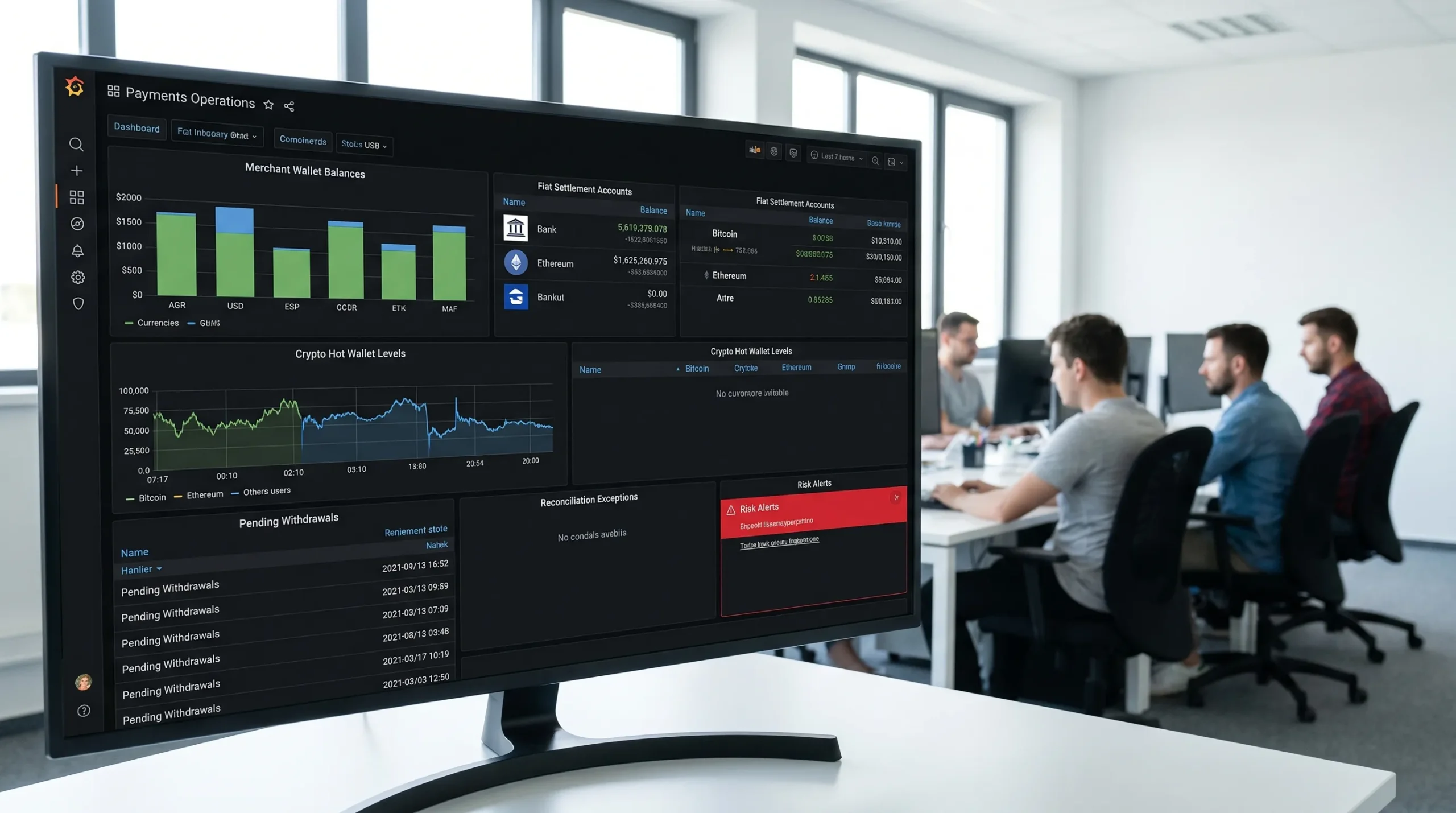
6. Withdrawal Liquidity and Payout SLAs
Merchant wallet design directly affects withdrawals. If hot liquidity is too low, legitimate players wait. If hot liquidity is too high, the operator increases custody exposure. If withdrawals require manual finance intervention, support tickets rise and player trust drops.
Operators should define liquidity buffers based on real withdrawal patterns, not guesses. Useful inputs include average daily withdrawal volume, peak-hour payout demand, VIP exposure, affiliate campaign timing, jackpot events, and asset-specific settlement speed.
A simple starting policy is to maintain enough hot liquidity for normal short-term withdrawal demand, keep warm liquidity for predictable replenishment, and move excess funds into safer storage. The exact numbers depend on your market, traffic, and risk appetite.
The key is to connect liquidity monitoring to the cashier experience. If a rail is temporarily unavailable, the player should see accurate options rather than submitting a withdrawal that later fails silently.
Build vs Buy: Should Operators Manage Merchant Wallets Themselves?
Some operators want full control over custody, treasury, and wallet infrastructure. Others prefer a white label casino platform or casino software provider that includes merchant custodial wallets and payment infrastructure.
The right answer depends on team maturity, licensing requirements, transaction volume, and crypto exposure.
| Approach | Best fit | Advantages | Trade-offs |
|---|---|---|---|
| Self-managed wallets | Crypto-native teams with strong security and finance operations | Maximum control, custom policies | Higher engineering, custody, compliance, and audit burden |
| PSP or custodian-led setup | Operators focused on fiat or regulated crypto flows | Faster setup, external custody controls | Less flexibility, vendor dependency, possible fee complexity |
| Platform-managed merchant wallets | Lean casino teams using a turnkey casino solution | Faster launch, integrated ledger, payments, compliance, and backoffice | Requires careful vendor due diligence |
| Hybrid model | Scaling operators with multiple regions and rails | Balance of control and speed | Needs strong governance and integrations |
For first-time founders or lean operators, managing merchant wallets entirely in-house can distract from product-market fit. For larger operators, outsourcing everything without data access or clear controls can create vendor lock-in. The strongest model is usually modular: integrated enough to launch and operate efficiently, open enough to export data, connect providers, and enforce your own policies.
Vendor Questions to Ask Before You Sign
When evaluating a white label casino platform, payment gateway, or crypto-ready solution, ask for proof rather than marketing language. Merchant wallet quality is visible in workflows, logs, and controls.
Ask these questions during the demo:
- How do merchant wallet balances map to player ledger balances? The vendor should show balance types, transaction states, and reconciliation views.
- Can we separate player liabilities from operator funds? This is essential for accounting, audits, and operational discipline.
- Which currencies, chains, and payment rails are supported? Confirm both current support and the process for adding new rails.
- How are hot wallet limits and replenishment rules configured? You need policy controls, alerts, and approval workflows.
- What happens when a deposit webhook is delayed or duplicated? Look for idempotency, state machines, and exception handling.
- Can compliance teams export evidence for a player, wallet, or transaction? Screenshots are not enough. You need structured evidence.
- How are fees, FX, gas, and settlement differences represented? Hidden cost leakage often starts here.
- What access controls protect wallet operations? Require role-based permissions, approval logs, and segregation of duties.
- Can we integrate external custodians, PSPs, or analytics tools through APIs? This reduces lock-in and improves operational flexibility.
If a vendor cannot show these flows clearly, assume your team will carry the operational burden after launch.
Where Spinlab Fits
Spinlab offers an all-in-one, modular iGaming platform for building, launching, and scaling online casinos. For merchant wallet operations, the important point is that Spinlab combines casino payments, crypto and fiat support, compliance workflows, game aggregation, analytics, fraud prevention, and backoffice controls in one platform.
For operators, that means merchant wallets are not treated as an isolated crypto feature. They connect to the cashier, player ledger, KYC and AML workflows, withdrawal controls, real-time analytics, and backoffice operations. Spinlab also supports merchant custodial wallets for safekeeping funds, which is especially useful for operators that want crypto-ready infrastructure without building every wallet and custody workflow from scratch.
Because Spinlab is modular, operators can use the platform as a turnkey casino solution while still keeping flexibility through APIs, multi-currency support, customizable admin tools, and integrated payments.
A Practical Merchant Wallet Readiness Checklist
Before launching or migrating casino payments, operators should be able to answer these questions with evidence:
- Do we know exactly where player funds, operator funds, bonus funds, and pending withdrawals sit?
- Can we reconcile ledger, PSP, bank, custody, and blockchain records daily?
- Do we have wallet tier policies for hot, warm, cold, and safekeeping funds?
- Can we screen crypto wallets and fiat payment activity against AML risk rules?
- Do we know our withdrawal liquidity requirements during normal and peak traffic?
- Can finance, risk, support, and compliance teams see the same transaction state?
- Do we have approval workflows for large wallet movements and manual balance adjustments?
- Can we export evidence quickly for regulators, auditors, PSPs, and dispute teams?
If the answer to any of these is unclear, the merchant wallet is not ready for scale.
Frequently Asked Questions
What is a merchant wallet for casinos? A merchant wallet is an operator-controlled wallet or account used to receive, hold, move, and settle casino funds. It supports deposits, withdrawals, liquidity management, reconciliation, and safekeeping behind the player-facing wallet.
Is a merchant wallet the same as a player wallet? No. A player wallet is the balance the player sees inside the casino. A merchant wallet is where the operator holds or moves real funds. The two must be connected through an accurate internal ledger.
Do crypto casinos need merchant custodial wallets? Many crypto-ready casinos use custodial or platform-managed merchant wallets to simplify safekeeping, withdrawals, and reconciliation. The right custody model depends on licensing, risk appetite, asset support, and operational capacity.
What is the biggest risk in merchant wallet management? The biggest risk is losing the link between real funds and internal ledger balances. This can lead to failed withdrawals, incorrect player credits, audit gaps, AML issues, and financial losses.
How often should casino merchant wallets be reconciled? Critical transaction states should be monitored continuously, and formal reconciliation should happen daily. Monthly reconciliation is too slow for high-volume casino payment environments.
Can a white label casino platform manage merchant wallets? Yes, if the platform includes integrated payments, ledger controls, wallet operations, compliance workflows, and audit-ready reporting. Operators should verify these capabilities during the vendor demo.
Build Merchant Wallets Into the Platform, Not Around It
Merchant wallets are now a core part of casino infrastructure. They affect deposits, withdrawals, compliance, fraud prevention, treasury, player trust, and finance operations. Treating them as a separate payment add-on creates avoidable risk.
If you are launching or scaling an online casino, choose an iGaming platform that connects merchant wallets to the ledger, cashier, KYC and AML workflows, fraud controls, reconciliation, and analytics from day one.
Spinlab gives operators a modular, crypto-ready, Shopify-like way to launch and manage casino operations with integrated payments, multi-currency support, merchant custodial wallets, real-time analytics, and a customizable backoffice. If you want to see how your merchant wallet setup could work inside a full white label casino platform, book a Spinlab demo and map your payment flows before you scale.
Had a great experience with the payouts here. Everything was handled professionally and arrived on time. Big thanks to brzzwin26 for the great service.
The best part about this site is how user friendly it is. Even a beginner can navigate it easily. I’m spending a lot of time on pk98pak lately.