

FX is one of those iGaming cost lines that rarely looks scary in a spreadsheet, until you launch in three regions, add two payout rails, and discover your “small” conversions are quietly eating the margin you fought for everywhere else.
Multi-currency wallets are supposed to help you grow internationally, lift deposit conversion, and reduce friction. But without explicit FX policies, they can also become a margin leak machine: inconsistent rate sources, hidden spreads, rounding loss, mispriced fees, bonus arbitrage, and reconciliation gaps that only surface when finance tries to close the month.
This guide is about designing FX policies inside multi-currency wallets that are operationally enforceable, measurable, and audit-friendly.
Why FX is a product problem (not just a treasury problem)
In online casinos, payments are not a back-office utility. They are a conversion funnel, a risk surface, and a profit lever.
FX touches all three:
- Conversion and UX: When players see one amount in the cashier and receive another in their wallet (or experience “mysterious” fees), trust drops.
- Risk and abuse: If your rate-lock rules are inconsistent, FX becomes an arbitrage vector for bonus abusers and advantage players.
- Unit economics: FX leakage compounds across deposits, wagers, withdrawals, chargebacks, and provider settlement.
The key shift is to treat FX like you treat RTP, bonus cost, and approval rate: define the policy, instrument it, and monitor it continuously.
Where margin leaks actually come from in multi-currency wallets
Most FX loss is not one big fee. It is a stack of small leaks across the lifecycle.
| Margin leak source | What it looks like in ops | Why it happens | Policy that stops it |
|---|---|---|---|
| Implicit conversion spreads | Players deposit in EUR, wallet credits in USD “at a rate” nobody can explain | Rate source is inconsistent (PSP vs internal), spread is unowned | Single rate authority, declared spread model, rate timestamping |
| Rate timing slippage | Same flow costs more at peak hours or on weekends | Async settlement, volatile rates, delayed callbacks | Rate locks per step, max age for rates, volatility buffers |
| Rounding and minimums | Micro-deposits lose outsized value; withdrawal fees look random | Decimal rules differ by currency/asset, fee floors | Rounding spec per currency, fee floors disclosed and enforced |
| Cross-currency promo arbitrage | Players cycle value through currencies to meet wagering or withdraw | Promo terms not currency-aware, conversion points exploitable | Currency-aware promo enforcement, conversion limits, loop detection |
| Negative balances amplified by FX | Chargeback creates deficit larger than expected | Chargeback in one currency, wallet is another, revaluation not controlled | FX revaluation policy, deficit handling, outflow blocks |
| Reconciliation “fog” | Finance cannot explain FX gains/losses, PSP totals do not match ledger | Missing FX fields on ledger entries, mixed rate sources | Ledger-first recording with FX metadata, three-way match |
If you want a useful mental model, think of FX leakage like “operational entropy.” Tiny inconsistencies multiply. That same principle shows up in personal finance narratives too: small, undocumented decisions add up over time. A non-technical but surprisingly relevant perspective on discipline and accountability is found in essays like those on Raw Life Thoughts (the theme is different, but the habit of documenting decisions is the point).
The FX policy stack: decisions you must make explicitly
A “multi-currency wallet” is not one feature. It is a set of rules that define how value moves and how you account for it.
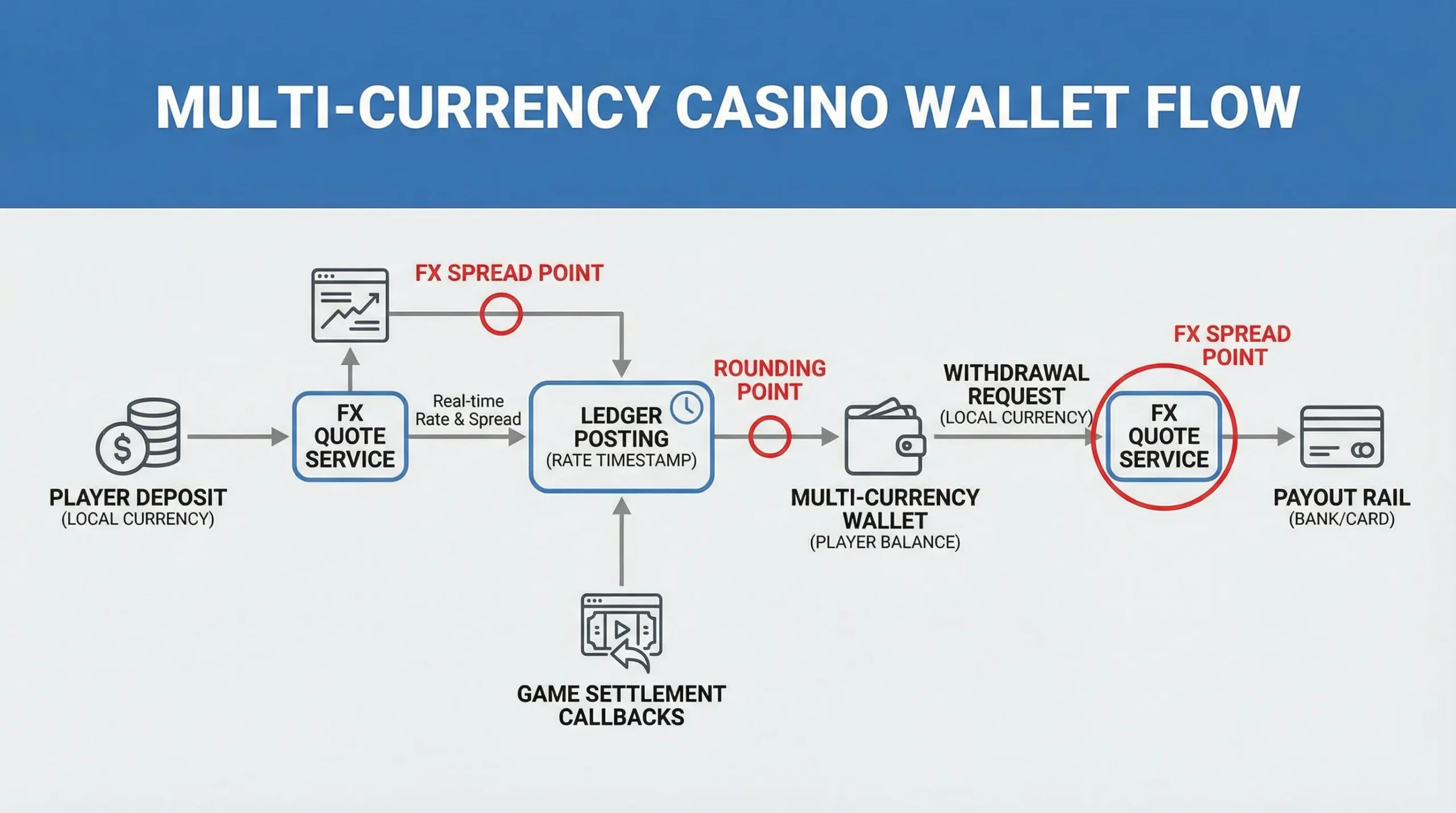
1) Choose your rate authority (and make it provable)
You need one authoritative FX service (even if it aggregates sources) so that:
- every conversion can be recomputed,
- every dispute can be answered,
- every reconciliation can be closed.
Policy decisions to document:
- Rate type: mid-market, mid plus spread, or provider rate.
- Rate sources: one source, or multi-source with failover.
- Timestamp rules: what time counts as “the rate,” request time, authorization time, settlement time, or posting time.
- Max staleness: how old a rate can be before you refuse or re-quote.
A practical pattern is multi-source quoting with a deterministic selection rule, such as “use Source A, fallback to B if stale or outside tolerance.” Then store both the chosen rate and the alternatives for audit.
If you want a sanity check for the reality of the market you are integrating into, the BIS Triennial Central Bank Survey is still the standard reference for FX market structure and turnover (useful when explaining to stakeholders why “FX is cheap” is not the same as “FX is free”).
2) Define your spread model (and who pays for FX)
Operators often drift into a spread model accidentally. That is when margin leaks.
You have three clean options:
- Player-paid FX: you quote a rate that includes your spread/fee.
- Operator-paid FX: you use a player-friendly rate and book FX cost as payment OPEX.
- Hybrid: certain rails or segments (for example, VIP withdrawals) get subsidized.
What matters is consistency and measurement.
Typical policy pitfalls to avoid:
- Taking spread on deposits but not withdrawals (or vice versa) without realizing it.
- Letting PSPs apply their own FX while you also apply internal FX (double conversion).
- Applying different spreads per channel without logging the reason (affiliate disputes love this).
A clean implementation is to treat FX as a line item with explicit ownership: it is either a fee (player-visible) or a cost (operator-visible), but never a mystery.
3) Decide when conversions happen (conversion triggers)
The biggest FX design choice is not the rate. It is the conversion point.
Common conversion triggers in iGaming flows:
- At deposit time: player deposits in local currency, you credit base wallet currency.
- At bet time: player wallet stays local, you convert per wager into game settlement currency.
- At withdrawal time: wallet stays local, convert only when paying out.
- Never (multi-balance wallet): player holds balances in multiple currencies and chooses.
Each has pros and cons, but the margin leak happens when you mix them without a clear rule.
High-leverage policy controls:
- Rate lock window: lock for X seconds/minutes from quote to confirmation.
- Re-quote rules: if the window expires, re-quote before completion.
- Partial fill behavior: if a payout rail fails after conversion, do you reverse at the same rate, current rate, or hold as balance.
- Refund and chargeback behavior: which rate is used and where gains/losses land.
If you operate both fiat and crypto, treat crypto pricing as part of the same conversion policy. Stablecoins can reduce volatility, but they do not eliminate spread and routing costs.
4) Netting and treasury rules (where FX really becomes money)
Wallet conversions are one side. Your real FX economics show up in treasury:
- PSP settlement currency vs player wallet currency
- Local bank accounts vs central treasury accounts
- Onramp/offramp currency pairs and liquidity
Policies that prevent “death by a thousand transfers”:
- Currency netting cadence: define when you net inflows/outflows per currency (daily, hourly, threshold-based).
- Liquidity buffers: set minimum operating balances per currency/asset to avoid emergency conversions.
- Threshold routing: route conversions only above a minimum size, otherwise hold local balance (avoids fee floors dominating small flows).
- Weekend/holiday rules: some rails settle later, so set FX buffers or widen locks.
A useful operational artifact is a per-currency “treasury runbook” that states:
- target float,
- refill triggers,
- who approves large conversions,
- what happens when a rail is degraded.
This is also where real-time observability matters. If you see conversion costs spike, you want to know whether it is rate movement, provider spread widening, or a routing change.
5) Stablecoins: when they reduce FX, and when they just move it
Stablecoins (USDT, USDC, EUR stablecoins where permitted) can reduce some cross-border frictions, but you still need policy clarity:
- Your “stable” asset is still a currency exposure (USD exposure is still exposure).
- You can still leak margin via onramp/offramp spreads, gas fees, and bridge costs.
- Regulation matters: in some jurisdictions, stablecoins have specific compliance requirements.
Treat stablecoins as another currency with:
- explicit pricing source,
- explicit conversion fees,
- explicit custody and payout controls.
Controls that keep FX from becoming an abuse vector
If you offer multi-currency wallets, some users will test the edges. Your FX policy should assume adversarial behavior.
FX arbitrage patterns to defend against
- Promo conversion loops: convert currency A to B to meet wagering, then cash out where fees are lowest.
- Rate-lock exploitation: initiate conversion, stall, then complete when rate moves in their favor.
- Fee floor gaming: split withdrawals into sizes that minimize percent fees.
- Cross-rail mismatch: deposit via a rail with subsidized FX, withdraw via a rail with favorable payout FX.
Practical guardrails
- Rate-lock expiry and re-quote by default.
- Conversion velocity limits (per account, per device, per payment instrument).
- Currency-aware bonus terms (wagering, max cashout, and eligible games should be enforceable regardless of currency).
- Detect “round-trip” patterns (same user cycles between two currencies with low gameplay volume).
FX is also closely tied to negative balances. If you want a deeper treatment of deficit scenarios, see Spinlab’s related guide on handling deficits in multi-currency systems: How to Handle Negative Balances in Multi-Currency Wallets.
Accounting and reconciliation: make FX audit-grade
The easiest way to “lose” margin is to make it impossible to measure.
At minimum, every money movement in your ledger that involves a conversion should include:
- source currency and amount,
- target currency and amount,
- FX rate used,
- rate timestamp,
- spread/fee component (separately stated if possible),
- conversion reason (deposit, withdraw, internal transfer, chargeback reversal, correction),
- reference IDs to the PSP/on-chain transaction.
This is what allows finance to book:
- FX fees (revenue or cost),
- realized FX gains/losses,
- unrealized revaluation (if you hold balances).
A strong operational pattern is to run a daily three-way match: ledger vs PSP vs bank (and on-chain, if applicable). Spinlab covers the mechanics in detail here: Casino Payments Reconciliation: Ledger, PSP, and Bank Match.
A simple (but effective) FX reconciliation tolerance policy
Even good systems need tolerances. Define them before you launch.
| Reconciliation item | Suggested policy question | Example control |
|---|---|---|
| Rate tolerance | How far from benchmark is acceptable? | Alert if rate differs from reference by > X bps |
| Timing tolerance | How old can the quoted rate be? | Block if older than Y seconds for certain flows |
| Amount tolerance | What rounding delta is acceptable? | Flag if delta > smallest currency unit or > fee floor |
| Exception SLA | How fast must mismatches be resolved? | Close exceptions within 24h, escalate > 72h |
The goal is not “zero exceptions.” The goal is bounded exceptions with clear owners.
KPIs that reveal FX margin leaks early
FX issues hide when you only look at blended payment cost. Track FX explicitly.
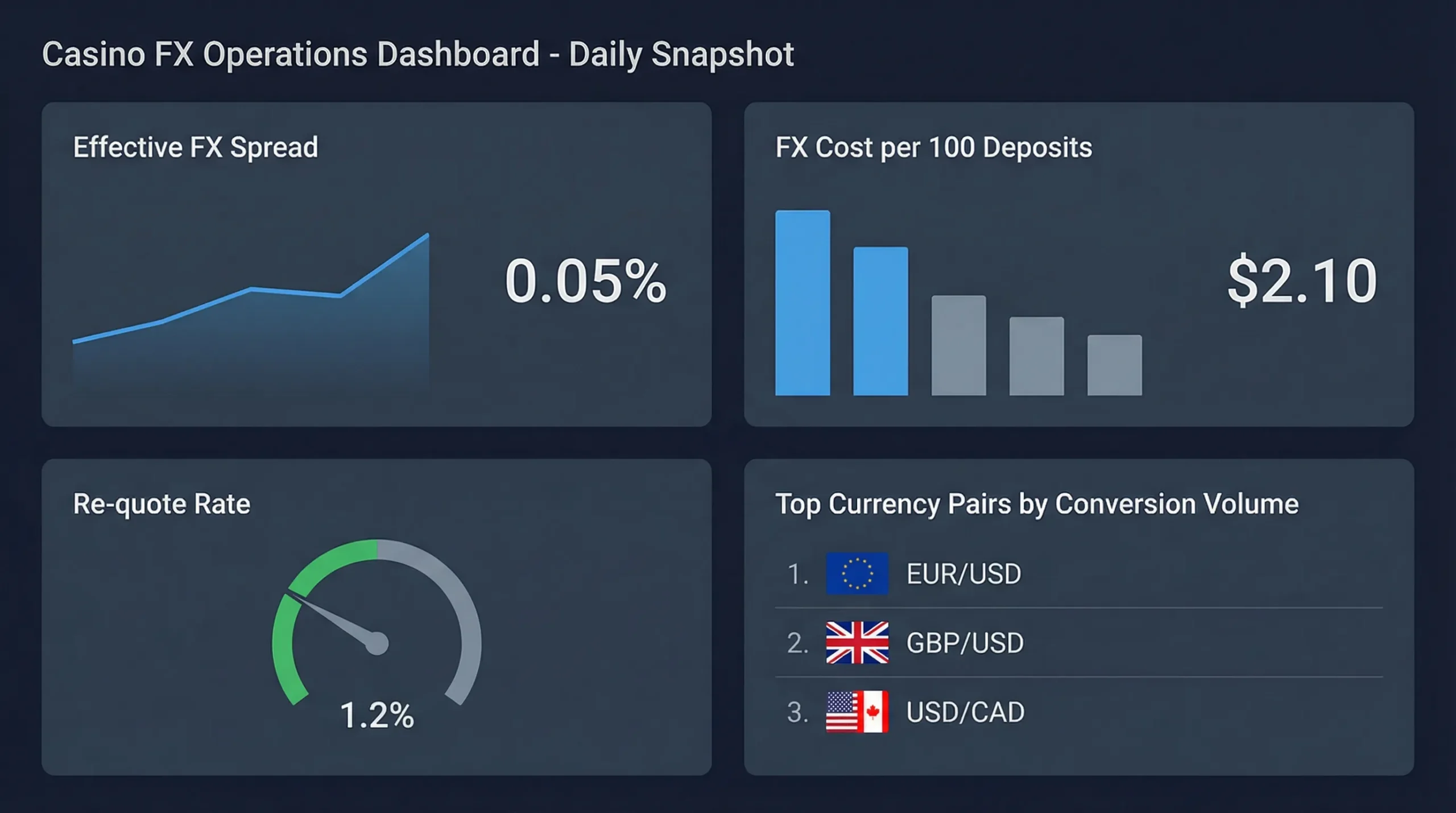
A practical weekly dashboard for multi-currency wallets:
- FX cost per 100 units of NGR (or per 100 units of deposits), segmented by currency pair.
- Effective spread by rail (card, APM, bank, crypto onramp), not just “fees.”
- Quote-to-complete time (P50/P95), because timing creates slippage.
- Re-quote rate (how often players hit an expired lock).
- FX exception rate (reversals, manual corrections, failed conversions).
- Round-trip conversion detection (users converting back and forth with low gameplay).
If you already run real-time metrics, FX belongs in the same operational view as approvals and fraud.
A 30-day implementation blueprint (policy first, then code)
You can implement FX policy without boiling the ocean, but you must sequence it.
Week 1: Write the policy and define configuration
Define your “source of truth” configuration keys.
| Policy setting | What it controls | Why it prevents leaks |
|---|---|---|
| Rate sources and fallback order | Which feeds are allowed | Prevents random provider-rate drift |
| Max rate age per flow | Quote validity | Prevents timing slippage and disputes |
| Spread schedule | Spread per flow/rail/segment | Makes FX economics measurable |
| Rounding rules | Decimal and rounding method per currency | Prevents silent rounding loss |
| Fee floors and caps | Minimum/maximum conversion fee | Prevents micro-transaction distortion |
| Conversion triggers | When FX happens | Prevents double conversion |
| Reversal rules | How failed conversions unwind | Prevents hidden FX gains/losses |
Week 2: Instrumentation and ledger fields
Before optimization, make it observable:
- Add FX metadata to ledger events.
- Emit events for quote, lock, completion, reversal.
- Build one “FX waterfall” view: from quoted amount to final credited amount.
Week 3: Guardrails and abuse controls
- Add rate-lock expiry and re-quote behavior.
- Add velocity limits for conversions.
- Add round-trip detection queries to your risk queue.
Week 4: Reconciliation automation and reporting
- Implement daily three-way matching for the highest-volume rails.
- Add exception queues with reason codes.
- Publish weekly FX KPIs alongside payment approval and fraud KPIs.
The fastest win is usually not negotiating a better rate. It is eliminating double conversions and making spreads consistent.
Where Spinlab fits (if you are building on a platform)
If you are evaluating an iGaming platform for global growth, FX policy is a good litmus test. Vendors that treat multi-currency as “just a UI toggle” often push complexity onto your team later.
Spinlab Studio positions its platform as an all-in-one, modular stack for launching and scaling online casinos with:
- multi-currency wallet support across fiat and crypto,
- integrated payments (including crypto-ready flows and onramps),
- compliance building blocks (KYC, AML),
- fraud prevention and real-time analytics,
- open APIs and a customizable backoffice.
If your goal is to avoid margin leaks, ask any provider to show two things in a demo:
- a ledger entry for a conversion including rate timestamp and spread,
- an FX reconciliation report that ties wallet movements to PSP or on-chain settlement.
This is also where modularity matters. The cleaner your wallet, payments, analytics, and compliance layers are integrated, the less likely FX becomes an “invisible” cost line.
The bottom line
Multi-currency wallets unlock growth, but FX policies are what protect your margin.
If you take only one action from this guide, make it this: pick a single FX rate authority, define conversion triggers, and store the full FX metadata on every ledger entry. Once you can measure FX precisely, you can optimize it, negotiate it, and defend it in audits and disputes.