

The smartest casino content strategy in 2026 is not a purity test. If you rely only on aggregated content, you can launch fast and offer variety, but your lobby may look like everyone else’s. If you invest too early in custom casino games, you can create a distinctive brand, but you also take on cost, certification, math, maintenance, and go-to-market risk.
For most online casino operators, the winning answer is a portfolio: use aggregated content for breadth, speed, and market validation, then add custom games where they create measurable differentiation, better retention, or better unit economics.
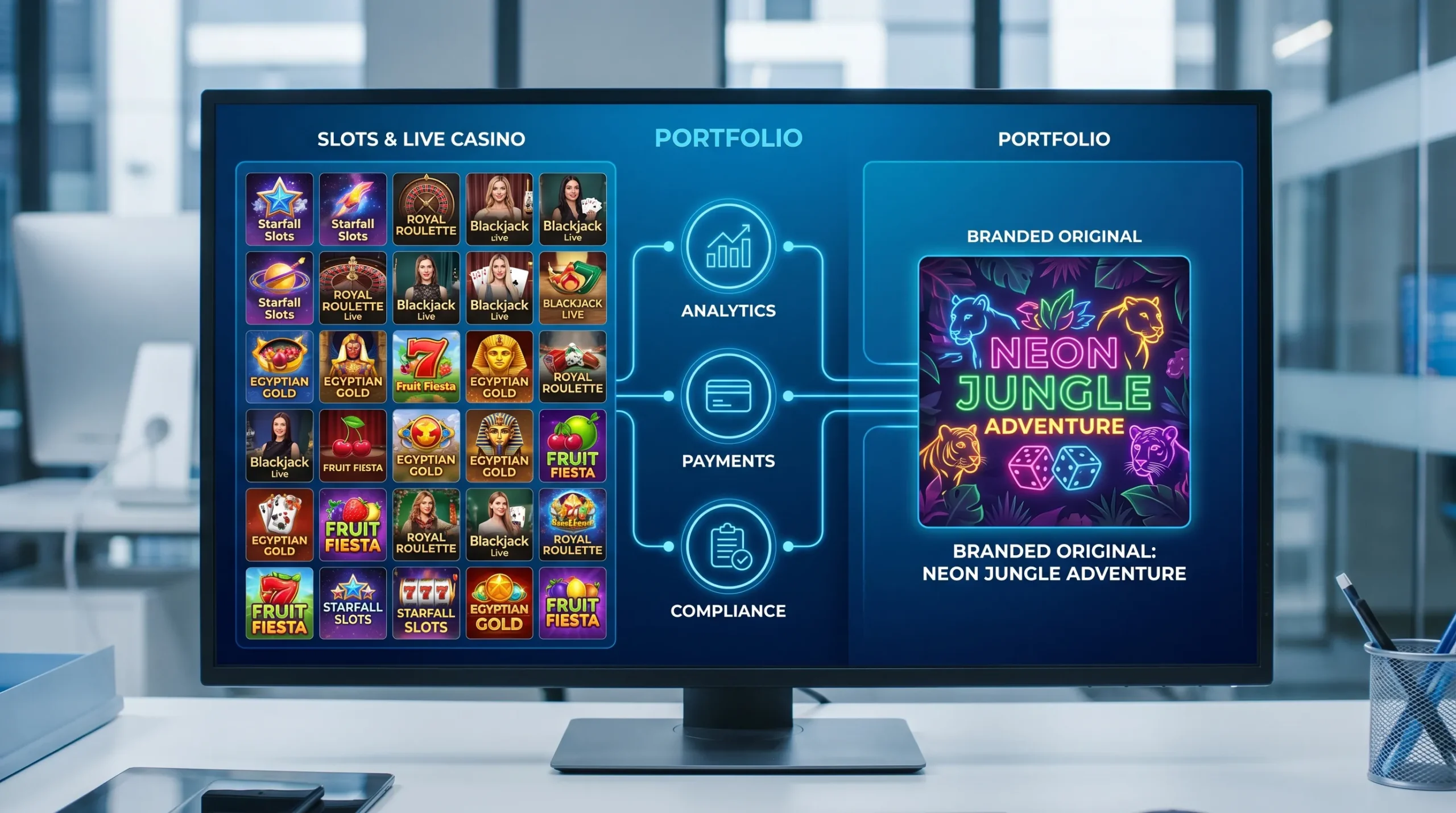
What aggregated casino content actually gives you
Aggregated content means games supplied through a game aggregator or provider network. Instead of negotiating and integrating every studio one by one, the operator connects to a catalog that can include slot games, live casino games, crash games, table games, and instant-win content.
A strong aggregator solves more than game access. It usually normalizes game metadata, manages session launch flows, routes wallet callbacks, supports jurisdictional availability rules, and provides reporting. If you want a deeper technical breakdown, Spinlab’s guide to casino game aggregation explains how the model works behind the scenes.
The main advantage is speed. A new white label casino platform can go live with a credible lobby much faster when it can plug into existing certified content. Players expect recognizable studios, familiar mechanics, and a wide choice of volatility profiles. Aggregation helps operators meet that expectation without building every game from scratch.
The trade-off is sameness. If your competitor has the same providers, similar promotions, and a similar homepage, content breadth alone will not create a durable brand advantage. You still need curation, personalization, payment UX, loyalty, and eventually some owned experiences.
What custom casino games bring to the table
Custom casino games are games designed specifically for your brand, audience, campaign, or product strategy. They can be original slots, crash games, instant-win titles, branded table-game variants, seasonal games, loyalty mini-games, or crypto-native originals with transparent mechanics.
Custom does not always mean “built entirely in-house.” Operators can buy IP, commission a studio, co-develop with a provider, or work with a casino software provider that supports custom-designed original games. The important point is control. You influence the theme, mechanics, math profile, visual identity, event hooks, and promotional use cases.
That control can become a moat. A player can find the same top provider slots at many casinos, but they cannot find your exclusive original game everywhere else. This matters for affiliate positioning, influencer campaigns, CRM, VIP retention, and brand memory.
The lesson is visible outside iGaming too. Premium service brands often win because the experience feels built for a specific audience, not because they list the longest catalog of services. A boutique destination such as Kimistry Hair’s luxury hair services in Orchard shows how a signature experience can make a brand feel more memorable than a generic provider list. Custom casino games play a similar role when they give players a reason to remember your brand specifically.
Custom casino games vs aggregated content: the core comparison
The right choice depends on launch stage, budget, market, and how much product control you need. Here is the practical comparison operators should use before committing spend.
| Factor | Aggregated content | Custom casino games |
|---|---|---|
| Speed to launch | Fastest path to a complete lobby | Slower due to design, math, QA, and certification |
| Upfront cost | Usually lower upfront, depending on platform and provider terms | Higher upfront or co-development commitment |
| Ongoing economics | Often includes rev-share, minimums, or provider fees | Potentially better long-term margin if the game performs |
| Differentiation | Limited unless curation and UX are strong | High, especially with exclusive IP or branded mechanics |
| Compliance burden | Provider supplies many artifacts, operator still must enforce jurisdiction rules | Operator needs stronger ownership of evidence packs and approvals |
| Player trust | Familiar studios can increase confidence | Trust depends on transparent rules, certification, and presentation |
| Marketing value | Useful for SEO around known studios and new releases | Strong for brand campaigns, influencer launches, tournaments, and loyalty |
| Data control | Varies by aggregator and contract | Can be designed with deeper event hooks from day one |
| Operational risk | Vendor dependency, latency, fees, content overlap | Build risk, hit-rate risk, maintenance, math and certification risk |
The table shows why this is rarely a binary decision. Aggregated content is an operating foundation. Custom content is a strategic layer that should be built on top of data, not ego.
When aggregated content is the better choice
Aggregated content is usually the right first move for new operators, lean teams, and market-entry tests. If your priority is to launch an online casino quickly, validate acquisition channels, and learn which player segments convert, you need breadth before originality.
It is also the safer route when entering a market where players already search for known game studios, familiar slot mechanics, or live dealer experiences. Recognizable content reduces education friction. Players do not need to understand why the game exists, they simply need to choose what they already like.
Aggregation also helps with portfolio balance. A healthy casino lobby needs low, medium, and high-volatility titles, a mix of themes, mobile-friendly games, jackpot-style excitement, and live casino options. Building all of that as custom IP would be expensive and slow.
Operators should still scrutinize aggregator contracts. The headline integration fee or rev-share rarely tells the whole story. Ask about premium studio surcharges, minimum guarantees, reporting access, certification coverage, data rights, settlement cadence, and latency commitments. If you are comparing suppliers, Spinlab’s article on the true cost of a game aggregator is a useful procurement companion.
When custom casino games are worth the investment
Custom games become more attractive once you know what your best players actually want. If analytics show that a specific segment over-indexes on crash games, high-volatility bonus buys, fast instant games, or a certain theme, a custom release can focus investment where it has a real chance to pay back.
They are also useful when your acquisition channel depends on novelty. Influencer-led casinos, crypto communities, streamer partnerships, and niche brands often need something exclusive to promote. A custom game can become the center of a campaign rather than just one more tile in the lobby.
Custom content can also improve economics if it reduces dependence on high-cost provider deals or creates incremental play that would not have happened in the aggregated lobby. The key word is incremental. If your original game merely cannibalizes existing slot activity, the economics may look good on gross gaming revenue but weak on net value.
A useful payback formula is:
Payback months = upfront custom game cost / (incremental monthly NGR + monthly provider-fee savings - monthly maintenance cost)
This formula forces the team to separate hype from commercial logic. The “incremental monthly NGR” line should come from controlled testing, holdout groups, or at minimum a realistic forecast based on similar player cohorts. If you are evaluating ownership, co-development, or licensing structures, see Spinlab’s guide to renting vs owning original slot IP.
The hidden cost difference operators often miss
Aggregated content feels cheaper because it avoids large upfront development costs. Custom content feels more expensive because the build cost is visible. But the true comparison is total cost of ownership and strategic value over time.
Aggregated content can include recurring costs that quietly reduce margin, especially if the catalog depends on premium providers. Custom content can include hidden costs too, such as math modeling, RNG review, QA, localization, responsible-gambling copy, accessibility improvements, certification updates, and ongoing bug fixes.
| Cost area | Aggregated content questions | Custom game questions |
|---|---|---|
| Commercials | What rev-share, minimums, surcharges, and settlement rules apply? | What is the build cost, ownership model, and revenue upside? |
| Compliance | Which jurisdictions and certificates are covered? | Who owns the RNG, RTP, math files, and evidence pack? |
| Operations | What happens if a provider has downtime or latency issues? | Who maintains the game after launch and handles incidents? |
| Marketing | Can you promote known studio titles legally in your target market? | Can you use the game in affiliates, streams, tournaments, and CRM? |
| Data | What event-level data can you access? | Which custom events should be instrumented from the start? |
| Exit rights | Can you migrate content and reporting history later? | Do you own the source, art, math, and rights needed to move? |
The most dangerous mistake is comparing an aggregator’s monthly fee to a custom game’s build quote without modeling revenue, margins, support load, certification, and player retention.
Compliance and certification: do not treat custom games as marketing assets only
A real-money custom game is not just a creative campaign. It is regulated software. The math must be documented, randomness must be testable, RTP must match the certified configuration, and the operator needs evidence for audits.
Aggregated games can reduce this burden because established providers often supply technical files and certification artifacts. But the operator still needs to prove that the correct game version is available in the correct jurisdiction, that bonus rules are enforced properly, and that player-facing information is accurate.
Custom games require tighter discipline. Before development starts, define the RNG approach, outcome mapping, volatility target, RTP options, source-control process, QA evidence, and release governance. Regulators and testing labs will care less about how creative the game is and more about whether it behaves exactly as documented.
The UK Gambling Commission’s remote gambling and software technical standards are a useful reference point for the kind of operational and technical expectations regulated markets place on remote gambling systems. Even if you do not operate in the UK, the underlying principle applies broadly: prove the game is fair, controlled, auditable, and presented clearly.
For operators preparing a custom release, Spinlab’s guide to game certification basics outlines the artifacts teams should prepare before launch.
Data should decide your content mix
The best content strategy starts with measurement. Operators should not decide based only on provider reputation, personal taste, or what competitors added last month. Measure how players actually behave across the lobby, cashier, bonuses, and retention flows.
A simple KPI framework helps reveal whether a game is creating value or just occupying space.
| KPI | Why it matters | Applies to |
|---|---|---|
| Lobby impression-to-launch rate | Shows whether the tile, theme, and placement attract clicks | Aggregated and custom |
| Launch-to-first-bet rate | Reveals load, wallet, or UX friction | Aggregated and custom |
| Average session value | Connects gameplay to revenue, not just activity | Aggregated and custom |
| Repeat play within 7 days | Measures retention and habit formation | Especially custom |
| Incremental NGR vs holdout | Shows whether the game adds revenue or cannibalizes | Especially custom |
| Bonus cost per retained player | Prevents promo-heavy games from hiding weak economics | Aggregated and custom |
| Provider fee as a share of NGR | Exposes margin pressure | Especially aggregated |
| Support tickets per 1,000 launches | Catches confusion, errors, or withdrawal disputes | Aggregated and custom |
Custom games should be judged on more than launch-day excitement. The real test is whether they create repeat behavior, cheaper reactivation, stronger brand recall, or higher margin over multiple player cycles.
Aggregated games should be judged on more than catalog size. A large lobby with poor metadata, slow launches, weak filtering, or no personalization can underperform a smaller but better-curated portfolio.
A practical portfolio model for 2026
Most operators should think in three content layers.
The first layer is the core aggregated lobby. This gives players variety, familiar providers, live casino coverage, and enough slot depth to support acquisition campaigns. It is the baseline that makes the brand feel complete from day one.
The second layer is curated differentiation. This includes featured collections, market-specific lobbies, exclusive provider promos, localized themes, and tournament packaging. You are still using aggregated games, but the experience feels more intentional because the lobby is organized around player needs.
The third layer is owned or custom IP. This is where original games, branded mechanics, seasonal drops, and custom casino originals sit. This layer should be smaller, but it should carry disproportionate brand value.
A lean operator might start with 95 percent aggregated content and one experimental original game. A more mature operator might run a broader program of custom games, but only after proving that each concept has a clear segment, launch plan, and measurement model.
Implementation roadmap: from catalog to custom IP
A sensible rollout avoids both extremes: launching with no distinctive content, or spending heavily on custom games before you have player data.
- Launch with a reliable aggregation spine: Start with enough game variety to support your target markets, devices, currencies, and player preferences.
- Instrument every content interaction: Track impressions, launches, first bets, session value, load times, bonus use, and repeat behavior.
- Identify content gaps from real data: Look for player segments with high value but limited content fit, such as crypto-first players, VIP slots players, instant-game fans, or local-market cohorts.
- Prototype one custom concept: Choose a game idea that has a defined audience, math target, compliance plan, and campaign angle.
- Run a controlled launch: Use segmented exposure, holdouts, and clear success metrics to separate incrementality from cannibalization.
- Scale only what proves value: Invest in sequels, localization, tournaments, or owned IP only after the first release shows commercial traction.
This staged approach helps operators use aggregated content for learning and custom games for compounding advantage.
Where Spinlab fits
Spinlab is built for operators who do not want to choose between speed and control. The platform supports seamless game aggregation for fast launch and broad content coverage, while also enabling original games that can be custom designed for a brand or campaign.
Because Spinlab combines core iGaming platform capabilities such as fiat and crypto payments, multi-currency support, KYC and AML compliance, fraud prevention, a customizable backoffice, open API integration, and real-time analytics, operators can connect content decisions to the rest of the business. A custom game is not isolated from the cashier, bonus engine, affiliate program, risk controls, or reporting layer. It becomes part of the operating system.
That matters because content performance is never only about the game. A strong title can underperform if deposits fail, KYC blocks the wrong players, bonus rules are confusing, or analytics arrive too late. Conversely, a well-integrated platform can turn both aggregated and custom content into measurable growth levers.
Frequently Asked Questions
Should a new online casino start with custom casino games or aggregated content? Most new operators should start with aggregated content because it provides fast market coverage and a credible lobby. Custom games become more attractive once you have enough player data to justify a specific concept and audience.
Are custom casino games more profitable than aggregated games? They can be, but only if they create incremental NGR, improve retention, reduce provider-fee dependence, or strengthen acquisition. If a custom game simply shifts play away from existing titles, the profit case is weaker.
Can custom games be certified for regulated markets? Yes, but they need proper RNG documentation, RTP reports, math files, QA evidence, jurisdiction-specific approvals, and release controls. Certification should be planned before development, not added at the end.
Do custom games replace the need for a game aggregator? Usually not. Aggregators provide breadth, familiar content, and operational speed. Custom games add differentiation. The best strategy for most operators is a hybrid portfolio.
What is the biggest risk of relying only on aggregated content? The biggest risk is commoditization. If many casinos offer the same games, similar bonuses, and similar lobbies, players may choose based on bonus size or payment convenience rather than brand loyalty.
How many custom games does a casino need? There is no fixed number. One strong original game with clear positioning can be more valuable than several weak exclusives. Start small, measure incrementality, and expand only when the data supports it.
Build a content strategy that launches fast and compounds
Aggregated content helps you enter the market. Custom casino games help you become memorable. The strongest operators use both, with data deciding where to invest next.
If you want a modular iGaming platform that supports fast game aggregation, custom original games, crypto and fiat payments, compliance workflows, analytics, and a Shopify-like operating experience, explore Spinlab Studio. Build the catalog players expect, then add the exclusive experiences they cannot find anywhere else.