

Game content is the inventory of an online casino. But integrating 20 studios one by one, each with its own API quirks, certification artifacts, and settlement rules, is where timelines and margins usually break.
That’s why casino game aggregation exists: it lets operators add and manage hundreds or thousands of titles through a single integration. Still, not all aggregation setups are equal. The difference between a clean aggregator layer and a fragile one shows up later as slow game launches, broken bonus campaigns, reporting gaps, and painful incident response.
This guide explains how game aggregation works in practice, and what you should check before you commit.
What is casino game aggregation?
A game aggregator (or aggregation layer inside an iGaming platform) is a system that sits between your casino and multiple game providers (slot studios, live dealer studios, crash games, etc.). It typically handles:
- One-to-many integration: one technical connection to the aggregator, many downstream providers.
- Unified game catalog: a normalized list of games, metadata, jurisdictions, and availability.
- Session launch: standardized flows to open a game session for a player.
- Wallet and round callbacks: consistent money movement logic (debit, credit, rollback, cancel).
- Operational controls: enable or disable games per market, apply limits, monitor uptime.
Aggregation can be delivered as a standalone vendor, or bundled into a full iGaming platform. Spinlab Studio, for example, positions its platform as an all-in-one modular stack with seamless game aggregation, integrated payments (crypto and fiat), compliance tooling, and an operator backoffice.
How casino game aggregation works (the real moving parts)
At a high level, aggregation looks simple: pick a game, click launch. Under the hood, it’s a chain of systems that must agree on identity, balances, jurisdictions, and game state.
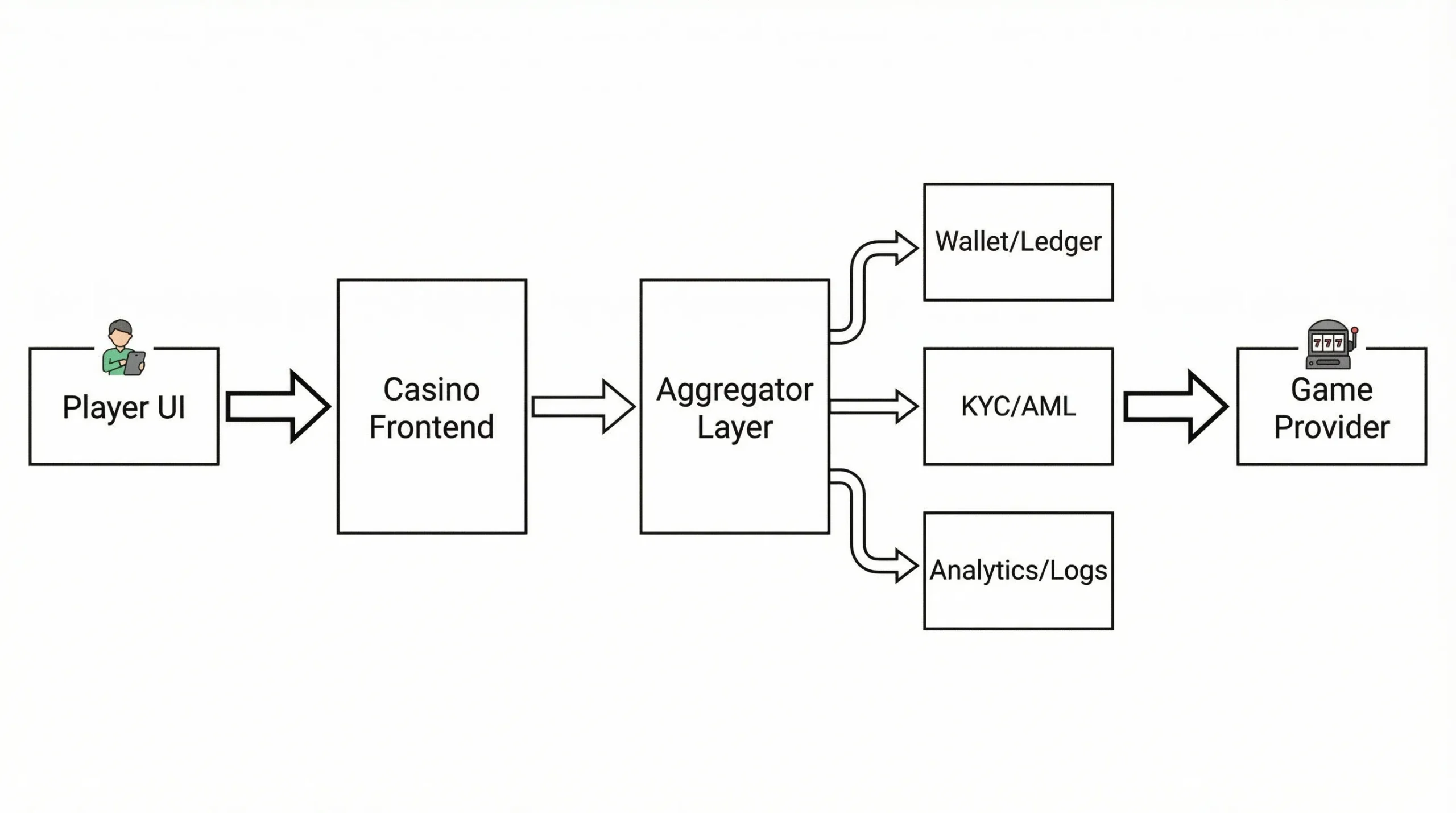
1) Catalog ingestion and normalization
Providers publish a catalog of game IDs, names, thumbnails, languages, RTP variants (sometimes), currencies, and market availability. The aggregator’s job is to normalize this into one schema so your lobby and CMS don’t need custom logic per studio.
What often goes wrong here is not the ingestion itself, but the “edge metadata” operators need later:
- Jurisdiction restrictions and certification references
- Device support and known compatibility constraints
- Feature flags (bonus buy, jackpots, autoplay rules, reality checks)
- Game grouping, tags, localization and search relevance
If you care about SEO and lobby conversion, catalog quality is not “nice to have”. It drives how quickly you can publish, localize, and rank game pages.
2) Jurisdiction and capability gating
Before a title appears in a lobby or can be launched, the platform should gate it by:
- Player location and allowed markets
- Brand and skin configuration (multi-brand setups)
- Currency and payment model (including crypto constraints)
- Responsible gambling controls and local requirements
This is the difference between a platform that “has games” and one that can run compliant operations across regions.
3) Session launch and authentication
When a player clicks a game, the aggregator typically:
- Confirms the player is eligible (region, status, KYC state if required)
- Generates a launch token or signed session payload
- Redirects or iframes the provider game with the correct parameters
Key technical details that matter:
- Token TTL and replay protection
- Device and cross-domain behavior (especially on mobile web)
- What happens when the player switches tabs, reconnects, or reloads
4) Wallet integration and money movement
This is where aggregation gets serious: the provider’s game server needs to request debits and credits. Depending on the ecosystem, you’ll see patterns like “seamless wallet” (real-time callbacks to the operator wallet) or alternative settlement styles.
Even if you never expose these terms to players, your engineers and finance team will live with their consequences.
At minimum, you want clear handling for:
- Debit (place bet)
- Credit (win)
- Cancel / rollback (failed rounds, timeouts, reconnection)
- Idempotency (the same callback must not double-charge)
A good aggregation layer treats wallet events like payments: deterministic, traceable, and auditable.
5) Bonus hooks, jackpots, and promotional mechanics
Operators often discover too late that “game integration” is not enough for growth. You also need reliable support for promotional mechanics, for example:
- Free spins grants and consumption reporting
- Bonus wagering contribution by game
- Tournaments and leaderboards
- Jackpot eligibility and contribution rules
If you have an affiliate and bonus engine, these hooks become even more important because tracking and enforcement must match what the game actually did.
6) Reporting, reconciliation, and dispute evidence
Aggregation produces multiple reporting surfaces:
- Game rounds and transactions (player-level)
- Provider settlement reports (what you pay or what you’re owed)
- Operational logs (for incident response and disputes)
If your reporting is incomplete, finance reconciliation and chargeback evidence get harder. It’s worth cross-reading your aggregation requirements with your payments discipline, for example the three-way match approach described in Spinlab’s guide to casino payments reconciliation.
The key APIs and events you should expect
Different vendors name things differently, but the underlying primitives are consistent. Here’s a practical view of what “must exist” in a production-grade setup.
| Area | What it does | What you should verify |
|---|---|---|
| Catalog API | Lists games and metadata for lobby and CMS | Metadata completeness, localization support, jurisdiction flags, update frequency |
| Launch/session API | Creates a playable session/token | Token security, TTL, replay defense, mobile behavior |
| Wallet callbacks | Debits/credits round outcomes | Idempotency, rollback logic, timeout behavior, ledger mapping |
| Player protection hooks | Applies limits, self-exclusion, reality checks | Where enforced (platform vs provider), audit logs |
| Bonus hooks | Free spins, wagering contribution, promo eligibility | Consistency across providers, edge cases documented |
| Reporting exports | Finance, BI, compliance evidence | Data ownership, retention, export formats, identifiers |
Three ways to source games (and when each makes sense)
Operators typically choose between direct integrations, a standalone aggregator, or a platform with built-in aggregation.
| Model | Best for | Common trade-offs |
|---|---|---|
| Direct to providers | Very large operators with deep engineering teams | Slow onboarding, higher maintenance, harder scaling across many studios |
| Standalone aggregator | Teams wanting a dedicated aggregation vendor | Extra vendor layer, commercial complexity, integration still needed with wallet/bonuses |
| iGaming platform with aggregation | Teams optimizing for speed and one consolidated stack | Need to vet platform flexibility, data access, and contract terms |
If you want a deeper cost view on aggregator deals and hidden fees, Spinlab has a dedicated breakdown in The True Cost of a Game Aggregator.
What to check before choosing a game aggregation setup
This is the due diligence section operators wish they had done earlier. Use it as a vendor demo script and an RFP backbone.
Commercials: don’t evaluate “rev share” in isolation
Ask for a full commercial map:
- Setup fees, certification pass-throughs, and minimum commitments
- Per-studio uplifts by region or by game type
- Reporting, API overage, or “premium access” surcharges
- Termination terms, migration support, and post-termination access to data
If you want a question set that procurement teams can copy into an RFP, use Spinlab’s Game Provider RFP Template and tailor it to aggregation.
Technical: latency, reliability, and correctness
A game catalog that looks great in a demo can still fail at runtime. Verify:
- Latency budgets: P95 launch time by region, not just averages
- Uptime and incident comms: how provider outages are detected and surfaced
- Wallet correctness: deterministic round states, idempotency keys, rollback flows
- Observability: traces or correlation IDs from launch to wallet callback
If latency is a priority for your markets, see Spinlab’s deep dive on how to cut aggregator latency.
Compliance and audit readiness
Aggregation touches regulated surfaces: game integrity evidence, jurisdiction gating, responsible gambling controls, and in some markets, explicit technical standards.
What to request:
- Certification artifacts per provider and per jurisdiction (or at least the process and evidence flow)
- Audit logs for game enablement, configuration changes, and player-impacting actions
- Data retention defaults and configurable retention policies
For context on how testing labs operate, you can review resources from GLI (as a general reference for gaming certification and standards).
Data rights and analytics
This is where vendor lock-in often hides.
Clarify:
- Who owns player-level round data and how you export it
- Whether you can join provider round IDs to your ledger transaction IDs
- Whether your BI team can access raw events or only summarized reports
If you are evaluating an iGaming platform (not just an aggregator), pair this with an API review. Spinlab’s Open API checklist for iGaming platforms is a solid baseline for what to demand.
Operations: game lifecycle, incident response, and change management
Aggregation is not a one-time integration. It’s a living supply chain.
Ask how the vendor handles:
- New game releases and metadata updates (cadence, approvals, rollback)
- Emergency disablement (by game, by provider, by market)
- Provider deprecations, endpoint changes, and versioning
- Support SLAs and escalation paths when a game is “stuck” mid-round
A practical way to force clarity is to request a sample runbook: “What happens operationally when Provider X is down in Brazil, but only on Android Chrome?”
A compact checklist you can use in demos
| Category | Check | Evidence to ask for |
|---|---|---|
| Catalog | Metadata includes jurisdictions, devices, languages, feature flags | Sample catalog export, schema docs |
| Launch | Secure tokens, stable mobile behavior, reconnect handling | Sequence diagram, test cases |
| Wallet | Idempotent callbacks, rollback/cancel flows, ledger mapping | API spec, sandbox tests |
| Bonuses | Free spins and wagering logic consistent across studios | Provider capability matrix |
| Compliance | Game enablement logged, market gating enforceable | Audit log examples |
| Data | Raw round and transaction data exportable | Export format, sample dataset |
| Ops | Clear SLAs and incident process | SLA doc, runbook outline |
Where Spinlab fits (if you want aggregation plus the rest of the stack)
If your goal is to launch and scale fast with fewer vendors, a platform approach can simplify operations. Spinlab Studio offers a modular iGaming platform that includes game aggregation, integrated crypto and fiat payments, KYC and AML compliance tooling, fraud prevention, and a customizable backoffice. The product is designed for fast onboarding and a Shopify-like operator experience, with API options for deeper integrations.
If you are comparing platforms, it can help to start from a broader baseline such as Spinlab’s 15 essential features for a white label casino platform and then drill specifically into aggregation using the checks above.
Frequently Asked Questions
What is the difference between a game provider and a game aggregator? A provider makes the games. A game aggregator connects many providers to your casino through one integration, standardizing catalog, launch, and wallet callbacks.
Does a game aggregator hold player funds? Typically no, the operator wallet holds player balances. The aggregator routes game sessions and money movement messages (debit/credit) to the operator wallet. Always confirm the exact funds flow and ledger mapping.
Why do some casinos still integrate studios directly? Direct integrations can make sense for very large operators optimizing margins, control, or custom features. The trade-off is higher engineering and operational overhead.
What causes slow game launches in aggregated setups? Common causes include regional routing inefficiencies, uncached catalog and capability checks, slow provider endpoints, and heavy client-side lobby scripts. You should measure P95 launch time by region.
How do I check if an aggregator is “audit-ready”? Ask for evidence flows: certification artifacts handling, change logs for game enablement, player-impact audit trails, and retention policies for round and transaction records.
What data should I demand access to? At minimum: raw game round events, wallet transaction references, provider round IDs, and exports that let you reconcile GGR and investigate disputes without waiting on vendor support.
Want to see a modern aggregation setup in action?
If you’re evaluating casino game aggregation as part of a broader launch or migration, Spinlab Studio can walk you through how aggregation, payments (crypto and fiat), compliance, and backoffice operations work together in a single modular platform.
Explore the platform at spinlab.studio and request a demo to review your target markets, game mix, and integration requirements.