

A casino backoffice is where a small online casino team either gains control or slowly gets buried in manual work. Deposits, withdrawals, KYC reviews, suspicious activity, game content, bonuses, affiliates, player complaints, and reporting all pass through the same operational layer.
That is why a casino backoffice checklist should not read like a generic feature list. For a small ops team, the real question is simpler: can three to five people run the casino safely, quickly, and consistently without living in spreadsheets?
This checklist is built for founders, operations leads, payments managers, compliance owners, and support teams preparing to launch or tighten an online casino operation. It focuses on the day-to-day controls that matter most when headcount is limited.
If you need a deeper explanation of the core modules before using this checklist, Spinlab has a separate guide on what casino platform backoffice software is. This article goes one layer more practical: what should be ready, assigned, visible, and repeatable before your team handles real players at scale?
The small-team rule: every backoffice screen needs an owner
Large operators can compensate for messy tooling with more staff. Small teams cannot. If a withdrawal is stuck, a bonus is abused, or a KYC document needs review, someone must know where to look, what to do, and how to document the decision.
A lean casino backoffice should support five operating principles:
- One source of truth for player, payment, risk, bonus, and support history.
- Clear permissions so users only access the tools and data they need.
- Queues instead of inbox chaos for KYC, withdrawals, disputes, fraud reviews, and escalations.
- Audit trails that show who changed what, when, and why.
- Fast exception handling so the team spends less time on normal cases and more time on risky ones.
Before you compare vendors or configure your own admin panel, define who owns each workflow. In a small team, one person may own multiple areas, but no workflow should be ownerless.
| Backoffice area | Pass condition for a small ops team | Typical owner |
|---|---|---|
| Access control | Roles, permissions, and admin audit logs are configured before launch | Founder or operations lead |
| Player management | Full player history is visible from one profile | Support or operations lead |
| KYC and AML | Reviews, statuses, documents, limits, and escalations are trackable | Compliance owner |
| Payments and wallets | Deposits, withdrawals, chargebacks, balances, and reconciliation are visible | Payments manager |
| Game operations | Providers, game status, categories, and availability can be managed centrally | Casino manager |
| Bonuses and affiliates | Campaign rules, abuse checks, and affiliate performance are measurable | Growth or affiliate lead |
| Fraud prevention | Risk signals and manual review triggers are easy to investigate | Risk or compliance owner |
| Reporting | Operational KPIs are available without exporting every report manually | Founder or operations lead |
Access, roles, and audit logs
The first item on any casino backoffice checklist is access control. Small teams often give too much access too early because it feels faster. That shortcut becomes dangerous once money, player data, KYC documents, and bonus settings are live.
Start by creating role groups around real responsibilities, not job titles. A support agent may need to view player profiles and transaction status, but should not be able to change bonus rules, approve high-risk withdrawals, or edit payment settings. A payments manager may need wallet and reconciliation visibility, but not full control over game configuration.
Audit logs are just as important as permissions. Your backoffice should record sensitive admin actions such as login attempts, password resets, manual balance adjustments, withdrawal approvals, bonus grants, KYC status changes, payment gateway changes, and player account restrictions. When something goes wrong, the team should not need to guess what happened.
For small ops teams, a practical launch standard is simple: no shared admin accounts, no permanent super-admin access for daily work, and no sensitive action without an audit trail.
Player profile and case management
A good player profile reduces context switching. When support, payments, compliance, and risk teams all use different views of the same player, decisions become slow and inconsistent.
At minimum, the player profile should show account status, registration details, verification state, communication history, deposit and withdrawal history, wallet balances, bonus usage, gameplay activity, limits, exclusions, risk flags, and admin notes. The goal is not to overload agents with data. The goal is to help them understand the player journey in one place.
For small teams, case management is especially valuable. A delayed withdrawal, failed KYC review, suspicious login pattern, or responsible gambling concern should be assigned, prioritized, and resolved with notes. If the same player contacts support again tomorrow, the next agent should see the full timeline.
This is also where backoffice UX matters. A powerful admin panel that is painful to use will still create operational drag. Queues, filters, timelines, saved views, and clear status labels help small teams act faster with fewer mistakes.
KYC, AML, and responsible gambling controls
Compliance cannot be bolted on after launch. Even if your team is small, you need structured workflows for identity checks, document review, source-of-funds requests, sanctions or PEP screening where applicable, transaction monitoring, account limits, self-exclusion, and responsible gambling escalations.
Exact requirements depend on your license, operating markets, payment methods, and legal counsel. As a global reference point, the FATF Recommendations emphasize a risk-based approach to customer due diligence, monitoring, and record keeping. Online casino operators should treat that as a reminder that compliance workflows need evidence, not just good intentions.
A small-team-ready backoffice should let you separate normal verification from escalated cases. Low-risk players should move through quickly. Higher-risk cases should trigger review based on factors such as transaction size, unusual deposit patterns, mismatched details, document issues, bonus abuse indicators, or location risk.
For new operators, it is useful to pair this checklist with a dedicated casino compliance stack for new operators so your policies, tooling, and daily routines align before launch.
Payments, wallets, and reconciliation
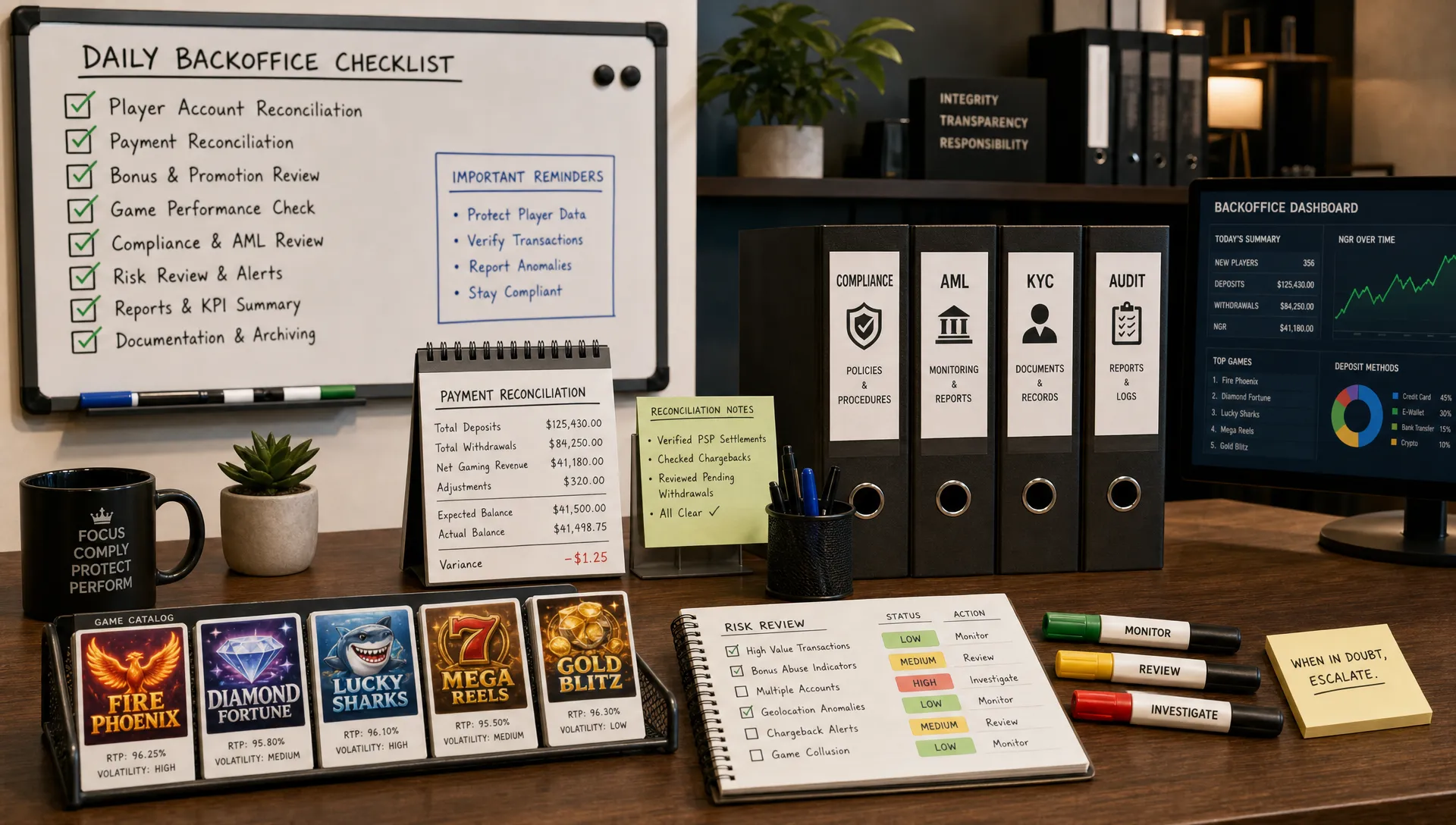
Payments are one of the highest-friction areas in online casino operations. A small team needs a cashier and backoffice setup that makes deposits, withdrawals, failed payments, refunds, chargebacks, crypto transactions, and reconciliation easy to understand.
Your payment gateway view should answer four questions quickly: did the player attempt a transaction, did the provider accept it, did the balance update correctly, and is there any risk reason to hold or review it?
For crypto-ready operations, the checklist becomes more detailed. Teams need visibility into supported assets, network confirmations, exchange or onramp flow where applicable, wallet movements, custodial wallet controls, transaction hashes, manual review flags, and balance reconciliation. Multi-currency support is helpful only if the backoffice makes currency conversion, reporting, and ledger visibility understandable.
Withdrawal workflows deserve special attention. A lean team should be able to filter pending withdrawals by amount, age, player risk level, KYC status, payment method, and prior activity. Manual approvals should require clear reasons, and rejected withdrawals should be documented consistently.
Game aggregator and content operations
Game content is not set-and-forget. Whether you offer slot games, live casino games, casino original games, or provider releases through a game aggregator, your backoffice should give the casino manager enough control to keep the lobby accurate and commercially useful.
At minimum, the team should be able to see which providers are active, which games are enabled, which markets or currencies each game supports, and whether any titles are unavailable due to maintenance, compliance restrictions, or provider issues. If a player reports that a game is not loading, support should not need to ask the technical team for every basic status check.
Small teams also need control over game categories and promotions. New releases, high-performing titles, live dealer tables, seasonal content, and custom-designed original games should be easy to position without developer involvement every time the lobby changes.
The best operational test is simple: can a non-technical casino manager find a game, check its status, understand where it appears, and disable or reposition it if needed?
Bonus and affiliate controls
Bonuses drive acquisition and retention, but they also create operational risk. A small ops team should never run campaigns that are difficult to understand, audit, or stop quickly.
Your bonus engine should make key rules visible before a campaign goes live: eligibility, deposit requirements, wagering requirements, maximum bet rules, expiry, excluded games, country restrictions, currency settings, and abuse controls. If an offer requires manual explanation every time a support ticket arrives, it is too complex for a lean team.
Affiliate operations need the same discipline. The backoffice should show referred players, campaign source, deposits, revenue, commission status, suspicious patterns, and disputes. Small teams are especially vulnerable to low-quality traffic, duplicate accounts, bonus hunting, and mismatched expectations with affiliates.
A useful rule is to connect bonus reporting with player and payment data. If bonus activity is isolated from deposits, withdrawals, KYC, and risk signals, abuse becomes harder to detect.
Fraud prevention and risk queues
Fraud prevention should not depend on one experienced team member remembering every red flag. Your backoffice should surface risk patterns early and route them into review queues.
Common risk signals include repeated failed deposits, unusual login locations, device or account duplication, rapid deposit and withdrawal behavior, bonus abuse patterns, suspicious affiliate cohorts, payment disputes, and mismatches between KYC data and payment data.
For small teams, the key is prioritization. A queue with 500 alerts is not operationally useful if every alert looks equally urgent. Risk reviews should be filterable by severity, value, age, player segment, and required action.
The team should also define decision labels in advance. For example, a case may be cleared, escalated, restricted, closed for insufficient evidence, or sent for enhanced verification. Consistent labels make later reporting more reliable.
Reporting and real-time analytics
Small casino teams need fewer dashboards than they think, but the dashboards they do use must be trustworthy. Real-time analytics should help the team catch operational problems, not just admire revenue charts.
The most useful backoffice reporting usually covers deposit success rate, withdrawal backlog, average approval time, failed payment reasons, KYC queue volume, support ticket drivers, bonus cost, affiliate performance, game revenue, provider availability, suspicious activity volume, and player retention.
The trick is to separate strategic dashboards from operating dashboards. Founders need revenue, retention, margin, and growth visibility. Ops teams need queues, exceptions, bottlenecks, and alerts. Mixing both into one cluttered screen usually helps no one.
If you are evaluating platforms, compare your requirements with these casino software features that reduce ops work. The right platform should remove recurring manual checks, not just digitize them.
Daily and weekly operating cadence
A checklist is only useful if it turns into a routine. Small teams should define a simple operating cadence before launch, then adjust it as volume grows.
| Cadence | What to review | Why it matters |
|---|---|---|
| Daily | Withdrawal queue, failed deposits, KYC backlog, high-risk alerts, support escalations | Prevents player frustration and cash-flow surprises |
| Twice weekly | Bonus performance, affiliate quality, suspicious cohorts, game availability | Catches abuse and content issues before they scale |
| Weekly | Reconciliation, operational KPIs, compliance exceptions, unresolved cases | Keeps leadership aligned on risk and workload |
| Monthly | Access review, audit log sampling, provider performance, policy updates | Reduces security and compliance drift |
Do not make the cadence too heavy. A small team will abandon a routine that requires endless meetings. The goal is to create a rhythm where the most important operational risks are reviewed before they become emergencies.
Red flags that your backoffice is not ready
Some problems are obvious before launch if you know where to look. If your team sees several of the signs below, pause and fix the workflow before scaling acquisition.
- Support agents rely on screenshots from other departments to answer payment questions.
- KYC decisions are tracked in spreadsheets instead of the backoffice.
- Withdrawal approvals do not require clear reasons or audit history.
- Bonus abuse can only be detected after exporting multiple CSV files.
- Game availability issues are discovered first by players, not operators.
- Admin users share credentials or use super-admin access for daily tasks.
- No one can explain the source of a balance mismatch quickly.
These are not just tooling issues. They are operating model issues. Better backoffice design gives small teams the confidence to scale without adding headcount for every new problem.
Frequently Asked Questions
What should a casino backoffice checklist include for a small team? It should include access control, player management, KYC and AML workflows, payment and wallet visibility, game operations, bonus controls, affiliate tracking, fraud prevention, reporting, and audit logs.
How is a small-team casino backoffice different from an enterprise setup? Small teams need fewer handoffs, clearer queues, simpler permissions, and more automation. Enterprise teams can split tasks across departments, while lean teams need one backoffice that keeps context together.
Why are audit logs important in an online casino backoffice? Audit logs show who performed sensitive actions, when they happened, and what changed. They help investigate disputes, payment issues, bonus changes, compliance reviews, and internal mistakes.
Should crypto payments change the backoffice checklist? Yes. A crypto-ready solution should add visibility into wallet movements, transaction status, network confirmations, currency handling, custodial controls, and reconciliation between player balances and treasury records.
Can a white label casino platform reduce backoffice workload? It can, if it combines payments, compliance workflows, game aggregation, fraud controls, analytics, bonuses, affiliates, and player management in one usable admin panel. The key is operational fit, not just feature count.
Build a backoffice your small team can actually run
For small ops teams, the best casino backoffice is not the most complicated one. It is the one that makes the next action obvious, keeps sensitive work controlled, and gives leadership a live view of the operation.
Spinlab is built for operators that want a modular, all-in-one iGaming platform with a Shopify-like operating experience. It supports crypto and fiat payments, game aggregation, compliance workflows, analytics, fraud prevention, multi-currency operations, and a customizable backoffice admin panel for launching and scaling an online casino.
If you are planning a lean launch or replacing a patchwork setup, explore Spinlab and see how a flexible white label casino platform can help your team move faster without losing operational control.