

Cutting casino ops costs does not have to mean shrinking the product, removing payment options, or slowing down your roadmap. For most online casino operators, the real savings are not hiding in fewer features. They are hiding in fewer handoffs, fewer manual checks, fewer vendor workarounds, and fewer support escalations.
In 2026, players expect a full product experience: fast onboarding, slot games, live casino games, flexible payments, smooth withdrawals, targeted bonuses, mobile performance, and responsible compliance. The operators that win on cost are not the ones offering the thinnest product. They are the ones running a feature-rich casino with a lean operating model.
That requires a different question. Instead of asking, “What can we remove?” ask, “Which operational tasks should not require humans, developers, or spreadsheets in the first place?”
Start by separating feature cost from ops waste
A feature can be valuable to players and still be expensive to operate if the underlying workflow is broken. For example, offering crypto and fiat payments is not the problem. The cost appears when finance teams reconcile transactions across disconnected dashboards, support agents cannot see payment status, and compliance teams have to chase documents manually.
The same is true for bonuses, KYC, affiliate management, game launches, and fraud prevention. The visible feature is only one part of the cost. The hidden expense is the labor required to keep that feature working every day.
A practical cost review should map each major feature to its operational burden:
| Feature area | Common hidden cost | Better cost lever | Metric to watch |
|---|---|---|---|
| Payments and withdrawals | Manual reconciliation, unclear statuses, support tickets | Unified payment visibility and automated status updates | Tickets per 1,000 withdrawals |
| KYC and AML | Manual review queues with no prioritization | Risk-based rules, document workflows, case history | Manual review rate |
| Game catalog | Separate provider integrations and launch coordination | Game aggregator with centralized controls | Time to launch new games |
| Bonuses | Developer-dependent setup and bonus abuse | Configurable bonus engine with limits and segmentation | Bonus cost per retained player |
| Customer support | Agents switching between tools | Single player timeline and clear escalation paths | Average handle time |
| Fraud prevention | Reactive investigation after losses occur | Real-time alerts, velocity rules, account linking | Fraud loss rate |
| Analytics | Manual reporting and spreadsheet exports | Real-time dashboards for ops, finance, and marketing | Hours spent on weekly reporting |
This table reveals why cost reduction should start with workflow design, not feature removal. A broad product can still be lean if the team has the right platform controls.
Consolidate around one operational backoffice
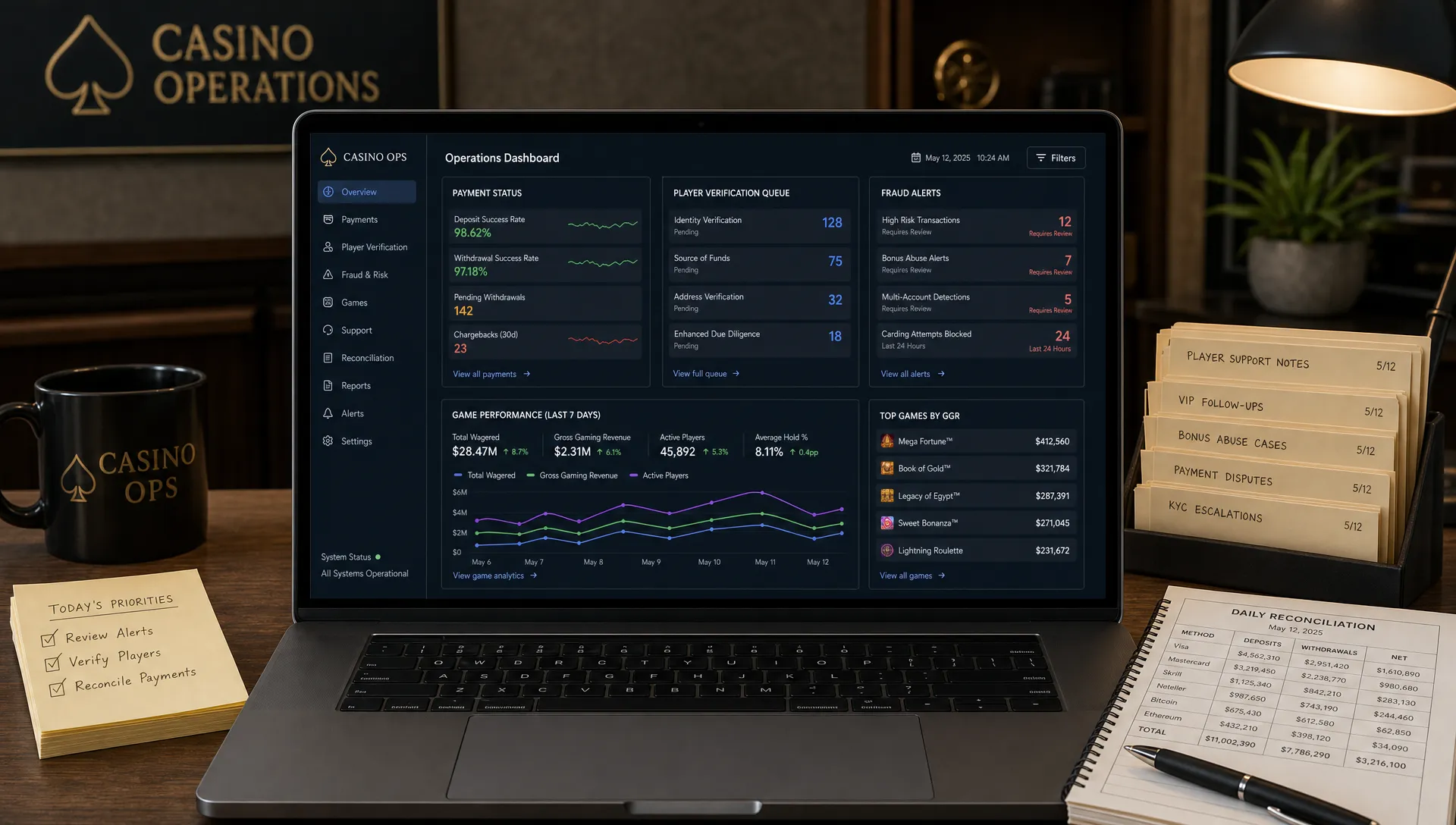
One of the fastest ways to reduce casino ops costs is to reduce the number of systems your team must open to resolve a single issue. When support, payments, compliance, fraud, marketing, and VIP teams all operate from separate tools, every case becomes slower than it should be.
A fragmented backoffice creates several expensive habits. Agents ask finance for screenshots. Compliance teams request player context from support. Marketing waits for developers to configure campaigns. Managers export data manually because the dashboard is incomplete. None of these tasks improve the player experience, but all of them increase payroll, error risk, and response time.
A cost-efficient casino backoffice should bring the most common workflows into one place. At minimum, operators should look for player profiles, wallet history, payment status, KYC progress, bonus activity, risk signals, game activity, support notes, and audit logs in a single admin environment.
This does not mean every tool must be built by one vendor. It means the operator should not be forced to manage the business through a patchwork of disconnected interfaces. If you are evaluating the operational layer of your platform, Spinlab’s guide on choosing casino software with low TCO is a useful companion because it looks beyond setup fees and into ongoing platform costs.
The goal is simple: fewer tabs, fewer escalations, fewer developer tickets, and fewer mistakes.
Automate compliance workflows without weakening compliance
Compliance is not an area where operators should cut corners. Poor KYC, AML, sanctions screening, source-of-funds controls, or responsible gambling processes can create regulatory, financial, and reputational risk. The opportunity is not to do less compliance. It is to remove unnecessary manual work from repeatable compliance steps.
The Financial Action Task Force emphasizes risk-based controls in AML programs, which is highly relevant for online gambling platforms. A risk-based approach does not treat every player, transaction, and behavior pattern the same. It uses rules and evidence to route cases appropriately.
For casino operations, that usually means automating the first layer of workflow and reserving human review for cases that actually need judgment. Low-risk players can move through standard checks quickly. Higher-risk activity can trigger document requests, enhanced due diligence, limits, or escalation.
Useful automation areas include:
- KYC document collection and status tracking
- Risk scoring based on player behavior, geography, payment patterns, and account history
- AML alerts for unusual deposit, withdrawal, or velocity patterns
- Duplicate account and account-linking detection
- Case management with notes, evidence, timestamps, and audit trails
- Responsible gambling flags based on session length, deposit behavior, or self-exclusion signals
The cost benefit is not only speed. Automated compliance workflows also improve consistency. Two analysts should not reach different conclusions simply because one had more context than the other. A clear system makes reviews easier to audit, easier to train, and easier to scale.
Reduce payment ops, not payment choice
Payments are one of the biggest operational cost centers in iGaming because they touch almost every team. Players contact support when deposits fail. Finance reconciles transactions. Risk teams monitor chargebacks, bonus abuse, and suspicious wallet movement. Compliance teams review source-of-funds signals. Product teams manage payment methods by country.
Cutting payment options can reduce complexity, but it can also reduce conversion. A better approach is to keep the payment experience broad while simplifying the operational layer behind it.
A strong payment gateway setup should give your team clear visibility into deposits, withdrawals, reversals, fees, failed transactions, pending reviews, and player communication. This is especially important for a crypto-ready solution where operators may support crypto deposits, fiat payments, multi-currency wallets, crypto onramps, and custodial wallet structures.
The most expensive payment issue is often uncertainty. If support cannot tell a player where a withdrawal stands, the player opens more tickets. If finance cannot see the reason for a failed payout, reconciliation slows down. If compliance cannot connect payment behavior with player history, reviews take longer.
To reduce cost, make payment status productized rather than hidden in the backoffice. Players should receive clear status updates, and agents should see the same source of truth. For a deeper operational playbook on this specific pain point, see Spinlab’s article on reducing withdrawal support tickets.
Payment choice should drive growth. Payment opacity drives cost.
Use game aggregation to keep the catalog broad
Game content is central to player acquisition and retention. Operators do not want to cut slot games, live casino games, original games, or high-demand releases just to simplify operations. The question is how to manage a large catalog without adding integration overhead every time the content strategy changes.
A game aggregator helps by centralizing access to multiple providers through one integration layer. Instead of managing separate technical and operational processes for every supplier, operators can handle more of the catalog from a unified environment. This is especially valuable when teams want to add new Pragmatic Play releases, new Hacksaw Gaming content, live dealer games, or custom casino original games without slowing down launch cycles.
The cost savings usually come from three places. First, engineering has fewer direct integrations to maintain. Second, operations teams can manage content availability, categories, and performance from fewer tools. Third, reporting becomes cleaner because game performance data is less fragmented.
A game aggregator should not be judged only by the number of games it offers. Operators should also ask how easily the team can launch, hide, test, localize, monitor, and report on games. A huge library that requires manual cleanup every week is not truly low-cost.
Control bonus costs with better rules, not smaller ambition
Bonuses can become expensive for two very different reasons. The first is commercial: the offer is too generous relative to player value. The second is operational: the bonus system is hard to configure, hard to monitor, or easy to abuse.
Many operators focus only on the first problem and start cutting promotions. That can protect margin in the short term, but it may also weaken retention and reduce player engagement. A better path is to make the bonus engine more precise.
A cost-efficient bonus setup lets non-technical teams create, test, pause, and segment campaigns without developer support. It should also include guardrails such as eligibility rules, wagering controls, maximum bet restrictions, country settings, payment method exclusions, player risk exclusions, and clear expiration logic.
This matters because bonus abuse is rarely caused by a single setting. It usually happens when player eligibility, payment behavior, duplicate accounts, and wagering activity are not connected. When the bonus engine, fraud prevention, and player data live in separate systems, abuse becomes easier and investigation becomes slower.
Operators can preserve a strong promotional calendar while reducing cost by using smaller, better-targeted campaigns. Examples include reactivation offers for specific cohorts, personalized free spins, cashback with loss limits, leaderboard incentives, and low-cost loyalty mechanics. The key is to measure bonus spend against retained value, not just deposits generated on launch day.
Move routine changes out of the developer queue
Developer time is expensive, and in many casino businesses it is used on work that should be configurable by operations or marketing teams. If every bonus change, payment method adjustment, landing page update, affiliate parameter, or game category edit requires engineering, the platform is generating avoidable cost.
This is where a Shopify-like operating model becomes valuable for iGaming. The idea is not that casinos are simple. They are not. The idea is that non-engineering teams should be able to manage routine commercial operations through a clean admin interface, while developers focus on higher-value technical work.
For a whitelabel casino or a growing online casino brand, low-code and no-code controls can reduce costs in several areas:
- Marketing teams launch campaigns faster without waiting for sprint capacity
- Ops teams adjust player limits, labels, and queues without custom scripts
- Compliance teams manage review flows with clearer audit trails
- Finance teams access payment data without manual exports
- Product teams test game positioning and content categories more often
The benefit is not only lower engineering cost. It is also speed. A team that can react to player behavior today does not need to wait two weeks for a small configuration change.
Watch the unit metrics that expose hidden labor
Cost reduction becomes much easier when operators measure the operational burden behind each feature. Revenue dashboards are not enough. You also need metrics that show how much work the platform creates.
Here are practical unit metrics to review monthly:
| Metric | What it reveals | Cost reduction signal |
|---|---|---|
| Support tickets per 1,000 active players | Overall operational friction | Falling tickets while engagement stays stable |
| Tickets per 1,000 withdrawals | Payment clarity and payout workflow quality | Fewer “where is my money?” contacts |
| Manual KYC review rate | Compliance automation quality | More players handled by rules, fewer unnecessary reviews |
| Average time to resolve payment cases | Finance and support alignment | Faster resolution with fewer escalations |
| Bonus cost per retained player | Promotion efficiency | Lower spend for the same or better retention |
| Time to launch a new game provider | Integration and game ops efficiency | Faster content expansion with less engineering work |
| Developer tickets from ops teams | Admin usability | More routine work handled inside backoffice |
| Fraud loss as a share of deposits | Risk control effectiveness | Lower losses without blocking good players |
These metrics help operators avoid blunt cuts. If bonus cost is high, the solution may be better segmentation rather than fewer campaigns. If support cost is high, the solution may be better payment visibility rather than fewer payment methods. If developer cost is high, the solution may be better admin tooling rather than a smaller roadmap.
Choose modular software instead of rebuilding around every constraint
Casino operating costs rise sharply when the platform cannot adapt. A team starts with a basic online gambling platform, then adds a separate payment provider, then a compliance tool, then a bonus workaround, then custom reporting, then another fraud layer, then manual game management. Eventually, every new feature creates another integration and another recurring cost.
A modular platform prevents this by letting operators add or configure capabilities without rebuilding the core system. The most important areas to keep modular are payments, compliance, game aggregation, analytics, bonuses, affiliate management, wallets, fraud prevention, and API integrations.
This is the main reason many teams consider a white label casino platform or turnkey casino solution. The right setup can reduce time to market and ongoing operational work by packaging the core casino infrastructure while still allowing room for brand customization, content strategy, payment localization, and growth.
Spinlab is built around this model: an all-in-one, modular iGaming platform with crypto and fiat payment support, game aggregation, real-time analytics, KYC and AML workflows, fraud prevention, affiliate and bonus tools, a customizable backoffice, open API integration, multi-currency support, crypto onramp options, and support for custom-designed original games. For operators looking for a lower-cost whitelabel iGaming software path, the value is not just launch speed. It is reducing the number of operational workarounds needed after launch.
A 90-day cost reduction plan for casino operators
Cost reduction works best when it is focused. Trying to optimize every department at once usually creates meetings, not savings. A practical 90-day plan should target the highest-volume manual workflows first.
| Timeline | Focus | Action | Expected outcome |
|---|---|---|---|
| Days 1 to 15 | Cost visibility | Map support, payment, KYC, bonus, and developer request volumes | Identify the top 3 operational cost drivers |
| Days 16 to 30 | Backoffice cleanup | Remove duplicate workflows and define one source of truth for player cases | Fewer escalations and less context switching |
| Days 31 to 45 | Payment transparency | Improve withdrawal statuses, agent visibility, and player notifications | Lower payment-related support volume |
| Days 46 to 60 | Compliance routing | Add or refine risk-based KYC and AML queues | Fewer unnecessary manual reviews |
| Days 61 to 75 | Bonus efficiency | Review campaigns by retained value and abuse risk | Lower promo waste without killing retention |
| Days 76 to 90 | Platform gaps | Decide what should be configured, automated, integrated, or replaced | Clear roadmap for lower TCO |
This plan does not require cutting the casino experience. It requires treating operations as a product. Every manual task should have an owner, a reason, a volume metric, and a path to automation or simplification.
Frequently Asked Questions
What is the fastest way to reduce casino ops costs? The fastest wins usually come from payment visibility, support workflow cleanup, and reducing developer dependency for routine changes. These areas create high-volume repetitive work that can often be simplified without removing player-facing features.
Should an online casino cut game providers to lower costs? Not necessarily. A game aggregator can help operators keep a broad catalog while reducing integration and management overhead. The better question is whether the current content setup is centralized, measurable, and easy to operate.
Can crypto payments increase operational costs? They can if the casino lacks clear wallet visibility, transaction monitoring, reconciliation, and compliance workflows. A crypto-ready solution with integrated payment controls and crypto onramp support can reduce that complexity.
How do bonus engines reduce operating costs? A configurable bonus engine reduces developer tickets, improves campaign speed, and helps enforce eligibility, wagering, and abuse-prevention rules. This lets operators run targeted promotions without relying on manual checks.
Is a white label casino platform cheaper than building from scratch? Often, yes, especially for teams that want faster launch, integrated payments, compliance workflows, game aggregation, and backoffice tools. The true comparison should include total cost of ownership, not just initial build cost.
Reduce cost by removing friction, not value
The best casino cost reductions are invisible to players. They do not remove live casino games, payment choice, bonuses, mobile performance, or compliance safeguards. They remove the unnecessary work behind those features.
If your team is spending too much time on manual reviews, payment escalations, developer requests, fragmented reporting, or vendor coordination, the platform is likely carrying hidden cost. Spinlab helps operators launch and scale with a modular, crypto-ready white label casino platform designed to keep the product rich and the operating model lean.