

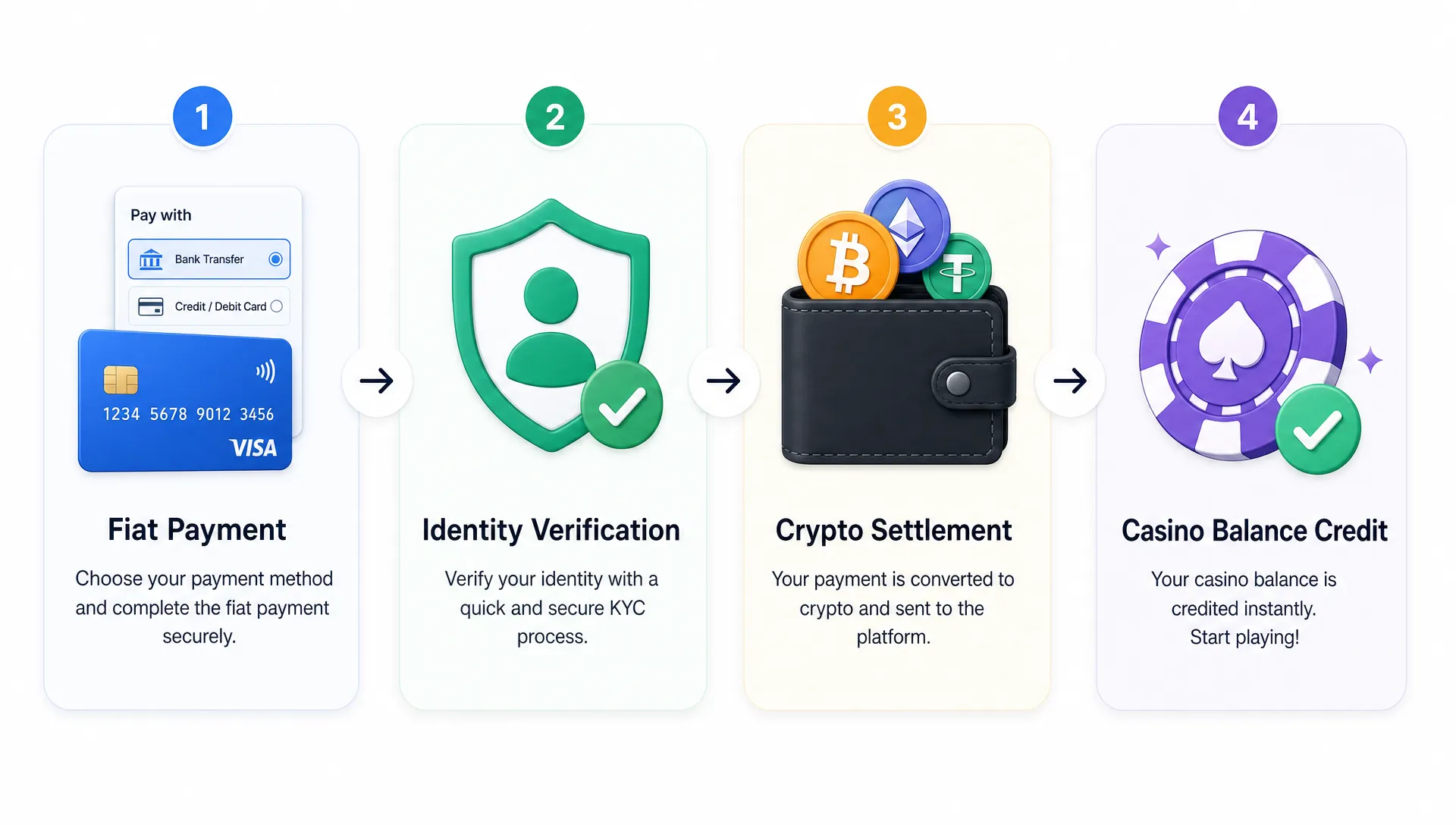
Adding a crypto onramp to an online casino is deceptively simple from the player's perspective. They choose an amount, pay with a card, bank transfer, or local payment method, complete any required verification, and receive crypto-funded casino balance.
For operators, the setup is more complex. A crypto onramp touches payments, licensing, KYC, AML, wallet infrastructure, ledgering, fraud controls, cashier UX, support, and reconciliation. Done well, it helps fiat-native players access crypto casino deposits without needing to buy assets elsewhere first. Done poorly, it creates pending deposits, rejected users, chargeback exposure, manual accounting work, and avoidable support tickets.
This guide walks through how to set up a crypto onramp for casinos from an operator's perspective, with a focus on practical implementation decisions rather than hype.
What a crypto onramp actually does in a casino
A crypto onramp is a fiat-to-crypto purchase flow embedded into or connected to your casino cashier. Instead of asking a player to leave your site, open an exchange account, buy crypto, send it to a wallet, and then deposit, the onramp compresses that journey into a single payment experience.
A typical casino onramp flow looks like this:
- The player selects a deposit amount in the cashier.
- The onramp collects fiat payment details and performs required checks.
- The provider converts fiat into a supported crypto asset, often a stablecoin.
- Funds are delivered to a merchant wallet, custody account, or player-linked address.
- The casino platform credits the player balance based on confirmed rules.
- The backoffice records the transaction, asset, network, fees, FX rate, player ID, and settlement status.
The key difference from a direct crypto deposit is intent. Direct deposits serve players who already own crypto and know how to send it. Onramps serve players who want crypto casino access but still think in fiat. If you are still deciding which flow to prioritize, a comparison of crypto onramp vs direct deposit conversion can help you map each method to your player segments.
For operators, the onramp should never be treated as just a widget. It needs to be part of the payment architecture of the casino platform, with clear rules for crediting, reversals, fraud review, player verification, and financial reporting.
Start with your operating model
Before choosing a provider or writing API tickets, define the commercial and regulatory model behind the onramp. The same technical integration can create very different obligations depending on your target markets, custody model, and balance structure.
| Setup decision | Common options | Why it matters |
|---|---|---|
| Target markets | Licensed markets, restricted geographies, phased regions | Determines payment methods, KYC rules, geo-blocking, and regulatory exposure |
| Player balance currency | Fiat balance, crypto balance, hybrid balance | Affects volatility, reporting, bonuses, and how players understand value |
| Asset policy | Stablecoins, selected major coins, multi-asset support | Influences settlement risk, liquidity, network fees, and support complexity |
| Custody model | Merchant custodial wallets, third-party custody, player-controlled addresses | Impacts reconciliation, fund safeguarding, operational controls, and withdrawals |
| Payment methods | Cards, bank transfers, local methods, wallets | Affects authorization rates, chargebacks, user coverage, and fees |
| Withdrawal model | Crypto withdrawals, fiat payouts, both | Must align with AML rules, source-of-funds checks, and player expectations |
The most important question is not which onramp is cheapest. It is whether the onramp fits your casino's license, player geography, risk tolerance, treasury process, and support capacity.
For a new operator, stablecoins are often the simplest starting point because they reduce volatility between the player's fiat purchase and the casino balance. That does not remove compliance or operational risk, but it does make accounting and player communication easier than supporting many volatile assets from day one.
Choose the right integration architecture
There are two common implementation paths.
The first is to integrate a standalone onramp provider into an existing casino platform. This can work, but it requires strong engineering ownership. Your team needs to connect payment intents, KYC outcomes, webhook events, wallets, ledger entries, support tooling, and reporting. If any of those systems fail to match, the player may see one status while finance sees another.
The second path is to use a crypto-ready iGaming platform where payments, wallets, compliance workflows, fraud prevention, and backoffice reporting are already designed to work together. This is usually the cleaner route for first-time founders, lean teams, and operators that want to launch faster without turning payments into a custom infrastructure project. If you are evaluating vendors, this guide to the best casino platform for crypto onramp integration covers the platform-level criteria worth reviewing.
Whichever path you choose, check these requirements before signing:
| Requirement | What to verify |
|---|---|
| Hosted or embedded checkout | Whether the player leaves your cashier, opens an iframe, or completes the flow inside your interface |
| Webhook reliability | Whether deposit, KYC, settlement, refund, and chargeback events are signed, retryable, and auditable |
| Ledger mapping | Whether every onramp order maps to a unique casino payment ID and player account |
| KYC handoff | Whether verification results are shared in a usable way for casino compliance and risk teams |
| Fee visibility | Whether players see payment fees, network costs, FX rates, and final credit amounts clearly |
| Backoffice controls | Whether operators can review pending, failed, reversed, and manually held transactions |
| Sandbox quality | Whether your team can test approvals, declines, expired sessions, KYC failures, and reversals before launch |
A weak integration may still process deposits, but it will create hidden operational cost. A strong integration gives product, compliance, support, and finance teams the same version of the truth.
Build compliance into the setup, not around it
Crypto onramps sit at the intersection of gambling regulation and virtual asset regulation. The onramp provider may handle parts of identity verification and payment screening, but that does not automatically remove the operator's responsibility for gambling compliance, responsible gaming controls, AML monitoring, age verification, jurisdiction blocking, and record keeping.
At a minimum, operators should align their virtual asset risk thinking with the FATF guidance on virtual assets, then map local requirements with qualified counsel. If card payments are part of the fiat leg, your payment setup may also affect PCI DSS scope, which is maintained by the PCI Security Standards Council.
Before launch, document the following clearly:
- Which countries, states, or territories are accepted and blocked.
- Which entity owns the player relationship and funds at each stage.
- When KYC is required during registration, deposit, play, and withdrawal.
- Which AML rules trigger enhanced due diligence or source-of-funds checks.
- How sanctions, politically exposed persons, and adverse media screening are handled.
- How suspicious activity is escalated internally and externally.
- How transaction records are retained for audits, disputes, and regulator requests.
For new teams, a structured casino compliance stack is the safest foundation. Crypto payments should be plugged into that stack from the beginning rather than patched in after the first payment dispute or regulatory review.
Configure wallets, ledgers, and reconciliation
The most dangerous mistake in crypto casino payments is confusing blockchain settlement with the casino ledger. The blockchain can show that funds moved, but your casino ledger determines the player's playable balance, bonus eligibility, wagering progress, withdrawal eligibility, and financial reporting.
Every onramp transaction should create a complete internal record that includes the provider reference, casino payment ID, player ID, fiat amount, crypto amount, asset, network, fee, FX rate, wallet address or custody account, transaction hash when applicable, status, timestamps, and reviewer notes if manual action occurs.
| Onramp event | Player-facing status | Backoffice action |
|---|---|---|
| Order created | Pending payment | Create a payment intent and reserve no playable balance yet |
| KYC review started | Verification required | Hold crediting until the required result is returned |
| Payment authorized | Processing | Track authorization but follow your crediting policy before releasing funds |
| Crypto delivered or settled | Completed | Credit the player balance and lock the ledger entry |
| Payment failed or expired | Failed | Close the payment intent and show a clear next step |
| Refund or chargeback received | Reversed or under review | Apply the operator policy for balance adjustment, account review, or restriction |
Reconciliation should not be an occasional finance exercise. It should be a daily operating process, especially during launch. Compare provider reports, wallet balances, casino ledger entries, payment gateway data, and player-facing balances. Any mismatch should be traceable to a specific event, not solved manually with vague notes.
Design the cashier for trust and conversion
Players do not care about your payment architecture. They care whether the cashier is fast, clear, and trustworthy. A strong onramp UX explains what is happening without overwhelming the player with blockchain details.
The cashier should show the deposit amount, expected credited balance, asset used, fees, estimated timing, required verification, and support path before the player commits. If the player needs to complete identity checks, make that visible early. If the final amount can change due to fees or FX, explain it plainly.
The best casino onramp flows also reduce avoidable abandonment. Pre-fill known user details when allowed, keep the player inside the branded cashier experience where possible, show real-time status updates, and provide recovery paths for expired sessions or failed payments. For a deeper product angle, these onramp UX tactics that boost crypto deposits are useful when refining the cashier after the first integration is live.
A practical rule is to make the payment feel familiar, then explain the crypto only where it affects the player's decision. Most fiat-native players do not need a lesson on wallet mechanics before depositing. They need confidence that their money will arrive, their account will be verified, and support can help if something goes wrong.
Add fraud controls before increasing limits
Onramps can increase deposit conversion, but they also introduce fraud patterns that differ from standard crypto wallet deposits. A direct crypto transaction is usually irreversible once confirmed. A fiat-to-crypto onramp may involve cards, bank rails, stolen payment credentials, synthetic identity, or chargeback risk depending on the payment method and provider model.
| Risk pattern | Control to consider | Why it matters |
|---|---|---|
| Stolen card usage | 3DS or strong customer authentication, device checks, payment velocity rules | Reduces unauthorized payment attempts and chargeback exposure |
| Multi-accounting | Device intelligence, duplicate identity checks, shared payment instrument detection | Protects bonuses, limits, and responsible gaming controls |
| Bonus abuse | Deposit source rules, wagering rules, risk scoring, manual review for edge cases | Prevents fraudsters from converting promotions into withdrawals |
| KYC mismatch | Name, country, date of birth, and payment ownership checks | Helps prevent account rentals and identity manipulation |
| Unusual transaction velocity | Deposit limits, cooling periods, risk-based reviews | Flags behavior that may indicate fraud, laundering, or account takeover |
| Reversal after play | Balance holds, withdrawal review, provider event monitoring | Reduces losses when a payment is disputed after gameplay |
Fraud controls should be progressive. New players, high-risk geographies, newly verified accounts, unusual payment methods, and first withdrawals may require stricter review. Established players with consistent patterns may move through a lighter flow, depending on your compliance obligations and risk policy.
This is where real-time analytics and a customizable backoffice become valuable. Operators need to see more than total deposits. They need visibility into failed attempts, KYC drop-off, chargebacks, bonus abuse indicators, player complaints, and payment method performance by market.
Implement API events like financial infrastructure
Even if the onramp is presented as a simple integration, treat it like financial infrastructure. Client-side callbacks are not enough. The casino platform should rely on server-side, signed webhook events and maintain a strict payment status model.
Good implementation practices include idempotency keys, webhook signature verification, retry handling, duplicate event protection, timestamp validation, immutable ledger entries, role-based backoffice permissions, and audit logs for manual changes. The payment state machine should define exactly when a player can play, when a transaction is pending, when support can intervene, and when finance must review.
Common statuses include created, pending payment, pending KYC, processing, settled, credited, failed, expired, refunded, charged back, and manually held. Avoid vague statuses that mean different things to engineering, support, and finance.
Your support team also needs operational playbooks. They should know what to tell a player when KYC is pending, a payment is authorized but not credited, a session expires, the wrong country is detected, or a reversal appears after gameplay. A good launch is not only an API launch. It is a support launch, a finance launch, and a compliance launch.
Test the setup before real money scale
Do not test only the happy path. Most onramp problems happen in edge cases: partial verification, declined cards, abandoned payment sessions, expired quotes, delayed settlement, device risk flags, mismatched player data, and duplicate webhook events.
| Test area | What to verify before launch |
|---|---|
| Geo controls | Blocked regions cannot access the onramp, accepted regions see the correct methods |
| KYC flows | Approved, rejected, pending, and manual review outcomes all update the casino correctly |
| Payment outcomes | Approved, declined, expired, refunded, and reversed payments produce the right ledger status |
| Asset and network rules | Supported assets, wallet destinations, confirmations, and fees match your policy |
| Bonus rules | Onramp deposits trigger or exclude bonuses exactly as intended |
| Withdrawal checks | Deposit source, wagering, AML, and risk review rules are applied before payout |
| Reconciliation | Provider reports, wallets, payment gateway records, and casino ledgers match |
| Support tools | Agents can identify transaction status and escalation path without engineering help |
| Analytics | Dashboards show conversion, failures, review queues, and settlement performance |
A phased rollout is safer than a full global release. Start with staff testing, then a closed beta, then selected markets, then broader availability. Increase limits only after you understand conversion, fraud, support load, settlement reliability, and reconciliation quality.
Monitor the metrics that reveal real performance
A crypto onramp should be managed as a funnel, not just a payment method. Deposit volume matters, but it can hide major issues. A high number of onramp starts with low completed deposits may indicate KYC friction, weak payment coverage, confusing fees, or trust problems in the cashier.
Track these metrics from day one:
| Metric | What it tells you |
|---|---|
| Cashier-to-onramp click rate | Whether players notice and understand the option |
| Onramp start-to-completion rate | Whether the payment and verification flow converts |
| KYC completion rate | Whether identity checks are appropriate for your audience and markets |
| Payment authorization rate | Whether payment methods fit the target geography |
| Time to credit | Whether settlement and ledger events are fast enough for casino expectations |
| Pending deposit volume | Whether users are getting stuck in unclear states |
| Reversal or chargeback rate | Whether fraud controls and provider risk rules are sufficient |
| Support tickets per deposit | Whether the UX is creating avoidable confusion |
| Repeat deposit rate | Whether players trust the method after first use |
Review these metrics by market, device, payment method, player segment, and verification status. Averages can hide the real issue. For example, the onramp may work well for bank transfer users in one market and fail for card users in another.
Common setup mistakes to avoid
Many operators make the same mistakes when adding a crypto onramp to an online gambling platform.
- Treating the onramp as a standalone payment button instead of part of the casino ledger.
- Launching too many assets, networks, and markets before support and finance are ready.
- Crediting player balances before settlement and reversal rules are clearly defined.
- Assuming the provider's KYC automatically covers every gambling compliance obligation.
- Hiding fees, verification steps, or timing from players until late in the flow.
- Forgetting that withdrawals, bonuses, risk reviews, and reconciliation must be designed with deposits.
- Scaling limits before fraud, chargeback, and support data are understood.
The best setups are boring in the right way. Every event is recorded, every status is explainable, every payment can be reconciled, and every player-facing message matches the operational reality behind it.
Frequently Asked Questions
Do casinos need a crypto onramp if they already accept direct crypto deposits? Not always, but the two flows serve different audiences. Direct deposits are best for players who already own crypto. Onramps are useful for fiat-native players who want to deposit into a crypto-ready casino without leaving the cashier to buy assets elsewhere.
Which crypto asset should a casino support first through an onramp? Many operators start with stablecoins because they reduce volatility and simplify player communication. The right choice still depends on licensing, provider coverage, liquidity, network costs, player demand, and your withdrawal policy.
Who handles KYC in a casino crypto onramp? The onramp provider may perform identity checks for the fiat-to-crypto transaction, but the casino operator may still have separate gambling, AML, age verification, responsible gaming, and record-keeping obligations. Define responsibilities contractually and operationally before launch.
Can a crypto onramp eliminate chargebacks? No. If the fiat leg uses cards or other reversible payment methods, chargeback or reversal risk may still exist depending on the provider and payment rail. Operators should use fraud controls, risk-based limits, payment monitoring, and clear crediting policies.
How long does it take to set up a crypto onramp for a casino? Timelines vary based on markets, compliance readiness, provider onboarding, platform architecture, wallet setup, testing, and approvals. A modular crypto-ready casino platform can reduce custom engineering work, but operators still need compliance, finance, fraud, and support processes in place.
Build a crypto-ready casino without stitching everything together
A crypto onramp works best when it is connected to the rest of the casino operation: payments, wallets, ledgering, KYC, AML, fraud prevention, analytics, bonuses, games, and backoffice controls.
Spinlab offers a modular iGaming platform for operators building, launching, and scaling online casinos with crypto and fiat payment support, crypto onramp solutions, merchant custodial wallets, multi-currency support, game aggregation, KYC and AML compliance, advanced fraud prevention, a customizable backoffice, real-time analytics, affiliate and bonus tools, open API integration, and mobile-optimized casino experiences.
If you want a cost-effective, Shopify-like way to launch a whitelabel casino or add crypto-ready payments to a new brand, Spinlab can help you move faster while keeping the operational pieces connected from day one.