

Building a multi-brand casino operation is not the same as launching several copies of the same online casino. The winners treat each brand like a focused commercial experiment, while the platform, payments, risk controls, reporting, and game operations run on a shared backbone.
That structure matters because multi-brand growth can either compound efficiency or multiply complexity. If every brand has a separate payment gateway, game integration, bonus setup, player database, reporting flow, and compliance workflow, the operation quickly becomes expensive to manage. If the foundation is centralized, each new brand can launch faster, test a distinct market, and add revenue without rebuilding the business from zero.
The goal is simple: create separate player-facing brands with differentiated positioning, while keeping the operational engine unified behind the scenes.
Define the Role of Each Casino Brand First
A multi-brand strategy should start with positioning, not software. If every brand targets the same players with the same bonuses, the same lobby, and the same payment methods, the group is only competing with itself.
Before launching the second or third brand, define why that brand should exist. A strong portfolio often separates brands by geography, product preference, player value, payment behavior, or acquisition channel. For example, one brand might focus on mobile-first casual slot players, while another leans into crypto deposits, VIP retention, and casino original games.
Use a simple brand architecture model before building:
| Brand decision | What to define | Why it matters |
|---|---|---|
| Target market | Country, language, currency, and regulatory scope | Prevents vague positioning and compliance gaps |
| Player segment | Casual, VIP, crypto-native, sports-led, slots-first, or live casino focused | Shapes acquisition, game mix, and bonus design |
| Product promise | Fast withdrawals, exclusive games, crypto payments, premium live casino, or low-wager promos | Gives the brand a reason to stand out |
| Payment profile | Fiat cards, bank transfers, e-wallets, crypto onramp, or multi-currency wallets | Impacts conversion, risk, and treasury operations |
| Marketing channel | Affiliates, SEO, paid media, streamers, communities, or retention-led growth | Determines tracking, content, and margin model |
This discipline avoids the most common multi-brand mistake: launching a new logo instead of a new market proposition.
Build One Shared Operational Backbone
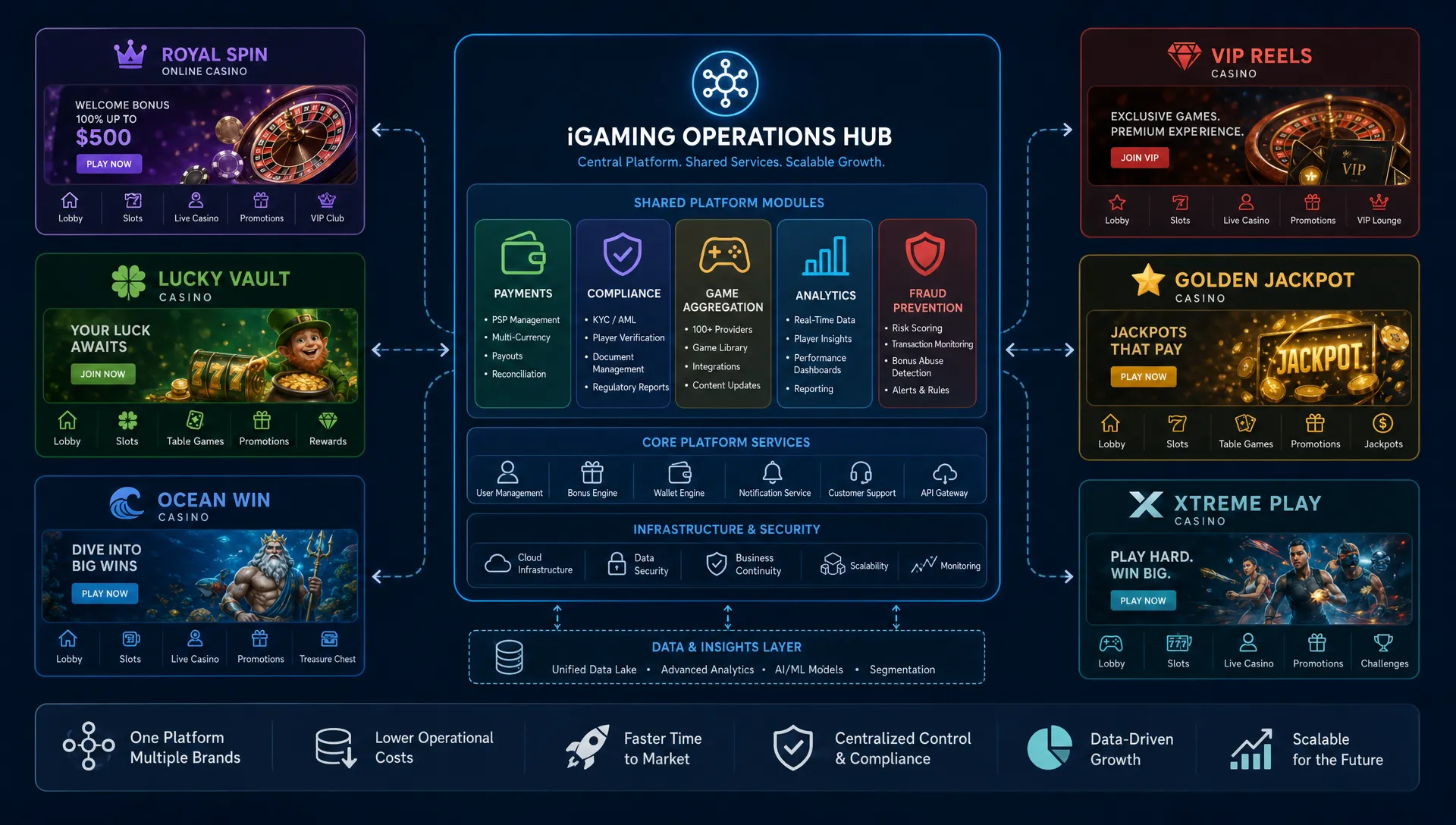
A scalable multi-brand casino operation needs a central iGaming platform that can support multiple front-end brands without requiring separate infrastructure for each one. The front end may change by brand, but the operating stack should remain consistent.
At minimum, the shared backbone should cover player account management, wallet and ledger logic, payments, KYC and AML workflows, fraud prevention, game aggregation, bonuses, affiliate tracking, analytics, and backoffice administration. This is where a modular white label casino platform can be more practical than a fully custom build, especially for operators trying to launch multiple brands without hiring a large engineering team.
Think of the platform as the group operating system:
| Shared platform layer | Multi-brand purpose |
|---|---|
| Brand management | Configure domains, themes, languages, content, and lobby layouts per brand |
| Wallet and payments | Support deposits, withdrawals, currencies, crypto flows, limits, and reconciliation |
| Game aggregator | Connect multiple studios once, then curate different lobbies per brand |
| Compliance tools | Apply KYC, AML, responsible gambling, and market restrictions consistently |
| Bonus engine | Create brand-specific offers while controlling abuse and bonus cost |
| Affiliate system | Track partners, campaigns, commissions, and player quality by brand |
| Analytics dashboard | Compare conversion, retention, revenue, payment performance, and risk across brands |
| Backoffice permissions | Give teams access to the brands and functions they actually manage |
The more you centralize the operational layer, the easier it becomes to scale. Operators running multiple casinos should also prioritize a multi-brand backoffice dashboard so leadership can compare performance, investigate issues, and manage workflows without logging into separate systems all day.
Separate the Player Experience, Not the Controls
Players should feel that each casino brand has its own identity. Operators, however, need common controls behind the scenes.
This balance is especially important for bonuses, payments, risk, and responsible gambling. You may want different welcome offers by brand, but you do not want uncontrolled bonus abuse across the portfolio. You may want different cashier options by country, but you still need consistent payment reconciliation. You may want separate VIP journeys, but you still need a complete view of risk, affordability triggers where required, and suspicious behavior.
A strong multi-brand setup usually keeps these controls centralized:
- Player verification rules and escalation workflows
- Deposit and withdrawal limits
- Fraud scoring and duplicate account detection
- Bonus abuse checks
- Payment status monitoring
- Responsible gambling controls
- Brand-level P&L and campaign reporting
Keep in mind that player data, cross-brand marketing, and identity matching can be legally sensitive. Depending on the jurisdictions involved, operators may need explicit consent, clear privacy notices, and strict data minimization practices. Treat cross-brand data strategy as a compliance decision, not just a marketing opportunity.
Design Payments for Markets, Margins, and Trust
Payments can make or break a multi-brand casino operation. A brand may have a strong game lobby and good acquisition, but if deposits fail, withdrawals feel slow, or players cannot use their preferred currency, conversion and retention suffer.
For multi-brand growth, the payment model should support both standardization and localization. Standardization gives the group consistent reconciliation, fraud monitoring, treasury controls, and reporting. Localization gives each brand the right payment methods, currencies, limits, and cashier messaging for its target audience.
For example, a crypto-ready brand may need crypto deposits, fiat-to-crypto conversion, merchant custodial wallets, and clear withdrawal workflows. A mainstream fiat brand may need card processing, bank transfer options, e-wallet support, and localized currency display. A global brand portfolio may require multi-currency support so players can understand balances and pricing without mental conversion.
If expansion across currencies is a priority, build the model before you scale. Spinlab has a deeper guide on multi-currency pricing strategies for global casinos that covers display, acceptance, wallet, and governance layers in more detail.
Good payment design should answer practical questions early:
- Which currencies does each brand display, accept, and settle?
- Are crypto payments native to the brand or an optional cashier route?
- How are chargebacks, refunds, blocked withdrawals, and manual reviews handled?
- Which payment methods require extra KYC, AML, or fraud checks?
- How are fees, exchange rates, and provider performance tracked by brand?
The payment gateway should not be treated as a plug-in afterthought. It is part of the product experience and one of the strongest trust signals for players.
Build Compliance Into the Operating Model
Multi-brand casino operations create compliance complexity because every brand may have different markets, offers, payment methods, and affiliate campaigns. If compliance is handled manually after launch, risk compounds quickly.
Licensing, KYC, AML, responsible gambling, geolocation, game availability, bonus terms, and advertising rules should be mapped before a brand goes live. This is especially important when operating across jurisdictions or supporting crypto transactions. The FATF Recommendations emphasize risk-based controls for money laundering and terrorist financing, and online gambling operators should work with qualified legal and compliance professionals to interpret local obligations.
In practice, each brand should have a compliance profile that defines where it can operate, which players it can accept, which games are available, what verification is required, and what marketing claims are allowed. That profile should be reflected inside the platform, not stored only in a spreadsheet.
Create Distinct Game Portfolios for Each Brand
Games are one of the easiest ways to differentiate brands, but they are often underused. Many operators connect a game aggregator, publish thousands of titles, and assume variety is enough. In reality, too much uncurated choice can hurt discovery and weaken brand identity.
A multi-brand group should use aggregation as infrastructure, then curate the experience by brand. One casino may highlight new slot games, crash games, and fast-play originals. Another may lead with live casino games, premium tables, and VIP experiences. A third may focus on mobile-first casual slots with simple navigation and low-friction promotions.
The launch catalog should be designed around player intent:
| Brand type | Game portfolio emphasis |
|---|---|
| Slots-first brand | Trending slots, high-volatility titles, jackpots, provider filters, strong search |
| Live casino brand | Roulette, blackjack, baccarat, localized tables, VIP rooms, live lobby UX |
| Crypto casino brand | Fast games, provably fair style experiences where supported, crash games, originals |
| Casual mobile brand | Simple navigation, lightweight games, popular themes, fast loading |
| VIP-focused brand | Premium live games, high limits where permitted, personalized promotions |
A well-managed game aggregator lets operators integrate content once and package it differently across brands. For a deeper approach to launch catalogs and lobby design, see Spinlab's guide to casino game portfolio strategy for new brands.
Standardize Analytics, Then Compare Brands Fairly
Multi-brand operations need analytics that separate noise from insight. Looking only at total revenue can hide the real story. One brand may have higher deposits but weaker retention. Another may have lower traffic but better player quality. A third may look profitable until bonus cost, payment fees, affiliate commissions, and fraud losses are included.
Set up reporting around brand-level unit economics from the beginning. Important metrics include registration conversion, KYC completion, first-time deposit rate, deposit approval rate, withdrawal time, bonus cost, active player retention, gross gaming revenue, net gaming revenue, affiliate ROI, chargebacks, and fraud flags.
The key is consistency. If every brand defines active players, bonus cost, or net revenue differently, leadership cannot make reliable decisions. A real-time analytics dashboard should allow the group to compare brands using the same definitions while still drilling down into market, campaign, provider, payment method, and segment performance.
Plan the Team Structure Around Shared Services
A multi-brand casino group does not need a separate full team for every brand. In many cases, the best model is shared services plus brand owners.
Shared services handle platform operations, payments, fraud, compliance, game provider management, analytics, and technical administration. Brand owners handle positioning, campaigns, content, community, affiliates, promotions, and player experience. This structure keeps expertise centralized while giving each brand commercial accountability.
A practical operating model may look like this:
| Function | Centralized or brand-specific? | Reason |
|---|---|---|
| Payments and reconciliation | Centralized | Requires control, consistency, and treasury oversight |
| Compliance and risk | Centralized with market input | Reduces regulatory gaps and inconsistent decisions |
| Game provider management | Centralized | Avoids duplicated integrations and contract complexity |
| Brand marketing | Brand-specific | Positioning and acquisition channels differ |
| Bonus strategy | Shared rules, brand-specific campaigns | Balances differentiation with abuse prevention |
| Analytics | Centralized definitions, brand-specific reporting | Enables fair comparison and local action |
| Customer support | Hybrid | Shared tooling, but scripts and languages may vary |
This structure becomes much easier when the backoffice admin panel supports permissions, brand-level views, and operational workflows without requiring developers for every change.
Launch in Phases, Not All at Once
The safest way to build a multi-brand casino operation is to prove the operating model with one brand, then replicate it with improvements. Launching five brands at once may look ambitious, but it creates too many unknowns across payments, support, compliance, bonuses, affiliates, and game performance.
A phased roadmap reduces operational risk:
| Phase | Focus | Success signal |
|---|---|---|
| Foundation | Platform setup, payments, compliance rules, game aggregation, analytics | The first brand can operate end to end without manual workarounds |
| Brand 1 launch | Validate acquisition, cashier, KYC, game lobby, support, and retention | Stable deposits, clean reporting, manageable risk, early retention signals |
| Brand 2 launch | Test differentiation with a new segment or market | Different audience, distinct game mix, independent acquisition performance |
| Portfolio scaling | Add brands only when shared operations are stable | Faster launches, lower marginal cost, consistent governance |
Each new brand should improve the playbook. Document what worked, which providers caused friction, which payment methods converted, which bonuses attracted low-quality play, and which acquisition partners produced sustainable value.
Choose Technology That Reduces Marginal Launch Cost
The economic advantage of a multi-brand strategy comes from reducing the cost and time required to launch the next brand. If every new casino requires custom development, separate integrations, and manual setup, the model becomes expensive. If the platform is modular, configurable, and operator-friendly, the marginal cost of launching the next brand can fall significantly.
A strong turnkey casino solution should support:
- Multiple casino brands from one operational environment
- Crypto and fiat payment support
- Multi-currency wallets and pricing logic
- Integrated KYC, AML, and fraud prevention
- Game aggregation across slots, live casino, and originals
- Configurable bonuses, affiliates, and promotions
- Real-time analytics by brand, market, and campaign
- Mobile-optimized player experiences
- Open API integration for future flexibility
This is where Spinlab fits naturally for operators who want a white label casino platform with a Shopify-like operating experience. Instead of building every workflow from scratch, teams can launch, configure, monitor, and scale brands using modular casino software designed for fast onboarding and global growth.
Avoid the Common Multi-Brand Traps
The biggest risks in multi-brand casino operations usually come from weak governance, not lack of ambition.
Avoid launching brands that differ only by color scheme. Avoid giving every brand a completely separate operational stack. Avoid bonus structures that encourage players to cycle through sister brands for welcome offers. Avoid affiliate deals that look profitable on FTD volume but fail after bonus cost and withdrawals. Avoid expanding into markets before legal, payment, and responsible gambling requirements are clearly understood.
Most importantly, avoid treating the second brand as a side project. A multi-brand operation should be designed as a portfolio from the start, with shared infrastructure, clear ownership, separate positioning, and consistent controls.
Frequently Asked Questions
What is a multi-brand casino operation? A multi-brand casino operation is a structure where one operator runs multiple online casino brands, usually with separate player-facing identities but shared technology, payments, compliance, game aggregation, reporting, and operational controls.
Is a white label casino platform suitable for multi-brand operations? Yes, if the platform supports brand-level configuration, shared backoffice workflows, multi-currency payments, game aggregation, compliance controls, analytics, and permissions. This can reduce launch time compared with building each brand separately.
How many brands should an operator launch first? Most operators should start with one brand, stabilize operations, then launch a second brand with a clearly different audience or market. Launching too many brands at once can create payment, compliance, support, and reporting problems.
Should every casino brand have the same game lobby? No. A shared game aggregator is efficient, but each brand should curate its lobby around its audience. A slots-first casino, live casino brand, and crypto-ready casino should not present the same experience.
How do crypto payments fit into a multi-brand casino strategy? Crypto can be a core differentiator for specific brands or an additional cashier option across the portfolio. Operators should plan crypto onramp flows, custodial wallet handling, AML checks, volatility exposure, and withdrawal rules before launch.
Build Your Multi-Brand Casino Foundation With Spinlab
A profitable multi-brand casino operation needs more than extra domains. It needs one scalable operating system for payments, compliance, games, analytics, fraud prevention, bonuses, affiliates, and backoffice control.
Spinlab gives operators a modular iGaming platform for launching and scaling online casino brands with crypto and fiat payments, game aggregation, KYC and AML workflows, real-time analytics, mobile-optimized experiences, open API integration, and customizable backoffice tools. If you want a cost-efficient way to build a portfolio of casino brands without the complexity of a custom platform, Spinlab is built for that path.