

For a new casino brand, the game catalog is not just a content library. It is the product experience, the acquisition hook, the retention engine, and one of the biggest drivers of margin quality. A weak casino game portfolio strategy can make a well-funded brand feel generic, while a focused one can help a lean operator look credible from day one.
The mistake many new brands make is simple: they chase the largest possible number of games before they understand what their players actually want. More slot games, more live casino games, more studios, more categories. On paper, it looks impressive. In practice, it can create a cluttered lobby, confusing promotions, poor supplier economics, and weak differentiation.
A better approach is to treat the portfolio like a merchandising system. You need the right mix of familiar hits, category depth, market-specific content, payment-compatible gameplay, and a path toward exclusive or original games once you have data.
Start with positioning, not providers
Before you compare game aggregators or studios, define what the brand is supposed to be. A casino game portfolio for a crypto-first brand should not look identical to one for a local fiat market, a VIP live casino brand, or a casual mobile-first casino.
Your positioning decides what needs to be visible in the lobby, what belongs in promotions, which suppliers deserve priority integration, and which games should be tested slowly rather than pushed from launch.
| Brand angle | Portfolio priority | Main risk if ignored |
|---|---|---|
| Slot-first mass market casino | Broad slot coverage, strong new releases, clear categories, jackpots if available | The brand feels thin or outdated compared with established competitors |
| Crypto-ready casino | Fast-loading slots, instant games where lawful, multi-currency UX, transparent wallet flows | Players may deposit easily but fail to find the game formats they expect |
| VIP or premium casino | High-quality live casino games, table games, private or branded experiences where possible | The brand attracts high-value users but lacks the depth to retain them |
| Local-market casino | Regionally relevant providers, localized titles, familiar payment and currency flows | The casino looks international but not trustworthy to the target market |
| Entertainment-led mobile casino | Simple navigation, casual games, lightweight lobby structure, strong retention loops | Users bounce because the first session feels overwhelming |
This is why game selection should be part of the business model, not a late-stage content decision. If your acquisition strategy is based on streamers, influencers, affiliates, or crypto communities, your first visible games must support that promise immediately.
Build the launch catalog in strategic layers
A new online casino does not need every game in the market on day one. It needs enough trusted content to convert first-time visitors, enough variety to support retention, and enough differentiation to avoid becoming another interchangeable white label casino.
Think in layers.
The first layer is credibility. These are recognizable slot games, table games, and live casino games from suppliers that players already trust. They reduce friction because players do not have to learn the entire product from scratch.
The second layer is discovery. This includes new releases, niche themes, higher-volatility slots, crash or instant-style games where permitted, jackpot content, and localized categories. Discovery gives players reasons to browse beyond the homepage.
The third layer is differentiation. This may include exclusive campaigns, branded game pages, or casino original games. For most new operators, this layer should be selective at launch and expanded once the brand understands player behavior.
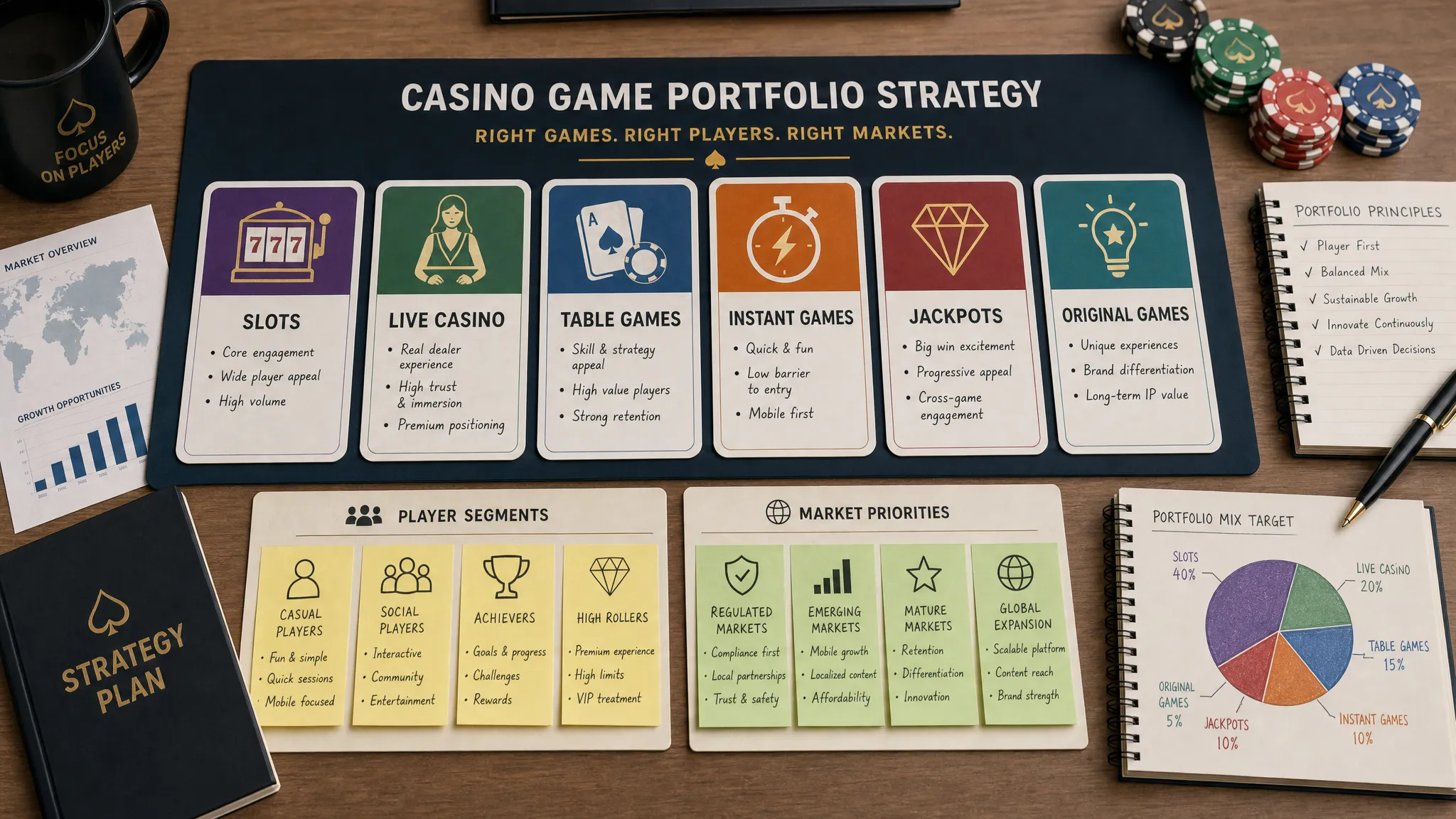
A practical launch mix might look like this:
| Category | Strategic role | Suggested focus for a new brand |
|---|---|---|
| Slots | Acquisition, variety, affiliate and streamer appeal | Prioritize proven titles, new releases, volatility variety, and strong mobile performance |
| Live casino | Trust, VIP engagement, longer sessions | Start with core roulette, blackjack, baccarat, and game-show formats if available in your market |
| Table games | Familiarity and coverage | Keep navigation simple and focus on blackjack, roulette, baccarat, poker-style games, and variants |
| Instant or crash-style games | Crypto and fast-session appeal | Use only where compliant and where the audience expects this format |
| Jackpot games | Excitement and promotional hooks | Add if the economics, provider terms, and regulatory rules fit the market |
| Original or custom games | Brand differentiation | Introduce selectively, ideally after you know which mechanics and themes your users prefer |
The exact percentages depend on the market, license, provider availability, and player profile. What matters is the logic: every category should have a job. If a game type does not support acquisition, retention, trust, margin, or differentiation, it should not dominate early merchandising.
Choose aggregation for control, not just quantity
Game aggregation is often the fastest route to a strong launch catalog. A good game aggregator can help operators access multiple providers through one integration, normalize catalogs, manage launch flows, support wallet callbacks, and reduce the operational pain of dealing with many studios directly.
However, new brands should not evaluate aggregation only by asking, “How many games do we get?” The better question is, “Can we control which games appear, where they appear, who can access them, and how they perform?”
A large catalog is valuable only if the platform helps you manage it. You need filtering, provider controls, game status visibility, jurisdiction rules, reporting, and the ability to promote or hide content quickly. If you are still learning the operational side, Spinlab’s guide to casino game aggregation and what to check is a useful starting point.
When reviewing aggregation options, look beyond the sales deck and check practical operating details:
- Provider coverage in your target markets, not just global provider count
- Game launch reliability on mobile, especially for slower networks
- Support for fiat and crypto wallet flows if your brand accepts both
- Jurisdiction and currency controls for restricted content
- Reporting by provider, title, category, device, and cohort
- Clear process for adding, removing, or prioritizing games after launch
For a new brand, the right aggregation layer should make the catalog easier to run, not harder.
Design the visible lobby separately from the full catalog
Players do not experience your portfolio as a spreadsheet. They experience it through the lobby.
This distinction matters. You may have thousands of games available in the backoffice, but the first session is shaped by the 20 to 50 titles that appear in key placements: homepage rows, search results, category tabs, promotional banners, and mobile navigation.
A smart casino game portfolio strategy separates the full catalog from the visible catalog. The full catalog gives depth. The visible catalog creates conversion.
For launch, your visible lobby should answer four questions fast:
- Does this casino have games I recognize?
- Does it have something new or exciting?
- Can I find my preferred game type quickly?
- Does the experience feel trustworthy on mobile?
If the answer to any of these is no, more games will not fix the problem. In fact, adding more titles can make the lobby worse if search, categories, thumbnails, provider labels, and localization are weak.
For mobile-first brands, reduce decision fatigue. Use fewer rows, clearer category names, faster-loading assets, and obvious return paths to recently played or favorited games. On smaller screens, a cluttered portfolio feels like a broken product.
Match games to payments and player expectations
The game portfolio should align with the way players deposit and withdraw. This is especially important for crypto-ready brands.
A player who arrives through a crypto campaign may expect fast account funding, multi-currency support, quick-session game formats, and transparent wallet balances. If that same player finds only a generic lobby with no clear category structure, the deposit experience and the game experience feel disconnected.
For fiat-heavy local markets, the expectation may be different. Players may care more about recognizable providers, localized content, familiar live casino tables, and payment methods that match local habits.
The key is consistency. Your online gambling platform, payment gateway, bonus engine, and portfolio merchandising should feel like one product. If you support both crypto and fiat, the catalog should still be easy to understand across currencies and player types. For operators planning this route, the guide on launching a crypto-ready casino brand covers the broader platform, payment, and compliance considerations.
Use compliance as a portfolio filter
Compliance should shape the portfolio from the beginning. Game availability can vary by jurisdiction, supplier agreement, license conditions, certification status, and player location. Some game types, promotional mechanics, or providers may not be suitable for every market.
This is not just a legal issue. It is an operational issue. If your team cannot confidently answer which games are available in which markets, which providers are certified, and which titles can be used in bonus campaigns, the portfolio becomes risky to scale.
Regulated operators should also understand the technical standards that apply to remote gambling software in their jurisdiction. For example, the UK Gambling Commission publishes remote gambling and software technical standards that illustrate how detailed these requirements can be.
A compliance-aware portfolio process should include provider documentation, jurisdiction gating, responsible gambling considerations, KYC and AML workflows, and clear internal ownership. Even if your platform supports these controls, your operating team still needs a policy for using them.
Balance player appeal with game economics
Not all popular games are equally valuable to a new casino. Some titles may drive clicks but create poor bonus economics. Others may have strong retention but low visibility. High-volatility games can be exciting, but they may also affect bonus cost, VIP risk, and short-term cash flow.
A good portfolio strategy connects game selection to commercial metrics. It is not enough to know which games are popular. You need to know which games produce profitable, sustainable engagement for your player cohorts.
| Metric | What it tells you | Portfolio decision it can influence |
|---|---|---|
| Game impression to launch rate | Whether lobby placement and thumbnails are working | Move, rename, feature, or remove games from prominent rows |
| Launch to real-money bet rate | Whether players actually engage after opening a game | Identify titles that attract curiosity but fail to convert |
| Bet volume by provider | Which suppliers drive meaningful activity | Prioritize provider relationships and content updates |
| Bonus cost by game or category | How promotions affect margin | Restrict certain titles in bonuses or adjust campaign rules |
| Retention by game cohort | Which games bring players back | Build recurring campaigns around high-retention categories |
| Device performance | Whether games work well on mobile and desktop | Deprioritize titles with poor mobile experience |
| Actual RTP patterns over time | Whether outcomes align with expected volatility and risk | Monitor anomalies and educate teams on variance |
New brands should review these metrics weekly during the first months. The goal is not to constantly change everything. The goal is to learn quickly enough to avoid wasting homepage space, bonus budget, and acquisition traffic on games that do not support the brand.
Plan a 90-day rollout instead of a one-time launch
A launch catalog should not be treated as final. The first 90 days are a learning period. Your job is to validate which categories attract deposits, which providers retain players, and which games create support or risk issues.
A phased rollout is usually stronger than releasing every available title at once.
| Phase | Portfolio focus | What to learn |
|---|---|---|
| Days 1 to 30 | Credibility titles, core slots, live casino basics, stable mobile experience | Which games convert first deposits and which lobby rows get ignored |
| Days 31 to 60 | New releases, provider expansion, localized categories, bonus-tested games | Which segments retain and which promotions create healthy activity |
| Days 61 to 90 | Niche formats, exclusive campaigns, early original game tests if justified | Where the brand can differentiate without hurting margin or operations |
This approach also gives the marketing team more to say. Instead of launching once and going quiet, the brand can create a content calendar around new releases, category weeks, live casino events, jackpot campaigns, or original game previews.
Know when to invest in casino original games
Original games can be powerful, but they should not be used as a shortcut for weak strategy. A custom game is most valuable when it extends a clear brand idea, serves a known player behavior, or gives affiliates and communities something distinctive to promote.
For a new brand, the safest path is often hybrid. Use aggregated content for credibility and breadth, then add original or custom-designed games once you know what themes, session lengths, volatility profiles, and mechanics resonate with your audience.
Original games can help with differentiation in crowded markets, but they also require careful attention to compliance, testing, wallet integration, responsible gambling rules, and operational support. If you are weighing the tradeoffs, Spinlab’s comparison of custom casino games versus aggregated content explains when each approach makes sense.
Spinlab can support both seamless game aggregation and original games that can be custom designed, which gives new operators a path from fast launch to differentiated portfolio development without treating those goals as separate projects.
Avoid the most common portfolio mistakes
Most early portfolio mistakes come from chasing scale before clarity. The result is a casino that has many games, but no point of view.
Common mistakes include:
- Launching with a huge catalog but no clear homepage merchandising plan
- Choosing providers based on name recognition alone, without checking market availability and performance
- Ignoring mobile load times, especially for acquisition traffic from social, affiliates, and messaging apps
- Letting bonus campaigns include games that create poor economics or abuse risk
- Treating live casino as a generic category instead of a trust and VIP retention tool
- Waiting too long to analyze game-level data after launch
- Investing in custom games before proving which player segments are worth targeting
The fix is operational discipline. Decide what the portfolio is supposed to achieve, measure whether it is achieving it, and adjust based on evidence rather than supplier pressure.
Make portfolio operations easy for non-technical teams
A strong strategy still needs a platform that operators can actually run. If every game change, provider update, bonus restriction, or lobby adjustment requires developer time, the portfolio will become slow and expensive to manage.
New brands benefit from a modular iGaming platform where commercial teams can manage game visibility, payments, bonuses, compliance workflows, and analytics without constantly waiting on engineering. This is especially important for founders launching without a large technical team. If you are still evaluating platform requirements, Spinlab’s casino platform checklist for first-time founders can help you connect portfolio decisions with the wider operating model.
Spinlab is built around an all-in-one, modular white label casino platform with crypto and fiat payment support, seamless game aggregation, KYC and AML compliance tools, fraud prevention, a customizable backoffice, affiliate and bonus capabilities, and real-time analytics. For a game portfolio strategy, that means operators can think beyond launch and plan for ongoing optimization.
Frequently Asked Questions
What is a casino game portfolio strategy? A casino game portfolio strategy is the plan for selecting, organizing, promoting, and optimizing games across an online casino. It covers categories, suppliers, lobby placement, compliance, bonus rules, player segments, and performance metrics.
How many games should a new online casino launch with? There is no universal number. A new brand should prioritize a focused visible lobby with trusted slots, live casino games, table games, and market-relevant content. A large backoffice catalog is useful only if players can easily find the right games.
Should new brands prioritize slot games or live casino games? Most new brands need both, but the emphasis depends on positioning. Slot games often support acquisition and variety, while live casino games can build trust, support VIP engagement, and create longer sessions.
When should a new brand add original casino games? Original games make the most sense after the brand has data on player preferences. They are useful for differentiation, affiliate campaigns, and community identity, but they should be supported by compliance checks, wallet integration, and clear commercial goals.
Why does game aggregation matter for portfolio strategy? Game aggregation helps operators access and manage content from multiple providers through a more streamlined setup. The strategic value is not only more games, but better control over availability, performance, reporting, and market-specific merchandising.
Build a portfolio that can launch fast and improve continuously
The best new casino brands do not win by adding every title they can find. They win by building a portfolio that matches the audience, supports payments and compliance, performs well on mobile, and improves as real player data arrives.
If you want to launch with a curated casino game portfolio and the operational tools to keep improving it, Spinlab provides a modular, crypto-ready white label casino platform designed for fast onboarding, game aggregation, payments, compliance workflows, analytics, and custom game possibilities.