

Most online casino lobbies do not have a content problem. They have a discovery problem.
A modern iGaming platform can give players access to hundreds or thousands of slot games, live casino games, table games, crash games, and casino original games. But if the lobby feels like a long, unfiltered grid, most players will only interact with the first few rows, the search bar, or whatever banner happens to load first.
That means operators can pay for great content and still leave value buried. Better player discovery helps more games get launched, improves session depth, supports cross-sell between categories, and gives new releases a fair chance without making the lobby feel chaotic.
The goal is not to push every player toward the same high-margin titles. The goal is to help each player quickly find a game that matches their intent, device, balance, market, and play style.
Why casino game lobby discovery matters
The game lobby is the merchandising layer of an online casino. It sits between acquisition and gameplay, which makes it one of the highest leverage areas for conversion and retention.
A player may arrive from an affiliate landing page, a bonus email, a provider campaign, or a direct search for a specific title. If the lobby does not make the next action obvious, the player can stall before launching a session. This is especially important on mobile, where screen space is limited and the first few rows carry a disproportionate share of attention.
Poor discovery creates several operational problems. New games underperform because players never see them. Strong niche games remain hidden behind generic categories. Search logs fill with misspellings and no-result queries. Live casino, slots, and originals compete for the same visual space without clear intent signals.
Good discovery does the opposite. It turns a large game catalog into a navigable experience.
Start with clean game metadata
Lobby optimization starts before design. If your game catalog metadata is incomplete or inconsistent, ranking logic, filtering, search, and personalization will all struggle.
A game aggregator should normalize information across providers so that each title can be sorted, filtered, and displayed accurately. This matters because providers describe content differently. One studio may tag a game as high volatility, another may use a different field, and another may not expose the same attributes at all.
At minimum, operators should maintain clean metadata for game category, provider, theme, mechanics, device compatibility, jurisdiction availability, supported currencies, bonus eligibility, newness, and status. Where allowed and accurate, RTP and volatility can also improve player decision-making.
If you are still evaluating the technical foundation, Spinlab’s guide to casino game aggregation explains the operational pieces behind catalog normalization, session launch, wallet callbacks, and jurisdiction controls.
| Metadata field | Why it improves discovery | Example lobby use |
|---|---|---|
| Category | Separates slots, live dealer, table games, crash games, and originals | Cleaner top navigation and category pages |
| Theme | Helps players browse by preference rather than provider | Mythology, fruit, bonus buy, adventure, sports |
| Mechanics | Matches players to the style of play they enjoy | Megaways, cluster pays, jackpots, crash, roulette |
| Provider | Supports studio fans and new release campaigns | Provider rows or filtered search results |
| Jurisdiction | Prevents unavailable games from appearing | Market-specific lobby visibility |
| Device support | Avoids poor mobile or desktop launches | Mobile-first rows and device-safe recommendations |
| Bonus eligibility | Reduces confusion during promotions | Bonus eligible tags and promo-specific shelves |
Clean metadata is not glamorous, but it is what makes the rest of the lobby feel intelligent.
Organize the lobby around player intent
Many casino lobbies are organized around internal logic: provider deals, commercial priorities, or the order games were imported. Players do not think that way. They arrive with intent.
Some players want the game they played yesterday. Some want a new slot from a favorite studio. Some want a fast session with a low balance. Others want a live dealer table with a specific minimum bet. A strong lobby gives each of those players a clear path.
Useful discovery shelves include:
- Continue playing for recently launched titles and unfinished habits.
- Popular right now for players who want a low-friction choice.
- New releases for fresh content, provider drops, and launch campaigns.
- Recommended for you for behavior-based discovery with responsible guardrails.
- Live tables available now for live casino games with open seats or suitable limits.
- Jackpots and prize features for players actively seeking jackpot mechanics.
- Originals and instant games for fast sessions, crypto-native audiences, or simple rules.
Each shelf should have a job. If two shelves serve the same intent, one of them is likely wasting space.
Make search forgiving and fast
Search is where high-intent players reveal exactly what they want. If search fails, the player may leave even when the game exists in your catalog.
A casino search experience should handle provider names, game titles, partial words, common misspellings, synonyms, and category terms. For example, a player might search for roulette, live roulette, lightning, pragmatic, hacksaw, bonus buy, or crash. Each query should return something useful.
No-result pages deserve special attention. Instead of showing a dead end, suggest related categories, popular alternatives, or similar providers. If a player searches for a game that is restricted in their market, the lobby should avoid confusion and present available alternatives where appropriate.
Search data is also a roadmap for merchandising. Repeated searches for new Pragmatic Play slots, new Hacksaw Gaming slots, or specific mechanics can inform homepage rows, provider campaigns, and acquisition landing pages.
Promote new games without overwhelming the lobby
New releases need visibility, but a lobby that over-promotes every new title becomes noisy. Players should be able to discover fresh content without losing access to proven favorites.
A simple launch framework works well. Give new titles a defined promotional window, place them in a new games shelf, add a visible but truthful new badge, and compare performance against similar titles. After the launch period, let data decide whether the game remains prominent, moves into a themed shelf, or settles into search and category pages.
This keeps the lobby fresh without turning it into a rotating banner wall. It also protects players from feeling that every tile is urgent or promotional.
Use ranking logic with guardrails
Game ranking is one of the most powerful discovery tools in a casino lobby. It is also one of the easiest to misuse.
A basic ranking model might consider recent launches, game popularity, device, player history, market availability, bonus eligibility, and commercial priorities. A more advanced model can adapt rows based on player segments and session context.
However, ranking should not optimize only for short-term GGR. If the lobby repeatedly shows the same titles, players may stop exploring. If it overweights games with higher margins, it may reduce trust and long-term engagement. If it ignores responsible gaming controls, it can create compliance and reputational risk.
Good ranking balances relevance, diversity, freshness, availability, and responsible constraints. Operators looking deeper into this topic can explore Spinlab’s article on game lobby personalization, which covers ranking slots with performance and guardrails in mind.
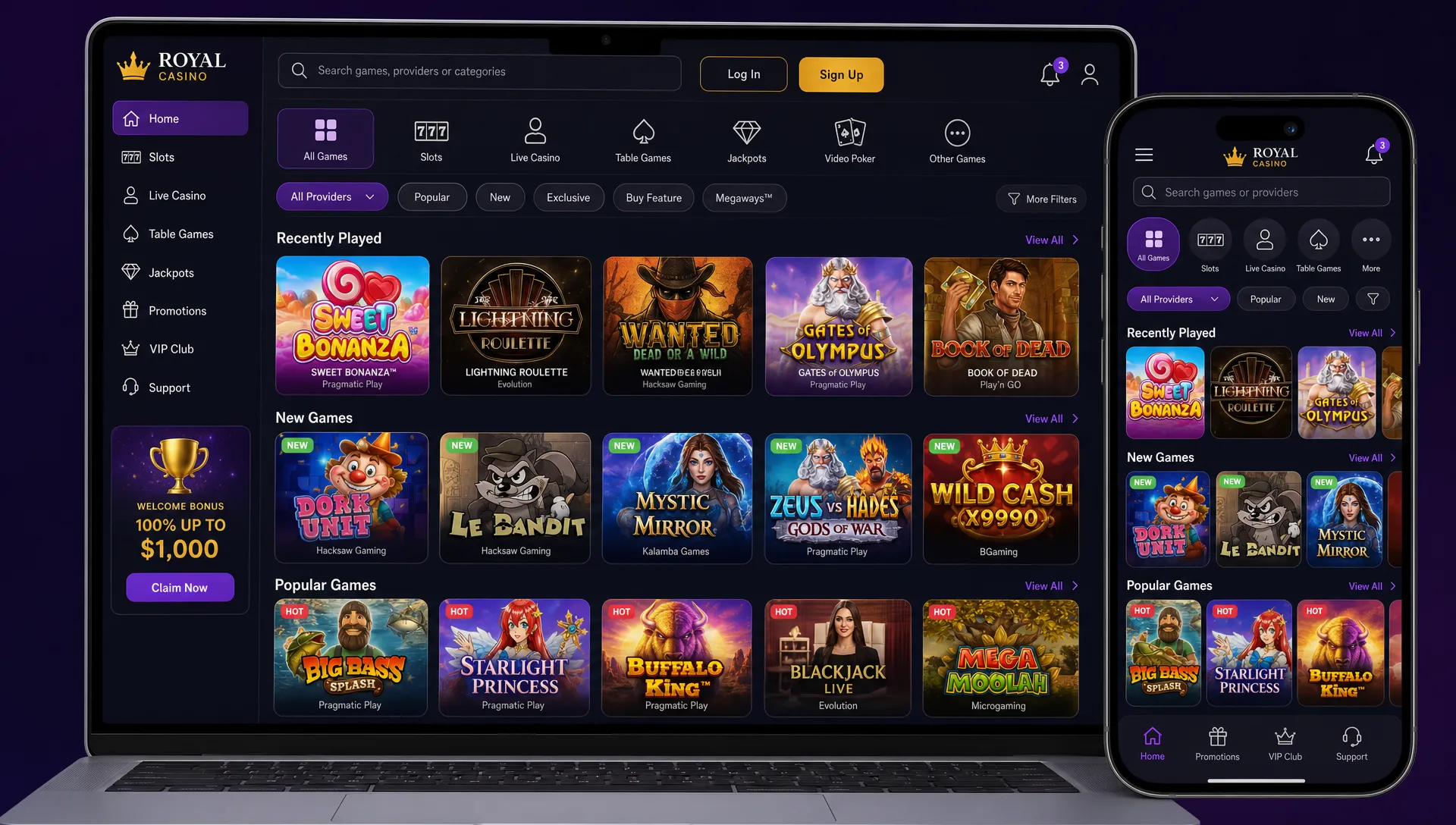
Add contextual signals that help players choose
Players scan lobbies quickly. Small labels can help them understand why a game is worth opening.
Common signals include new, trending, jackpot, live now, bonus eligible, exclusive, recently played, and popular with similar players. These labels should be accurate, consistent, and easy to understand. If every tile has three badges, none of them matter.
Social proof can be especially effective when it is based on real activity. Active player counters, recent winner messages, and hot streak indicators can guide attention, but they must be truthful and compliant. Spinlab’s analysis of social proof banners explains how these signals can influence slot selection order without relying on guesswork.
The best contextual signals reduce uncertainty. They help players answer simple questions: Is this game new? Is it popular? Can I use my bonus? Is it available on my device? Does it match the type of session I want right now?
Design for mobile discovery first
For many casino brands, the mobile lobby is the primary lobby. That changes how discovery should work.
Desktop layouts can expose more shelves, filters, and comparison cues. Mobile layouts need sharper prioritization. The search bar should be easy to reach. Category tabs should not require precise tapping. Game tiles should load quickly, and important labels should remain readable at small sizes.
Mobile discovery also depends on performance. If tile images, provider scripts, or game launch flows slow down the experience, players may never reach the game. A beautiful lobby that feels heavy will underperform a simpler lobby that launches reliably.
Practical mobile improvements include sticky category navigation, compact filters, fast-loading thumbnails, visible recent games, and short rows with clear labels. Avoid long homepage pages that make players scroll through every provider before finding useful categories.
Give every category page a purpose
The homepage gets the most attention, but category pages often decide whether players explore beyond the first session.
A slots page should not simply duplicate the homepage with a slots filter applied. It should help slot players browse by theme, provider, mechanics, volatility where permitted, jackpot type, and new releases. A live casino page should prioritize table availability, game type, language or region where relevant, minimums, and provider quality. An originals page should make rules and session speed easy to understand.
This category-level merchandising is important for new brands using whitelabel casino software because the initial catalog can be broad from day one. Without category structure, a large catalog feels like clutter instead of choice.
Measure discovery with better KPIs
Lobby performance should not be measured only by homepage clicks. A player may click a top tile because it is easy, not because the lobby helped them discover something valuable.
Use a mix of engagement, exploration, and quality metrics to understand whether discovery is improving.
| KPI | What it reveals | How to use it |
|---|---|---|
| Game launch rate | How often lobby visits become gameplay | Compare by device, segment, and category |
| Search success rate | Whether searchers find playable results | Improve synonyms, typo handling, and metadata |
| Unique games played per player | Depth of exploration | Track whether discovery expands beyond top titles |
| New game trial rate | Visibility of new releases | Evaluate launch shelves and badges |
| Repeat play after discovery | Quality of recommendations | Identify games that create durable interest |
| Scroll depth by row | Whether key shelves are too low | Reorder rows and reduce clutter |
| No-result searches | Missing content or poor matching | Add aliases, alternatives, or acquisition insights |
A/B testing is useful, but tests should be designed around player outcomes. Moving a high-performing row higher may lift clicks while reducing exploration. Adding more badges may raise short-term attention while making the lobby harder to scan. Always watch second-order effects.
Build feedback loops between analytics and merchandising
Discovery is not a one-time setup. It is an operating rhythm.
Review search logs weekly. Monitor which games receive impressions but few launches. Compare new release performance by provider, theme, and position. Look for categories with strong repeat play but weak homepage visibility. Identify markets where certain shelves underperform due to payment behavior, content restrictions, or device mix.
This is where a real-time analytics dashboard and a customizable backoffice become valuable. Operators need to adjust rows, promotions, filters, and visibility rules without waiting on development cycles. A Shopify-like admin experience can make casino merchandising feel more like running a modern commerce storefront, while still respecting compliance and wallet logic.
Quick casino lobby discovery checklist
Use this checklist to audit your current lobby:
- Are the first three rows tied to clear player intent?
- Can players find recent games, new games, and popular games quickly?
- Does search handle misspellings, provider names, and category terms?
- Are unavailable games hidden or clearly handled by market?
- Do badges communicate useful information without clutter?
- Are mobile rows shorter, faster, and easier to scan than desktop rows?
- Are new releases promoted for a defined window, then ranked by performance?
- Do analytics show exploration quality, not just tile clicks?
If several answers are unclear, the problem may not be your game portfolio. It may be the way the portfolio is presented.
Frequently Asked Questions
What is player discovery in a casino game lobby? Player discovery is the process of helping users find relevant games quickly through navigation, search, filters, ranking, personalization, badges, and category design. It turns a large game catalog into an experience that feels easy to explore.
How many games should appear on the casino homepage? There is no universal number. The better question is how many meaningful choices a player can understand at once. Most lobbies perform better when the homepage is organized into focused shelves rather than one long grid of every available title.
Should new casinos prioritize slots or live casino games in the lobby? It depends on brand positioning, traffic source, market, and player intent. A slots-first brand should still give live casino clear navigation, while a live-led brand should create easy paths into slot games and originals for cross-sell.
How can a new online casino improve discovery without much player data? Start with clean metadata, strong category pages, popular and new game shelves, provider filters, fast search, and market-specific visibility rules. As data grows, add personalization and ranking models with responsible guardrails.
What role does a game aggregator play in lobby discovery? A game aggregator supplies and normalizes content from multiple providers, helping operators manage availability, metadata, session launch, and portfolio scale. Better aggregation makes it easier to create searchable, filterable, and personalized lobbies.
Turn your game catalog into a discoverable casino experience
A strong lobby makes every part of your online gambling platform work harder: acquisition, retention, game aggregation, payments, bonuses, and analytics. Players should not have to hunt through a crowded grid to find a good session.
Spinlab helps operators build, launch, and scale online casinos with a modular, crypto-ready, white label casino platform. With integrated payments, game aggregation, compliance tools, analytics, mobile optimization, and a customizable backoffice, operators can create lobbies that are easier to manage and easier for players to explore.