

After a casino incident, the most tempting question is also the least useful one: who caused it? A stronger postmortem asks what conditions made the incident possible, why the team did not detect it earlier and how the operation can reduce the chance of a repeat.
For an online casino, that distinction matters. Incidents can affect player balances, game availability, withdrawals, KYC decisions, bonus eligibility, affiliate tracking and regulatory reporting. A blame-heavy review makes people defensive, hides weak signals and slows learning. A blame-free casino incident postmortem creates a factual record, protects player trust and turns a bad day into a better operating system.
Blame-free does not mean accountability-free. Owners still accept action items, vendors still need follow-up and compliance still needs accurate evidence. The difference is that the review focuses on system improvement rather than personal failure.
Why casino postmortems need a specific approach
Most incident postmortem advice was written for software outages. Online gambling platforms have those problems, plus money movement, wagering records, fraud risk and regulated player interactions.
A failed payment gateway can leave deposits pending, duplicate a transaction or block withdrawals at peak time. A game aggregator issue can make slot games unavailable across several providers. A wallet or ledger mismatch can create reconciliation work that finance and compliance need to understand. A KYC or AML queue failure can stop legitimate players from withdrawing or allow risky activity to remain unchecked.
Casino incidents also have more external dependencies than many SaaS products. Your team may rely on game studios, payment processors, crypto onramp providers, identity vendors, affiliate networks, fraud tools and hosting providers. The postmortem must therefore separate what happened inside your iGaming platform from what happened in third-party systems, without turning the meeting into vendor blame.
If your incident response process is still informal, start with an iGaming incident response playbook before refining postmortems. The playbook handles the live incident. The postmortem makes the next incident easier to detect, contain and resolve.
Define blame-free before the meeting starts
A casino incident postmortem should begin with a working agreement. Everyone in the room needs to understand that the review is about decisions, signals, tools and constraints, not personal criticism.
Google's Site Reliability Engineering book describes postmortem culture as a way to learn from failure without punishing people for actions that made sense with the information available at the time. That framing is useful for casino operations because many incidents unfold under pressure, with incomplete data and real player impact.
Use these principles as the baseline:
- People acted based on the information, alerts and permissions they had at the time.
- Human error is a starting point for investigation, not a final cause.
- The timeline must distinguish confirmed facts from assumptions.
- The final report should name roles and systems more often than individuals.
- Action items should change tools, controls, documentation, monitoring or training.
- Compliance and audit needs must be met without turning the review into a search for someone to punish.
For example, do not write that a support lead failed to notify players. Write that the incident workflow did not define when support should send the first player-facing update, which meant the support lead had to wait for informal approval.
That wording is more precise, and it points to a fix.
Decide which incidents deserve a postmortem
Not every small alert needs a full meeting. If every minor provider timeout produces a one-hour review, your team will start treating postmortems as bureaucracy. At the same time, an online casino should review more than total outages. Money, player trust and compliance risk can make a narrow incident worth serious analysis.
A simple trigger table helps teams stay consistent.
| Incident type | Postmortem depth | Examples |
|---|---|---|
| Severe platform incident | Full postmortem with leadership visibility | Wallet balance discrepancy, withdrawal outage, widespread game downtime, suspected data exposure |
| Material operational incident | Focused postmortem with affected teams | Delayed settlements, payment gateway degradation, KYC backlog, failed bonus campaign |
| Repeated low-severity incident | Pattern review | Same provider timeout recurring weekly, repeated false fraud alerts, recurring backoffice permission confusion |
| Isolated low-impact issue | Lightweight notes and action item | Short-lived admin error with no player impact and clear fix |
The key is not just severity. Repetition, unclear ownership and poor detection are strong reasons to run a postmortem, even when the immediate financial impact is small.
Preserve evidence before memories rewrite the incident
A postmortem is only as good as its evidence. Memories change quickly after a stressful event, especially when teams are tired or worried about consequences. Capture the record as soon as the incident is stable, ideally before the team moves on to the next release or campaign.
Casino evidence usually comes from several places:
| Evidence source | What it helps explain |
|---|---|
| Incident channel or war room transcript | Decisions made, timestamps, handoffs and unanswered questions |
| Application logs, traces and metrics | Failure point, latency, error rate, affected services and recovery path |
| Payment gateway responses | Failed, pending, reversed, duplicate or delayed transactions |
| Wallet and ledger entries | Balance impact, reversals, settlements and reconciliation needs |
| Game round IDs and provider callbacks | Incomplete rounds, provider-side errors and player-visible game impact |
| KYC and AML decision logs | Verification delays, review queues and risk decision changes |
| Backoffice admin actions | Manual changes, role usage, configuration edits and approvals |
| Support tickets and chat transcripts | Player confusion, complaint themes and communication gaps |
| Deployment and configuration history | Code releases, feature flags, rule changes and environment differences |
Good evidence depends on instrumentation. If your team often reconstructs incidents from screenshots and chat messages, invest in observability for iGaming so logs, metrics, traces and business context are ready before the next incident.
For financial incidents, the ledger record deserves special care. A casino should be able to trace deposits, wagers, wins, bonuses, reversals and settlements without editing history. If this is a weak area, review your casino ledger design before the next balance-related incident forces the issue.
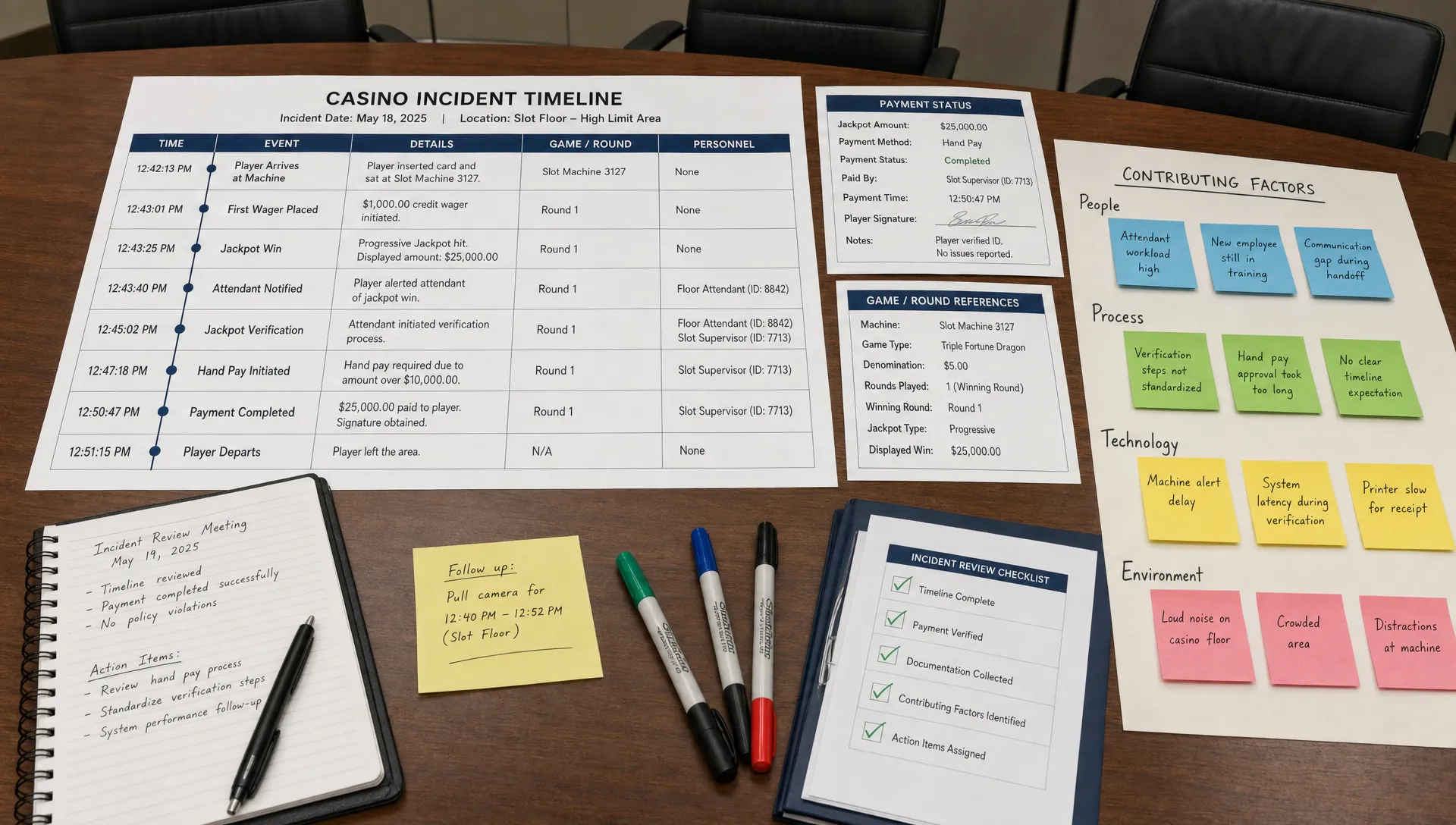
Build a neutral timeline
The timeline is the spine of the postmortem. It should show when the incident began, when the team detected it, what decisions were made, when players were affected and when the service returned to normal.
Use UTC for technical records, then add local time only when needed for business context. This avoids confusion when vendors, processors and casino teams operate across regions.
A practical timeline format looks like this:
| Time | Event | Source | What the team knew then | Impact |
|---|---|---|---|---|
| 14:02 UTC | Deposit success rate dropped below normal range | Payment metrics | Gateway errors increased, root cause unknown | Some players saw pending deposits |
| 14:07 UTC | Support tickets started mentioning missing funds | Support queue | Player impact confirmed | Support volume rising |
| 14:14 UTC | Payments owner contacted gateway vendor | Incident channel | Errors appeared external | Waiting for vendor response |
| 14:22 UTC | Deposits temporarily disabled for affected method | Backoffice audit log | Risk of more pending deposits reduced | New deposits blocked for one method |
| 14:49 UTC | Vendor confirmed processor degradation | Vendor status update | External dependency confirmed | Recovery estimate pending |
| 15:18 UTC | Deposit method restored | Payment metrics | Success rate back to baseline | Monitoring continued |
Do not clean up the timeline to make the team look better. If detection took too long, write that. If support heard from players before monitoring fired, write that too. A postmortem that hides uncomfortable facts is just a formatted excuse.
Invite the right people, not the whole company
A useful postmortem needs the people who can explain the incident and the people who can fix the conditions behind it. Too many attendees create performance anxiety. Too few attendees leave gaps.
For a casino incident, consider including the incident commander, engineering lead, operations lead, payments owner, game operations owner, support lead, compliance or risk representative and a product or business owner for the affected area. If a vendor was materially involved, assign one internal owner to bring vendor facts into the meeting rather than letting the session become a group complaint about the provider.
One person should facilitate. Ideally, the facilitator was not the person most emotionally involved in the incident. Their job is to keep the group factual, prevent blame language and make sure action items are concrete.
Use a meeting structure that keeps learning on track
Most casino postmortems can be handled in 45 to 60 minutes. Major incidents may need longer, especially if payments, compliance and player remediation are all involved. Do not start with solutions. Start with shared facts.
| Timebox | Focus | Output |
|---|---|---|
| 5 minutes | Purpose and ground rules | Blame-free frame, scope and desired decisions |
| 10 minutes | Player and business impact | Affected players, services, regions, money movement and support load |
| 15 minutes | Timeline review | Confirmed sequence of events and open questions |
| 15 minutes | Contributing factors | Technical, process, vendor, monitoring and communication gaps |
| 10 minutes | Corrective actions | Owners, due dates and validation method |
| 5 minutes | Report ownership | Final editor, approvers and follow-up schedule |
The facilitator should stop vague statements early. If someone says the payment team was slow, ask what signal was missing, what approval was unclear or what dependency created the delay. If someone says the game provider broke everything, ask which provider response codes, callbacks or status updates support that claim.
Ask better questions for casino failure modes
Generic root cause questions often miss casino-specific risk. A postmortem for a live casino game outage should not use the same checklist as a KYC backlog or crypto onramp failure.
Use questions that fit the incident type.
| Incident area | Questions to ask | Useful artifacts |
|---|---|---|
| Payments and withdrawals | Were failed transactions pending, reversed or retried? Did the player see a clear status? Were limits, processors or risk rules changed recently? | Gateway logs, transaction IDs, reconciliation report, support tickets |
| Crypto onramp and wallets | Was the issue with onramp approval, custody, network confirmation, exchange rate display or internal balance crediting? | Wallet records, onramp status, blockchain transaction references, ledger entries |
| Game aggregation | Did the failure affect one provider, one title, one region or all game launches? Were incomplete rounds settled correctly? | Provider callbacks, game round IDs, aggregator logs, player session data |
| Bonus and affiliate systems | Did the incident over-credit, under-credit or misattribute players? Was abuse possible during the incident window? | Bonus rules, campaign changes, affiliate click records, fraud alerts |
| KYC and AML | Were players blocked incorrectly, approved incorrectly or left in manual review too long? Were high-risk events escalated? | Decision logs, queue history, policy version, analyst notes |
| Backoffice operations | Did permissions, unclear workflows or manual overrides contribute? Was there an audit trail for every change? | Admin audit logs, role matrix, approval records, configuration history |
A strong postmortem does not need one perfect root cause. Most incidents involve several contributing factors. For example, a deposit incident might combine a processor outage, a missing alert on pending transaction volume, unclear player messaging and a manual reconciliation process that only one person knew well.
Separate causes into useful categories
The phrase root cause can be misleading because it suggests there is one thing to find. Casino incidents usually sit at the intersection of technology, operations and risk controls. Categorizing contributing factors makes the report more actionable.
| Category | What to look for | Example fix |
|---|---|---|
| Technical design | Single points of failure, weak retries, missing idempotency or fragile integrations | Add safer retry logic or isolate one provider failure from the rest of the lobby |
| Monitoring and detection | Alerts that fired late, lacked context or went to the wrong owner | Alert on pending withdrawal age by provider and route to payments owner |
| Process and ownership | Unclear escalation path, missing approval or undocumented workaround | Add a payments incident checklist and escalation threshold |
| Vendor management | Slow vendor response, unclear status page or missing support SLA | Create vendor incident contact map and escalation template |
| Player communication | Late, vague or inconsistent support messaging | Pre-approve incident message templates by incident type |
| Risk and compliance | Unclear reporting, missing audit evidence or inconsistent remediation | Define evidence retention and compliance review steps |
This structure keeps the team from stopping at easy explanations. A person clicking the wrong backoffice setting is not the full cause if the interface allowed a risky change without review, the role had broader permissions than necessary and no alert detected the abnormal result.
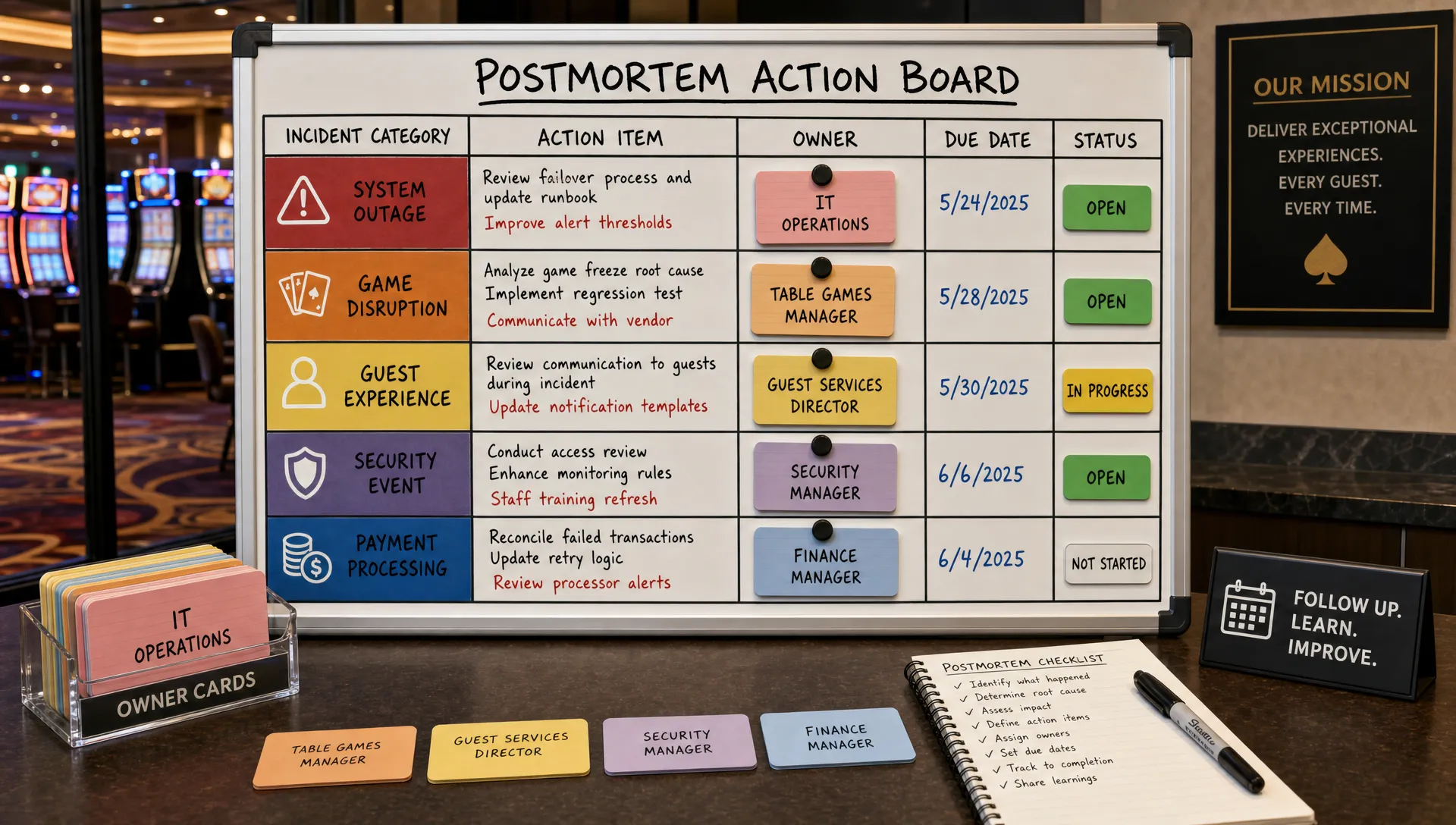
Write a postmortem report people will actually use
The report should be concise enough to read and detailed enough to support future decisions. If it becomes a ten-page narrative with no owner for fixes, it will not change behavior.
A practical casino postmortem report includes these sections:
| Section | What to include |
|---|---|
| Summary | One paragraph explaining what happened, who was affected and current status |
| Impact | Player count if known, affected products, regions, payment methods, games, revenue risk and support volume |
| Timeline | Confirmed events with timestamps and evidence sources |
| Detection | How the team discovered the issue and what should have detected it earlier |
| Response | Key actions taken during containment, mitigation and recovery |
| Contributing factors | Technical, operational, vendor, monitoring and communication issues |
| Player remediation | Refunds, reversals, bonus corrections or support follow-up, if applicable and approved |
| Compliance notes | Evidence retained, reports required and unresolved review items |
| Corrective actions | Owner, due date, priority and validation method for each fix |
| Open questions | Items that still need vendor, legal, finance or compliance input |
Be careful with player remediation language. Refunds, bonus credits and goodwill offers should follow your terms, responsible gambling obligations and compliance review. The postmortem should record what was done and why, not invent ad hoc compensation rules during the meeting.
Make corrective actions hard to ignore
A postmortem is not finished when the report is published. It is finished when the highest-value actions are complete, validated and visible to the teams that need them.
Weak action items sound like improve monitoring or update documentation. Strong action items identify the change, owner and proof that the change works.
| Weak action | Stronger action |
|---|---|
| Improve payment alerts | Add an alert when pending deposits for any payment method exceed the normal operating threshold for 10 minutes, owned by payments operations |
| Fix game provider issue | Add provider-specific launch error tracking and fallback lobby messaging for unavailable games, owned by game operations |
| Train support | Update the support macro for pending withdrawals and run a 20-minute briefing with weekend agents, owned by support lead |
| Review permissions | Remove bonus rule editing from roles that do not require it and require approval for campaign imports, owned by backoffice admin |
| Talk to vendor | Send vendor incident packet with timestamps, error codes and requested prevention measures, owned by vendor manager |
Track corrective actions in the same place your team tracks operational work. Each item should have a due date, owner and validation method. For high-severity incidents, review open actions in an operations meeting until closure.
Keep compliance involved without freezing the discussion
Casino teams sometimes avoid honest postmortems because legal, regulatory or licensing concerns feel risky. That fear is understandable, but silence creates a different risk: repeat incidents with weaker evidence.
Set rules with legal and compliance before the next serious incident. Some events may need privileged legal review, formal regulator notification or restricted distribution. Others can use a standard internal postmortem. Decide who classifies that need, what evidence must be preserved and which report version can be shared with operations teams.
The goal is not to publish sensitive details everywhere. The goal is to make sure the people responsible for prevention can learn from the incident while compliance receives the factual record it needs.
A useful pattern is to maintain two layers when necessary: an operational postmortem focused on facts, contributing factors and fixes, plus a separate restricted file for legal advice, regulatory strategy or sensitive player information. Always follow counsel and applicable licensing requirements.
Watch for anti-patterns that bring blame back
Blame rarely appears as someone shouting in a meeting. It often hides in wording, action items and informal side conversations.
Common anti-patterns include:
- Naming an employee as the cause instead of describing the control gap.
- Treating vendor failure as the end of analysis, even when internal detection or communication was weak.
- Publishing a timeline that removes confusion, delays or wrong turns.
- Assigning corrective actions to a department instead of a named owner.
- Creating so many action items that none of them get done.
- Using the report to justify a decision already made before the review.
The facilitator should edit blame language in real time. Replace careless with no second approval existed. Replace support failed with support had no approved message for this incident type. Replace engineering missed it with the alert did not include the affected payment method.
That is not softer language. It is more operationally useful language.
Use platform design to make postmortems easier
A blame-free culture works better when the iGaming platform gives teams the data they need. If payments, game sessions, backoffice actions, KYC states, fraud signals and player communications live in disconnected systems, the postmortem becomes detective work.
Operators should evaluate whether their casino software provider makes incident review easier in practical ways. Useful capabilities include clear admin audit trails, integrated payment context, game aggregation visibility, real-time analytics, fraud prevention signals, KYC and AML status visibility, multi-currency transaction context and Open API access for connecting operational data.
This is especially important for lean teams running a whitelabel casino or turnkey casino solution. A small operations team cannot afford to spend days reconciling basic facts after every incident. The more context available in the backoffice and connected systems, the faster the team can move from what happened to what changes next.
A simple postmortem checklist for casino operators
Use this checklist after the incident is stable:
- Confirm the incident scope, affected services and current status.
- Preserve logs, transaction records, game round IDs, admin actions and incident communications.
- Build a timeline using UTC and evidence sources.
- Identify player, financial, compliance and support impact.
- Invite the right functional owners and assign a neutral facilitator.
- Review contributing factors by category, not by person.
- Define corrective actions with owners, due dates and validation methods.
- Decide whether legal, compliance or regulator-specific handling is required.
- Publish the approved report to the right internal audience.
- Track action items until they are complete and tested.
The checklist is intentionally plain. Postmortems fail when they become too complex to run during a busy operating week.
Frequently Asked Questions
How soon should an online casino run an incident postmortem? Run it after the incident is stable and urgent player remediation is under control. For most material incidents, schedule the review within 24 to 72 hours so evidence and memory are still fresh.
Should vendors attend the casino incident postmortem? Usually, keep the main review internal and assign one owner to gather vendor facts. For complex payment gateway, game aggregator or crypto onramp incidents, a separate vendor review can help, but the internal team still needs its own analysis.
Does blame-free mean no one is responsible? No. Blame-free means the report focuses on systems, controls and decisions rather than personal punishment. Owners still commit to corrective actions and leadership still follows up on completion.
What if the incident involved a serious compliance or security issue? Involve legal, compliance and security leadership early. Some details may need restricted handling, but the operational team still needs a factual learning process that supports prevention.
What is the most common postmortem mistake for casino teams? The most common mistake is stopping at the visible trigger, such as a vendor outage or admin mistake, without examining detection, escalation, player messaging, audit evidence and recovery controls.
Build a casino operation that learns faster
Postmortems are easier when your platform keeps operational context close to the work. Spinlab offers an all-in-one, modular iGaming platform for launching and scaling online casinos, with crypto and fiat payment support, game aggregation, real-time analytics, fraud prevention, KYC and AML compliance, a customizable backoffice admin panel and Open API integration.
If you want a flexible whitelabel casino platform with a Shopify-like operating experience, explore Spinlab and see how a more connected backoffice can support faster, cleaner incident learning.