

A casino platform exit plan is not a sign that you expect a vendor relationship to fail. It is a sign that you understand the economics of iGaming infrastructure.
Online casino operators depend on a dense stack of platform software, wallets, payment gateways, game aggregators, KYC tools, fraud controls, bonus engines, affiliate tracking, data warehouses and support workflows. Once those systems are live, switching providers can become painful unless you planned for it before launch.
Vendor lock-in usually starts quietly. A founder chooses a fast turnkey casino solution, accepts the vendor’s default data model, connects a few payment methods and launches. Six months later, the brand wants better reporting, lower payment costs, different slot games, stronger affiliate controls or a more flexible backoffice. The operator then discovers that key data cannot be exported cleanly, the wallet ledger is hard to reconcile outside the platform, or the contract charges excessive transition fees.
A good exit plan protects your leverage. It gives you options if your casino software provider stops improving, raises prices, misses support targets or no longer fits your growth strategy.
What Vendor Lock-In Looks Like in Casino Platforms
In SaaS, vendor lock-in often means losing access to workflow data or facing a difficult integration rebuild. In iGaming, the stakes are higher because the platform holds financial, regulatory and player trust records.
For an online casino, lock-in can appear in several forms:
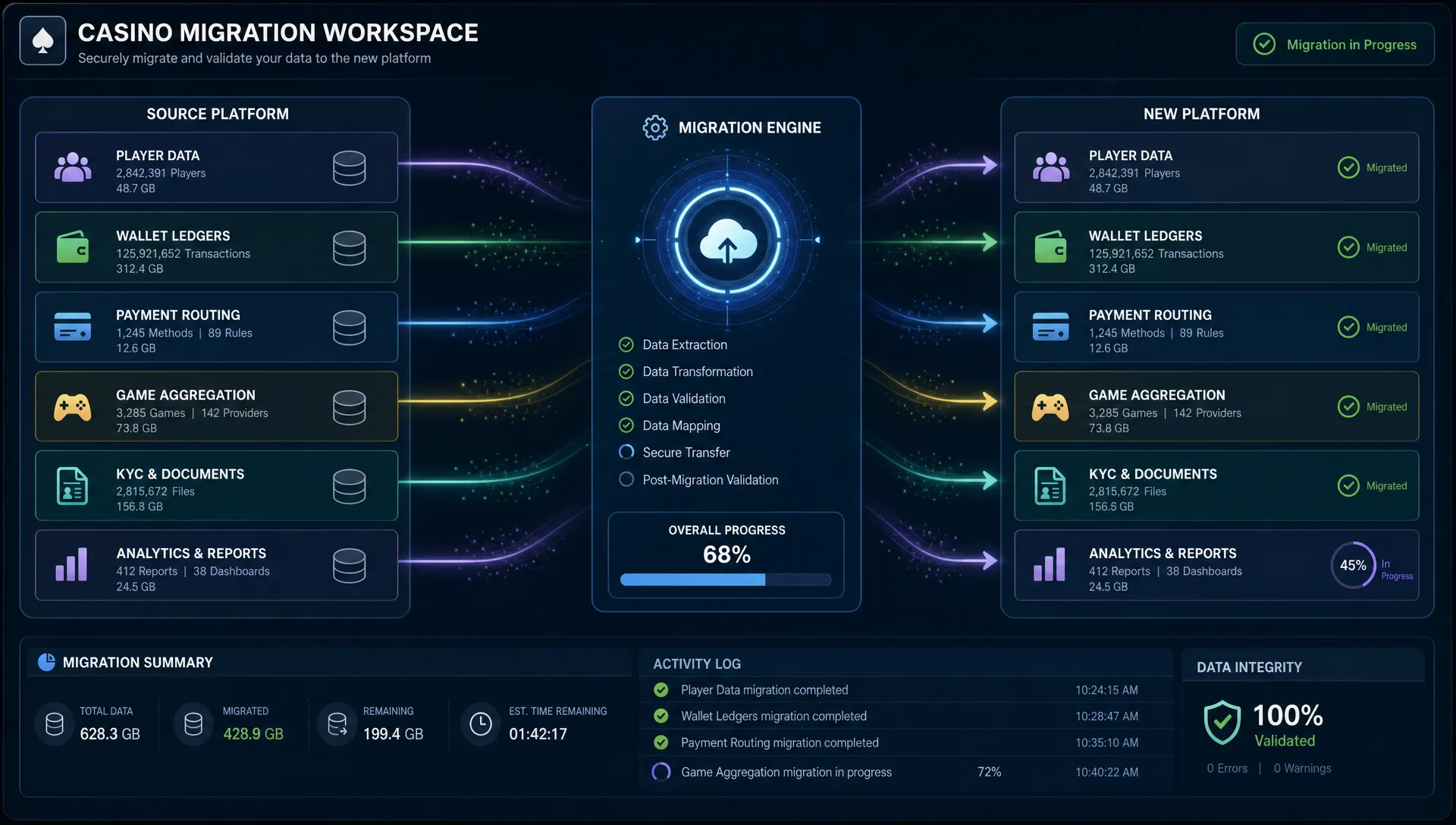
- Data lock-in: Player records, KYC status, consents, transaction history, game rounds, bonus activity and affiliate attribution cannot be exported in a usable format.
- Wallet lock-in: Player balances, crypto and fiat ledgers, adjustments, chargebacks and reconciliation records are tied to a proprietary wallet with limited audit trails.
- Game aggregation lock-in: Your game catalog, provider contracts, game IDs, RTP configurations and lobby metadata depend entirely on one game aggregator.
- Payment lock-in: The platform controls your payment gateway routing, settlement records, crypto onramp access or merchant wallet structure.
- Operational lock-in: Bonus setup, fraud rules, risk reviews, customer segmentation and affiliate campaigns require vendor support instead of your internal team.
- Compliance lock-in: KYC, AML, responsible gambling, geolocation and reporting evidence are stored in a way that cannot be retrieved quickly during audits or migration.
The problem is not using a white label casino platform. For many operators, a modular whitelabel casino is the fastest and most cost-effective way to enter the market. The problem is signing into a platform relationship with no defined exit rights, no tested data export and no clarity on who controls the critical operating records.
Why Exit Planning Belongs Before Go-Live
Exit planning is easiest before you sign the contract. After launch, your negotiating leverage drops because the vendor knows that migration risk is expensive.
This is especially true for real-money gaming because the platform becomes part of your compliance perimeter. You may need to produce player activity records, AML review history, payment evidence, self-exclusion status, game round details and promotional terms after a vendor relationship ends. Under GDPR, data portability and access rights also matter where personal data is involved. The text of GDPR Article 20 is a useful reminder that portability is not just a convenience issue for European players, even though gambling compliance and retention rules can make execution more complex.
A strong exit plan also supports day-to-day vendor governance. If you already maintain a vendor inventory, risk tiering and contract control process, your exit plan becomes part of a broader risk discipline. Spinlab’s guide to casino vendor risk management is a helpful companion if you want to build that discipline across payments, games, compliance and infrastructure providers.
The best time to ask “how do we leave?” is when everyone is still excited to work together.
The Core Components of a Casino Platform Exit Plan
A practical exit plan should be short enough for executives to understand but specific enough for legal, finance, compliance and technical teams to use. It should not live only in a contract folder. Treat it as an operating document that gets reviewed whenever your platform scope changes.
| Exit plan area | What to define | Why it matters |
|---|---|---|
| Data ownership | Which records belong to the operator and how they can be exported | Prevents disputes over player, wallet, affiliate and reporting data |
| Export format | CSV, JSON, database dump, API export or secure file transfer | Reduces migration cleanup and data mapping effort |
| Transition support | Vendor duties during migration, including timelines and named support channels | Keeps the old platform stable while the new one is being configured |
| Wallet reconciliation | Balance snapshots, transaction logs, bonus funds and adjustment history | Protects player funds and auditability |
| Compliance records | KYC, AML, responsible gambling, consent and audit logs | Supports regulatory requests after termination |
| Game and provider mapping | Game IDs, provider IDs, categories, jurisdictions and lobby metadata | Helps rebuild the game lobby without losing commercial continuity |
| Payment continuity | Settlement files, merchant account dependencies, wallet custody arrangements and routing logic | Reduces failed withdrawals and deposit disruptions |
| Domain and brand assets | Control of domains, front-end code ownership, creative files and tracking tags | Prevents brand hostage situations |
| Exit fees | Costs for data export, transition assistance and early termination | Stops surprise invoices during an already sensitive period |
This table is not legal advice, but it is a useful starting point for commercial, legal and operational review.
Contract Clauses That Reduce Lock-In
A contract cannot solve every migration challenge, but it can prevent the most predictable disputes. The contract should state what happens during termination, not just what happens during launch.
The most important clause is data ownership. Your agreement should make clear that the operator owns or has continuing access to the operational data required to run, audit and migrate the casino brand. That usually includes player account data, transaction records, game activity, KYC outcomes, AML case notes, bonus history, affiliate attribution, responsible gambling records and marketing consent logs.
Export rights should be specific. “Reasonable access to data” is too vague. A better agreement defines export frequency, format, delivery method, support obligations, costs and timeframes. If you rely on a real-time analytics dashboard, confirm whether the underlying raw data is exportable or whether you only get screenshots and reports.
Transition assistance also deserves detail. The vendor may need to support balance reconciliation, game catalog mapping, backoffice access, payment reporting, incident response and final audit reports. Agree what assistance is included in the platform fee and what becomes billable professional services.
Termination rights should cover more than non-payment. Operators should review remedies for chronic downtime, repeated SLA breaches, security failures, compliance failures, unresolved payment issues, loss of key integrations and material changes to pricing or product scope. For support-heavy environments, it is worth aligning these rights with your SLA expectations. If you have not formalized that yet, Spinlab’s article on evaluating casino platform support and SLAs breaks down the operating questions to ask.
Technical Choices That Keep Your Options Open
Exit planning is not only a legal exercise. Your architecture can either increase or reduce lock-in every week you operate.
A flexible casino platform should make critical components accessible through documented APIs, exports or admin workflows. If every change requires a vendor ticket, your operational knowledge stays outside the company. That slows migration and weakens your negotiating position.
Pay close attention to your identity model. Player IDs, affiliate IDs, transaction IDs and game round IDs should be stable, unique and exportable. If IDs are regenerated during export or differ across reports, reconciliation becomes harder. This matters most for wallets, bonuses, fraud investigations and lifetime player value analysis.
Payment architecture needs the same discipline. An operator should know which payment gateway relationships are direct, which are controlled by the platform and what happens to settlement records after termination. For crypto-ready solutions, clarify the role of merchant custodial wallets, crypto onramp partners, withdrawal approval workflows and chain transaction references. You do not need to own every payment integration from day one, but you should understand which parts can move with you.
Game aggregation creates another lock-in point. New slot games, live casino games and original casino games are valuable only if the operator can manage the catalog, track performance and migrate metadata when needed. Ask whether game IDs, categories, provider data, jurisdictional restrictions, thumbnails and promotional tags can be exported. If your lobby is heavily customized, confirm who owns the design and front-end components.
A “Shopify-like” casino backoffice can reduce operational lock-in when it lets your team configure bonuses, pages, payment rules, content, affiliates and reporting without constant developer involvement. The goal is not to avoid vendors altogether. The goal is to avoid being dependent on vendor labor for routine commercial decisions.
Data You Should Be Able to Export Before You Need It
The best proof of portability is a test export. Do it before you launch, then repeat it after major platform changes.
| Data category | Examples of records to export | Migration risk if missing |
|---|---|---|
| Player accounts | Profile fields, verification status, limits, exclusions and communication preferences | Account recreation errors and compliance gaps |
| Wallet and ledger | Deposits, withdrawals, balances, bonuses, reversals, manual adjustments and settlement references | Balance disputes and audit failures |
| Game activity | Game rounds, provider IDs, bet amounts, wins, timestamps and session data | Incomplete player history and reporting inconsistencies |
| KYC and AML | Verification results, risk scores, document references, case notes and review timestamps | Weak evidence for regulatory or banking reviews |
| Bonus activity | Bonus grants, wagering progress, forfeits, expiries and abuse flags | Promotional disputes and incorrect liability calculations |
| Affiliate data | Partner IDs, referral links, commission rules, player attribution and payout history | Revenue share disputes and partner churn |
| Marketing consent | Opt-in source, timestamp, channel preferences and unsubscribe records | Privacy and communication compliance risk |
| Support records | Complaints, dispute outcomes, responsible gambling interactions and refund notes | Poor continuity in player care |
Do not wait until termination to discover that an export is incomplete. A quarterly export test can be enough for many lean teams. Larger operators may need more frequent automated extracts into their own data warehouse.
A Practical Exit Readiness Test
You do not need a full migration project to measure exit readiness. Run a lightweight test that answers a few operational questions.
Ask your team to export a sample of player, wallet, game, payment, KYC, bonus and affiliate records. Then ask a separate person to use the files to reconstruct one player’s full lifecycle: registration, verification, deposits, gameplay, bonus use, withdrawals, support contacts and marketing consent.
If the lifecycle cannot be reconstructed, you have a portability gap. The gap might be technical, contractual or procedural. Either way, it should be logged and resolved before the platform becomes harder to leave.
Next, test administrative independence. Can your team disable a payment method, adjust a bonus, update a game lobby, review fraud alerts and export reports without vendor intervention? If the answer is no, decide whether that dependency is acceptable for your current stage. Early-stage operators may accept more vendor dependency in exchange for speed, but they should do so consciously.
Finally, review your runbook. A real exit will involve player communications, payment cutoff timing, bonus liability treatment, domain and DNS changes, payment reconciliation, final vendor invoices and compliance evidence. If those steps are not written down, your plan is still theoretical.
How to Evaluate a Replacement Platform Without Repeating the Same Problem
When operators migrate away from a restrictive platform, they sometimes overcorrect. They look for the opposite of whatever frustrated them most, then miss other risks. A team burned by weak reporting may choose the vendor with the best dashboards but ignore payment ownership. A team frustrated by slow support may choose a smaller vendor with direct founder access but limited compliance tooling.
Evaluate the next casino platform through the same exit lens you wish you had used earlier. Confirm who owns the data, how exports work, what APIs are documented, how wallet records are audited, how game aggregation is structured and what transition support is included.
This is also the point to compare your future operating model. Do you want a full turnkey casino solution, a modular white label casino platform or a more custom build with selected third-party services? Each model can work, but each creates a different exit path. Spinlab’s guide on evaluating a casino platform before migration covers the broader due diligence process if you are already considering a move.
A replacement platform should make growth easier, not just migration possible. Look for practical flexibility in areas such as fiat and crypto payments, game aggregation, KYC and AML workflows, fraud prevention, mobile performance, affiliate operations, bonus management and backoffice usability. These features matter because the most expensive form of lock-in is not always contractual. Sometimes it is the slow accumulation of manual workarounds that your team becomes afraid to change.
Warning Signs That Your Current Platform Is Becoming Too Sticky
Some lock-in is obvious, such as a vendor refusing to provide wallet data. Other signs are more subtle.
You should review your exit position if your team cannot explain how balances are reconciled, if basic exports require custom vendor work, if support tickets are the only way to change commercial settings, if payment reports do not match wallet reports, or if your provider cannot document what happens during termination.
Another warning sign is pricing pressure without increased value. If platform fees, game aggregation margins, payment fees or professional services costs rise while platform flexibility stays flat, you may be paying more for less control.
A final warning sign is fear. If leadership avoids product, payment or compliance changes because “migration would be too hard,” the vendor relationship has started to shape your strategy. That is exactly what an exit plan is meant to prevent.
Frequently Asked Questions
What is vendor lock-in in an online casino platform? Vendor lock-in happens when an operator becomes too dependent on a casino software provider to access data, run operations, manage payments, configure games or migrate to another platform without major disruption.
Should a startup casino worry about exit planning before launch? Yes. Early planning does not mean you expect to leave. It means you are protecting data ownership, wallet auditability, payment continuity and negotiating leverage before the platform becomes business-critical.
What data matters most during a casino platform migration? Wallet and ledger data, player account records, KYC and AML evidence, game round history, payment records, bonus activity, affiliate attribution, marketing consent and support history are usually the most important categories.
Can a white label casino platform avoid vendor lock-in? It can reduce lock-in if it provides clear data export rights, documented APIs, transparent wallet records, usable backoffice controls and reasonable transition support. A white label model is not the problem by itself. Poor portability is the problem.
How often should operators test data exports? Many operators can start with quarterly export tests, plus additional tests after major changes to payments, wallet logic, game aggregation, KYC workflows or bonus systems. Regulated operators may need a stricter schedule based on their compliance obligations.
Build on a Platform You Can Grow With
The best casino platform relationship gives you speed now and options later. Exit planning helps you preserve both.
Spinlab is built for operators that want a modular, crypto-ready iGaming platform with fiat and crypto payment support, game aggregation, KYC and AML workflows, fraud prevention, real-time analytics, affiliate and bonus tools and a customizable backoffice. Its Shopify-like approach is designed to help lean teams launch and operate without turning every commercial change into a development project.
If you are comparing whitelabel iGaming software or planning a migration away from a restrictive provider, start with the uncomfortable question: “Could we leave cleanly if we had to?”
A platform that can answer that question clearly is usually a better platform to stay with. You can explore Spinlab’s casino platform at spinlab.studio.