

Why crash games are the breakout genre of 2025
In the space of five years, crash games have gone from a niche crypto experiment to a must-have title in every modern casino lobby. According to H2 Gambling Capital, arcade-style instant games (crash, plinko, mines) now account for an estimated 8 % of global iGaming GGR, up from just 1.6 % in 2020. The appeal is obvious:
- Rounds resolve in seconds, delivering TikTok-level dopamine hits.
- Multipliers reaching x100 or more create screenshot-worthy wins that go viral on social media.
- “Provably fair” hashes build trust with crypto-native players.
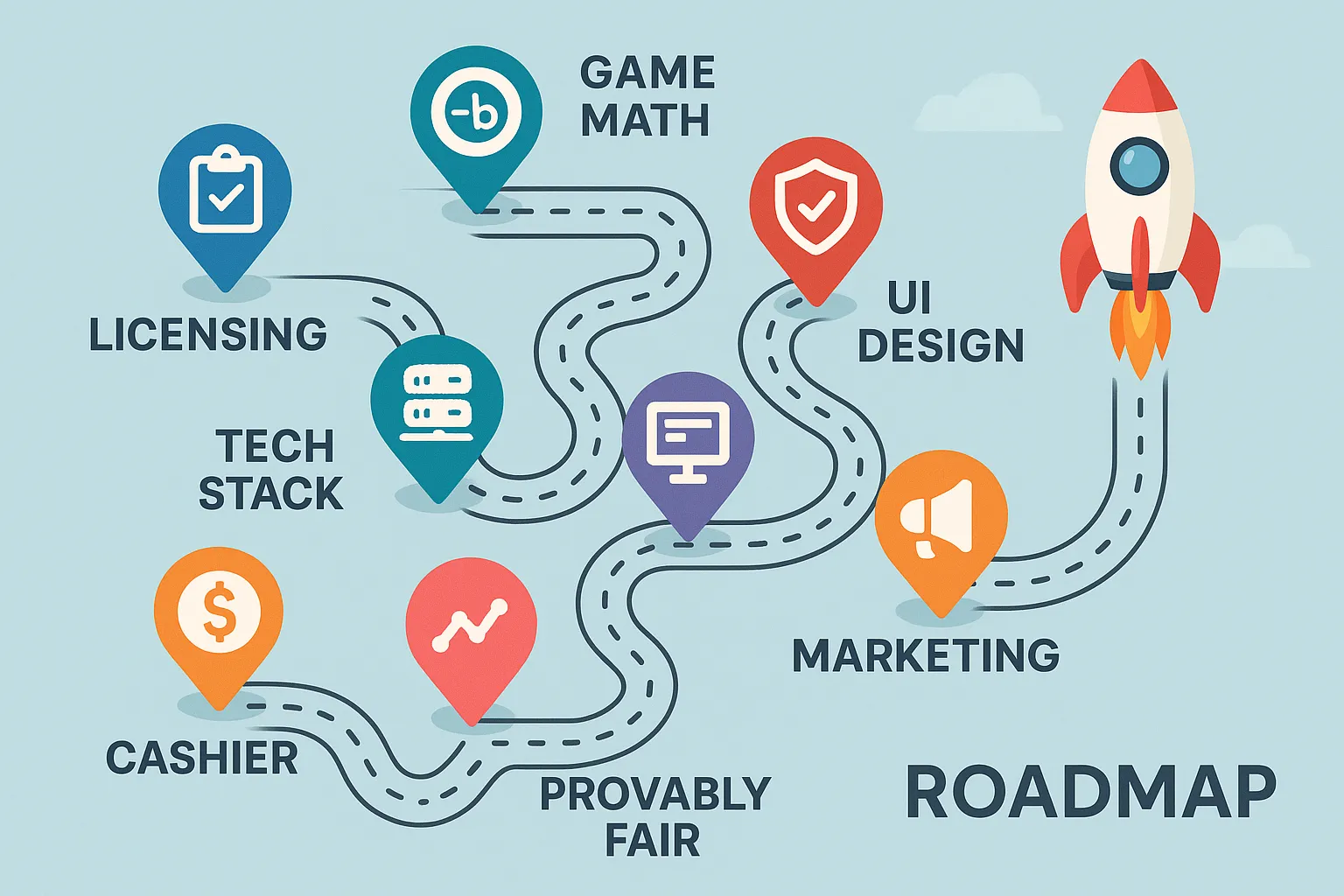
If you run — or plan to run — an online casino, launching your own crash game in 2025 is one of the fastest ways to boost session length and cross-sell to sportsbook or slots traffic. This beginner’s roadmap walks you through every major checkpoint, from math certification to market launch, so you can avoid common pitfalls and hit the runway with confidence.
1. Clarify your business model and jurisdiction
Before you even sketch a multiplier curve, decide where and how you will operate.
-
Licensing
- Curacao’s new 2025 regime (KOA-compliant) still offers the quickest on-ramp but now enforces tighter game testing. Expect a 6- to 8-week approval cycle.
- Malta, Isle of Man and Ontario require separate RNG certifications and responsible-gaming controls but drastically improve payment provider acceptance.
-
Ownership model
- In-house proprietary: You own the code, math, and IP. Higher upfront cost but unique branding and no rev-share.
- White-label or turnkey: A provider like Spinlab bundles game engine, cashier, compliance, and hosting for a monthly platform fee plus GGR percentage. Fastest time to market.
-
Target currencies
- If you plan to serve Latin America or Southeast Asia, multi-currency support (BRL, MXN, IDR) is mandatory.
- Crypto-only operations see 25 % higher average bet size (Spinlab network data, Q2 2025) but require an on-ramp solution for first-time buyers.
Tip: Our guide to Choosing an iGaming Platform for Emerging Markets breaks down the regulatory nuance in high-growth regions.
2. Design the game math: RTP, volatility, and crash curve
Crash looks simple — a line rises until it bursts — yet small math tweaks change monetisation dramatically.
- Return to Player (RTP): Industry norm sits between 96 % and 98 %. Lower RTP accelerates house margin but also shortens player lifetimes.
- Volatility: A flatter curve (frequent small busts) suits casual bettors. A steeper exponential curve excites high-rollers who chase x300 multipliers. Run Monte Carlo simulations to find your sweet spot.
- Max cap: Most regulators now limit the maximum payout to 100,000× stake or €250,000 equivalent.
Spinlab’s crash template ships with an open math model in YAML, so you can A/B test RTP and curve parameters without touching core code.
3. Pick a technology stack built for speed and scale
Latency is the silent killer of crash engagement. A half-second delay in multiplier rendering can tank confidence and retention.
Recommended stack in 2025:
- Frontend: React 18 with WebGL canvas for smooth 60 fps animations.
- Backend: WebSockets over Redis streams for sub-100 ms state pushes.
- RNG: Hardware entropy source (e.g., TrueRNGpro) seeded into a SHA-256 or Keccak hash that is displayed to the player before each round.
- Autoscaling: Kubernetes + KEDA to handle traffic spikes during Twitch streamer promotions.
Spinlab’s platform bundles all of the above, pre-configured on GCP’s global edge network, delivering average round-trip latency below 70 ms for 80 % of players.
4. Integrate a compliant and crypto-ready cashier
Crash players are disproportionately crypto-native. A Spinlab analysis of 22 operators shows 72 % of crash turnover is in BTC, ETH, or USDT. Make deposits effortless or they will churn to an alternative in two clicks.
Essentials:
- Multi-chain support (BTC, ETH, TRON, Solana) with dynamic gas fee logic.
- Instant swaps for major stablecoins.
- Card and e-wallet rails for fiat users who want a hybrid experience.
- Crypto on-ramp API (e.g., MoonPay, Transak) embedded inside KYC flow so first-timers can buy USDT with Apple Pay in under 60 seconds.
For a deep dive, read Crypto vs Fiat: Which Payment Gateway Drives Higher Player Lifetime Value?.
5. Build provably fair transparency and obtain certifications
Provably fair is more than a marketing buzzword; it is a math proof delivered in real time. Implement:
- Seed reveal: Player seed + server seed + nonce displayed pre-round.
- Verification tool: Allow users to paste the hash into an independent checker.
- Third-party audit: GLI-19 or iTech Labs certification remains the gold standard.
Most regulators now require a Certificate of Integrity even for games classified as “skill with chance,” so add 3-4 weeks to your timeline for external testing.
6. Craft a mobile-first UI that drives retention
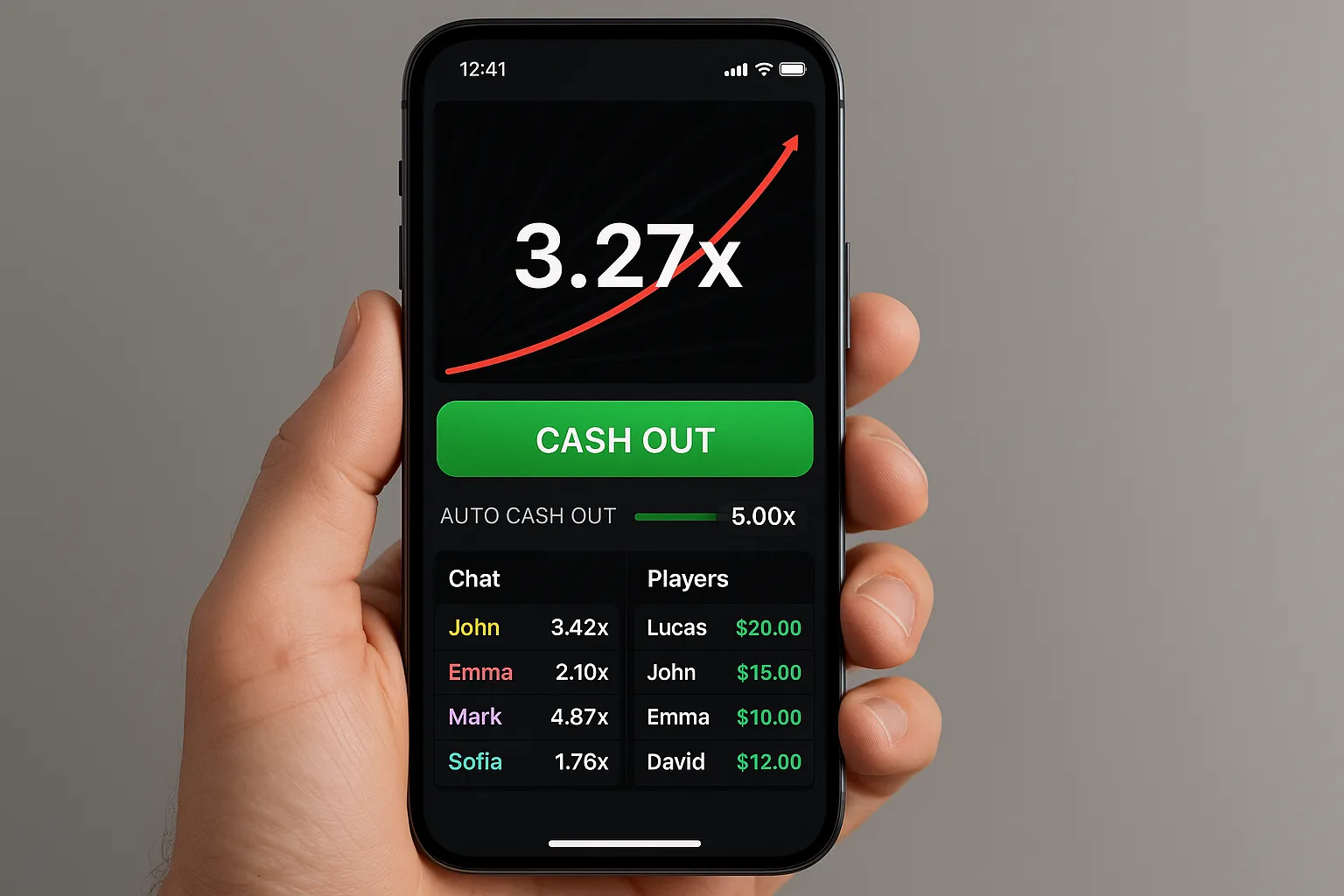
Your average crash round lasts 8 seconds. The interface must let players bet, chat, and cash out within that tiny window.
Checklist:
- One-tap stake presets (1×, 2×, 5×, 10×) plus a numeric keypad.
- Auto cash-out slider with haptic feedback.
- Live chat with emoji reactions (heavily moderates toxicity).
- Leaderboard that resets hourly to stimulate repeat visits.
Spinlab’s white-label skin editor lets you drag-and-drop these widgets, then instantly preview on 20 device viewports.
7. Layer real-time analytics and risk controls
Crash volatility can expose you to sudden six-figure hits. Deploy a live risk dashboard that tracks:
- Cash-flow at risk (CFaR) per round.
- Hit frequency vs theoretical expectation to flag RNG anomalies.
- Top player exposure with auto-hedging triggers (e.g., place mirrored bets on external liquidity pools).
Our earlier article Real-Time Analytics in iGaming: Turning Live Data into Bigger Profits explains how to wire these metrics into Spinlab’s Kafka event stream in less than an hour.
8. Plan your go-to-market: affiliates, streamers, and retention loops
Crash games are community-driven. A single influencer can bring 5,000 concurrent viewers and break your servers if you are not prepared.
Marketing sprint:
- Pre-launch whitelist
- Invite high-value VIPs from your slots database. Offer 0 % rake for the first 48 hours.
- Streamer partnerships
- Sign fixed-fee contracts to avoid revenue cannibalisation. Provide OBS overlays that display live multiplier data.
- Affiliate network
- Add crash-specific landing pages with embedded demo play. Use CPA + rev-share hybrid deals to balance upfront cost and long-term LTV.
- Retention automation
- Deploy a “near-miss bounce back” bonus: if a player cashes out below x2 five times in a row, push a free bet before session end. Our bonus engine template covers this out of the box.
According to Spinlab telemetry, casinos running crash-tailored retention scripts see 31 % higher seven-day stickiness compared with static reload bonuses.
Timeline and budget snapshot (white-label scenario)
| Phase | Duration | Typical Cost (USD) |
|---|---|---|
| Game math & skin design | 2 weeks | 5,000 – 8,000 |
| Licensing & RNG certification | 4 weeks | 12,000 – 20,000 |
| Platform & cashier integration | 3 weeks | 7,000 setup + 5 % GGR |
| Soft launch & QA | 1 week | 3,000 |
| Marketing launch (influencers + affiliates) | Ongoing | 15,000 initial budget |
| Total to go live | 10 weeks | ≈ 42,000 |
A proprietary build can exceed $200k when you factor development manpower and backend infrastructure, which is why most first-time operators start with a white-label.
Common pitfalls to avoid
- Ignoring AML screening on crypto deposits. Regulators now fine operators for accepting funds from sanctioned wallets.
- Overlooking localisation. A multiplier shouting “Bust!” in English means nothing to a Thai player. String tables are your friend.
- Copy-pasting competitor math. You risk patent infringement and a bland player experience.
- Underestimating customer support. Crash attracts “all-in” behaviour; disputes escalate fast when a cash-out click misses by 0.1 seconds.
Frequently Asked Questions (FAQ)
What is the minimum RTP regulators will accept for crash games? Most reputable jurisdictions require at least 92 %. The sweet spot for player retention is 96 %–97 %.
Can I re-skin a third-party crash title instead of building my own? Yes, but you lose the ability to tweak math and branding. A unique in-house or white-label build typically yields a 15 % higher margin, according to Spinlab client data.
How do I prove fairness to players who do not understand cryptography? Provide a one-click “Verify Round” button that opens a modal explaining the hash in plain language and links to an external verifier.
Is server-seed rotation necessary? Best practice is to rotate every 10,000 rounds or daily, whichever comes first, and publish the old seed for auditability.
What happens if the multiplier keeps rising beyond the UI cap? Configure a hard stop at your max liability threshold (e.g., x100,000) and disclose it in the game rules.
Ready to build your crash hit?
Spinlab’s Shopify-style backoffice lets you configure game math, upload custom skins, and deploy to production in a single click — all for the lowest white-label pricing on the market. Book a 15-minute demo and see how fast you can go from idea to live crash game.