

Why PCI DSS Still Matters in the Age of Crypto Casinos
If you run an online casino in 2025, chances are more than half of your deposits already come through crypto. So why should you still worry about PCI DSS, a standard that was created for card payments? Because:
- Even crypto-first brands offer Visa, Mastercard, or local card rails to reach casual players.
- Card processors and banks require proof of compliance before they will even underwrite your merchant account.
- Breaches hurt trust. A 2024 study by Verizon found that 51% of users who learn about a payment data breach stop depositing for at least six months.
In short: if you touch cardholder data anywhere in your cashier flow, PCI DSS applies. This guide translates the 400-page standard into plain English, shows what changed in version 4.0, and explains how iGaming operators can reach (and maintain) compliance without drowning in paperwork.
PCI DSS 4.0 in a Nutshell
| Requirement | What it means for online casinos |
|---|---|
| 1. Install and maintain firewalls | Segregate your production VPC, game servers, and payment APIs. |
| 2. Do not use vendor defaults | Change default passwords on routers, game aggregation servers, and CMS backoffice. |
| 3. Protect stored card data | Use format-preserving encryption (FPE) or vault tokens; never store CVV. |
| 4. Encrypt transmission | TLS 1.2+ for all card data in motion, including traffic between microservices. |
| 5. Protect against malware | Endpoint detection (EDR) on employee laptops and RDP jump servers. |
| 6. Develop & maintain secure systems | Quarterly code scans, OWASP testing for player portals, documented SDLC. |
| 7. Restrict access by business need | Role-based access to the backoffice; MFA for admins and VIP managers. |
| 8. Identify & authenticate users | Unique IDs, password rotation, MFA. |
| 9. Physically secure systems | Applies to your colocation racks or cloud root-account hardware keys. |
| 10. Track & monitor all access | Centralized logging (e.g., ELK, Datadog) with 365-day retention. |
| 11. Regularly test security | Quarterly ASV scans, annual penetration tests, segmentation checks. |
| 12. Maintain an InfoSec policy | Updated yearly, signed by executive leadership. |
New in v4.0 (effective Q1 2025):
- Customized Approach – Allows risk-based controls, but you must document equivalence.
- TLS 1.3 preferred – 1.2 is still allowed until March 2026.
- Targeted risk analyses – Each control now needs a documented risk review.
Full details: PCI Security Standards Council, “PCI DSS v4.0 Summary of Changes,” 2024.
Mapping PCI DSS to the iGaming Tech Stack
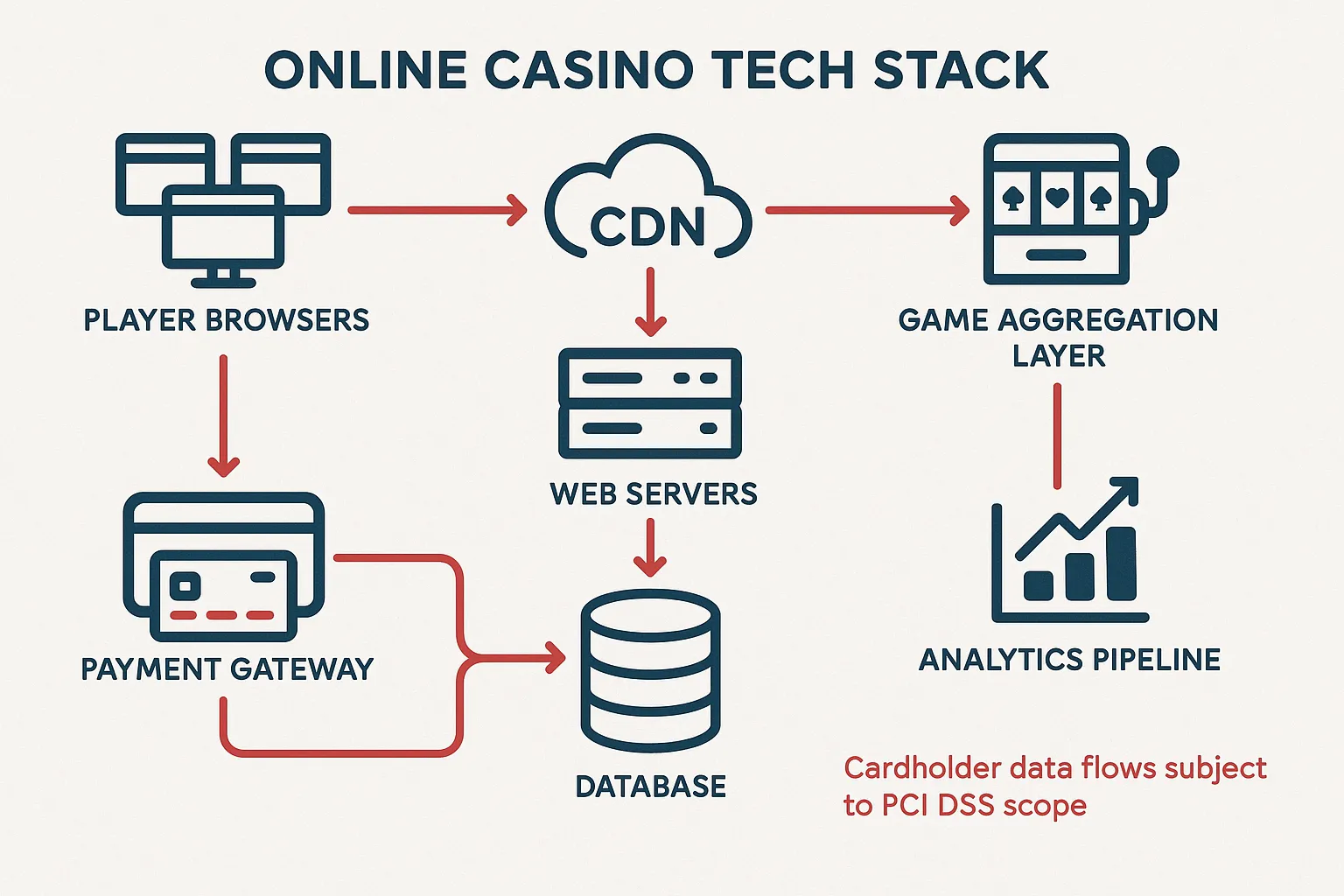
The easiest way to cut costs is to minimize your compliance scope. Here’s how each layer of a typical iGaming platform is affected:
-
Frontend (React/Next.js site or native mobile app)
- Scope: Only if you collect card details directly. Use hosted payment fields or iFrames to push the browser out of scope.
-
Payment gateway / cashier microservice
- Heavy scope. Must encrypt all traffic, store nothing but tokens, and pass quarterly ASV scans. If you process both crypto and cards, the crypto nodes can be logically segmented to stay out of PCI.
-
Game aggregation layer
- Usually out of scope if it never sees card data. Verify via network segmentation checks.
-
Player database & CRM
- Card tokens may be stored here for quick re-deposits. They are not cardholder data, but make sure logs don’t include PANs.
-
Analytics & BI pipeline
- If you export transaction logs, mask PAN and truncate BIN ranges before feeding dashboards. For inspiration, read our earlier article on real-time analytics in iGaming. [source]
-
Backoffice admin panel
- Needs MFA and strict role permissions (Reqs 7 & 8). Limit “view PAN” rights to fewer than six employees.
Five Compliance Pitfalls Specific to Online Casinos
-
Bonus abuse tools that read deposit metadata
- Some legacy scripts log full PAN to flag duplicate cards. That is a direct violation of Req 3. Store only BIN-range and last 4 digits.
-
Affiliate tracking pixels on the cashier page
- Injecting third-party JavaScript where card forms live can break PCI DSS 6.4.3. Use a post-back server-side call instead.
-
Live-chat widgets retrieving ticket history
- If agents paste masked PAN in chat, transcripts must be purged within 24 hours or encrypted at rest.
-
Multi-currency support via middleware
- Any service that reads the original authorization response is in scope. Forgetting to patch it can void your annual Report on Compliance (ROC).
-
Hybrid custody of crypto and fiat
- Converged wallets are great for UX, but if the same Redis cache stores USD authorization IDs and BTC tx hashes, your crypto subsystem inherits PCI duties.
A 90-Day Roadmap to Passing Your Next Audit
-
Day 1–7: Scope & Gap Analysis
Map every data flow, mark network segments, interview devs. Use the PCI DSS Prioritized Approach spreadsheet for quick wins. -
Day 8–21: Remediate Critical Gaps
- Turn on MFA for all privileged accounts.
- Remove any PAN logging in staging/QA.
- Deploy a web application firewall (WAF) in front of cashier endpoints.
-
Day 22–45: Implement Continuous Controls
- Centralize logs into SIEM.
- Automate quarterly internal scans with tools like Tenable or Qualys.
- Document SDLC that references OWASP Top 10.
-
Day 46–60: Internal Audit & Pen Test
Hire a CREST-certified firm that understands gambling platforms. Address findings fast. -
Day 61–75: Prepare Evidence Package
Collect policies, diagrams, change-management tickets, and penetration test results. -
Day 76–90: QSA On-Site & ROC Submission
Your Qualified Security Assessor validates controls, issues Attestation of Compliance (AOC). Submit AOC to acquiring bank or payment processor.
Spinlab customers can shorten this cycle because our Payment Hub is already PCI Level 1 certified and decouples card flows from your main infrastructure. [related]
Build vs. Buy: How Much Does PCI Compliance Cost in 2025?
| Approach | Year 1 Cost | Annual Renewal | Time to Certify |
|---|---|---|---|
| DIY – host cashier, vault cards | $150k–$300k | $80k | 6–9 months |
| Managed tokenization service | $50k–$120k | $40k | 3–4 months |
| Spinlab Payment Hub (included) | Included in platform fee | $0 (bundled) | <30 days (inherit certification) |
Numbers based on interviews with three leading QSAs and publicly available pricing from major tokenization vendors.
Seven Quick Wins You Can Implement This Week
- Turn on TLS 1.3 everywhere – Many cloud load balancers make this a checkbox.
- Expire inactive admin sessions after 15 minutes – Satisfies Req 8.2.8.
- Adopt passkeys – Meets MFA requirement without SMS costs.
- Mask PAN in log aggregators – Use regex filters before logs leave the container.
- Run a free ASV scan – Companies like SecurityMetrics offer one trial scan per year.
- Create an incident-response Slack channel – Map to Req 12.10.
- Add a compliance banner in Jira – Engineers can tag tickets that touch card data; helps evidence gathering.
Frequently Asked Questions (FAQ)
Does PCI DSS apply if we only store card tokens? Yes. Even if you never see raw PAN, the systems handling token creation and authorization responses are in scope.
Is PCI DSS 3.2.1 still valid in 2025? No. Version 4.0 fully replaced 3.2.1 in March 2025.
Can we self-assess instead of hiring a QSA? Only if your annual transaction volume stays below 6 million. Most iGaming operators exceed that threshold and need a Level 1 ROC.
How often do we need penetration tests? At least annually, and after any significant change to the cashier or network segmentation.
Does using crypto remove the need for PCI? Not if cards are still an option. To exit PCI scope entirely, you must eliminate every card payment method and ensure no residual card data passes through logs or backups.
Ready to simplify PCI compliance and launch faster? Book a demo to see how Spinlab’s crypto-ready, PCI-certified Payment Hub can get your casino live in weeks, not months.