

Online casino operators walk a tightrope: set deposit limits too high and you invite regulatory headaches; set them too low and high-value players quietly drift to the competition. Smart A/B testing is the only data-driven way to locate the narrow band where player lifetime value (LTV), compliance, and social responsibility align.
Why Deposit Limits Deserve Their Own Experiment Plan
Regulators from the UK Gambling Commission to Ontario iGaming now treat effective spending caps as a licence condition, not a nice-to-have. A GambleAware study (April 2025) found that players who opt into deposit limits show a 36 percent reduction in markers of harm within 90 days, yet a blunt blanket limit can slash operator gross gaming revenue (GGR) by double-digit percentages. That spread makes deposit limits one of the highest-leverage optimisation levers in iGaming—on par with cashier UX or bonus conversion.
The good news: most operators already gate deposits through a common cashier, so injecting controlled limit variants is technically straightforward. The challenge is designing tests that surface the behavioural inflection point without breaching duty-of-care obligations.
Experiment Objectives and Hypotheses
Before switching on feature flags, get crystal-clear on why you are testing. Common hypotheses include:
- Raising the default weekly cap from €1 000 to €1 500 increases day-30 retention (R30) without elevating RG flags or chargebacks.
- Moving the limit prompt earlier in the funnel (registration instead of first deposit) reduces manual CS interventions by at least 15 percent.
- Introducing an adaptive limit (dynamic multiple of historical net deposits) lifts VIP share of GGR while keeping self-exclusions flat.
Tie each hypothesis to one primary metric and up to three guardrail metrics to avoid p-hacking.
| Hypothesis | Primary metric | Guardrails |
|---|---|---|
| Raise default cap to €1 500 | Day-30 retention | RG flag rate, chargebacks, average withdrawal time |
| Early limit prompt | CS tickets per 1 000 players | Conversion to first deposit, self-exclusion rate |
| Adaptive limit | VIP GGR share | RG interventions, complaint rate, churn |
Segmenting Test Populations
Not every cohort responds the same. Recommended splits:
- Lifecycle stage (new registrants, first-time depositors, VIPs).
- Jurisdiction (EU, LATAM, gray-market) because local laws differ.
- Funding rail (crypto vs fiat). Crypto players often show higher average deposits; mixing them can mask insights. See our crypto vs fiat LTV analysis.
Run parallel experiments only where legally permissible. UKGC, for example, forbids offering weaker protections to any subset of UK players; therefore variant B can tighten a cap but cannot loosen it for UK traffic.
Test Design Blueprint
- Randomisation method – Assign users at account creation using a deterministic hash of user ID to avoid cross-contamination.
- Sample-size calculator – Start with at least 10 000 players per arm for medium-effect detection (α = 0.05, power = 0.8) on R30.
- Sequential vs fixed horizon – Sequential testing with a 2-percent alpha spend per look provides early-stop flexibility, reducing exposure if a variant spikes RG incidents.
- Duration – Minimum 30 days to capture weekend cycles and payday effects.
- Data capture – Log every limit-related event (prompt display, limit set, limit change, limit hit) to your analytics stream. Operators using Spinlab’s Real-Time Analytics can pipe these events into the existing
player_eventKafka topic with a single JSON extension.
Choosing Metrics That Balance Revenue and Responsibility
Revenue metrics alone will push you toward ever-higher caps. Layer in at least three responsibility indicators to keep the test honest.
| Metric type | Specific KPI | Recommended source |
|---|---|---|
| Retention & value | R7, R30, LTV, ARPDAU | Core data warehouse |
| Risk & compliance | Self-exclusion rate, time-out requests, SAR filings | RG module / compliance DB |
| Payment health | Chargeback rate, failed deposit ratio | Payment processor logs |
| Operational cost | CS tickets relating to limits, manual review hours | Zendesk/Jira export |
Interpreting Results: Statistical vs Practical Significance
Imagine Variant B (higher cap) boosts R30 by 4.2 percent with p < 0.05 but doubles the share of players triggering RG review. Even if extra reviews consume only €0.12 per active user in staff time, the reputational and regulatory downside can outweigh revenue. Adopt a weighted decision framework that scores both upside and downside:
- +1 point per 1 percent R30 uplift
- –3 points per 1 percent increase in RG flags
- –2 points per basis-point increase in chargebacks
Total score ≤ 0? Kill the variant.
Implementation on Spinlab’s Fullhouse Platform
Fullhouse ships a declarative Deposit-Limit Rule Engine accessible via Backoffice or API. Key steps:
- Create rule templates – Define daily, weekly, and monthly caps as parameterised rules.
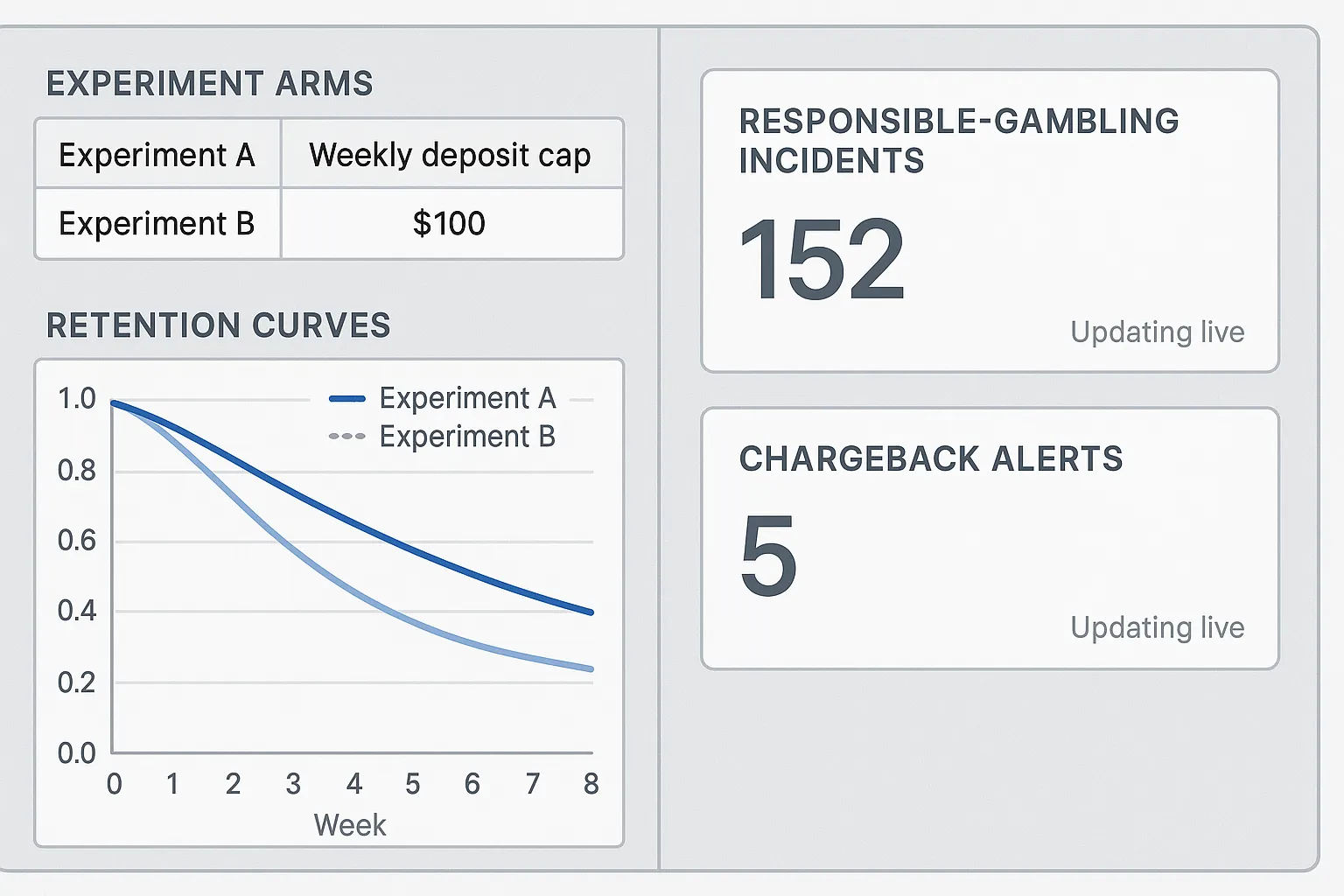
- Set experiment arms – Use the Experiments tab to allocate traffic share per variant. The assignment SDK (JavaScript, Go, PHP) auto-assigns new accounts.
- Stream events – Enable the
limit_eventsstream to push real-time hits into Redpanda/Kafka where your analytics or third-party ESP listens. - Dashboard monitoring – Pull the Deposit Limit Experiment widget into your RG Operations dashboard. It ships with built-in guardrail alerts (e.g., RG flags > x per 1 000 players in any arm).
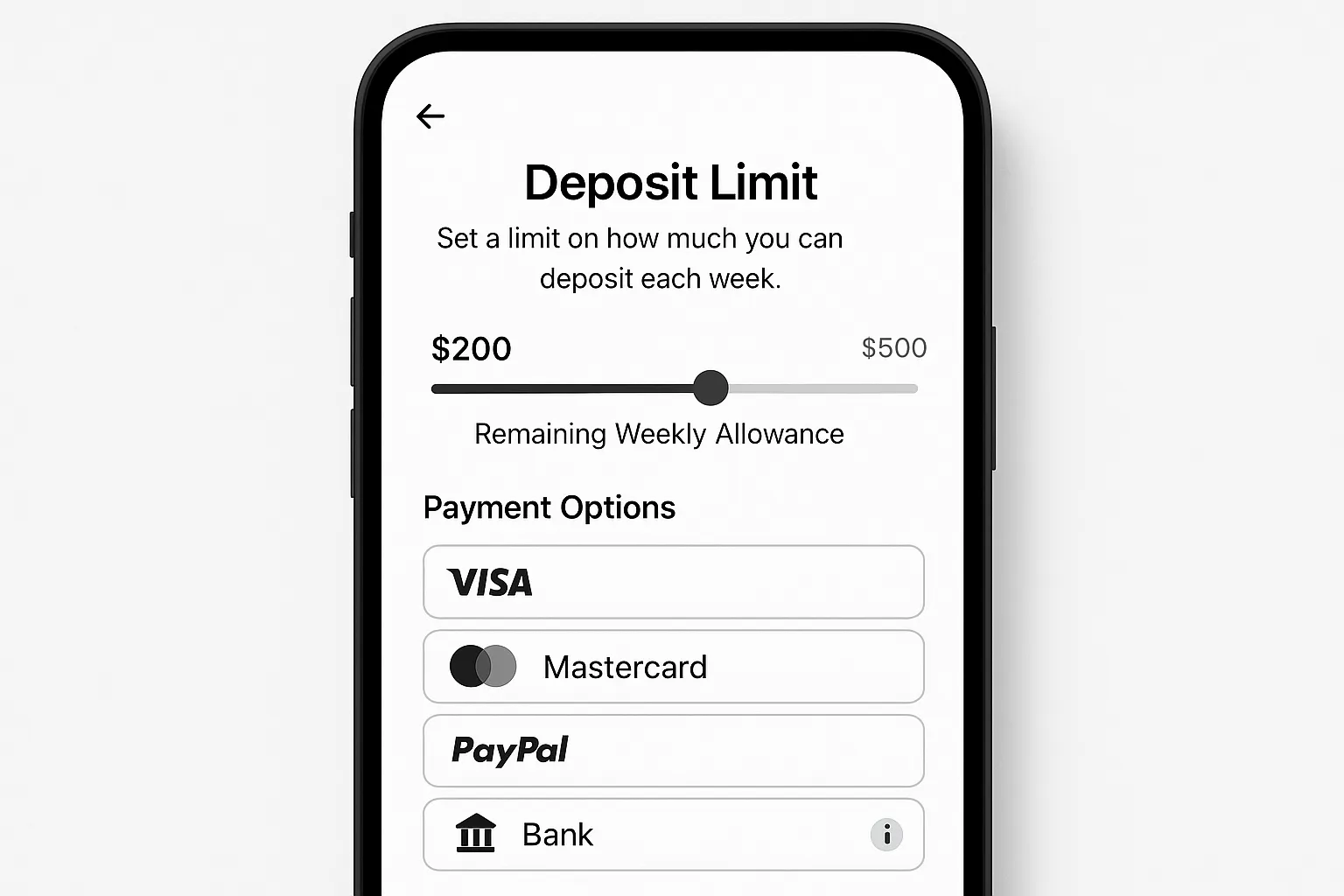
Operators already running 3-second checkout flows can inject limit prompts without adding fields by leveraging Spinlab’s progressive field loading: only players exceeding preset caps see the slider.
Mini Case Study: BetWave LATAM
- Setup – BetWave, a mid-tier LATAM sportsbook running on Fullhouse, tested raising its default weekly cap from BRL 3 000 to BRL 4 000 for 50 percent of new sign-ups.
- Result – Variant B posted a 6.8 percent R30 uplift (CI 95 percent: 4.5–9.1) and a 0.3 percent uptick in self-exclusions. The weighted score model returned +23.
- Action – BetWave rolled out the higher cap to all verified players above 25 years old and retained the lower cap for younger cohorts. Projected annual GGR boost: USD 1.4 million.
Best-Practice Checklist for Your First Limit Test
- Map local regulations first—some markets allow only tighter or self-selected limits.
- Anchor hypotheses in both revenue and RG metrics.
- Randomise at account creation, not session, to preserve statistical purity.
- Monitor in real time; pause automatically if RG incidents spike.
- Run post-test audits with compliance and CS to catch qualitative feedback.
- Iterate: deposit-limit optimisation is not a one-off but a quarterly cycle.
Ready to Build Data-Driven Limits?
Spinlab’s modular platform lets you deploy, monitor, and iterate deposit-limit experiments without engineering heavy lifting—while keeping regulators and players on your side. If you want to discover how Fullhouse can surface your own sweet spot between retention and responsibility, schedule a 30-minute strategy call with our team today.
Been spinning on the slot games here and the variety is seriously impressive. Every new release seems to have great sound effects and the hit frequency feels completely balanced. Deposits go through instantly and I never wait long when cashing out. A solid choice for anyone who loves classic and modern slot thrills mme92slot
Just wanted to share how impressed I am with how streamlined everything feels here. Logging in is hassle free and the game loading times are consistently fast. The promotional calendar makes every month feel like a new adventure and cashouts never get stuck in unnecessary reviews jt777login
Signing in is quick and I love how the dashboard organizes my bets so I can track my progress easily. The promo codes they send via email actually work on the first try. A solid choice for daily players in Lagos who want a dependable app. secretbetlogin