

The best casino software for crypto and fiat payments is not just the platform with the longest list of payment logos. For operators, the real question is whether the software can move money safely, credit balances instantly, reconcile transactions cleanly, and adapt to different markets without creating compliance or fraud gaps.
That matters more in 2026 because players expect choice. Some prefer cards, bank transfers, wallets, and local payment methods. Others want USDT, BTC, ETH, stablecoin withdrawals, or a fiat-to-crypto onramp inside the cashier. If your casino software treats those rails as separate add-ons, your operations team will eventually feel the pain in support tickets, manual reconciliation, blocked withdrawals, and unclear player risk.
A strong payment-ready iGaming platform should unify crypto and fiat under one operational layer: cashier, ledger, risk, KYC, AML, fraud prevention, analytics, and backoffice. That is the difference between adding payment methods and building a casino that can scale.
What “best” really means for casino payment software
For online casino founders, “best” often starts as a cost question. Which white label casino platform is affordable? Which provider can launch quickly? Which payment gateway is easiest to integrate?
Those questions are valid, but they are incomplete. The best casino software for payments should be judged by business outcomes, not feature labels. It should help you increase approved deposits, reduce payment failures, automate compliance evidence, support withdrawals without chaos, and protect margin across currencies.
In practical terms, best-in-class casino software should deliver four outcomes:
- Higher conversion by offering the right payment rails for each market, device, currency, and player segment.
- Lower operational risk through KYC, AML, fraud rules, chargeback controls, wallet policies, and audit logs.
- Cleaner financial operations with a reliable ledger, PSP reports, bank settlement matching, and crypto wallet reconciliation.
- Faster market expansion by letting operators add rails, currencies, and game content without rebuilding the platform.
This is why a payment-first casino platform should be evaluated as a full operating system, not just a gateway integration.
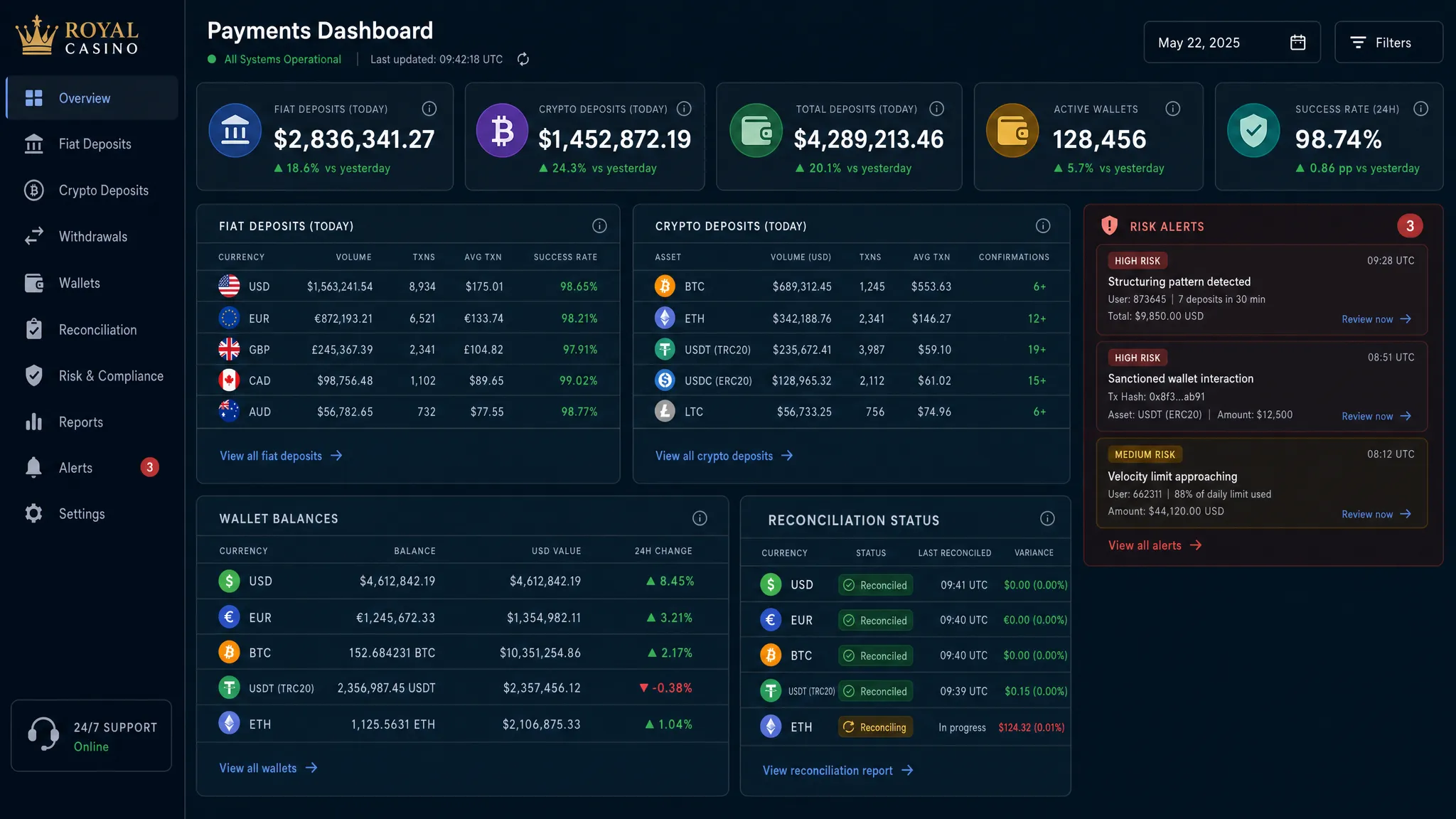
Why crypto and fiat payments need one operating layer
Fiat and crypto rails behave very differently. Fiat payments often involve issuer approval, 3DS, chargebacks, settlement delays, PSP routing, and local regulatory obligations. Crypto payments are usually irreversible, depend on blockchain confirmations, require wallet security, and introduce AML/KYT considerations.
If those rails are handled by separate tools, operators lose visibility. A player can deposit in fiat, play games, claim bonuses, withdraw in crypto, trigger a KYC review, and contact support, all within the same lifecycle. Your platform must understand that lifecycle as one connected journey.
| Payment area | Fiat rail challenge | Crypto rail challenge | What the software should do |
|---|---|---|---|
| Deposits | Issuer declines, SCA, PSP routing | Address errors, confirmation delays, wrong network | Track payment state, credit balances safely, and show clear player status |
| Withdrawals | Bank validation, payout limits, chargeback exposure | Wallet screening, custody policy, irreversible sends | Apply risk-based review, limits, and auditable approval flows |
| Compliance | KYC, AML, sanctions, affordability checks where required | KYT, Travel Rule readiness, source-of-funds risk | Use one risk profile across all rails |
| Reconciliation | PSP report vs ledger vs bank mismatch | On-chain transaction vs ledger vs treasury mismatch | Provide daily matching, exception queues, and exportable evidence |
| Fraud | Card testing, friendly fraud, bonus abuse | Wallet hopping, mixer exposure, multi-accounting | Combine device, payment, identity, and gameplay signals |
This is also where casino software differs from a generic payment gateway. A gateway may process a transaction. Casino software must decide when to accept, credit, hold, reverse, investigate, report, or block that transaction in the context of gameplay and regulation.
Core features the best casino software should include
Unified cashier for fiat, crypto, and onramps
The cashier is one of the highest-impact screens in an online casino. A weak cashier creates deposit abandonment, failed payments, and support tickets. A strong cashier adapts to the player’s context.
For fiat, this means supporting the right mix of cards, bank transfers, e-wallets, open banking, and local alternative payment methods. For crypto, it means supporting direct wallet deposits, clear network selection, stablecoin options, and fiat-to-crypto onramps for players who do not already hold crypto.
The important point is not simply “more methods.” The software should route users to the most relevant rail based on geography, currency, risk, device, and prior success. If a player in one market is more likely to complete a bank-based payment than a card transaction, the cashier should make that path obvious.
For a deeper comparison of when each rail works best, Spinlab’s guide to fiat vs crypto casino payments expands on the strategic trade-offs.
A ledger that treats money movement as the source of truth
The ledger is the backbone of payment-ready casino software. It should not be an afterthought bolted onto the cashier. Every deposit, withdrawal, bonus credit, wager, win, reversal, fee, FX conversion, and settlement adjustment should be recorded in a way that finance, support, compliance, and auditors can trust.
A good casino ledger should support append-only records, idempotent transaction handling, clear posting types, and traceable links between player activity and payment events. This matters when a PSP webhook arrives late, a crypto transaction confirms after a timeout, or a withdrawal is approved and then flagged for review.
Without a strong ledger, even simple questions become difficult: Was the player credited? Did the PSP settle the funds? Was the withdrawal sent to the correct wallet? Did the bonus balance convert into cashable funds correctly?
Crypto wallet and custody controls
Crypto-ready casino software needs more than address generation. It needs a wallet architecture that supports deposits, withdrawals, treasury movement, reconciliation, and security policies.
Operators should look for support for merchant custodial wallets, hot and warm wallet policies, multi-currency balances, asset-specific limits, and clear operational approval flows. Custody should be connected to the casino ledger and backoffice so that finance teams are not switching between wallet tools, spreadsheets, and admin panels.
The platform should also help operators avoid common crypto cashier mistakes. These include unclear network instructions, missing memo or tag warnings, no confirmation tracker, weak withdrawal limits, and no clear policy for volatile assets versus stablecoins.
Crypto compliance should also be considered early. The FATF virtual assets guidance is a useful reference point for understanding why crypto payments require risk-based controls, not just wallet connectivity.
KYC, AML, and fraud prevention built into payment flows
Payments, KYC, AML, and fraud prevention should not be separate departments inside your software. They should work together.
For example, a low-risk returning player making a small deposit may be allowed through with minimal friction. A new account using a high-risk device, unusual IP pattern, mismatched identity data, and a rapid withdrawal request should trigger a step-up review. A crypto withdrawal to a risky wallet cluster may need a different workflow from a card deposit decline.
The best casino software supports this risk-based approach. It should connect player identity, device intelligence, payment behavior, bonus activity, gameplay history, and withdrawal patterns. This creates a more accurate view than blanket rules that either block too many good players or miss coordinated abuse.
For card payments, operators also need to consider payment security standards. The PCI Security Standards Council maintains PCI DSS, which applies to environments handling cardholder data. Even when tokenization and PSP-hosted fields reduce scope, your platform should be designed with payment data security in mind.
Real-time analytics for payment performance
A payment stack cannot improve what it cannot measure. Casino operators need analytics that connect payment events to revenue outcomes.
At minimum, the platform should track deposit initiation rate, completion rate, approval rate, time to credit, withdrawal time to paid, failed payment reasons, PSP performance, crypto confirmation times, chargeback rate, fraud losses, and reconciliation exceptions.
The more advanced view is fraud-adjusted payment performance. A PSP with a high approval rate is not necessarily better if it also generates higher chargebacks or risk reviews. A crypto rail with low fees may not be profitable if it creates manual operational overhead. A local APM may be valuable in one market and irrelevant in another.
The software should make these trade-offs visible in the backoffice, ideally in real time.
Game aggregation connected to wallet and payments
Payment software cannot be evaluated in isolation from game aggregation. In a live online casino, every bet and win depends on wallet callbacks, session state, bonus rules, and game provider reporting.
A seamless game aggregator should support fast game launches, normalized metadata, jurisdictional controls, wallet integration, and clear reporting. If a player deposits via crypto, claims a bonus, opens a slot, and triggers a win, the platform needs to handle that entire journey without mismatched balances or provider disputes.
This is especially important when operators combine slot games, live casino games, original games, and promotional mechanics. A strong platform ties payment state, bonus state, and gameplay state together.
Software models compared: which is best for your payment strategy?
There is no single best casino software model for every operator. The right choice depends on budget, timeline, team size, target markets, and regulatory complexity.
| Software model | Best fit | Payment strengths | Main risk |
|---|---|---|---|
| Gateway-only integration | Existing operators adding one rail | Fast to add a specific PSP or crypto provider | Fragmented ledger, risk, and reconciliation |
| Traditional white label casino | Startups needing fast launch | Bundled cashier and basic payment methods | Limited flexibility or hidden payment costs |
| Custom-built casino platform | Large operators with engineering teams | Maximum control over rails and treasury | High cost, long timeline, more compliance burden |
| Modular all-in-one iGaming platform | Growth-focused operators wanting speed and flexibility | Unified fiat, crypto, compliance, analytics, and games | Vendor selection must be evidence-based |
For many founders and lean operators, the modular all-in-one model is the practical middle ground. It gives you the operational speed of a white label casino platform while preserving room to customize payments, games, backoffice workflows, and integrations.
That is the category Spinlab is built for: an all-in-one, modular iGaming platform with crypto and fiat payment support, game aggregation, KYC and AML workflows, fraud prevention, real-time analytics, a customizable backoffice, open API integration, multi-currency support, crypto onramp options, merchant custodial wallets, and the ability to support custom-designed original games.
How to evaluate casino software vendors in a demo
The mistake many buyers make is evaluating payment software from screenshots. A polished cashier UI is not enough. You need to see how the system behaves when payments fail, risk changes, withdrawals are held, or reconciliation breaks.
Ask vendors to demonstrate real workflows, not just modules. The best providers should be comfortable showing operational proof.
| Demo scenario | What to ask the vendor to show | Why it matters |
|---|---|---|
| Failed card deposit | Decline reason, player message, retry path, analytics event | Prevents silent abandonment and support tickets |
| Successful crypto deposit | Address creation, confirmation tracker, ledger credit, backoffice record | Proves crypto is integrated, not just displayed |
| Fiat-to-crypto onramp | Player journey, fees, KYC trigger, deposit crediting | Reduces friction for non-crypto-native users |
| Withdrawal review | Risk score, reason codes, approval workflow, player status updates | Balances speed with fraud and AML control |
| Reconciliation exception | Ledger vs PSP or on-chain mismatch, queue, resolution workflow | Shows finance readiness |
| Multi-currency deposit | FX policy, wallet balance, reporting, settlement view | Protects margins during global expansion |
| Bonus-funded play | Bonus wallet, wagering rules, game contribution, cashout logic | Prevents abuse and disputes |
A vendor that cannot show these workflows may still be able to process payments, but it may not be ready to operate a real-money casino at scale.
The payment architecture checklist
Before choosing casino software, product and operations teams should align on the architecture they actually need. This helps avoid buying a cheap platform that becomes expensive once real players arrive.
Your shortlist should cover:
- Cashier flexibility with fiat rails, crypto deposits, stablecoins, onramps, local APMs, and mobile-optimized flows.
- Ledger reliability with idempotency, audit trails, reversals, settlement states, and clear balance views.
- Compliance workflows for KYC, AML, sanctions screening, risk scoring, responsible gambling controls, and audit evidence.
- Fraud prevention across card testing, bonus abuse, multi-accounting, account takeover, suspicious withdrawals, and affiliate fraud.
- Operational visibility through real-time dashboards, reason codes, exception queues, and role-based backoffice permissions.
- Extensibility via open APIs, webhooks, provider integrations, and modular configuration.
This checklist is intentionally operational. The point is to select software that your finance, risk, support, compliance, marketing, and product teams can actually run.
Why regional payment fit matters
Crypto and fiat payment strategy is also a localization strategy. Players in different markets trust different rails. A cashier that works well in one country can underperform badly in another if it lacks familiar payment options, local currency display, or clear withdrawal expectations.
This is especially true in emerging and high-growth markets where user behavior may be shaped by local gaming habits, fast-result formats, and mobile-first payment expectations. For example, operators researching South Asian demand may observe audiences that follow quick-update gaming information such as DPBoss satta matka results, but any real-money operator targeting similar user segments still needs jurisdiction-specific legal review, compliant age gating, and payment methods that are permitted locally.
The takeaway is simple: do not choose casino software only by global feature claims. Choose software that can adapt cashier UX, currency support, risk rules, game availability, and compliance workflows market by market.
Red flags when choosing casino software for payments
Some payment issues only appear after launch. By then, switching platforms is painful. Watch for these red flags during procurement.
A platform is risky if fiat and crypto balances are handled in separate systems with no unified ledger. It is also risky if reconciliation depends on manual spreadsheet exports, if crypto withdrawals require logging into a separate wallet tool, or if support teams cannot see the payment status that players are asking about.
Be careful with vendors that advertise “instant crypto payments” but cannot explain confirmation rules, wallet screening, custody controls, Travel Rule readiness, or treasury reconciliation. Similarly, be cautious with platforms that list card payments but cannot show 3DS behavior, chargeback evidence, PSP routing, or PCI-aware data handling.
Another common red flag is a beautiful player frontend paired with a weak backoffice. Payments are operationally complex. Your team needs reason codes, filters, audit trails, permissions, notes, exports, and dashboards. A Shopify-like admin experience can be valuable, but only if it still handles the complexity of regulated money movement.
Where Spinlab fits
Spinlab is designed for operators who want the speed of a white label casino platform without giving up the payment, compliance, and operational controls needed to scale. The platform combines crypto and fiat payment support, game aggregation, real-time analytics, advanced fraud prevention, KYC and AML workflows, multi-currency support, crypto onramp solutions, merchant custodial wallets, an affiliate and bonus engine, open APIs, and a customizable backoffice.
For startups, the advantage is speed and simplicity. Instead of stitching together a casino frontend, payment gateway, wallet provider, game aggregator, KYC vendor, bonus tool, fraud stack, and analytics layer, operators can start from a modular platform that already connects the core operating pieces.
For growing brands, the advantage is flexibility. Payment strategies change as markets, regulations, and player segments change. A modular platform makes it easier to add rails, adjust risk rules, localize the cashier, test crypto onramps, and expand content without a full rebuild.
Spinlab also aims to deliver a Shopify-like experience for casino operators, giving non-technical teams a cleaner way to manage core operations while still supporting API-based extensibility where developers are needed.
If you are comparing platform economics, pair your vendor review with a full 24-month cost view. The cheapest casino software is not the one with the lowest setup fee. It is the one that reduces hidden costs across integrations, failed payments, manual reviews, reconciliation work, compliance gaps, and slow launches.
For more on the finance side of payment operations, read Spinlab’s guide to casino payments reconciliation.
A practical rollout plan for crypto and fiat payments
Once you choose casino software, avoid launching every payment feature at once. A phased rollout is safer and easier to measure.
Start with the core fiat rails required for your launch market, plus the crypto assets you can operationally support. Stablecoins are often easier to manage than highly volatile assets, but the right mix depends on your audience and treasury policy. Make sure the platform can show deposit status clearly, handle failed payments, and generate backoffice records for every money movement.
Next, connect KYC, AML, fraud rules, and withdrawal policies to payment behavior. Do not wait until after fraud appears. Decide which players can withdraw automatically, which need step-up checks, and which require manual review. Configure these workflows before marketing spend scales.
Then add optimization. Use analytics to compare deposit completion, approval rates, time to credit, withdrawal speed, fraud losses, chargebacks, and support volume by rail. Improve the cashier based on evidence, not assumptions.
Finally, expand market by market. Add local rails, currencies, language support, and region-specific risk policies as you validate demand. This approach is slower than adding every logo to the cashier, but it produces a more reliable and profitable payment operation.
Frequently Asked Questions
What is the best casino software for crypto and fiat payments? The best option is usually a modular iGaming platform that unifies fiat rails, crypto deposits, onramps, wallets, KYC, AML, fraud prevention, reconciliation, and analytics under one operational layer. This is stronger than using separate plugins for each payment method.
Should a new online casino offer both crypto and fiat payments? In most cases, yes. Fiat payments are familiar and often essential for mainstream conversion, while crypto can support faster cross-border movement, stablecoin payouts, and crypto-native players. The key is to manage both through one ledger and risk framework.
Is a crypto-ready casino platform enough for compliance? No. Crypto-ready software helps, but operators still need licensing, jurisdiction-specific legal advice, AML policies, KYC workflows, wallet screening, reporting processes, and responsible gambling controls. Software should make these processes easier to operate and evidence.
What payment features should I demand from a white label casino platform? Demand a mobile cashier, multi-currency wallet, fiat and crypto support, crypto onramp options, transaction status tracking, fraud controls, KYC and AML integration, withdrawal workflows, reconciliation tools, and real-time payment analytics.
How important is the backoffice for casino payments? It is critical. A strong backoffice lets operations teams review payment status, investigate risk, approve withdrawals, resolve reconciliation exceptions, manage currencies, and export audit evidence without relying on developers.
Can Spinlab support both casino payments and game aggregation? Yes. Spinlab’s modular platform includes crypto and fiat payment support, game aggregation, compliance workflows, fraud prevention, analytics, bonus and affiliate tooling, open APIs, and customizable backoffice controls for online casino operators.
Build your casino on payment software that can scale
Crypto and fiat payments are no longer separate product decisions. They are part of the same player journey, the same risk profile, and the same operating model.
If you want a white label casino platform that combines fast onboarding, crypto and fiat payment support, game aggregation, KYC and AML workflows, fraud prevention, real-time analytics, and a Shopify-like admin experience, explore Spinlab Studio. Spinlab gives operators a modular, cost-effective way to build, launch, and scale online casinos without stitching together a fragile payment stack from scratch.