

Casino licensing is one of the first budget lines founders ask about, and one of the easiest to underestimate. The regulator's application fee is only the visible part. Your real spend depends on the jurisdiction, product scope, company setup, policies, technical evidence, banking, payment processing, responsible gambling controls and how much advisory support you need to get approved.
For 2026 planning, the main split is simple: low-cost offshore licenses can support a fast early launch, recognized hubs like Malta, Isle of Man and Kahnawake cost more but usually improve counterparty confidence, and local regulated markets such as the UK, Ontario, Sweden, the Netherlands and US states can require much larger compliance budgets.
This guide compares casino licensing costs by jurisdiction from an operator's perspective. It is a budgeting guide, not legal advice. License rules, official fees and regulator expectations change often, so treat the numbers below as planning ranges and confirm the current requirements with local counsel before committing.
What licensing costs actually include
A casino license budget is not just the government fee. Most operators need to pay for a combination of regulator charges, corporate setup, legal preparation, compliance documentation and technical evidence. The more regulated the target market, the more detailed the evidence package becomes.
A realistic first-year license budget often includes:
- Regulator application fees, review fees and annual license fees
- Local company formation, registered office and director or representative requirements
- Legal advice, document drafting and application management
- UBO, source of funds and source of wealth preparation
- AML, KYC, responsible gambling and risk management policies
- Platform documentation, game certificates, RNG evidence and audit logs
- Payment, crypto onramp, wallet and transaction monitoring evidence
- Security testing, penetration testing and hosting documentation
- Ongoing reporting, renewal fees and compliance staff or outsourced MLRO support
The important point is that a cheap official fee can still become expensive if your platform, game aggregator, payment gateway or operational controls do not satisfy due diligence. Before choosing a jurisdiction, map your target countries, product mix, currencies and payment methods. Spinlab has a separate guide on how to choose a casino license for your target market if you are still deciding between offshore, local and multi-license strategies.
2026 casino licensing cost comparison by jurisdiction
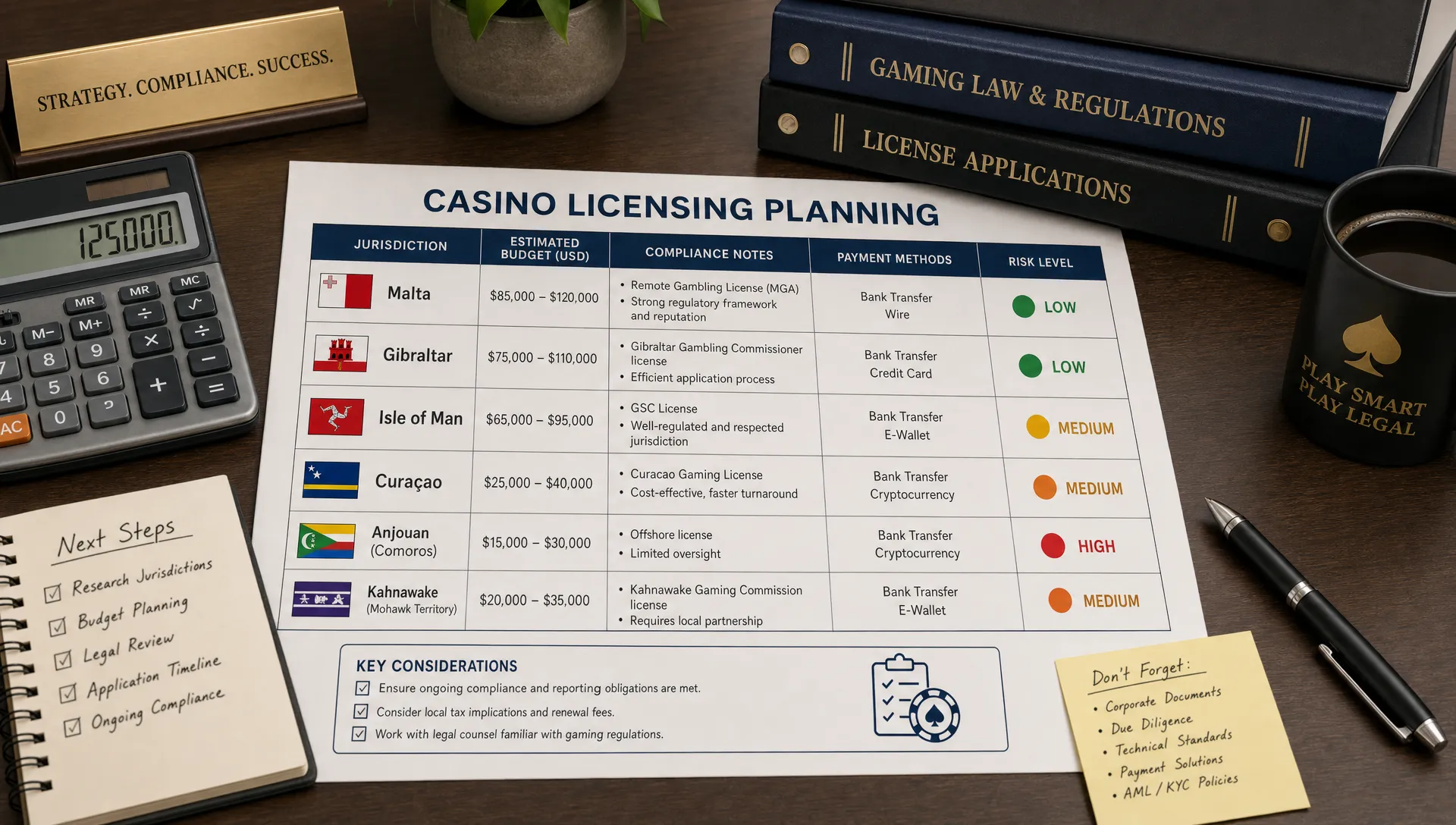
The table below gives broad first-year planning budgets for B2C online casino operators. These figures combine typical official fees, advisory costs, setup costs and licensing preparation. They do not include player acquisition, working capital, gaming tax, platform subscription, game provider fees, payment processing fees or jackpot reserves.
| Jurisdiction | Typical first-year licensing budget | Typical renewal or annual burden | Cost profile | Best fit |
|---|---|---|---|---|
| Anjouan | USD 15,000 to USD 35,000 | USD 10,000 to USD 25,000 | Low | Lean offshore launches, fast MVPs, early-stage casino brands |
| Curacao | USD 25,000 to USD 75,000 | USD 20,000 to USD 60,000 | Low to mid | Operators wanting a well-known offshore framework with improving oversight |
| Kahnawake | CAD 60,000 to CAD 150,000 | CAD 25,000 to CAD 75,000 | Mid | Brands seeking a recognized North American offshore-style regime |
| Isle of Man | GBP 75,000 to GBP 200,000+ | GBP 35,000 to GBP 100,000+ | Mid to high | Operators prioritizing reputation, payments and corporate governance |
| Malta | EUR 100,000 to EUR 250,000+ | EUR 50,000 to EUR 150,000+ | High | EU-facing operators with stronger compliance budgets |
| Alderney | GBP 100,000 to GBP 250,000+ | GBP 50,000 to GBP 150,000+ | High | Established operators and B2B groups needing strong regulatory credibility |
| Gibraltar | GBP 150,000 to GBP 300,000+ | GBP 100,000+ | High | Larger operators with substantial financial and compliance resources |
| United Kingdom | GBP 100,000 to GBP 500,000+ | Depends heavily on GGY | Very high | Operators targeting Great Britain under strict local regulation |
| Ontario, Canada | CAD 150,000 to CAD 500,000+ | CAD 100,000+ | Very high | Operators targeting Ontario through the local regulated model |
| Sweden, Denmark and similar EU local markets | EUR 100,000 to EUR 300,000+ | EUR 50,000 to EUR 150,000+ | High | Operators targeting specific regulated European countries |
| Netherlands or Germany | EUR 250,000 to EUR 750,000+ | High ongoing compliance and tax burden | Very high | Mature operators prepared for strict local technical and conduct rules |
| US state iGaming markets | USD 500,000 to several million+ | High, state-dependent | Enterprise | Operators with casino partnerships, large capital and local counsel |
These ranges are intentionally conservative. Some operators spend less when the application is simple, the technology is already certified and the ownership structure is clean. Others spend far more because of complex UBO chains, multi-product betting and casino scope, local market opinions, technical remediation or payment due diligence.
Low-cost offshore licenses: Anjouan and Curacao
Low-cost offshore licenses attract founders because they can reduce time to market. They are often used for international casino launches where the operator does not yet have the budget or business case for local licenses in every target country.
Anjouan
Anjouan is usually one of the lowest-cost options in 2026. For many startups, it is attractive because the first-year budget can be planned in the low five figures, the timeline can be relatively short and the documentation burden is lighter than in major European jurisdictions.
That does not mean there is no diligence. You should still expect checks on UBOs, source of funds, company documents, AML controls, game fairness, payment flows and website terms. Payment providers, crypto processors, affiliate partners and game suppliers may also run their own checks after the license is granted.
A typical Anjouan budget is often built around:
- License application and first-year licensing cost
- Local company or corporate structure setup
- Legal and compliance documentation
- Platform evidence, game provider documents and payment flow descriptions
- Ongoing renewal and basic compliance support
For a deeper breakdown, see Spinlab's dedicated guide to Anjouan license costs, timelines and key requirements in 2026.
Curacao
Curacao has long been one of the best-known offshore licensing jurisdictions for online casino operators. The main budgeting issue for 2026 is that Curacao's regulatory framework has been moving toward more direct supervision, stronger compliance expectations and a clearer licensing structure.
For operators, that usually means Curacao is no longer just a low-paperwork option. You may need more substantial AML policies, technical evidence, responsible gambling controls, segregation of player funds and reporting processes. The budget can still be much lower than Malta, the UK or Ontario, but it is safer to plan for a mid five-figure first year rather than assuming a minimal setup.
Curacao can make sense when an operator wants a known offshore jurisdiction, a broader supplier ecosystem and a stronger brand signal than very light-touch regimes. The tradeoff is that the compliance workload and cost are rising.
Mid-tier recognized jurisdictions: Kahnawake and Isle of Man
The next cost tier includes jurisdictions that are more expensive than offshore startup licenses but can offer stronger reputational value with banks, payment companies and B2B partners.
Kahnawake
Kahnawake is a recognized gaming jurisdiction based in Canada. It is often considered by operators that want a more established framework without entering a full local market licensing model like Ontario or individual US states.
The budget is usually higher than Anjouan or Curacao because the application review, due diligence and operational expectations are more demanding. Operators should plan for application costs, local hosting or approved hosting arrangements where required, legal support, documentation, investigations into key persons and annual renewal costs.
Kahnawake may be attractive for operators with a serious compliance posture and North American strategic interest, but it does not replace state or provincial licenses where those are required.
Isle of Man
The Isle of Man is known for a mature online gambling framework, corporate stability and a reputation that can help with banking and payment conversations. It is not a budget license. It is better suited to operators that can show clean ownership, experienced management, strong financial resources, audited systems and a credible operating plan.
Costs usually include the official application process, annual licensing, local presence or service provider expenses, professional advisers, compliance personnel, technical audits and detailed operational policies. Crypto-facing operators may also face additional scrutiny around custody, transaction monitoring, wallet controls and fiat conversion.
The Isle of Man can be a strong fit for operators building a long-term brand that needs more institutional credibility than a lean offshore license can provide.
High-credibility European hubs: Malta, Alderney and Gibraltar
European licensing hubs tend to cost more because they require more preparation, more governance and stronger proof that the business can operate responsibly. They also tend to matter more to banks, payment processors, game studios and institutional partners.
Malta
Malta remains one of the most recognized iGaming jurisdictions. A Malta Gaming Authority license can be valuable for operators that need European credibility, but it comes with a meaningful upfront and ongoing compliance burden.
The MGA model includes official fees, compliance contributions and detailed regulatory obligations. The Malta Gaming Authority fee information should be checked directly because the final cost depends on license type, revenue and activity. In practice, operators should also budget for local legal support, company administration, key function holders, AML controls, audits, technical documentation and ongoing reporting.
For a startup, Malta can be too expensive if the business is still validating acquisition channels. For a funded operator with a serious European plan, it can improve trust with suppliers and financial partners.
Alderney
Alderney is often used by established operators and B2B suppliers that value strong regulatory credibility. It is generally not the cheapest path to market, but it can support sophisticated structures, including arrangements involving platforms, game suppliers and managed services.
The first-year cost is shaped by the category of license, corporate structure, technical hosting setup, audits and professional support. Operators should expect a high level of review and ongoing obligations.
Gibraltar
Gibraltar is usually associated with larger, established gaming companies rather than early-stage casino startups. The licensing bar is high, and regulators expect strong financial standing, proven management, robust controls and a credible business case.
Because of that, Gibraltar can be difficult to justify unless the operator already has scale, capital and experienced compliance leadership. The licensing budget may be only one part of a broader operating commitment that includes local substance, professional staff and significant governance costs.
Local regulated markets: UK, Ontario and Europe
Local licenses cost more because they grant access to a specific regulated market. They also come with stricter advertising, affordability, responsible gambling, AML, reporting, dispute handling and technical compliance rules.
United Kingdom
The UK is one of the most demanding online gambling markets. Fees vary by activity and gross gambling yield. The UK Gambling Commission operating licence fees guidance should be used for current official calculations, but the official fee is only part of the budget.
Operators targeting Great Britain should also plan for legal advice, personal management license requirements, AML controls, safer gambling systems, customer interaction processes, advertising compliance, technical standards, reporting and possible affordability-related operational costs. The UK can be commercially attractive, but it is rarely a low-cost launch market.
Ontario
Ontario's regulated iGaming market requires operators to work through the provincial framework. The budget includes regulatory application costs, commercial registration requirements, technical and compliance preparation, legal support and ongoing reporting.
Ontario is often more realistic for operators with proven products, sufficient funding and a clear customer acquisition plan. It is not a shortcut into all of Canada, and it should not be confused with a lower-cost offshore license.
Sweden, Denmark, Netherlands and Germany
European local markets vary widely, but the pattern is consistent: the official application fee is only a starting point. Operators must budget for translated documents, local legal advice, technical certifications, responsible gambling integrations, tax modeling, advertising restrictions, AML procedures and ongoing reporting.
Sweden and Denmark can be manageable for well-prepared operators, but they still require disciplined compliance. The Netherlands and Germany are usually more expensive to enter because of demanding technical requirements, market conduct rules and higher operational complexity. Germany's tax and product restrictions can materially affect unit economics, so licensing cost should be assessed together with projected margins.
US state iGaming licensing costs
US online casino licensing is in a category of its own. Online casino is legal only in certain states, and access usually depends on partnerships with licensed land-based casinos or other approved market access arrangements. The direct licensing fees can be substantial, but the larger cost is often the full commercial package: market access, legal work, vendor registration, compliance operations, technical certification, taxes and ongoing regulatory reporting.
For a new operator, a US state iGaming launch can require hundreds of thousands of dollars before marketing, and in many cases the realistic budget reaches several million dollars. That is why many founders start with offshore or non-US international markets, build operating history and return to US licensing only after raising significant capital.
Crypto-ready casino licensing costs in 2026
Crypto can simplify some payment experiences for players, but it rarely simplifies licensing. Regulators and counterparties want to understand how the casino handles wallet custody, blockchain monitoring, fiat conversion, sanctions screening, suspicious transaction reporting and source of funds risk.
A crypto-ready solution may add cost in several areas:
- Crypto onramp and offramp provider due diligence
- Merchant custodial wallet controls and fund safekeeping procedures
- Blockchain analytics or transaction monitoring tools
- AML policies that address wallet risk, mixers, sanctions and high-risk jurisdictions
- Clear accounting for deposits, withdrawals, balances, bonuses and chargeback-like disputes
This is where the platform decision and licensing decision overlap. If your technology cannot produce clean payment ledgers, player histories, KYC records, bonus logs and suspicious activity evidence, you may spend more on remediation than you saved on the license. Spinlab's casino licensing technology checklist is useful for understanding what your platform should be able to prove before regulators and payment partners ask.
How to choose a jurisdiction based on budget
A license should match the stage of the business, not just the founder's ambition. The cheapest license is not always the cheapest route if it blocks key payment methods, game providers or target markets. The most prestigious license is not always wise if it consumes the budget before the casino has product-market fit.
A practical way to think about the decision is:
| Operator stage | Sensible licensing approach | Budget logic |
|---|---|---|
| MVP or first casino brand | Anjouan or similar low-cost offshore license | Preserve capital for platform, payments, content and acquisition testing |
| Early growth with supplier due diligence needs | Curacao or Kahnawake | Balance cost with stronger recognition and documentation |
| Funded international operator | Isle of Man, Malta or Alderney | Improve credibility with banks, providers and partners |
| Country-specific expansion | UK, Ontario, Sweden, Denmark or similar local license | Pay more only when the market justifies local compliance cost |
| Enterprise US strategy | State-by-state licensing and market access | Requires major capital, local counsel and long-term commitment |
For most startups, the right answer is staged. Launch under a license that fits the initial market, build revenue and compliance maturity, then add local licenses when the economics support them.
Red flags that increase licensing cost
Some applications become expensive because of the jurisdiction. Others become expensive because the operator is not ready. Before you pay application fees, look for issues that will slow down review or trigger extra legal work.
Common cost escalators include opaque ownership structures, unexplained source of funds, high-risk target markets, weak AML policies, missing game certificates, unclear payment flows, no responsible gambling tooling, poor data retention, incomplete terms and conditions, undocumented bonus rules, weak fraud controls and no audit trail for player balances.
These are fixable, but fixing them after an application has started can be more expensive than preparing them upfront. A modular platform, clean backoffice, game aggregation documentation, multi-currency payment records and real-time analytics can reduce friction because the operator can answer regulator and partner questions faster.
Frequently Asked Questions
What is the cheapest casino license in 2026? Anjouan is often one of the lowest-cost options for online casino startups, with many first-year planning budgets in the low five figures. The cheapest suitable license still depends on target markets, payment needs, supplier acceptance and compliance readiness.
Is a Curacao license still affordable in 2026? Curacao can still be affordable compared with Malta, the UK, Ontario or US state licensing, but operators should expect stronger compliance expectations than in the past. Budgeting only for a very low application fee is risky.
How much does a Malta gaming license cost? A Malta license often requires a six-figure first-year budget once legal support, company setup, compliance preparation, audits and official fees are included. The exact cost depends on license scope, revenue and operating model.
Do I need a local license for every country? Not always, but a license from one jurisdiction does not automatically authorize targeting every market. Many countries require local licenses or restrict offshore operators. Get market-specific legal advice before accepting players.
Do crypto casinos need a different license? Some jurisdictions allow crypto-facing operations under their existing online gambling framework, but they may require stronger AML, wallet, custody and transaction monitoring evidence. Payment partners may also impose their own requirements.
What costs are not included in licensing budgets? Licensing budgets usually exclude platform fees, game provider fees, payment processing, marketing, affiliate commissions, staff, tax, chargeback reserves and working capital. Those costs can exceed the license itself.
Build the license plan and platform plan together
Licensing is easier when the casino platform can already support the evidence regulators and counterparties expect. Spinlab offers a modular iGaming platform for launching and scaling online casinos, with crypto and fiat payment support, game aggregation, KYC and AML compliance, fraud prevention, analytics, affiliate and bonus tools, customizable backoffice controls and mobile-optimized player experiences.
If you are comparing jurisdictions for a 2026 launch, start by matching your target market, compliance budget and payment strategy to the right license tier. Then choose technology that can support that license from day one rather than forcing expensive fixes later. You can explore Spinlab's all-in-one white label casino platform at spinlab.studio.