

A casino license is not just a legal checkbox. It determines where you can operate, how you can advertise, which payment gateways will work with you, which game suppliers will approve your account and how much compliance overhead your team must carry from day one.
For operators building an online casino, the right question is not “Which license is cheapest?” It is “Which license fits the market I want to reach, the product I want to offer and the risk profile I can support?” A low-cost license can be a smart entry point for some brands. For others, it can block local payments, affiliate partnerships or long-term expansion.
This guide gives you a practical framework for choosing a casino license based on your target market. It is written for founders, operators and product teams comparing licensing routes for a whitelabel casino, turnkey casino solution or custom iGaming platform. It is not legal advice, so use it as a planning tool and validate decisions with qualified gaming counsel before applying.
Start with the market, not the jurisdiction
Many licensing mistakes happen because operators start with a jurisdiction list instead of a go-to-market plan. A license only makes sense when it matches the real commercial conditions of your target market.
Before comparing regulators, define the operating model in plain terms:
- Target countries or regions where players will be accepted
- Countries that will be blocked from registration, deposits and marketing
- Main acquisition channels, including affiliates, SEO, paid media and influencers
- Product mix, such as slot games, live casino games, crash games, table games or casino original games
- Payment model, including fiat, crypto, local bank transfers, cards, e-wallets or crypto onramp flows
- Languages, currencies, customer support hours and responsible gambling workflows
- Expected launch timeline, compliance budget and internal staffing capacity
This exercise matters because a “good” license for one brand can be a poor fit for another. A crypto-first casino targeting international traffic has different needs from a fiat casino focused on one highly regulated local market. If your licensing decision is part of a wider international rollout, it helps to pair it with a platform assessment like Spinlab’s guide to choosing casino software for global markets.
Understand the main casino licensing routes
Casino licensing is fragmented. There is no single license that gives unrestricted access to every market. In practice, operators usually evaluate one of three routes: a local license, an international or offshore license, or a phased multi-license strategy.
| Licensing route | Best fit | Main advantage | Main risk |
|---|---|---|---|
| Local market license | Operators targeting one regulated country or state | Stronger legal certainty, better access to local ads and payment partners | Higher cost, longer approval process and stricter reporting |
| International or offshore license | Brands testing multiple permitted markets where local licensing is not required or practical | Faster entry, lower setup cost and simpler initial structure | Market restrictions, banking friction and reputational differences |
| Multi-license roadmap | Operators scaling from one launch market into several regulated markets | Better long-term flexibility and market coverage | More legal complexity, duplicated compliance work and higher cost |
| B2B supplier certification | Game studios, platform providers or aggregators serving licensed operators | Helps with commercial acceptance and technical trust | Usually not enough to operate a player-facing casino |
Local licenses are usually needed when you want to actively target a regulated market with local advertising, local affiliates and domestic payment methods. For example, the UK Gambling Commission publishes detailed License Conditions and Codes of Practice for operators serving Great Britain. Other regulated markets have their own licensing, reporting, responsible gambling and technical requirements.
International licenses can work well for operators entering markets where that license is accepted by partners and not prohibited by local law. They are often used by startups that need a faster, leaner launch path. The tradeoff is that some payment gateways, game providers, affiliates and media buyers may apply extra scrutiny.
A multi-license roadmap is often the most realistic long-term plan. You may begin with one license for initial launch, then apply for local approvals as traction, revenue and team maturity grow.
Match the license to player location and marketing activity
Target market analysis must go beyond “where the company is incorporated.” Regulators and payment providers look at where players are located, where promotions are aimed and how the brand presents itself.
If your site uses a local language, local currency, local sports sponsorships, local influencers or country-specific affiliate pages, that can signal that you are targeting a market. The same applies if you accept local payment methods or run campaigns around national events.
This is why geo-blocking, terms and conditions, KYC checks and traffic source controls need to align with the license. A mismatch between your written restrictions and your actual marketing behavior can create regulatory, payment and reputational problems.
For each target country, classify it into one of four buckets:
| Market status | What it means for licensing | Practical decision |
|---|---|---|
| Locally regulated and license required | You usually need a domestic license to target players | Budget for local application or exclude the market |
| Restricted or prohibited | Online gambling may be banned or heavily limited | Block the market and avoid direct or indirect marketing |
| Permitted with international license | Offshore or international operation may be possible if compliant | Confirm with counsel, PSPs and game suppliers |
| Legally unclear or changing | Rules may be ambiguous, outdated or in transition | Treat as high risk until counsel confirms a position |
The highest-risk approach is assuming that a license from one jurisdiction automatically permits traffic from everywhere else. It does not. A license tells you who supervises your business, but it does not override laws in the countries where your players live.
Check product scope before you apply
A casino license must cover the product you actually plan to launch. “Online casino” can mean different things depending on the regulator. Some licenses distinguish between casino games, sportsbook, poker, lotteries, live dealer content, skill games, virtual games and original games.
This matters if your roadmap includes more than standard slots. Crash games, provably fair crypto games, branded originals, tournaments, jackpots and live casino features can trigger additional technical reviews or supplier documentation. If you plan to operate casino original games, you may need to show how random number generation, return to player settings, fairness, game logs and dispute resolution are handled.
Game aggregation adds another layer. A game aggregator can give you access to many studios, but not every studio distributes every game into every jurisdiction. New titles from major slot providers can be restricted by license, geography or commercial policy. Before choosing a license, ask whether your preferred suppliers will approve the jurisdiction, the business model and the target markets.
Evaluate payment gateway and banking acceptance
Licensing and payments are inseparable in iGaming. A casino license that looks affordable on paper can become expensive if it limits access to reliable payment gateways, acquiring banks, crypto providers or settlement partners.
Payment providers usually assess the full risk profile: license jurisdiction, target countries, ownership structure, AML controls, chargeback exposure, player verification, responsible gambling practices and transaction monitoring. Crypto-ready casinos face additional questions around wallet custody, source of funds, blockchain analytics and fiat conversion.
For each licensing option, verify payment fit early:
| Payment question | Why it matters |
|---|---|
| Will PSPs support this license and target market? | A license with poor PSP acceptance can slow launch or increase fees |
| Can you support local currencies? | Currency mismatch hurts deposits, withdrawals and player trust |
| Are crypto deposits, withdrawals or onramps allowed? | Some regulators restrict or scrutinize virtual asset use |
| Can you run proper KYC and AML checks before withdrawals? | Weak controls can lead to frozen accounts and compliance failures |
| Are chargeback and fraud controls compatible with the market? | High-risk traffic can quickly damage payment relationships |
For crypto operations, align your licensing review with AML expectations for virtual assets. The Financial Action Task Force maintains guidance on virtual assets and anti-money laundering standards, which is useful background when designing crypto casino controls. If your launch plan includes digital assets, Spinlab’s crypto casino compliance checklist is a useful companion to the licensing work.
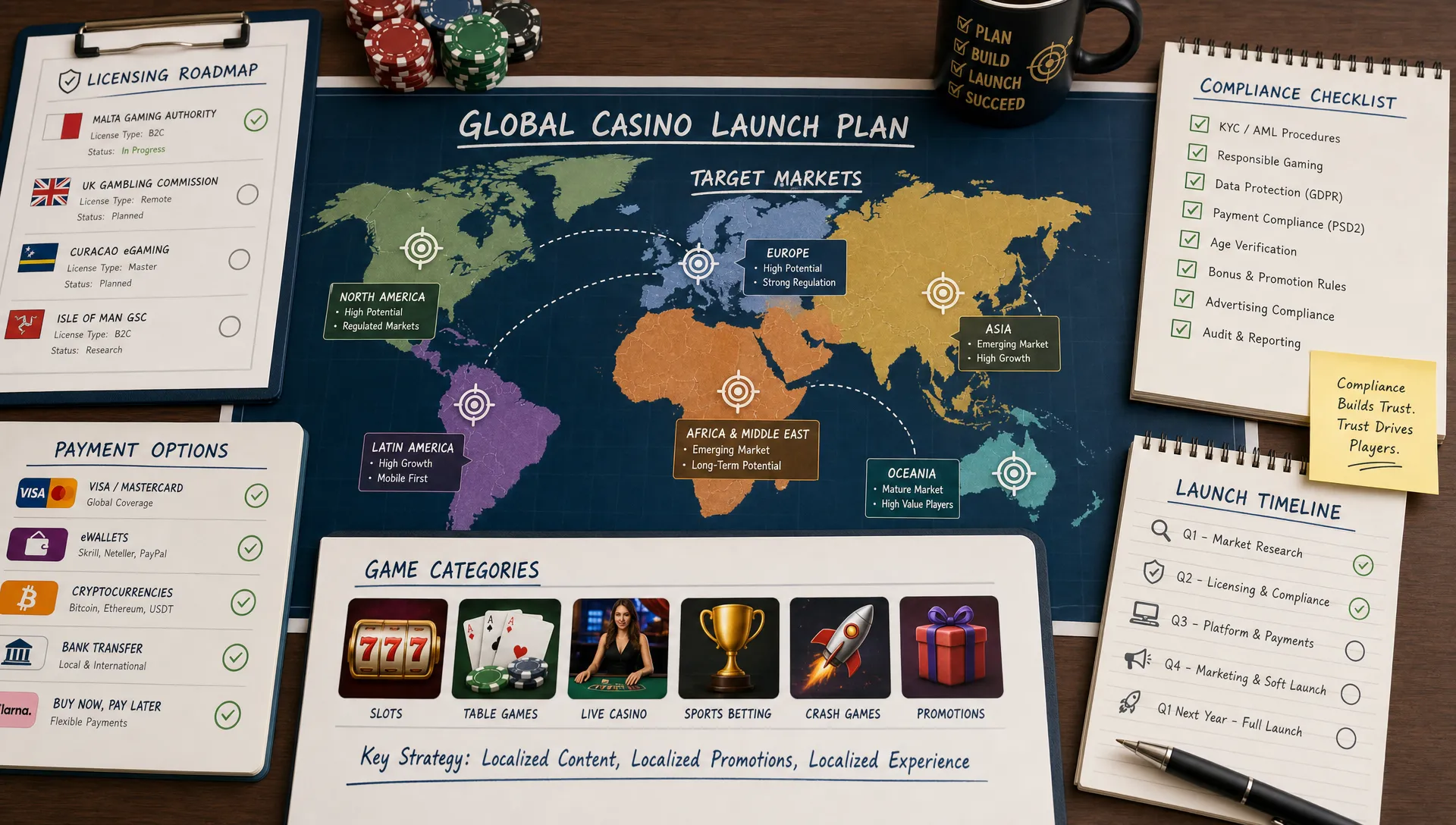
Compare cost by total operating burden, not headline fees
License cost is more than the government fee or agent quote. A realistic budget includes legal work, company formation, policies, key person checks, technical documentation, testing, compliance staff, audits, renewals and ongoing reporting.
A cheaper license can still be the right choice if it supports your market and product. It becomes expensive when it forces workaround after workaround, such as manual payment operations, limited content access, high-risk processors or constant rework to satisfy partners.
Use a total cost view across three periods:
| Cost period | What to include |
|---|---|
| Application phase | Legal advice, document preparation, company setup, due diligence, policies and regulator fees |
| Launch phase | Platform configuration, KYC provider setup, payment gateway integration, game supplier onboarding and testing |
| Operating phase | Renewals, reporting, compliance reviews, audits, responsible gambling processes, fraud monitoring and staff time |
Timeline should be assessed the same way. The fastest license is not always the fastest market entry if payments, games or compliance tooling lag behind. Conversely, a more demanding license can speed up commercial partnerships because counterparties recognize the regulatory standard.
If speed is your main constraint, licensing should be evaluated together with platform readiness. A fast license paired with slow software implementation still delays launch. Spinlab has a separate guide on choosing casino software for faster market entry if you are comparing build paths.
Assess regulator reputation and commercial trust
A casino license is also a trust signal. Players may not read regulatory statutes, but partners do. Affiliates, game studios, payment gateways, crypto onramp providers and investors all form opinions based on your licensing jurisdiction.
Reputation affects several practical areas:
- Which suppliers will sign with you
- How quickly compliance reviews are completed
- Whether banks and PSPs accept your traffic mix
- Whether affiliates are comfortable promoting the brand
- How players perceive withdrawal safety and dispute handling
This does not mean every operator needs a top-tier local license at launch. It means the license should match the trust level required by your commercial strategy. If you want premium live casino content, major fiat payment routes and high-value affiliate relationships, a very light licensing setup may create friction. If you are validating a smaller international market with a disciplined compliance model, a leaner license may be acceptable.
Do not ignore KYC, AML and responsible gambling requirements
Licensing should be treated as an operating system, not a certificate on the footer. Your daily workflows must reflect the rules of the license.
Most credible regimes expect controls around customer due diligence, suspicious activity monitoring, self-exclusion, underage gambling prevention, bonus fairness, complaints, record keeping and anti-fraud processes. The exact requirements differ by jurisdiction, but the operational themes are consistent.
Before applying, map each requirement to an owner inside your team. If no one owns AML reviews, bonus abuse investigation, withdrawal checks or regulator reporting, the license will create risk instead of structure.
Your platform should also support the obligations. For example, a modern online gambling platform should make it practical to manage player verification, payment history, bonus activity, risk flags and reporting evidence without relying only on spreadsheets. Spinlab’s modular iGaming platform includes features such as KYC and AML compliance, advanced fraud prevention, real-time analytics, crypto and fiat payment support, multi-currency handling and a customizable backoffice admin panel, which are the types of capabilities operators need to align software with licensing obligations.
Consider how licensing affects affiliates and bonuses
Affiliate-first growth can be powerful in online casino, but it adds regulatory exposure. In many markets, operators remain responsible for how affiliates promote their brand. Misleading bonus claims, prohibited targeting, underage audiences or local compliance breaches can create problems even when the operator did not publish the content directly.
This should influence your license choice. If your growth model depends on aggressive affiliate marketing in a specific region, you need to understand whether that region requires local authorization, advertising approvals or bonus restrictions. Some regulators closely supervise promotional language, wagering terms, inducements and responsible gambling messaging.
Bonus engines should also be configured to match the license. That includes wagering rules, maximum bet limits, excluded games, country restrictions, bonus abuse detection and clear player communication. A license that seems easy to obtain can still become difficult to operate if your marketing model is not compatible with its conditions.
Build a phased licensing roadmap
For many operators, the best answer is not one license forever. It is a phased roadmap tied to business milestones.
A sensible roadmap might start with one commercially viable license for initial launch, then add local licenses only when market data supports the investment. This protects capital while keeping the business compliant and scalable.
Use a simple scorecard when comparing options:
| Criterion | Weight | What a high score looks like |
|---|---|---|
| Target market legality | 25% | Counsel confirms the license fits your intended player geographies |
| Payment acceptance | 20% | PSPs, banks and crypto providers can support the model |
| Game supplier compatibility | 15% | Key studios and aggregators approve the jurisdiction and markets |
| Compliance workload | 15% | Requirements are clear and your team can operate them |
| Cost and timeline | 15% | Setup and ongoing costs match your runway and launch plan |
| Future expansion | 10% | The structure can support additional licenses or local approvals later |
The point of the scorecard is not mathematical precision. It forces the team to discuss tradeoffs openly. If a license scores well on cost but poorly on payments and market legality, the cheaper option may not be cheaper in practice.
Red flags when evaluating a casino license
Some licensing proposals sound attractive because they remove friction. That is exactly why they deserve extra scrutiny.
Be cautious if you hear claims like these:
- “This license lets you target every country”
- “No KYC is needed for casino players”
- “You can ignore local marketing rules because the license is offshore”
- “Payment approval is guaranteed”
- “Game suppliers will accept it automatically”
- “Crypto means gambling regulations do not apply”
- “You can launch now and fix compliance later”
Good advisors will talk about restrictions, documentation, ownership checks, AML duties, renewals, reporting and commercial limitations. If a proposal only talks about speed and price, it is incomplete.
For operators comparing popular lower-cost jurisdictions, it can also help to study practical jurisdiction comparisons. Spinlab’s guide on Curacao and Anjouan licensing differences looks at two routes often considered by early-stage iGaming brands.
Choosing the right license for your target market
The best casino license is the one that lets you operate your intended business model without creating hidden bottlenecks. That means it must fit your player geographies, product scope, payment stack, content suppliers, compliance capacity, marketing channels and expansion plan.
If you are building a regulated local brand, expect a longer, more rigorous licensing path. If you are launching an international whitelabel casino, focus on whether the license is accepted by your PSPs, game providers and intended markets. If crypto is central to the product, treat AML, wallet custody, onramps and blockchain monitoring as core licensing topics from the start.
A good licensing decision is both legal and operational. It should make your casino easier to launch, easier to supervise and easier to scale.
Frequently Asked Questions
What is the best casino license for a new online casino? There is no universal best license. The right choice depends on your target countries, product type, payment methods, marketing channels, budget and timeline. A startup testing international markets may choose a different route from an operator targeting one tightly regulated local market.
Can one casino license cover all countries? No. A license from one jurisdiction does not automatically authorize you to target players everywhere. You still need to consider local gambling laws in each player market, especially where advertising, payments or active solicitation are involved.
Is an offshore casino license enough for payment gateways? Sometimes, but not always. Payment gateways review the license, ownership, target markets, AML controls, chargeback risk and transaction model. You should speak with PSPs before committing to a licensing route.
Do crypto casinos need a gambling license? In most cases, using crypto does not remove gambling licensing obligations. Crypto adds extra compliance questions around AML, wallet custody, source of funds, sanctions screening and fiat conversion.
Should I choose the cheapest casino license? Cost matters, especially for early-stage operators, but the cheapest license is only valuable if it supports your target market, payments, game suppliers and compliance model. A low upfront fee can become costly if it blocks growth.
When should I involve a lawyer? Involve gaming counsel before you accept players, sign major payment contracts or launch marketing in a target country. Legal review is especially important when rules are unclear, local licensing may be required or crypto payments are involved.
Launch with a platform built for licensed growth
Choosing a license is easier when your platform can support the operating model behind it. Spinlab offers a modular, crypto-ready whitelabel casino platform with fiat and crypto payments, game aggregation, KYC and AML tools, fraud prevention, analytics, affiliate and bonus features, multi-currency support and a customizable backoffice.
If you are planning your target markets and licensing path, talk to Spinlab about launching a flexible online casino that can be configured for compliance, payments and growth from day one.