

A crypto-ready casino brand is not simply an online casino that accepts Bitcoin, Ethereum, or stablecoins. It is a casino operation where the brand promise, payment flows, compliance processes, fraud controls, game portfolio, and backoffice operations are designed from day one to support digital assets safely.
For founders, that distinction matters. Players may be attracted by fast deposits, global currencies, and Web3-style UX, but regulators, payment partners, affiliates, and game suppliers still expect a serious operating model. The winners in 2026 will not be the brands that add crypto as a gimmick. They will be the ones that make crypto feel smooth for players while keeping operations controlled behind the scenes.
This guide walks through how to launch a crypto-ready casino brand, from positioning and platform selection to payments, compliance, games, and go-to-market planning.
Start with the brand model, not the coin list
Many first-time operators start by asking, “Which cryptocurrencies should we accept?” That is the wrong first question. Your crypto strategy should follow your brand model, target markets, licensing route, and risk tolerance.
A crypto-ready casino can take several forms. Some brands focus on stablecoin deposits because they reduce volatility and simplify accounting. Others support crypto as one option alongside fiat cards, bank transfers, and local payment methods. A smaller group attempts a crypto-first model, but that route requires stronger wallet operations, enhanced transaction monitoring, and careful market selection.
Before choosing software or payment providers, define the operating model clearly.
| Decision | Why it matters | Practical launch choice |
|---|---|---|
| Target markets | Licensing, KYC rules, payment access, and marketing channels vary by jurisdiction | Start with a limited set of allowed markets |
| Crypto scope | Affects wallet custody, risk monitoring, support, and settlement | Begin with major assets or stablecoins, then expand |
| Fiat support | Helps mainstream players enter without already owning crypto | Add fiat and a crypto onramp if your audience is mixed |
| Brand promise | Shapes UX, promotions, game mix, and affiliate strategy | Position around speed, trust, games, or low-friction onboarding |
| Compliance model | Determines verification, transaction monitoring, and reporting workflows | Build a risk-based model before accepting deposits |
The goal is to avoid building a brand that is technically exciting but operationally fragile. A narrow, compliant, well-supported launch is better than a broad launch that creates support tickets, payment failures, and regulatory exposure.
Build compliance into the launch plan early
Crypto-ready gambling sits at the intersection of gaming regulation, payments, financial crime controls, and consumer protection. That means compliance cannot be bolted on after the brand is live.
At minimum, operators need to understand licensing obligations, Know Your Customer rules, Anti-Money Laundering procedures, sanctions screening, player protection requirements, and recordkeeping. Crypto also introduces wallet risk, source of funds questions, and transaction monitoring considerations.
The Financial Action Task Force has long emphasized a risk-based approach for virtual assets and virtual asset service providers, which is a useful mindset for casino operators even when the legal classification varies by market. In practice, that means your controls should match the risks created by your product, geography, player behavior, and payment methods.
For a more detailed regulatory sequencing framework, Spinlab’s compliance-first crypto casino launch checklist is a useful companion to this broader brand launch guide.
Compliance planning should answer these questions before launch:
- Which jurisdictions will you accept players from, and which will you block?
- What license or legal structure applies to your operating model?
- When will KYC be triggered, at registration, deposit, withdrawal, or risk threshold?
- How will you monitor deposits from high-risk wallets or suspicious patterns?
- What responsible gambling tools will be available from day one?
This is not legal advice, and operators should work with qualified gaming counsel. Still, founders should know enough to make platform and payment choices that do not create avoidable compliance problems later.
Choose a modular iGaming platform that can scale with the brand
The platform is the operating system of your casino brand. It controls the player account, wallet, game lobby, bonus logic, payment flows, compliance workflows, admin permissions, reporting, and integrations. For a crypto-ready launch, it is not enough to choose any white label casino platform. You need a platform that can handle both iGaming operations and digital asset complexity.
A strong launch stack should cover four layers.
| Platform layer | What it should support | Why it matters for crypto-ready casinos |
|---|---|---|
| Player experience | Mobile-optimized registration, wallet, lobby, bonuses, and cashier | Reduces friction and improves first-deposit conversion |
| Payments | Crypto and fiat deposits, withdrawals, multi-currency balances, onramps | Lets players fund accounts through the method they trust |
| Operations | Backoffice controls, analytics, affiliate tools, fraud prevention | Gives non-technical teams daily control over the brand |
| Integrations | Open API, game aggregation, payment gateway connections, compliance tools | Keeps the platform adaptable as the business grows |
Spinlab is built around this modular approach. The platform supports crypto and fiat payments, game aggregation, real-time analytics, advanced fraud prevention, KYC and AML workflows, a customizable backoffice admin panel, affiliate and bonus tools, multi-currency support, crypto onramp options, merchant custodial wallets, and mobile-optimized casino operations. It is designed to make casino operations feel closer to a Shopify-like experience, where a business team can configure and run the brand without needing a large in-house engineering department.
That matters for launch speed. A founder can spend months coordinating separate vendors for wallet infrastructure, games, front-end development, admin tooling, analytics, and compliance workflows. Or they can start with an all-in-one platform and customize the pieces that truly differentiate the brand.
Design payments around player trust and operational control
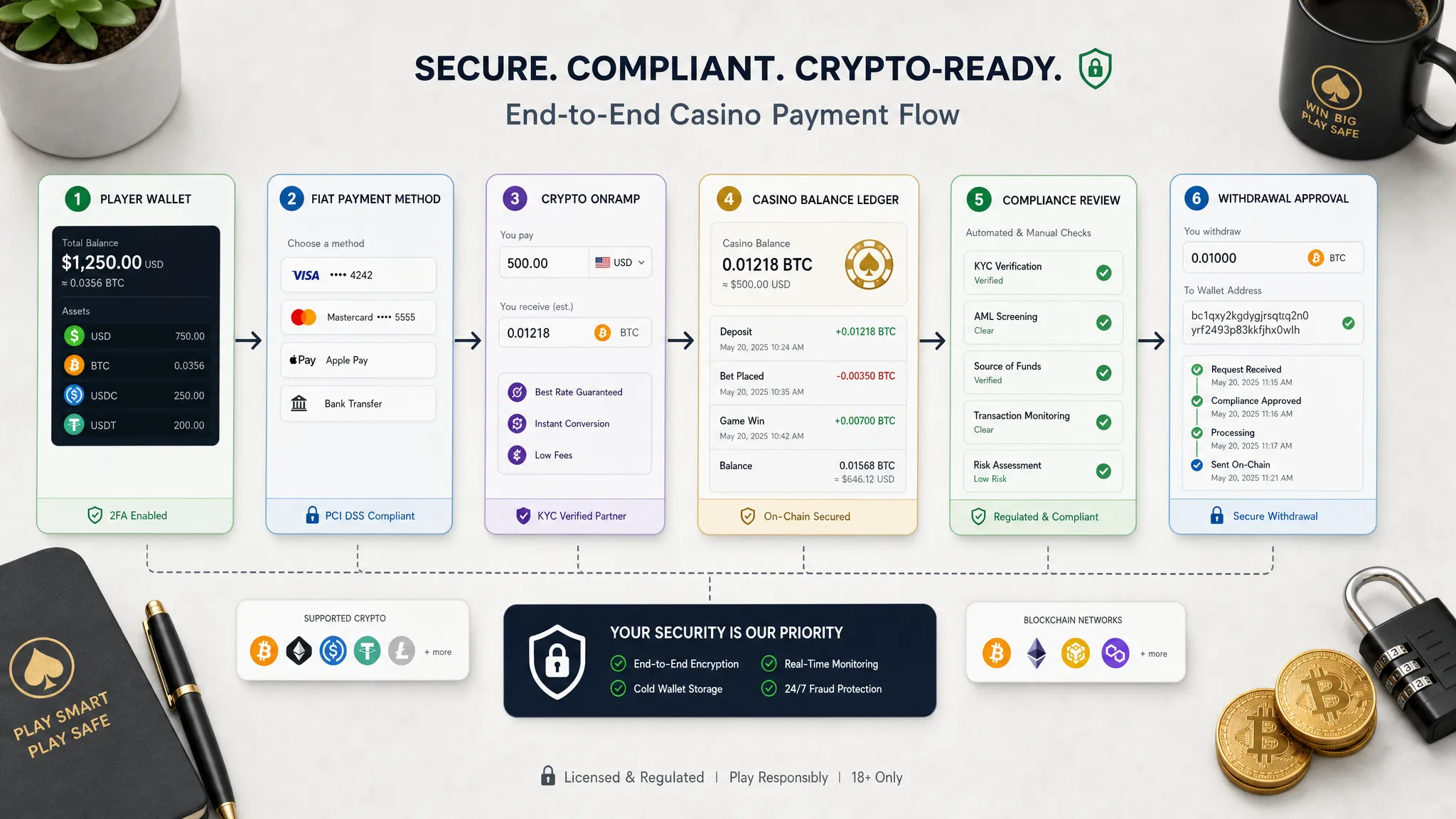
Crypto payments are a major acquisition advantage only if they work reliably. Players expect deposits to be recognized quickly, balances to be accurate, withdrawals to be predictable, and support teams to understand what happened when something goes wrong.
The most important payment decision is not whether to accept crypto. It is how crypto funds move through your operation.
Some casinos use custodial wallets, where the operator or merchant wallet infrastructure holds player funds within a controlled platform environment. Others connect non-custodial flows, where players interact more directly with blockchain wallets. Some use a crypto onramp to let players purchase crypto using fiat payment methods before funding their account. Many brands choose a hybrid model, especially when they want to serve both crypto-native and mainstream players.
For most new operators, a hybrid crypto and fiat model is the most practical. It avoids excluding players who prefer cards or local payment methods while still giving crypto users a fast funding option. It also gives finance teams more flexibility in treasury management.
| Payment component | Launch priority | What to verify before going live |
|---|---|---|
| Crypto deposits | High | Supported assets, confirmation rules, wallet reconciliation, risk checks |
| Crypto withdrawals | High | Approval workflow, limits, fees, suspicious activity review |
| Fiat gateway | Medium to high | Accepted countries, chargeback exposure, settlement timing |
| Crypto onramp | Medium | KYC ownership, supported currencies, conversion fees, user flow |
| Internal ledger | Critical | Balance accuracy, audit logs, bonus restrictions, multi-currency reporting |
A casino payment gateway is only one part of the system. The internal ledger is just as important because it determines what players can wager, withdraw, or use in promotions. If a deposit is confirmed on-chain but not reconciled correctly inside the casino, the player experience breaks. If bonus funds and cash funds are not separated properly, fraud and accounting issues follow.
For a deeper operator-level breakdown, see Spinlab’s guide to crypto casino payments for new operators.
Curate games for both conversion and retention
A crypto-ready casino still wins or loses on its games. Payments may bring players in, but the game lobby determines whether they stay.
Your launch portfolio should balance familiarity and differentiation. Slot games are usually essential because they are easy to understand, simple to promote, and broad enough to serve multiple player segments. Live casino games can increase trust because players see real dealers and real-time outcomes. Table games, crash-style games, and instant-win products can add variety. Casino original games can help differentiate the brand if they are designed with clear mechanics, responsible limits, and a strong visual identity.
A game aggregator can simplify this process by connecting the platform to multiple game providers through one integration layer. The key is to avoid launching with a cluttered lobby that looks large but feels generic. A smaller, well-organized lobby often performs better than a huge catalog with weak navigation.
Think in terms of player journeys:
- A first-time depositor should find recognizable, easy-entry games quickly.
- A crypto-native player may look for fast rounds, transparent mechanics, and modern game formats.
- A high-value live casino player may care more about table variety, limits, and withdrawal reliability.
- A bonus-driven player needs clear wagering rules and visible progress tracking.
The brand layer matters here. If your casino promises speed, the lobby should highlight fast-loading games and instant-play formats. If it promises premium entertainment, live casino and polished visual design should be prominent. If it promises crypto-native transparency, the cashier, wallet, and game experience should feel consistent.
Put fraud prevention, cybersecurity, and operations on the same roadmap
Crypto-ready casinos need strong security thinking because they combine real-money gaming, payment flows, personal data, affiliate traffic, and digital wallets. Fraud prevention is not only about blocking bad players. It is about protecting the economics of the business.
Common risks include bonus abuse, multi-accounting, payment fraud, chargebacks on fiat deposits, suspicious wallet activity, affiliate fraud, account takeovers, and withdrawal manipulation. Operators should define risk rules before launch so support and payments teams know when to approve, pause, escalate, or reject activity.
Cybersecurity also needs to be treated as an operating discipline, not a one-time setup. The NIST Cybersecurity Framework is a widely used reference for organizing cybersecurity work around identifying, protecting, detecting, responding, and recovering from threats. For casino operators, that translates into access controls, admin permissions, incident response plans, secure vendor management, and regular monitoring.
Infrastructure decisions depend on your operating footprint. If your team is distributed or you operate in specific regions, it can be valuable to work with managed IT, cloud, and cybersecurity partners that understand local business environments, such as AITEC Antilles for IT management and cloud support in the Antilles-Guyane region.
Inside the casino platform, your daily operations team should have the tools to act quickly. That includes role-based admin access, player risk flags, payment review queues, affiliate performance monitoring, bonus abuse detection, and real-time analytics. The faster your team can see abnormal behavior, the less damage it can do.
Plan the launch in phases, not as a single go-live event
A strong launch is staged. The public launch date matters, but it should be the final step in a controlled sequence of internal testing, soft launch, payment validation, affiliate readiness, and player support training.
| Phase | Main objective | What to complete |
|---|---|---|
| Pre-build | Confirm the business model | Market selection, license path, brand positioning, platform decision |
| Configuration | Set up the operating system | Payments, wallets, games, bonuses, KYC, AML, fraud rules, admin roles |
| Internal testing | Validate the player journey | Registration, deposits, gameplay, withdrawals, support workflows, reporting |
| Soft launch | Test with limited traffic | Real deposits, live support, affiliate tracking, risk reviews, retention campaigns |
| Public launch | Scale acquisition | Paid campaigns, affiliate push, VIP handling, analytics review, optimization |
| Post-launch | Improve unit economics | Conversion rate, withdrawal speed, fraud loss, bonus ROI, player lifetime value |
Founders often underestimate the importance of internal testing. Before sending paid traffic or affiliates to the brand, test the full journey with realistic scenarios. A player registers, passes KYC, deposits with crypto, claims a bonus, plays slot games, triggers wagering rules, requests a withdrawal, contacts support, and receives funds. Then repeat the same flow with fiat and with edge cases.
The objective is not perfection. It is confidence that your team can operate the brand when real players arrive.
Build acquisition around credibility, not hype
Crypto casino marketing can easily drift into exaggerated promises. That might produce short-term clicks, but it creates long-term problems with payment partners, affiliates, regulators, and players. A durable brand should compete on clarity and reliability.
Your launch messaging should answer practical player questions. Which currencies are supported? How long do withdrawals usually take after approval? What verification is required? Are bonuses easy to understand? Which games are available? Is the casino mobile-friendly? What responsible gambling tools are provided?
Affiliate marketing can be powerful, but it needs governance. Give affiliates accurate terms, approved claims, brand guidelines, and market restrictions. Monitor traffic quality closely. If an affiliate sends restricted traffic, misleading traffic, or bonus-abuse traffic, the brand absorbs the risk.
Retention should begin on day one. Crypto-ready players may value speed, but they still respond to strong lifecycle campaigns, personalized bonuses, VIP recognition, and a reliable support experience. Real-time analytics can help operators see which channels, games, promotions, and payment methods produce valuable players rather than just registrations.
What to measure after launch
Once the brand is live, the team should review performance daily at first, then weekly as operations stabilize. The right metrics combine player experience, financial performance, and risk.
| Metric | What it tells you | Why it matters |
|---|---|---|
| Registration to first deposit | Onboarding effectiveness | Shows whether the brand and cashier are converting interest into revenue |
| Deposit success rate | Payment reliability | Reveals friction in crypto, fiat, or onramp flows |
| Average withdrawal time | Trust and operational efficiency | Faster, controlled withdrawals improve player confidence |
| Bonus cost per active player | Promotion quality | Helps prevent overpaying for low-value activity |
| Fraud and chargeback rate | Risk exposure | Protects margins and payment relationships |
| Game retention by category | Product fit | Shows whether slots, live casino, or originals drive repeat play |
| Affiliate cohort value | Traffic quality | Separates strong partners from expensive volume |
A crypto-ready casino brand should improve every week. Payment limits can be adjusted, suspicious activity rules can be tuned, game categories can be reorganized, bonuses can be simplified, and onboarding can be refined. The best operators treat launch as the start of optimization, not the finish line.
Frequently Asked Questions
What does crypto-ready mean for an online casino? Crypto-ready means the casino can support cryptocurrency payments safely and operationally, including wallet handling, internal ledger accuracy, risk checks, KYC and AML workflows, reporting, and player support. It can also include fiat payments and crypto onramp options.
Can I launch a casino with crypto only? It is possible in some operating models, but crypto-only casinos can face more friction with licensing, compliance, player onboarding, and treasury management. Many new operators choose a hybrid model with both crypto and fiat support.
Do I need a license to launch a crypto casino? In most serious operating models, yes. Requirements depend on your target markets, product structure, and jurisdiction. You should speak with gaming counsel before accepting real-money players.
What games should a crypto-ready casino launch with? Most brands start with a balanced lobby that includes slot games, live casino games, and simple table or instant-win games. Casino original games can help differentiate the brand when they fit the positioning and compliance model.
How long does it take to launch a crypto-ready casino brand? Timing depends on licensing, vendor readiness, payment setup, game integrations, and compliance work. A modular white label casino platform can shorten technical setup, but legal, operational, and testing steps still need proper attention.
Launch with the right operating foundation
A crypto-ready casino brand needs more than a wallet button. It needs a clear market strategy, compliant onboarding, reliable payments, a strong game lobby, fraud controls, analytics, and an operations team that can manage the business without waiting on developers for every change.
Spinlab gives founders and operators a modular way to build, launch, and scale an online casino with crypto and fiat payment support, game aggregation, compliance tools, fraud prevention, affiliate and bonus capabilities, and a customizable backoffice. If you want a flexible, cost-effective platform for launching a crypto-ready casino brand, explore Spinlab’s all-in-one iGaming platform.