

Live dealer games are now table-stakes for any competitive online casino, but the commercial terms behind those glossy blackjack and roulette streams are anything but standard. Most studios still default to a blended hosting-plus-rev-share model where you pay a per-table streaming fee and then share a slice of gross gaming revenue (GGR) on top. While that structure protects studios from downside, it can quickly turn your P&L into a game of chance—especially once traffic scales or VIP volatility swings in your favour.
A growing cohort of operators are pushing back by negotiating flat hosting rates that cap the cost of streaming regardless of turnover. Done right, a fixed fee converts an unpredictable cost centre into a forecastable line item and can increase net hold by 2–4 pp. Below is a playbook—drawn from 20+ contract reviews on the Spinlab platform—for landing a fair flat rate without burning bridges with your favourite studios.
1. Understand the Studio Cost Stack
Knowing what drives your counterpart’s costs helps you argue for a win-win structure rather than a one-sided discount.
| Cost Driver | Why It Matters to the Studio | Typical Share of Total Cost |
|---|---|---|
| Video infrastructure (encoders, uplinks, CDNs) | Fixed; scales with table count and resolution | 35–45 % |
| Dealers and pit supervisors | Semi-variable; shifts with table hours | 25–30 % |
| Licensing & compliance | Mostly fixed per jurisdiction | 10–15 % |
| Payment processing, dispute handling | Variable with turnover | 5–10 % |
| Marketing overlays, affiliates | Revenue-linked | 5–10 % |
When you switch from rev-share to flat hosting, the studio loses its natural hedge against high-roller variance but gains guaranteed cost coverage. Your job is to price the flat fee so that both parties maintain margins across realistic traffic scenarios.
2. Benchmark Current Pricing Models
- Blended rev-share: 18–30 % of GGR plus a small per-table technology fee (USD $200–$400 p.m.).
- Hybrid floor-plus-rev-share: lower rev-share (10–18 %) with a monthly minimum guarantee per table or per brand.
- Pure flat hosting: fixed fee per streaming table (USD $2k–$4k for standard blackjack, $6k–$9k for game-show formats) irrespective of turnover.
Run a 12-month projection using your own handle/GGR history. Operators on Spinlab’s analytics dashboard typically see break-even at:
- Blackjack: ~USD $110k GGR per table per month.
- Roulette: ~USD $90k GGR.
- Baccarat: ~USD $120k GGR.
Above those thresholds, flat rates start adding direct margin.
Tip: Use real-time GGR alerts (see our post on Real-Time Analytics in iGaming) to watch when a table consistently beats those numbers—prime evidence for your negotiation.
3. Build Leverage Before You Talk Numbers
- Volume and growth story: Studios prioritise partners who can fill seats 24/7. Share your user-acquisition roadmap, traffic projections, and proof of high session times.
- Multi-brand consolidation: If you operate several skins or plan new launches, pool demand to negotiate master terms.
- Exclusive marketing slots: Offer on-site real estate or tournament promotion in exchange for better hosting fees.
- Data insights: Studios crave anonymised player behaviour data to improve formats. Your ability to share aggregated insights (with consent) can sweeten the deal.
4. Price the Flat Fee With Scenarios, Not Haggling
Come armed with three scenarios—base, upside, and downside—showing net EBITDA for both parties. A simple shared sheet with colour-coded margins often outperforms endless bargaining.

Key parameters to model:
- Average bet size and spins per hour.
- Expected win rate (RTP).
- Peak concurrent players (PCU).
- Seasonality (World Cup, Lunar New Year, end-of-year spikes).
- VIP whale impact (95th percentile turnover).
Show that even in your upside case, the studio’s margin doesn’t fall below its weighted cost stack. Transparency builds trust and often trims negotiations from weeks to days.
5. Negotiate Service Levels Into the Same Document
Flat fees only pay off if uptime and streaming quality stay rock-solid. Bake service-level agreements (SLAs) into the contract:
- Streaming latency ≤ 1 s 95th percentile (or specify WebRTC vs HLS, referencing your performance benchmarks—see WebRTC vs HLS).
- Table downtime < 0.3 % monthly, with credits applied pro-rata to hosting fees.
- Failover procedures for dealer no-shows or hardware failures.
Tie fee reductions or credits to missed SLAs. Studios accustomed to pay-per-GGR may resist, but remember: you’re providing guaranteed revenue; it’s fair they guarantee service.
6. Cap Hidden Extras and Future-Proof the Deal
Even “flat” deals can sprout cost overruns:
- New game surcharges: Game-show titles or branded tables often incur premium rates. Negotiate a blended portfolio fee or pre-agreed uplift cap (<15 %).
- Jurisdictional uplifts: Studios might charge more for markets with specific dealer language or compliance overhead. Lock multipliers now.
- Currency or crypto settlement: If you operate in USDT or local fiat, define FX spreads or conversion methods up front.
- Table expansion rights: Add a right-of-first-refusal clause for additional tables at the same flat rate for 12–24 months.
7. Align Settlement Terms With Your Cash Flow
Flat hosting means front-loaded costs, so match payment cadence to revenue reality:
- Opt for weekly or bi-weekly invoicing that draws against player wallet balances instead of monthly lump sums.
- If the studio insists on advance payment, request a rolling deposit equal to one billing cycle that refreshes automatically; anything beyond that is dead working capital.
8. Document a Review Mechanism, Not a One-Way Clause
Include a clear review trigger: e.g., when monthly GGR deviates ±25 % from the base forecast for three consecutive months, either party can request fee renegotiation or revert to blended rev-share. That gives both sides protection against black-swan swings (think unprecedented VIP run or regulatory clampdown).
9. Tech Integration Checklist
A flat-rate deal is useless if integration delays push back your go-live. Cover these technical points in the term sheet:
- API endpoints for table status, bets, and settlements (JSON over HTTPS preferred).
- Stream keys and DRM scheme.
- Compliance hooks: KYC pass-through tokens, data retention requirements.
- Sandbox environment ready within 5 business days.
- Go-live support window (engineers on standby for first 72 h).
Spinlab’s modular platform automates most of this via our Open API integration layer and real-time monitoring dashboard, but explicit milestones keep everyone on target.
10. Example Savings: Blackjack Table Scenario
| Metric | Blended Rev-Share | Flat Hosting |
|---|---|---|
| Monthly GGR | $150,000 | $150,000 |
| Rev-Share (22 %) | $33,000 | N/A |
| Flat Hosting Fee | N/A | $4,000 |
| Net Cost | $33,000 | $4,000 |
| Incremental Margin | – | +$29,000 |
| Annualised Gain | – | +$348,000 |
Even after factoring marketing rev-share to affiliates or other overheads, the upside is hard to ignore.
11. Common Pitfalls—and How to Avoid Them
- Overestimating table utilisation: If you launch a new market with thin liquidity, you might overpay. Use a phased migration—move one or two peak-hour tables to flat rates first.
- Ignoring VIP rebate schemes: If you heavily rebate high rollers, your actual margin may shrink. Recalculate net GGR before committing.
- Complex multi-currency settlements: Hidden FX fees can erase savings. Spinlab’s multi-currency ledger can help net settle positions.
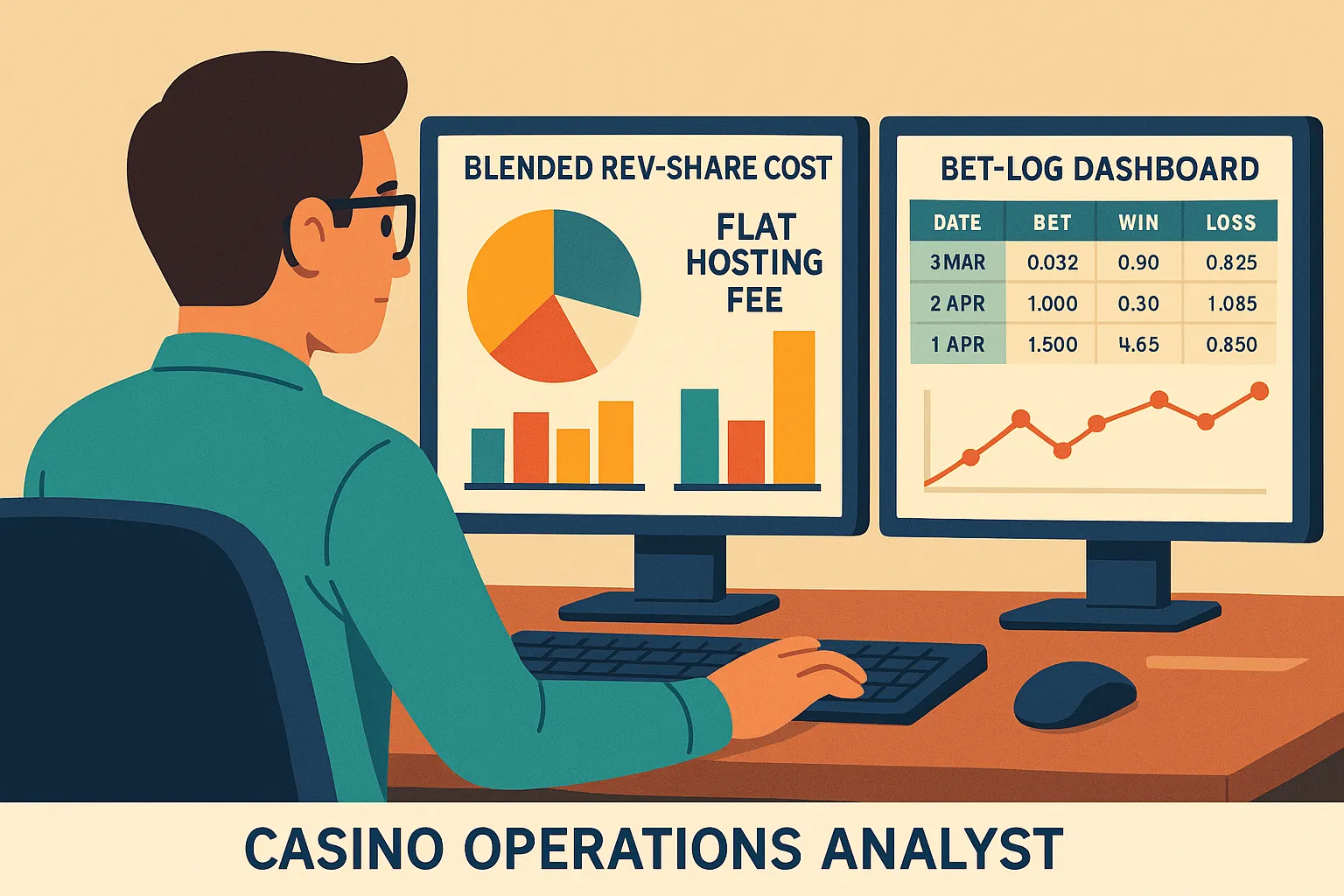
- No audit trail: Without granular bet logs, disputes can stall payments. Insist on immutable log access (another reason many operators rely on Spinlab’s analytics stack).
Frequently Asked Questions
Is flat hosting suitable for small startups? It depends on your projected GGR. If you’re below break-even thresholds, stick to rev-share until acquisition ramps up.
Can I mix flat and rev-share tables? Yes. Many operators keep high-margin blackjack on flat fees while leaving niche titles on rev-share.
How long should the contract term be? Aim for 12–18 months with auto-renewal, giving flexibility to reassess market conditions.
What KPIs should I track post-switch? Monitor GGR per table, peak concurrency, uptime, and cost per active player. Spinlab’s real-time dashboard can automate these alerts.
Do regulators care about fee structures? Generally no, provided game fairness and tax reporting stay intact. Always document fee flows in compliance reports.
Ready to Add Predictable Margin to Your Live Casino?
Spinlab’s iGaming platform integrates with 35+ live dealer studios and ships pre-built analytics to model costs in real time. Whether you want to trial a single fixed-fee blackjack table or renegotiate your entire lobby, our team can surface data, automate settlement, and accelerate go-live.
Book a 30-minute strategy session to see how Spinlab turns hosting negotiations into bottom-line gains. Visit spinlab.studio or click Schedule Demo inside your dashboard.