

Online casino players trust that every spin, card draw, and crash multiplier is genuinely random. Regulators demand proof. Yet the classic pseudo-random number generators (PRNGs) approved by testing labs remain a black box to most players, while purely on-chain randomness often struggles with latency and cost. Enter the hybrid RNG: a model that fuses cryptographically secure PRNG output with publicly verifiable blockchain seeds to deliver fast, certifiable, and provably fair entropy in a single workflow.
Why the Industry Is Looking Beyond Stand-Alone PRNGs
Traditional PRNGs—from Mersenne Twister variants to ANSI X9.17 and CTR-DRBG—produce high-throughput randomness that easily passes GLI-19, iTech Labs, or UKGC tests. However, they expose two pain points:
- Opacity. Players can’t independently verify that the casino hasn’t manipulated the seed.
- Single-point compromise. If the internal seed or implementation leaks, attackers can predict future outputs, as highlighted by the famous 2020 MT vulnerability in several self-hosted slots.
Blockchain-based randomness (e.g., using Bitcoin block hashes or Chainlink VRF) solves transparency but introduces new concerns:
- Transaction fees and confirmation times impede sub-second games like crash or roulette.
- Public pre-reveal of pending block hashes invites miner front-running in niche scenarios.
- Some regulators still have no formal test scripts for L1/L2 oracles, delaying certification.
A hybrid approach combines the strengths of both worlds while neutralising their weaknesses.
How a Hybrid RNG Works
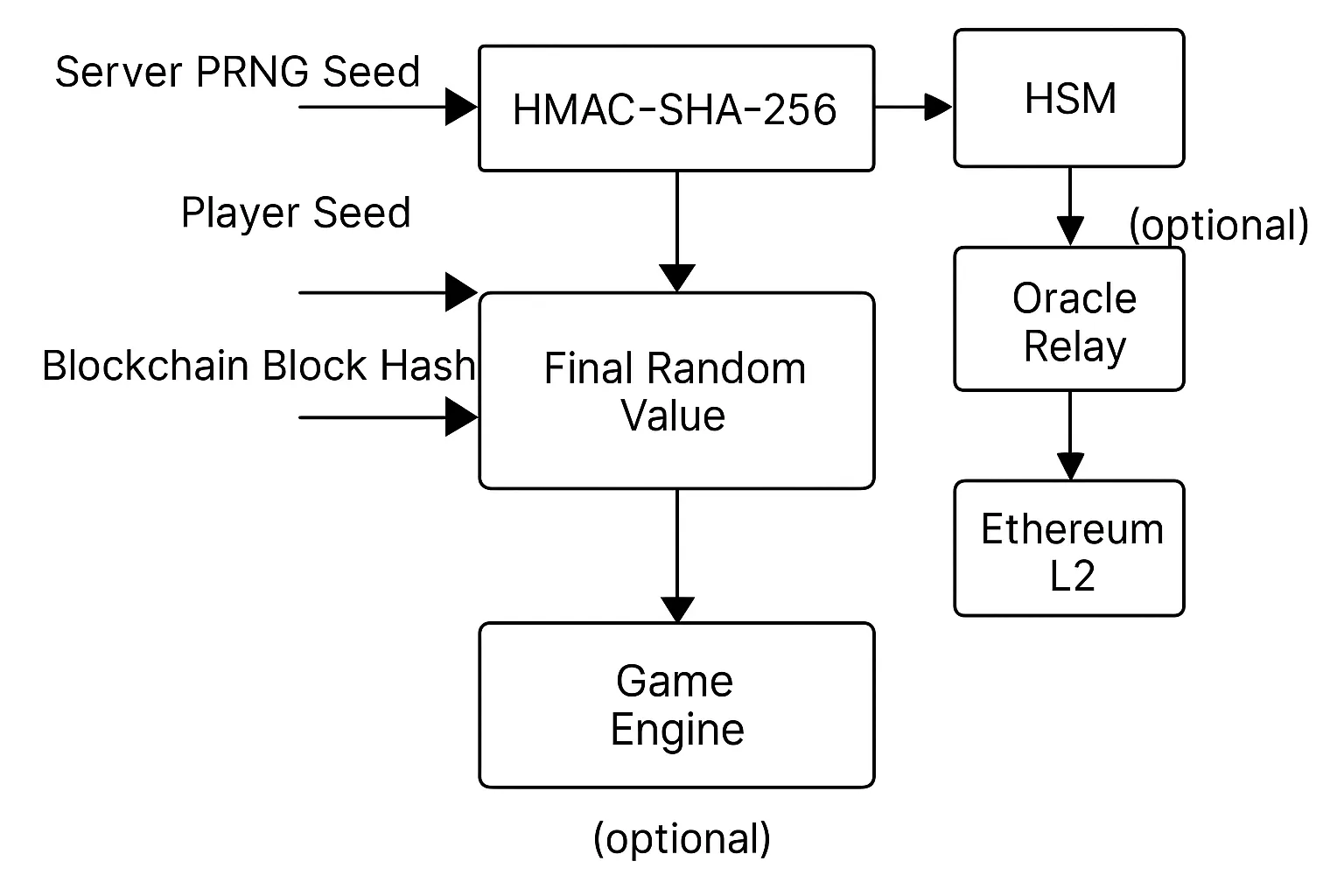
At its core, a hybrid model mixes three independent entropy sources:
- Server seed: Continuous output from a lab-certified cryptographic PRNG hosted in a Hardware Security Module (HSM).
- Player seed: A client-supplied nonce (optional but popular in provably fair implementations).
- Blockchain seed: The hash of a recently finalised blockchain block (L1 or L2), delivered via an oracle API.
The final random value is produced by hashing the concatenation—often through HMAC-SHA-256 or SHA-3—of the three seeds. Because any single component changing alters the output, neither the operator nor the player nor the blockchain alone can bias the result.
Mixing Algorithms in Practice
- Collect new PRNG bytes from the HSM (e.g., 32 bytes).
- Accept the player seed sent during bet placement (e.g., 16 bytes).
- Pull the latest confirmed block hash using a low-latency oracle (≤ 1 second for most L2s).
- Compute
rand = HMAC_SHA256(server_seed || player_seed || block_hash, key). - Feed
randto the game math engine (e.g., convert to 0-1 float or integer range). - Store all inputs in an append-only audit log; make them downloadable in the game history UI so players can reproduce outcomes off-chain.
Performance & Latency Benchmarks (2025)
| RNG Type | Avg Latency (ms) | Cost / 1M Calls | Player Verifiable? | Lab Certifiable? |
|---|---|---|---|---|
| Stand-alone PRNG (HSM) | 0.4 | $0.12 | No | Yes |
| Blockchain-only (L1 block hash) | 7000 | $210 | Yes | Mixed |
| Blockchain-only (Chainlink VRF v2) | 450 | $110 | Yes | Mixed |
| Hybrid (PRNG + L2 hash) | 2.5 | $0.35 | Yes | Yes |
Data source: Spinlab internal latency tests on a Nov 2025 benchmark environment using Optimism block hashes and an A800 HSM cluster.
Regulatory Acceptance: Walking the Line
Most major labs (GLI, eCOGRA, BMM) base approval on statistical quality and tamper-resistance. They generally allow hybrid models provided:
- The PRNG component alone meets industry standards (NIST SP 800-90A or ISO IEC 18031).
- The mixing function is deterministic, open-sourced, and documented in the test plan.
- Blockchain seeds are sourced from a finalised block (≥ 6 confirmations for Bitcoin; ≥ 2 for most L2s) to avoid reorg ambiguity.
The Isle of Man GSC, for instance, green-lit its first hybrid-RNG bingo title in May 2025 after a dedicated audit appendix. Expect wider recognition by 2026 as more operators submit similar models.
Security Threat Model
- Seed leakage. Use envelope encryption and split-key custodial storage inside an HSM to protect server seeds.
- Oracle tampering. Fetch block hashes from at least two independent nodes and cross-verify.
- Chain reorgs. Reference blocks deep enough to withstand probabilistic finality or implement game-outcome caching with rollback logic.
- Front-running. Because the server PRNG seed remains secret until after the game, attackers can’t predict the final value even if they know the block hash in advance.
Implementation Checklist for Operators
- Choose a high-performance HSM or cloud KMS that supports CTR-DRBG or Fortuna.
- Integrate a low-latency oracle (e.g., Chainlink CCIP Read, Spinlab’s upcoming RNG Oracle API) for L2 hashes.
- Document the mixing algorithm in your RNG submission to the test lab.
- Build a player-facing verification widget with one-click export of seeds and result.
- Configure monitoring alerts when oracle latency exceeds 100 ms or block age > 2 min.
- Maintain a cryptographic audit log and replicate to write-once storage for 7 years (typical UKGC retention rule).
Real-World Adoption Signals
- Stake .com and BC.Game already expose combined server/blockchain seeds in their “verify fairness” pages, clocking < 5 ms RNG response times.
- Several LATAM-focused operators piloting Spinlab’s white-label Crash module recorded a 26 % lift in first-time deposits after emphasising provably fair hybrid RNG in landing page copy (Q3 2025 A/B test; contact Spinlab for the private report).
Where Spinlab Fits In
Spinlab’s modular iGaming platform includes:
- A pluggable RNG microservice that supports hybrid seed mixing out of the box.
- Append-only audit logging streamed to both S3 and BigQuery for real-time analytics—see our guide on Real-Time Analytics in iGaming for monetisation ideas.
- Open API endpoints so studios can call the hybrid RNG directly or request raw entropy for off-platform math engines.
- Optional L2 relay nodes (Optimism, Polygon zkEVM) maintained by Spinlab to minimise oracle latency without dev-ops overhead.
Ready to upgrade fairness and transparency without sacrificing speed? Reach out for a sandbox key and test Spinlab’s hybrid RNG against your current stack in under 30 minutes.
Looking Ahead: Quantum Seeds on the Horizon
Hybrid models are a stepping-stone. As hardware costs fall, expect quantum RNG cloud APIs to replace or supplement server seeds. For a deep dive, see our article How Quantum RNG Could Redefine Game Fairness by 2027. Combining quantum entropy with blockchain transparency could deliver unparalleled trust—and Spinlab’s architecture is already designed to plug in that fourth seed when the market is ready.
Hybrid RNGs let operators keep the blazing performance and certification workflow of classic PRNGs while layering on the transparency today’s crypto-savvy players demand. By blending server, player, and blockchain seeds in a verifiable formula, casinos can upgrade trust, pass audits, and even boost conversion—without rewriting their game engines. The technology is production-ready and waiting; the competitive edge goes to the first movers who deploy it at scale.