

KYC is often treated like a compliance checkbox. In practice, it is a product decision that can determine whether a new player deposits in the first session or disappears forever. The challenge is that the “best” KYC vendor on paper can still destroy conversion if their mobile capture, decisioning latency, or retry UX is weak.
This guide gives you a vendor-comparison framework built for iGaming teams that need strong KYC/AML controls without killing UX.
First: decide what “good KYC” means for your casino
A vendor comparison goes sideways when teams compare feature checklists instead of outcomes. Before you evaluate providers, define your target KYC strategy in terms a product lead, compliance officer, and head of risk can all sign.
Key questions to answer (before you book demos)
- Where are you licensed, and where do you plan to expand next? Vendor coverage is rarely uniform across jurisdictions and document types.
- What is your risk-based KYC policy? Do you require verification at registration, at first deposit, at withdrawal, or at specific thresholds?
- What payment mix are you optimizing for? Card-heavy funnels behave differently than crypto-ready funnels (risk signals, chargebacks, speed expectations).
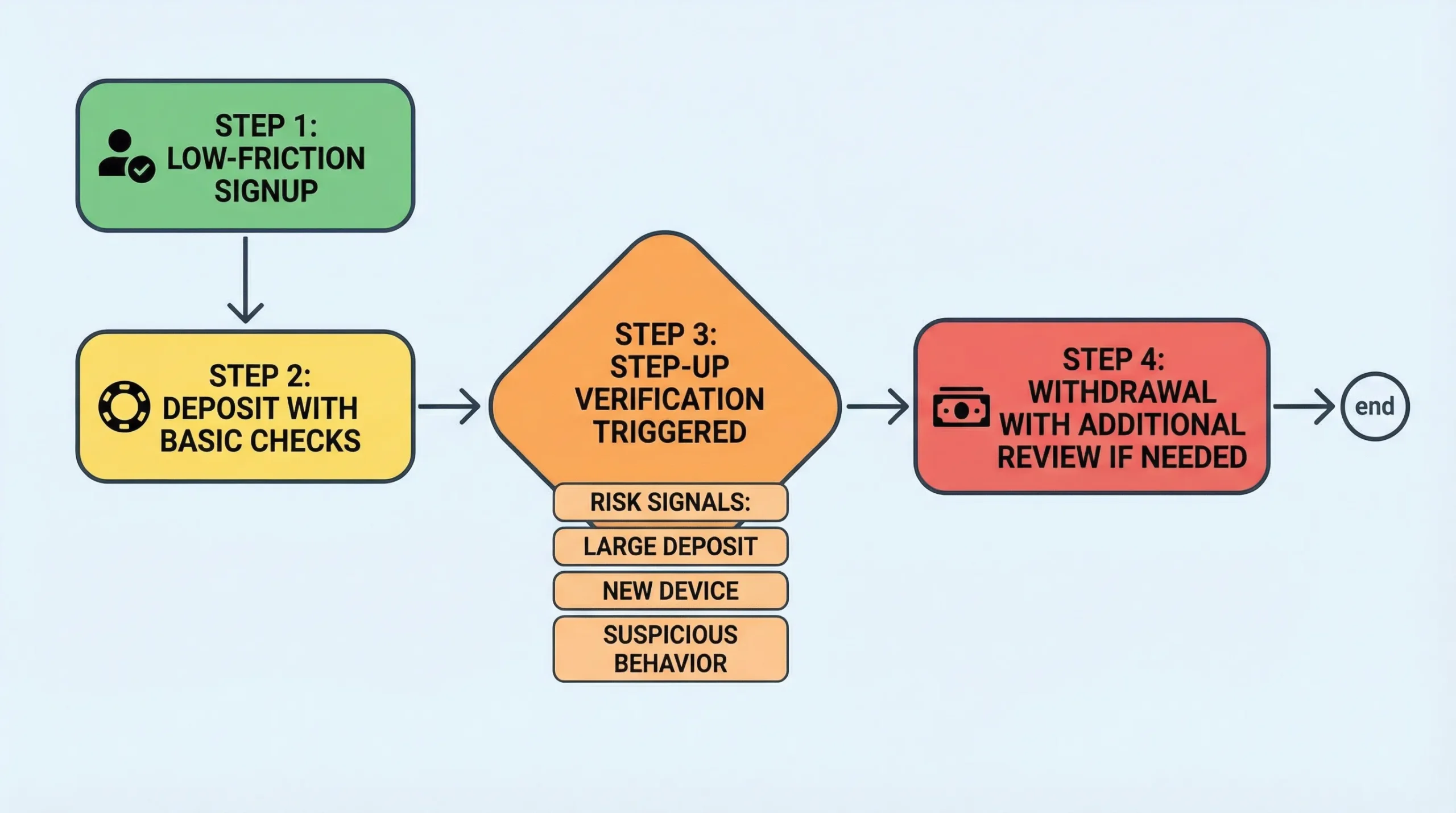
- What is your stance on progressive profiling? Some teams start with age/identity checks, then step up to address or source-of-funds at higher risk.
- What is your manual review appetite? Faster “auto-approve” can increase fraud losses if your downstream controls are weak.
If you want a practical companion read, Spinlab’s checklist on common KYC/AML operator mistakes is a good way to pressure-test your current assumptions.
Understand the KYC vendor categories (so you compare like-for-like)
Most “KYC vendors” are actually bundles of multiple capabilities. You will evaluate faster if you separate them into categories and map them to your flow.
- Document + biometric verification: ID capture, OCR, liveness, face match.
- Database / identity network checks: identity corroboration, address matching, device and phone signals (varies widely by region).
- AML screening: sanctions, PEP, watchlists, sometimes adverse media.
- Ongoing monitoring: post-onboarding re-screening, periodic refresh, event-based reviews.
- KYB (if you operate B2B or affiliates at scale): business verification, UBO checks.
- Orchestration layers: vendor routing, fallback providers, rules-based step-up.
In iGaming, orchestration matters more than most teams expect because you need to balance:
- conversion and speed,
- fraud resistance,
- and auditability.
The UX killers to look for in KYC vendor demos
A KYC demo can look flawless in a controlled environment. What breaks UX is usually edge cases: low-end Android devices, shaky hands, worn documents, glare, and patchy connectivity.
Here is what to actively test during evaluation.
1) Mobile capture quality and “time to a usable image”
If the SDK cannot guide users to a valid capture quickly, your drop-off will spike. In trials, insist on testing with:
- low light
- older devices
- front camera smudges
- passports and IDs from your top geos
Ask whether the vendor supports:
- real-time feedback (blur/glare detection)
- auto-capture (not just manual shutter)
- smart cropping and perspective correction
- clear, localized instructions
2) Retry and recovery UX (the hidden funnel)
Most users who fail once will quit unless the retry path is clear.
Check whether the vendor provides:
- explicit failure reasons that you can show to users (not only internal codes)
- “try again” loops without forcing a full restart
- the ability to switch document type (ID card to passport) mid-flow
- save-and-resume (especially important for emerging markets and mobile web)
For UX-specific patterns you can apply regardless of vendor, see 11 UX tweaks that cut KYC drop-off.
3) Latency and asynchronous states
A high-accuracy decision that takes 45 seconds is often worse than a slightly weaker one that returns in 5 seconds, if you do not design asynchronous handling.
During evaluation, measure:
- P50 and P95 verification decision time
- the frequency of “pending” states
- how long pending typically lasts (minutes vs hours)
If the vendor has meaningful pending volume, you need product support for:
- clean “we’ll notify you” states
- automatic status updates
- a frictionless return path
4) Localization and accessibility
This is a frequent blind spot. If you operate globally, insist on testing:
- RTL support (where relevant)
- local date formats and character sets
- camera permission prompts that match platform norms
- accessible contrast, text size behavior, and screen reader compatibility
Compliance and risk capabilities that impact UX (directly)
It sounds counterintuitive, but better compliance architecture often improves UX because it reduces unnecessary step-ups and re-verification.
Risk-based step-up support
Ask whether the vendor can support multiple verification levels cleanly, for example:
- age/identity only
- identity + document authenticity
- identity + address
- enhanced due diligence triggers (policy-driven)
This aligns with the risk-based approach promoted by global AML guidance such as FATF recommendations (high level, but useful for framing your internal policy).
Evidence and audit exports
In gambling, “we verified them” is not enough. You need audit-ready evidence with chain-of-custody clarity.
Evaluate:
- what artifacts you can export (images, metadata, decision reasons)
- retention controls and deletion workflows
- reviewer action logs
- how quickly you can assemble an audit pack
Data residency and privacy controls
If you operate across the EU, LATAM, and other regions, your legal team will care about:
- data storage location options
- subprocessors
- breach history and disclosure practices
- support for DSAR workflows
(For broader privacy comparisons relevant to casino data, Spinlab’s GDPR vs LGPD guide is a practical reference.)
Integration questions that separate “easy onboarding” from a 3-month mess
KYC vendors can be technically “simple” but operationally painful. Your goal is to minimize engineering complexity while maximizing control over the player journey.
Ask these integration questions early
- Is there a stable API versioning policy? Breaking changes in KYC are production incidents.
- Do they provide webhooks for every state transition? (created, started, submitted, approved, rejected, pending)
- Can you self-host any components, or is it fully vendor-hosted? This affects latency, data control, and outage blast radius.
- How do manual reviews work? Queue management, SLAs, reviewer notes, and escalation paths.
- Can you route by jurisdiction, document type, or risk score? This matters if you plan multi-vendor fallback.
Operational reliability (the part procurement often forgets)
Treat KYC as a mission-critical dependency, because it is.
Request:
- uptime numbers with definitions (monthly, quarterly)
- incident postmortem practices
- support SLAs (including weekends)
- sandbox realism (do they provide test documents and edge cases?)
If you already centralize risk tooling, combine KYC signals with device and payment signals. Spinlab’s primer on device fingerprinting for casino fraud prevention shows the kinds of signals that reduce unnecessary KYC step-ups.
Pricing: compare total cost, not “cost per verification”
KYC pricing can be deceptively simple. The real cost includes retries, manual reviews, and false rejects that lower revenue.
Use a TCO model that includes:
- verification attempts per approved player (retries)
- manual review rate and reviewer cost
- false rejection cost (lost first-deposit margin)
- chargeback and bonus abuse loss reduction (downstream benefit)
Here is a pricing checklist you can use in vendor conversations.
| Cost component | What to ask | Why it matters for UX and ops |
|---|---|---|
| Base price per verification | What is counted as a “verification”? | Some vendors bill per attempt, others per outcome. |
| Retries | Are retries free, discounted, or full price? | Poor capture UX becomes a direct cost multiplier. |
| Manual review | Is it bundled, optional, or per case? | Manual review queues can create “pending” UX. |
| AML screening | Is sanctions/PEP bundled with identity checks? | Splitting vendors can add latency and integration burden. |
| Ongoing monitoring | How is re-screening billed? | Impacts lifecycle compliance cost. |
| Data storage | Are you charged for storage or exports? | Audits and disputes require evidence. |
Run a KYC vendor bake-off that protects conversion
If you only do subjective demos, you will choose based on sales polish. A bake-off gives you measurable UX and risk performance.
A practical 2-phase test design
Phase 1 (lab test, 2 to 5 days): your team runs edge cases across top devices and top document types.
Phase 2 (live pilot, 1 to 3 weeks): route a controlled percentage of new users to Vendor A vs Vendor B, with clear fallback rules.
Important: do not only measure approval rate. High approval rate can mean weak detection.
Track a balanced KPI set:
| KPI | Definition | What “good” indicates |
|---|---|---|
| KYC start rate | % of users who begin verification when prompted | Your UX prompt and placement are working. |
| KYC completion rate | % who submit successfully | Capture flow and retries are healthy. |
| Approval rate | % approved among submissions | Balance of friction vs strictness. |
| Time to decision (P50/P95) | End-to-end time until final result | Latency and pending behavior. |
| Retry rate | Attempts per completed submission | SDK guidance quality. |
| Manual review rate | % escalated to manual | Ops load and pending volume. |
| Fraud loss per approved user | Downstream loss indicator | Whether “easy KYC” is costing you later. |
| Support ticket rate | KYC-related tickets per 1k users | Hidden UX breakage. |
If you have a modern event pipeline, treat KYC like any other funnel. Spinlab’s post on turning abandoned deposit attempts into triggered revenue is a useful pattern: instrument the event, segment it, and act on it.
A simple decision matrix you can reuse (with weights)
This scorecard helps align stakeholders. Start with weights, then score each vendor 1 to 5 based on evidence from the pilot.
| Category | Weight (example) | What to include |
|---|---|---|
| UX performance | 30% | completion rate, retry rate, mobile capture quality, localization, accessibility |
| Risk and compliance | 30% | AML screening depth, audit logs, step-up support, ongoing monitoring, policy alignment |
| Coverage | 15% | supported countries, document types, languages, age verification support |
| Integration and control | 15% | APIs/webhooks, orchestration support, sandbox quality, fallback patterns |
| Commercials and TCO | 10% | transparent pricing, retry costs, manual review costs, contract flexibility |
You can adjust weights depending on your stage. New brands may overweight UX to get activation. Mature brands with high VIP volume may overweight compliance and fraud resistance.
Architecture patterns that keep KYC strong without wrecking UX
Even the best vendor will fail if you embed them in a rigid flow. These patterns reduce friction while improving control.
Pattern 1: progressive verification (with clear triggers)
Instead of forcing full verification at the earliest moment for every user, apply step-up triggers tied to your policy.
Examples of triggers (policy-dependent):
- large deposit attempt
- first withdrawal
- device or location anomaly
- high bonus abuse signals
Pattern 2: multi-vendor fallback for edge cases
Some documents or geos will fail disproportionately. A second provider for specific routes can recover conversion.
To do this cleanly you need:
- consistent internal “verification state” objects
- routing rules
- unified analytics across vendors
Pattern 3: treat “pending” as a designed state
If pending exists, design it explicitly:
- set expectations (“usually takes under X minutes” if you can justify it)
- provide a notification mechanism
- allow users to browse and learn without breaking session
Pattern 4: decouple KYC from the rest of onboarding
Do not let a KYC provider outage block your entire acquisition funnel. Use graceful degradation when allowed by policy, and keep your risk controls layered.

Where Spinlab fits (without locking you in)
Spinlab is an all-in-one, modular iGaming platform designed to launch and scale online casinos with built-in compliance tooling, fraud prevention, payments (crypto and fiat), and a customizable backoffice.
From a KYC vendor selection perspective, the key is avoiding a brittle, vendor-defined onboarding. A modular platform with an open API and configurable admin workflows helps you:
- integrate your chosen KYC vendor(s) without rewriting your casino stack
- monitor KYC outcomes alongside payments and fraud signals
- keep the UX consistent across mobile and web
If you are comparing platforms as well as KYC providers, Spinlab’s broader iGaming selection guide for emerging markets is a useful checklist for payments, compliance, and localization readiness.
Frequently Asked Questions
Which KYC vendor is best for online casinos? The best KYC vendor is the one that hits your required compliance outcomes while maintaining high completion rates on your actual device mix and top geos. Run a live pilot and score vendors on UX, risk performance, and operational reliability, not demos.
How do I choose a KYC vendor without increasing drop-off? Focus on mobile capture quality, retry UX, and decision latency. Then design progressive verification and clear pending states so users are not forced into a dead end during onboarding.
Should we do KYC at signup or at first withdrawal? It depends on your license, risk appetite, and payment mix. Many operators adopt risk-based step-up, verifying later for low-risk users while enforcing stronger checks before high-risk actions like large deposits or withdrawals.
What metrics should we track during a KYC vendor pilot? At minimum: KYC start rate, completion rate, approval rate, time to decision (P50/P95), retry rate, manual review rate, support tickets, and downstream fraud loss per approved user.
Is a single KYC vendor enough for global coverage? Sometimes, but many operators use fallback routing for specific countries or document types to recover conversion and reduce false rejects. This works best with a clean orchestration layer and consistent internal verification states.
How can we keep KYC compliant for crypto flows? Treat KYC as one layer of a broader compliance stack that may also include transaction monitoring and, in some cases, Travel Rule requirements. Your vendor choice should support your policy and your custody model.
Want a KYC stack that stays compliant without slowing deposits?
If you are rebuilding onboarding or switching verification providers, Spinlab can help you implement a KYC flow that protects conversion while meeting KYC/AML requirements.
Explore the platform at spinlab.studio or book a demo to review your current funnel, your jurisdictions, and the fastest path to a cleaner KYC experience.