

In 2025 more than half of crypto wagers processed on Spinlab’s network are micro-bets under US $1. These bite-size spins, crash multipliers, and faucet-drip wagers keep players engaged for hours—but they also break the economics of L1 blockchains where gas fees routinely dwarf the stake. Layer-2 (L2) rollups promise sub-cent fees and near-instant finality, yet real-world performance can vary wildly.
This field report shares the results of a week-long speed test on three of the most popular L2s—Arbitrum One, Polygon PoS, and zkSync Era—using a wagering workload that mimics a live casino micro-bet flow. If you are evaluating an iGaming platform, payment hub, or provably-fair on-chain game logic, these benchmarks will help you choose the right rail and avoid costly surprises.
Why L2 Throughput Matters for Micro-Bets
- Player UX: A two-second delay feels snappy; a ten-second delay between click and spin outcome triggers churn.
- Fee Ratio: On a $0.25 wager, a $0.02 fee equals 8 % of handle—unacceptable for casino margins.
- Risk & Fraud: Longer confirmation windows open race conditions for double-spend orphans and time-bandit attacks.
We previously explored L2 theory in “Why Layer-2 Blockchains Matter for Instant Payouts”. The present article moves from theory to practice with hard numbers.
Test Design
- Client: Headless Node.js script executed from Frankfurt, São Paulo, and Singapore AWS regions.
- Wallets: Ten fresh EOAs per chain seeded via native faucets/exchanges.
- Transaction mix (per wallet):
- 50 token transfers (ERC-20 USDC or equivalent)
- 50 simple smart-contract calls (bet -> emit result)
- Gas policy: 1.3× current base fee; no priority support.
- Measurement:
- TTFB = time to first block inclusion
- TTF = time to finality (fraud window for optimistic rollups counted separately)
- Effective Fee = gas × prevailing token USD price
The test ran continuously from 14–21 August 2025 capturing 9,000+ tx per chain.
Benchmark Results
| Metric (Median) | Arbitrum One | Polygon PoS | zkSync Era |
|---|---|---|---|
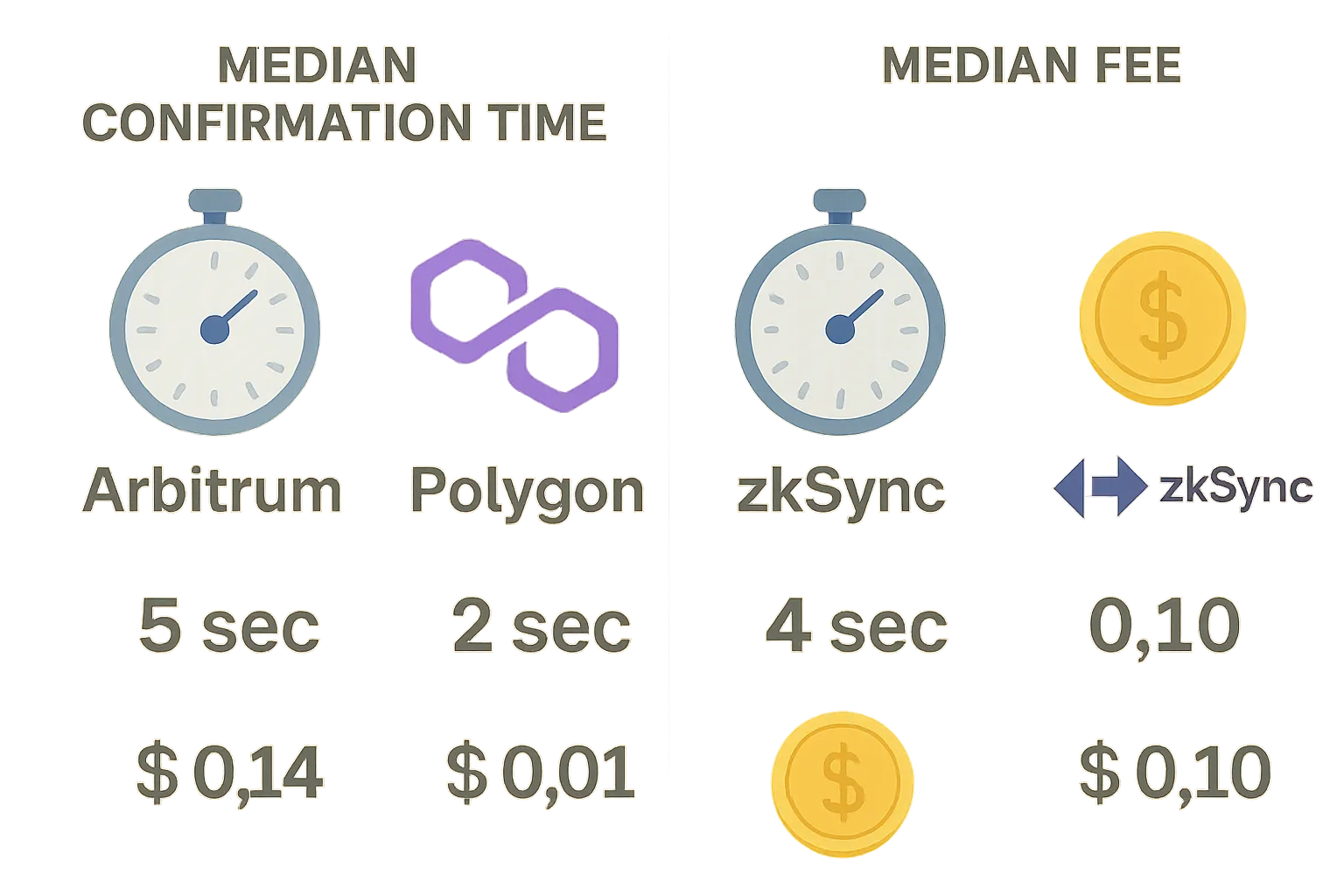
| TTFB (s) | 1.9 | 2.4 | 1.6 |
| TTF (economic) (s) | 2.0 | 2.6 | 1.7 |
| Finality (safe withdrawals) | ~7 days (fraud window) | 2–3 min (checkpoint) | <10 min (zk proof) |
| Effective Fee (USD) | $0.0041 | $0.0028 | $0.0037 |
| Throughput headroom * | 7–12 % network utilisation | 9–14 % | 4–8 % |
*At the time of testing; high-volatility events may spike utilisation and latency.
Key Takeaways
- Polygon leads on cost thanks to its hybrid PoS architecture and aggressive fee market; average micro-bet fee was under half a cent.
- zkSync delivers the fastest inclusion and lowest jitter, critical for synchronous game rounds like crash.
- Arbitrum’s UX is solid but the seven-day challenge period still complicates instant cashouts to L1 for some jurisdictions. On-rollup spend remains final after two seconds, but bridging policy must account for the window.
Deep Dive by Chain
Arbitrum One (Optimistic Rollup)
Strengths:
- Mature ecosystem, supported by major exchanges.
- Nitro upgrade reduced L1 calldata cost by ~50 %.
- High EVM equivalence simplifies contract porting.
Caveats for casino operators:
- The fraud proof window means fully finalized withdrawals to L1 take a week. Offer “instant” payouts by keeping liquidity on Arbitrum or using liquidity bridges—both add counter-party or smart-contract risk.
- Occasional sequencer downtime (Aug 16, 12-minute gap) caused 5× latency spikes. Plan for hot-failover routing to Polygon/zkSync.
Polygon PoS
Strengths:
- Cheapest average fee in the test.
- Massive wallet adoption; easy onramp via almost every exchange.
- Staking checkpoint to Ethereum every few minutes provides adequate security for micro-stakes.
Watch-outs:
- High TVL dApp launches can fill blocks and push fees north of one cent. Auto-adjust gas strategy or implement player-pays-gas logic for large events.
- Polygon zkEVM Mainnet Beta offers stronger security but is 3-4× more expensive today; monitor as it matures.
zkSync Era (zk-Rollup)
Strengths:
- Best raw speed and consistent latency under two seconds.
- Native account abstraction (AA) makes gasless meta-bets easier.
- Validity proofs remove the fraud window; withdrawals are trustless once the proof posts.
Constraints:
- API and node ecosystem still early; self-hosting archival nodes required for high-volume analytics.
- Tooling quirks (logs, debug) differ from geth; factor extra dev time.
Micro-Bet Economics: L1 vs L2
| Scenario | L1 Ethereum | L2 Average (test) |
|---|---|---|
| Wager size | $0.50 | $0.50 |
| Fee (USD) | $0.40 | $0.0035 |
| Fee / Handle | 80 % | 0.7 % |
Switching to an L2 reduces cost-to-handle by two orders of magnitude, enabling sustainable micro-bet margins even after promotions and affiliate rev-share.
Integration Blueprint for Casino Operators
- Unified Cashier: Extend your existing “hybrid fiat+crypto” cashier to support ERC-20 stablecoins on at least two rollups. See our 3-second UX checklist in “Cashier Conversion Hacks”.
- Bridging Strategy:
- Hot wallet=on-rollup for instant payouts.
- Treasury wallet=L1 for cold storage.
- Use native bridges for safety; overlay fast bridges for VIP cashouts with insurance caps.
- Gas Management: Drip micro-USDC balances to player sub-accounts and batch top-ups with 1Block’s bundler API or Spinlab’s built-in gas station.
- Provably-Fair Game Calls: Deploy RNG and game settlement contracts directly on the rollup. For third-party studio titles, wrap the settlement hash and emit it on-chain for auditability.
- Risk & Compliance:
- Run AML checks on L2 deposit addresses; most screening APIs now support rollup traces.
- Configure on-chain spend caps until KYC completes. Our “11 UX Tweaks That Cut KYC Drop-Off by 30%” guide shows how to surface limits without killing conversion.
How Spinlab Helps
Spinlab’s Fullhouse platform ships with a modular Crypto Cashier that already supports Arbitrum, Polygon, and zkSync:
- One API for deposits, withdrawals, and internal transfers.
- Automated gas escrow so players pay zero gas on eligible micro-bets.
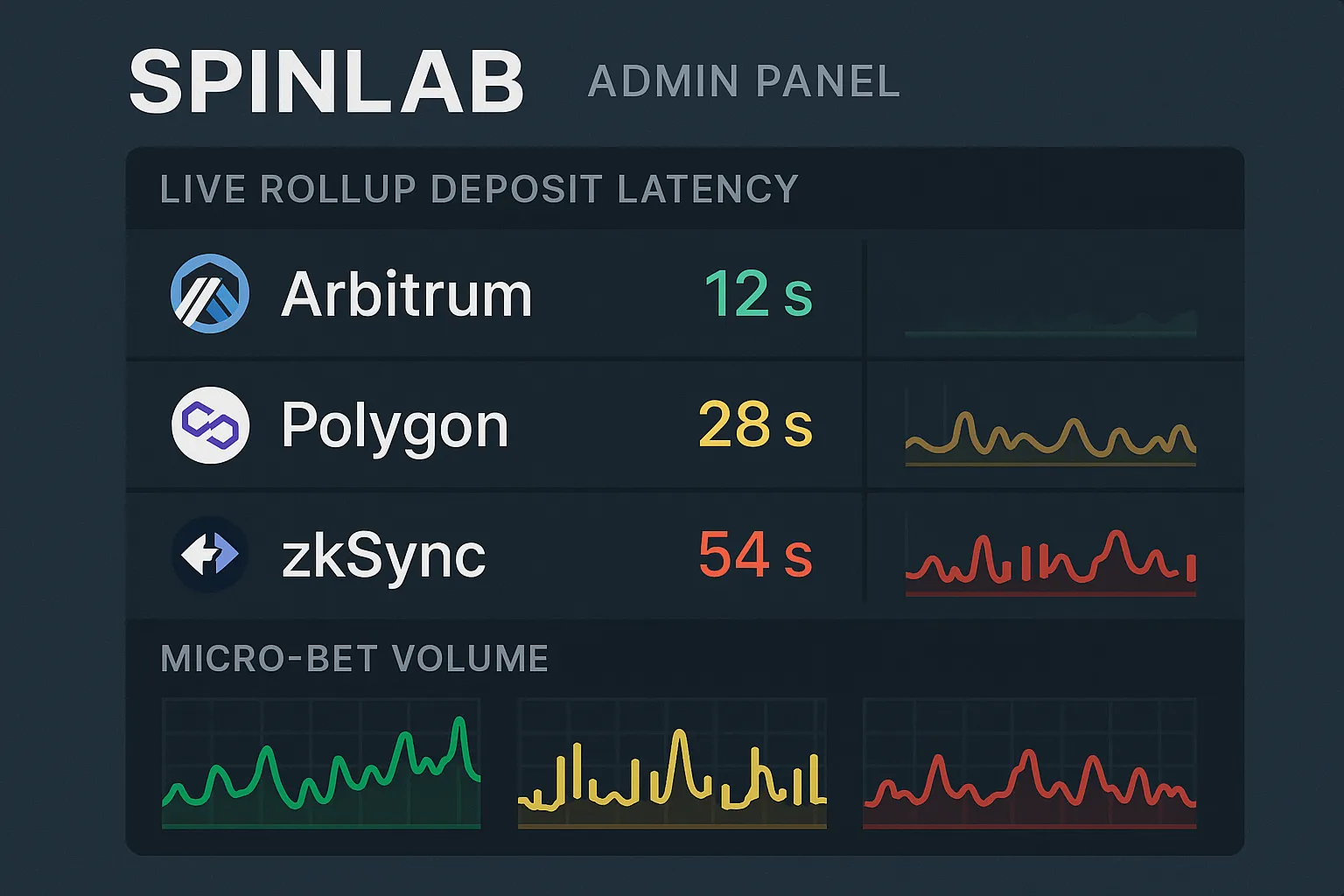
- Real-time analytics dashboards correlate rollup latency with session value—see “Real-Time Analytics in iGaming” for profit examples.
- Risk engine auto-quarantines funds crossing sanctioned bridges, keeping your licence safe.
Contact your account manager to enable additional rollups or request custom fee ceilings.
Roadmap Watch: What’s Next for L2 Gaming
- EIP-4844 (Proto-Danksharding) is projected to cut calldata costs by 70–90 % on rollups that adopt blobs, pushing average micro-bet fees below 0.1 cent.
- Shared Sequencers (Espresso, Radius) may remove single-point latency spikes and enable cross-rollup atomic bets.
- Intent-based wallets will let players deposit once and let the network choose the cheapest rollup per bet.
Forward-looking operators should architect abstraction layers now rather than hard-coding to a single L2.
Frequently Asked Questions
Do I need separate game contracts for each rollup? Not necessarily. If your game logic is stateless per round, you can deploy identical bytecode and share an RNG oracle. For stateful games, isolate liquidity pools per rollup or implement cross-rollup messaging with strict escrow limits.
How do gasless bets work on Polygon and zkSync? Both chains support meta-transactions. Spinlab’s cashier signs the transaction covering gas, then deducts an in-game service fee denominated in chips or loyalty points.
Is the Arbitrum seven-day window a deal-breaker? For on-rollup play it’s fine—only L1 withdrawals wait the window. Many casinos keep a portion of liquidity on Arbitrum and periodically bridge home when limits allow.
Which stablecoin should I list first? USDC remains the best-supported across all three rollups and major exchanges, simplifying onramps and treasury management.
Can I switch rollups without redeploying my whole stack? Yes. Spinlab’s open API abstracts chain IDs, while our routing layer lets you add or remove rollups via config toggles. Existing player wallets remain valid.
Ready to Slash Micro-Bet Fees?
If high gas costs or slow confirmations are throttling your growth, it’s time to test drive Spinlab’s L2-optimised cashier and provably-fair engine. Book a 30-minute demo and see how quickly we can add Arbitrum, Polygon, or zkSync support to your casino—often in under one week.
Schedule your private walkthrough at https://spinlab.studio today and start winning the micro-bet race.
Игровые автоматы — являются одни из самых известные развлечения в казино.
https://sciencehub.urban-moda.ru/LNyhBIMKxm6a/
На нашем веб-сайте можно обнаружить обилие полезной информации.
https://pitersk.ru/articles/2024-05-03-krossovki-premiata-italyanskiy-premium-dlya-praktichnyh/
Концепция разумного риска — это комплекс мер, направленный на сохранение контроля над собственными действиями и исключение потенциальных проблем.
https://1-mk.ru/detail/257-zhiteli-bragino-trebuyut-remonta-trotuara-nevozmozhno-proyti-ot-shestogo-mikrorayona-do-panina/
Принцип безопасного участия — это алгоритм, ориентированный на укрепление дисциплины по отношению к своими решениями и предотвращение зависимости.
https://e-transavto.ru/read/kambek-argentiny-i-uverennyy-bilet-shveytsarii-razbor-matchey-483/
На нашем сайте удастся обнаружить обилие практичной материалов.
https://sofiamoda.ru/style/2026-07-25-kak-otlichit-poddelku-ot-originala-klyuchevye-priznaki-podlinnykh-sumok-jimmy-choo/
A generic medication is a pharmaceutical product that contains the equivalent active substance as the original product.
It is produced to be equivalent the reference medication in strength, safety, and effectiveness.
After the exclusivity period on the brand-name product runs out, other manufacturers can produce and market generic alternatives at a reduced price.
iMedix diseases
A generic drug is a pharmaceutical product that contains the equivalent active substance as the original product.
It is designed to be equivalent the brand medication in dosage form, safety, and efficacy.
When the patent on the original drug runs out, other manufacturers can produce and distribute generic alternatives at a reduced price.
viagra professional chest pain warning
Здесь сайте вы сможете найти обилие нужной материалов.
https://www.reddit.com/user/Rare_Ad6396/
На представленном веб-сайте удастся обнаружить обилие нужной материалов.
https://labdiz.ru/full/570-berlinskiy-gambit-ilkhama-alieva-neozhidannaya-replika-v-epitsentre-taynykh-peregovorov.htm
Товарные перевозки выполняют основополагающую роль в хозяйстве любой страны.
Такие перевозки обеспечивают непрерывное обеспечение магазинов и производств всеми необходимыми материалами.
Эффективная транспортировка позволяет сокращать сроки и затраты на доставку товаров, что повышает рыночные позиции фирм.
В итоге, сектор перевозок являются критическим звеном текущей экономической системы.
https://perevozimgruz.by/
Online titles present users the exciting opportunity to socialize and have fun with gamers everywhere.
https://for-el.ru
Здесь ресурсе есть возможность отыскать обилие ценной материалов.
https://pitersk.ru/articles/2026-07-25-trendy-2024-goda-v-sumkakh-jimmy-choo-tsveta-formy-i-materialy/
Ежегодный осмотр автомобиля является важной процедурой для сохранения безопасности автомобиля.
Во время проверки обнаруживаются незаметные неисправности, что способны вызвать серьёзных поломок на трассе.
Регулярное посещение ТО дает возможность избежать больших расходов на сложный восстановление в будущем.
Помимо этого исправный транспорт гарантирует безопасность вашу и пассажиров на пути.
техосмотр на карте