

Provably fair systems have become a baseline expectation in crypto-forward iGaming, especially for crash games, dice, mines, and instant-win titles where players want to verify every result, not just trust a certificate. But many operators learn the hard way that “provably fair” marketing copy is not the same as an audit-ready implementation.
This guide breaks down what auditors actually look for when you claim provably fair, what evidence they expect to see, and how to prepare your platform and internal processes so the concept holds up under scrutiny.
What “provably fair” means (and what it does not)
In iGaming, provably fair generally means a player (or an independent third party) can cryptographically verify that:
- The operator committed to a secret value before the bet was resolved.
- The game outcome was derived from that committed value plus public or player-controlled inputs.
- The operator could not change the outcome after seeing the player’s action.
Most implementations use some version of a commit-reveal scheme (publish a hash commitment first, reveal the secret later), combined with deterministic randomness generation (often HMAC-SHA256) and an outcome mapping procedure.
What provably fair does not automatically guarantee:
- Regulatory compliance or licensing approval.
- Correct RTP or volatility over long samples.
- No insider manipulation outside the randomness function (for example, changing payout tables, max exposure rules, or game logic).
- Fairness across the entire stack (wallet settlement, bonus wagering logic, or withdrawal decisions).
Think of provably fair as “auditable randomness per round,” not “audited casino operations.”
Who audits provably fair in iGaming?
In practice, claims get reviewed by different parties depending on your business model:
- Regulators and licensing authorities may require independent testing for game integrity, change management, and operational controls.
- Independent test labs (for example, GLI, BMM Testlabs, eCOGRA, or iTech Labs) typically evaluate game RNG integrity, system behavior, and technical controls, usually against jurisdictional standards.
- Enterprise and banking partners may look for security and governance evidence (change control, access control, incident response), even when it’s not framed as “provably fair.”
For crypto casinos and provably fair-first products, the audit focus often shifts from “is your RNG certified” to “can an external party reproduce the exact outcome for a specific bet using your disclosed data and logs?”
The provably fair evidence auditors actually require
Auditors rarely fail you because you chose the “wrong” hash algorithm. They fail you because the implementation is ambiguous, not reproducible, or not governed. Below are the controls that come up most often during reviews.
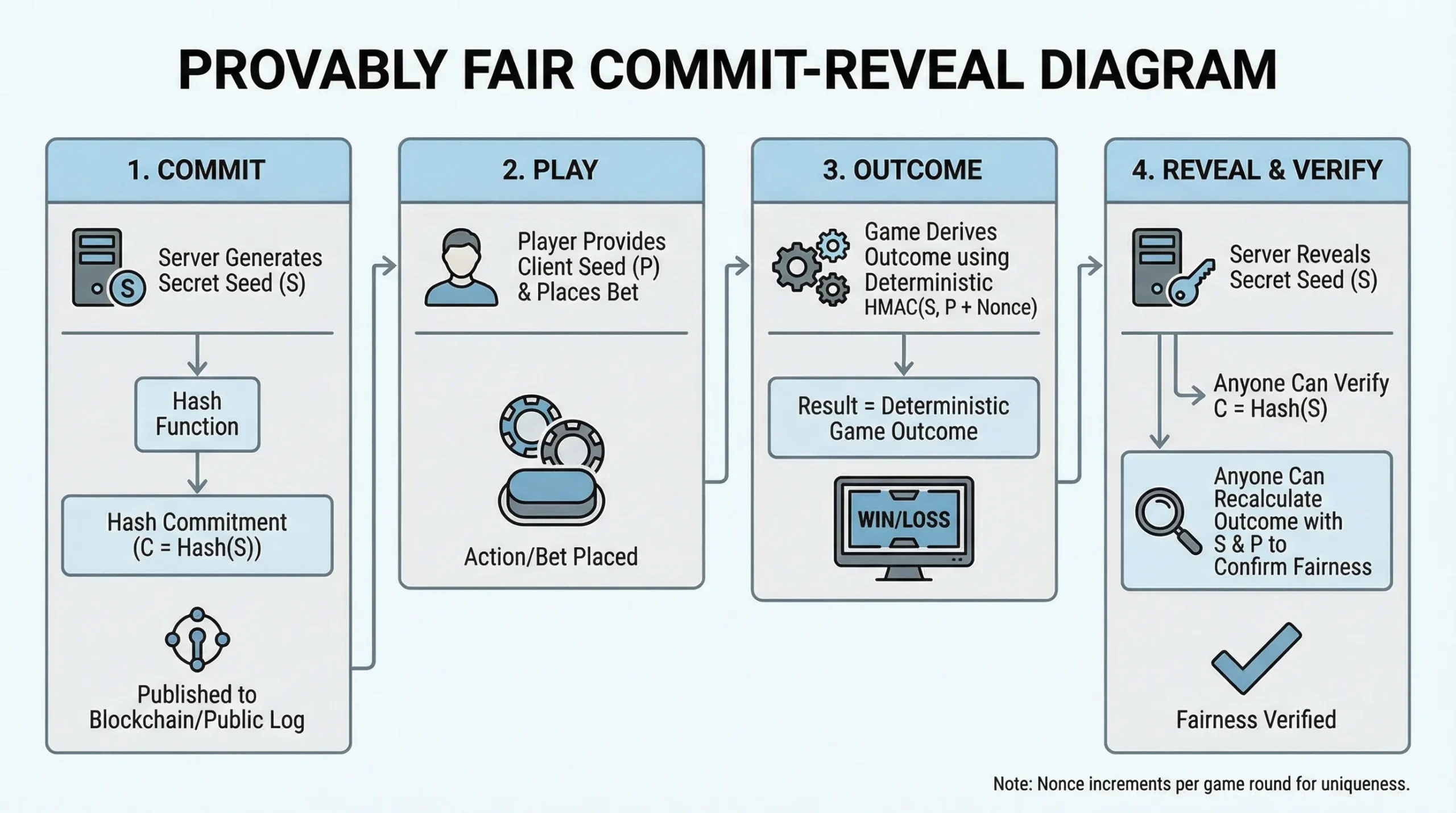
1) A precise, versioned randomness specification
Auditors want a written spec that answers, without interpretation:
- What inputs exist (server seed, client seed, nonce, optional block hash).
- How they’re combined (exact concatenation format, encoding, separators).
- The deterministic function used (for example, HMAC-SHA256).
- The mapping from random bytes to outcomes (uniformity and rejection sampling if needed).
- How the spec is versioned over time (so old bets remain verifiable).
If your “how to verify” page does not match the code (or changes without traceability), that is a red flag.
2) Seed generation quality and key management
Auditors expect you to show that server seeds are:
- Generated from a cryptographically secure RNG.
- Not guessable or predictable.
- Protected at rest and in transit.
The biggest governance question is usually: who can access or rotate server seeds, and how is that access controlled and logged?
For many operators, this becomes a key-management discussion (HSM/KMS usage, RBAC, break-glass access, audit trails), even though the feature is marketed as a gameplay fairness tool.
3) Commitment timing and immutability
Commitment is only meaningful if it is provably generated before the bet outcome is determined.
Auditors commonly look for:
- A timestamped record of the commitment per session, per game, or per round.
- Evidence it cannot be altered retroactively (append-only logs, signatures, immutable storage, or equivalent controls).
- Clear linkage between commitment and the later revealed seed.
A common failure mode is generating a commitment “just-in-time” after the bet request arrives, which weakens the claim that the operator could not adapt to the player’s choice.
4) Nonce handling and replayability
Provably fair verification depends heavily on correct nonce management. Auditors will ask:
- What exactly increments the nonce (per bet, per game, per session)?
- What resets it (new seed pair, new session, new wallet)?
- Is the nonce ever skipped, reused, or editable?
To pass a serious review, you should be able to replay any disputed round from logs and reproduce the same result deterministically.
5) Outcome mapping must be demonstrably unbiased
Getting deterministic bytes is only half the story. The mapping from bytes to results must not introduce bias.
Auditors may request:
- Proof the mapping is uniform across the intended range.
- Rejection sampling details if you map to non-power-of-two ranges.
- Simulation evidence (for example, statistical sanity checks) to demonstrate distributions behave as expected.
This is where many “simple” implementations fall down, especially for games with complex state machines or multiple random draws per round.
6) Change management, access controls, and separation of duties
Even if the math is perfect, auditors will look for controls that prevent someone from silently changing behavior:
- Source control discipline and peer review.
- Build integrity (signed artifacts, controlled deployments).
- Environment separation (dev, staging, prod).
- RBAC for configuration and any “operator tools.”
If your backoffice can change critical parameters (or swap out randomness code paths), you need governance around it, plus audit logs that can be correlated to gameplay events.
7) Player-facing verification UX and dispute workflow
Auditors increasingly care about whether the feature is real in practice:
- Can a player retrieve the exact seeds, nonce, and commitment for a round?
- Is verification explained clearly?
- Is there a support workflow for disputes that references immutable logs?
A provably fair system that only engineers can verify, using internal tools, often gets treated as “not truly player-verifiable,” especially in crypto-native markets.
Audit checklist table: controls and evidence
Use this as an internal pre-audit checklist.
| Area | What the auditor checks | Evidence you should have ready |
|---|---|---|
| Algorithm spec | Clear, unambiguous, versioned definition | Public or internal spec doc, version history, test vectors |
| Seed generation | Server seed is CSPRNG-generated and protected | Key management notes, access controls, seed rotation policy |
| Commitment | Commitment is created before outcome resolution | Commitment logs with timestamps, linkage to bet IDs |
| Nonce | Nonce rules are deterministic and non-editable | Event logs showing nonce per bet, replay scripts |
| Mapping | No bias in mapping random bytes to outcomes | Mapping proof notes, statistical sanity checks |
| Governance | Changes are controlled and attributable | Change tickets, code review trails, signed releases |
| Player verification | Players can actually verify results | “Verify” UI, exportable round data, support SOP |
The most common provably fair pitfalls (that trigger audit findings)
Most issues are operational and architectural, not cryptographic.
- Seed reuse across contexts (for example, reusing the same server seed across multiple games or long periods without strong logging and nonce guarantees).
- Inconsistent encoding (UTF-8 vs ASCII, hidden delimiters, JSON stringify differences), which makes external verification fail even if outcomes were deterministic.
- “Verification pages” that don’t match production code after a refactor.
- Editable or ambiguous nonces (support can “fix” a nonce, or the system can skip values under load).
- No immutable link between wallet settlement and game round (you can verify randomness but cannot prove the payout actually corresponded to that round).
- Backoffice overrides without audit trails (manual adjustments with no signed or append-only evidence).
If you want provably fair to survive disputes, build it like a financial control, not a marketing widget.
A practical 30-day prep plan for an audit
If you already have a provably fair implementation, the fastest path to audit readiness is usually documentation, test vectors, and log discipline.
Week 1: Define scope and lock the spec
Decide what is in scope:
- Which games are provably fair (often instant games first).
- What data must be disclosed per round.
- How long verification data remains accessible.
Then produce a spec with test vectors (known inputs and expected outputs) so an auditor can validate correctness quickly.
Week 2: Make replayability a first-class feature
Build an internal replay script that takes:
- Commitment
- Revealed server seed
- Client seed
- Nonce
- Game parameters (bet size, risk mode, etc.)
…and reproduces the outcome and payout exactly.
If you cannot replay deterministically from logs, you are not audit-ready.
Week 3: Harden governance and logging
Focus on:
- Append-only event logging for commitments, reveals, nonces, and result derivation.
- RBAC around seed rotation and any configuration affecting outcome mapping.
- Deployment controls so “hot fixes” do not silently change verification behavior.
Week 4: Run a mock audit and dispute simulation
Pick 20 to 50 historical rounds and verify:
- External verification works.
- Payouts reconcile to wallet entries.
- Logs prove ordering (commit before resolve).
Also run a simulated dispute: can support retrieve a complete evidence pack in minutes, not days?
Where your iGaming platform choice matters
Provably fair does not live in a vacuum. It touches game orchestration, identity, wallets, analytics, and compliance logging. If those systems are fragmented, audits become slow and expensive because evidence is scattered.
A modular all-in-one iGaming platform can reduce friction by centralizing:
- Game aggregation and session orchestration
- Wallet and payment records
- Compliance logging and access control
- Real-time analytics for anomaly detection
If you are building provably fair or hybrid models (common in crypto casinos), you may also want open APIs for exposing verification data and integrating third-party verification tools.
Spinlab is built as a modular, crypto-ready iGaming platform with integrated payments, compliance, and game aggregation. If you are exploring provably fair mechanics for instant games, you may also find these guides useful:
- Hybrid RNG Models: Combining Blockchain Seeds With Traditional PRNG
- The Beginner’s Roadmap to Launching a Crash Game in 2025
- How to Launch a Crypto Casino: Compliance-First Checklist
Frequently Asked Questions
Do regulators require provably fair for online casinos? Not universally. Many regulated markets focus on certified RNGs, system testing, and operational controls. Provably fair is more common in crypto-forward products, but your licensing requirements should drive the approach.
Is a certified RNG the same as provably fair? No. RNG certification generally tests that randomness generation meets statistical and security requirements. Provably fair focuses on per-round verifiability via cryptographic commitments and disclosed inputs.
What data must be shown to players for provably fair verification? At minimum, players typically need the commitment (hash), the revealed server seed, their client seed (or a record of it), and a nonce or round counter, plus clear instructions on the deterministic function and mapping.
What’s the most common audit failure for provably fair systems? Lack of reproducibility. If an auditor cannot replay a round from your logs and spec and get the same outcome, the implementation is not defensible.
Can provably fair work with aggregated third-party games? Sometimes, but it depends on what the provider exposes. Many third-party slots and live games are not built for player-verifiable randomness. Provably fair is typically easiest for first-party or tightly integrated instant games.
How long should you retain provably fair logs? It depends on your jurisdiction, dispute windows, and internal policies. Auditors generally expect retention aligned with financial and compliance recordkeeping, not just short-term gameplay analytics.
Want an audit-ready provably fair architecture (not just a badge)?
If you’re launching a crypto-ready casino or adding provably fair instant games, Spinlab can help you map the exact evidence auditors will ask for, then implement the logging, governance, and verification flows inside a modular platform.
Explore the platform at spinlab.studio or request a walkthrough to discuss your jurisdiction, game mix, and audit timeline.