

Search engines do not “see” your casino the way players do. They infer what your site is, what each page represents (brand page, lobby, game detail page, bonus page, support article), and how everything connects. Schema markup is the cleanest way to make those meanings explicit, using machine-readable JSON-LD that Google, Bing, and other crawlers can parse reliably.
For casino sites, this matters even more than in many other industries because:
- Your site usually has thousands of near-templated URLs (games, categories, providers, promos).
- You often run multiple brands, languages, and currencies.
- Trust, compliance, and clarity are part of conversion.
Below is a practical, operator-friendly guide to schema markup for casino sites, plus copy-paste JSON-LD templates you can adapt to your own pages.
What schema markup can (and cannot) do for casino SEO
Schema markup is not a ranking hack. It is structured data that helps search engines:
- Understand your entities (brand, website, pages, content types).
- Disambiguate your casino brand from similarly named brands.
- Build better sitelinks and navigational understanding.
- Qualify eligible pages for certain rich results (where supported).
What it cannot do:
- Force rich snippets to appear.
- Override Google’s gambling-related SERP restrictions.
- Make thin, duplicated, or non-compliant pages rank.
Google is also strict about structured data matching visible content and following policies. If you mark up content that is not shown to users, or you add ratings/reviews you cannot substantiate, you risk manual actions for structured data.
Helpful references:
JSON-LD basics (casino-friendly)
Use JSON-LD whenever possible. It is easier to deploy, easier to version, and less likely to break your UI than microdata.
Key rules that prevent 80 percent of casino schema issues:
- Use stable
@idvalues for your main entities (your Organization and WebSite). Think of@idas the “primary key.” - Keep structured data consistent across languages, domains, and subdomains.
- Do not mark up what you do not show. If a bonus has restrictions, the user should be able to find them on-page.
- Prefer a small set of correct schema types over dozens of questionable ones.
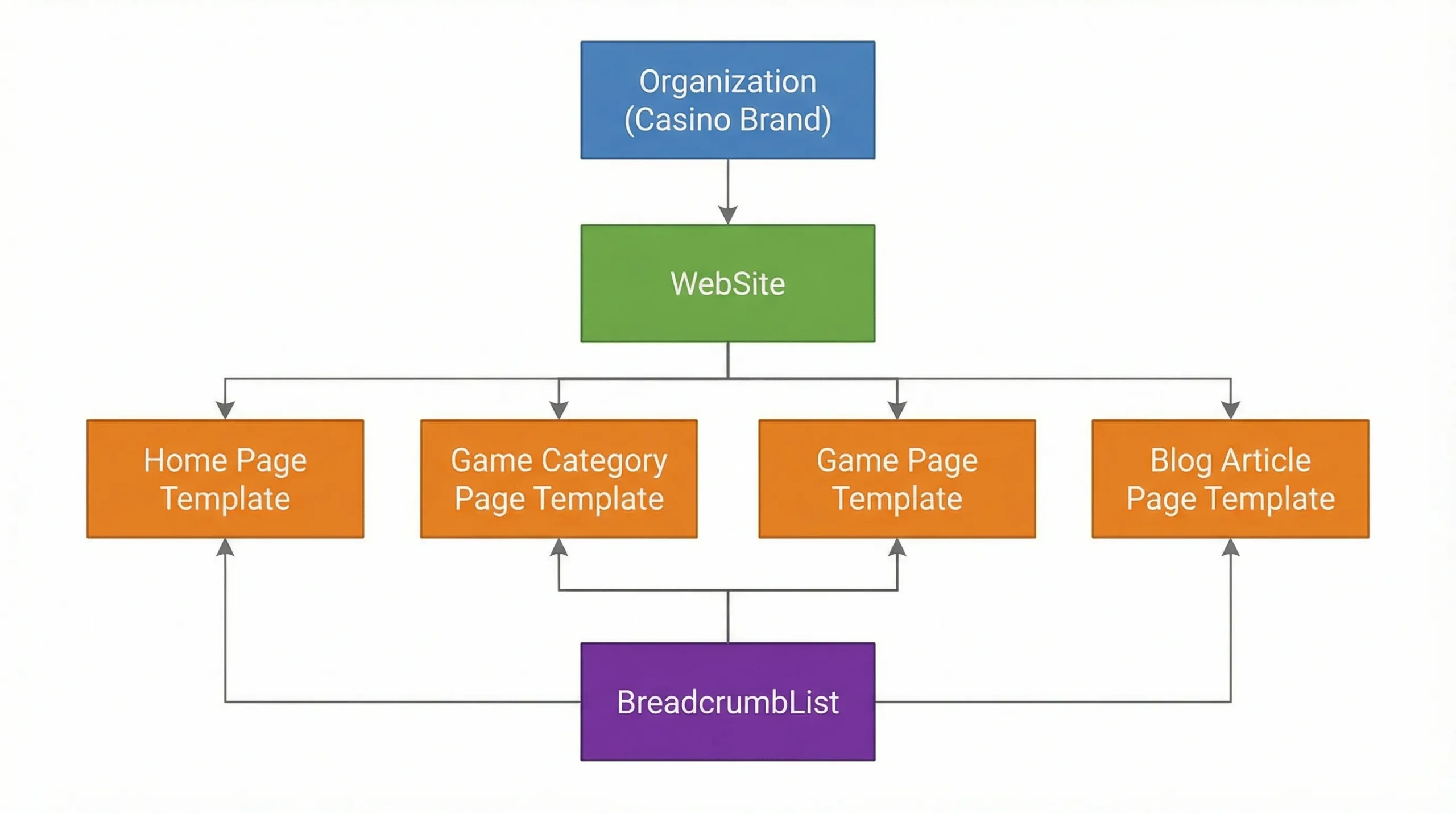
The schema types most casino sites should implement
A practical schema stack for online casinos is usually:
- Organization (or Casino, depending on what you are representing)
- WebSite (with
SearchActionif you have a real site search) - WebPage (implicitly via page-specific markup, or explicitly)
- BreadcrumbList (especially for game categories and game pages)
- Article (for editorial/blog content)
- FAQPage (for help content where appropriate)
Here is a simple mapping of page type to recommended markup.
| Page type | Recommended schema | Primary goal |
|---|---|---|
| Homepage | Organization + WebSite | Brand entity clarity and sitelinks support |
| Game category (provider, type, theme) | BreadcrumbList (+ optional ItemList) | Better page context and internal structure |
| Individual game page | BreadcrumbList + (optional Game) | Clarify “this is a game detail page” |
| Bonus/promo landing page | BreadcrumbList + (optional Offer) | Make promo details machine-readable (with caution) |
| Blog article | Article | Eligibility for article features and clean indexing |
| Help/Support FAQs | FAQPage | Better understanding and (sometimes) FAQ display |
JSON-LD templates for casino sites (copy, paste, customize)
All templates below use placeholders like YOUR_BRAND_NAME, https://www.example.com, and so on. Replace them with your real values.
1) Global Organization schema (brand entity)
Add this sitewide (commonly in your global layout head or footer). For most online casinos, Organization is a safe baseline.
<script type="application/ld+json">
{
  "@context": "https://schema.org",
  "@type": "Organization",
  "@id": "https://www.example.com/#org",
  "name": "YOUR_BRAND_NAME",
  "url": "https://www.example.com/",
  "logo": "https://www.example.com/static/logo.png",
  "sameAs": [
    "https://x.com/YOURHANDLE",
    "https://www.linkedin.com/company/YOURCOMPANY"
  ],
  "contactPoint": [{
    "@type": "ContactPoint",
    "contactType": "customer support",
    "url": "https://www.example.com/support"
  }]
}
</script>
Notes for casino operators:
- Only include
sameAsprofiles you control. - If you operate multiple brands, each brand should have its own
@idand Organization node. - If you have jurisdiction-specific brands/domains, keep IDs domain-scoped (do not reuse
@idacross unrelated sites).
2) WebSite schema + SearchAction (only if search exists)
If your casino has a real search function (for games, providers, promos), add WebSite with SearchAction.
<script type="application/ld+json">
{
  "@context": "https://schema.org",
  "@type": "WebSite",
  "@id": "https://www.example.com/#website",
  "url": "https://www.example.com/",
  "name": "YOUR_BRAND_NAME",
  "publisher": {
    "@id": "https://www.example.com/#org"
  },
  "potentialAction": {
    "@type": "SearchAction",
    "target": "https://www.example.com/search?q={search_term_string}",
    "query-input": "required name=search_term_string"
  }
}
</script>
If you do not have a search endpoint, skip SearchAction. Do not fake it.
3) BreadcrumbList schema (category pages)
Breadcrumbs are high-signal for casino sites because they clarify hierarchy across massive content catalogs.
Example for a slot category page:
<script type="application/ld+json">
{
  "@context": "https://schema.org",
  "@type": "BreadcrumbList",
  "itemListElement": [
    {
      "@type": "ListItem",
      "position": 1,
      "name": "Home",
      "item": "https://www.example.com/"
    },
    {
      "@type": "ListItem",
      "position": 2,
      "name": "Slots",
      "item": "https://www.example.com/slots"
    },
    {
      "@type": "ListItem",
      "position": 3,
      "name": "New Slots",
      "item": "https://www.example.com/slots/new"
    }
  ]
}
</script>
Implementation tip: breadcrumb markup should match the breadcrumb UI (or at least the visible navigation path).
4) Optional ItemList schema (game listings that are actually visible)
Many casino category pages are essentially “lists of games.” If your page visibly lists games, you can add an ItemList node.
Do not add 5,000 items. Keep it tight, for example top 20 visible games (or whatever is rendered server-side).
<script type="application/ld+json">
{
  "@context": "https://schema.org",
  "@type": "ItemList",
  "name": "New Slots",
  "itemListOrder": "https://schema.org/ItemListOrderAscending",
  "numberOfItems": 20,
  "itemListElement": [
    {
      "@type": "ListItem",
      "position": 1,
      "url": "https://www.example.com/games/game-slug-1"
    },
    {
      "@type": "ListItem",
      "position": 2,
      "url": "https://www.example.com/games/game-slug-2"
    }
  ]
}
</script>
Why this helps: it reinforces that the page is a curated list, not just a thin template.
5) Game detail page schema (careful and conservative)
Schema.org includes game-related types, but Google’s rich results support is limited and gambling-specific SERP behavior can be stricter than other verticals.
Still, adding conservative markup can help with entity understanding.
<script type="application/ld+json">
{
  "@context": "https://schema.org",
  "@type": "WebPage",
  "@id": "https://www.example.com/games/game-slug-1#webpage",
  "url": "https://www.example.com/games/game-slug-1",
  "name": "GAME_NAME",
  "isPartOf": { "@id": "https://www.example.com/#website" },
  "about": {
    "@type": "Game",
    "name": "GAME_NAME",
    "url": "https://www.example.com/games/game-slug-1",
    "genre": "Slots",
    "inLanguage": "en",
    "publisher": { "@id": "https://www.example.com/#org" }
  }
}
</script>
Avoid adding:
aggregateRatingunless you have a genuine, policy-compliant review system.- Fake “offers” or “price” fields. Casino play is not a standard ecommerce product.
6) Bonus or promotion landing page schema (optional Offer)
Bonuses are sensitive. Marking them up is possible, but you must ensure the offer details are clear on-page (terms, eligibility, time window).
This pattern uses Offer as “about” data on a WebPage.
<script type="application/ld+json">
{
  "@context": "https://schema.org",
  "@type": "WebPage",
  "@id": "https://www.example.com/bonuses/welcome-bonus#webpage",
  "url": "https://www.example.com/bonuses/welcome-bonus",
  "name": "WELCOME_BONUS_NAME",
  "isPartOf": { "@id": "https://www.example.com/#website" },
  "about": {
    "@type": "Offer",
    "name": "WELCOME_BONUS_NAME",
    "url": "https://www.example.com/bonuses/welcome-bonus",
    "availabilityStarts": "2026-02-01T00:00:00Z",
    "availabilityEnds": "2026-12-31T23:59:59Z",
    "eligibleRegion": "GLOBAL_OR_COUNTRY_CODE",
    "seller": { "@id": "https://www.example.com/#org" }
  }
}
</script>
Important:
- If a promotion is geo-restricted, reflect that in the page content and align the structured data.
- Do not use structured data to imply something stronger than your terms.
7) Blog Article schema (for your SEO content)
For editorial content, implement Article (or BlogPosting) consistently.
<script type="application/ld+json">
{
  "@context": "https://schema.org",
  "@type": "BlogPosting",
  "headline": "ARTICLE_TITLE",
  "description": "SHORT_META_DESCRIPTION",
  "image": ["https://www.example.com/static/blog/cover.jpg"],
  "datePublished": "2026-02-03",
  "dateModified": "2026-02-03",
  "author": {
    "@type": "Organization",
    "name": "YOUR_BRAND_NAME",
    "@id": "https://www.example.com/#org"
  },
  "publisher": {
    "@id": "https://www.example.com/#org"
  },
  "mainEntityOfPage": {
    "@type": "WebPage",
    "@id": "https://www.example.com/blog/article-slug"
  }
}
</script>
If you publish under named authors, use Person as author, but ensure your author page and byline support it.
8) FAQPage schema (use selectively)
FAQ schema is best for support and informational pages where the Q and A are clearly visible.
Note: Google has reduced FAQ rich results visibility for many sites over time, so treat this as an understanding and clarity play, not a guaranteed SERP feature.
<script type="application/ld+json">
{
  "@context": "https://schema.org",
  "@type": "FAQPage",
  "mainEntity": [
    {
      "@type": "Question",
      "name": "QUESTION_1",
      "acceptedAnswer": {
        "@type": "Answer",
        "text": "ANSWER_1"
      }
    },
    {
      "@type": "Question",
      "name": "QUESTION_2",
      "acceptedAnswer": {
        "@type": "Answer",
        "text": "ANSWER_2"
      }
    }
  ]
}
</script>
How to structure schema across multi-brand, multi-currency casino networks
Casino operators often have multiple brands, plus localized variants by language and jurisdiction. Schema can become inconsistent fast.
A clean approach:
Use stable entity IDs
- Organization:
https://brand-domain.com/#org - WebSite:
https://brand-domain.com/#website - WebPage:
canonical-url#webpage
This keeps your graph connected and avoids “floating” nodes that search engines cannot reconcile.
Avoid cross-brand pollution
Do not point different brands to the same Organization @id. If Spinlab helps you launch multiple casino brands on a single iGaming platform, each brand still needs its own public web identity in structured data.
Keep localization explicit
On localized pages, set inLanguage (for example en-US, es-MX, pt-BR) where relevant, especially on Articles and key WebPages.
If you manage localization at scale, pairing structured data with a disciplined content model helps. For a related implementation approach, see Spinlab’s guide on metafields for casino CMS.
Testing and monitoring schema markup (a simple QA workflow)
Schema should be treated like production code.
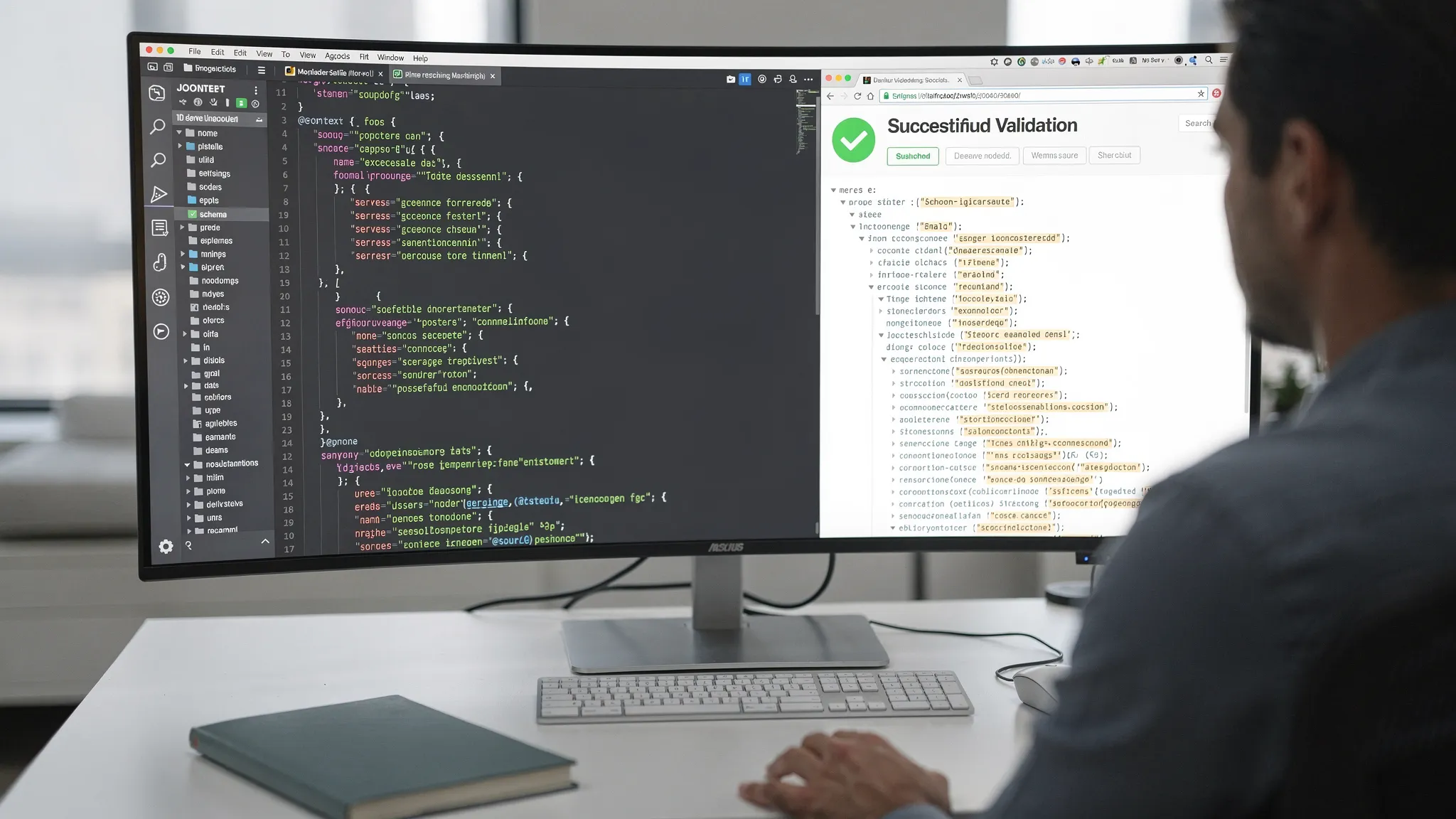
Validate on every template
- Validate representative URLs in Rich Results Test.
- Validate schema syntax and graph correctness in the Schema Markup Validator.
Add regression checks
If you deploy frequently (which many iGaming teams do), consider:
- Snapshot tests for JSON-LD blocks.
- CI checks that fail builds when required fields are missing.
- Monitoring for unexpected drops in indexed pages in Google Search Console.
Common schema mistakes on casino sites (and how to avoid them)
Marking up content that is not visible
This is the fastest way to get structured data issues. If you add bonus terms, game descriptions, or FAQs in schema, they should also exist in the rendered page.
Overusing Product and Review markup
Casino content is not standard ecommerce. If you add Product schema for games to chase star ratings, you can create policy risk. Only use review/rating markup when it is real, first-party, and compliant.
Duplicating schema blocks across the same page
Many casino frontends inject JSON-LD multiple times (theme + plugin + CMS block). Duplicate Organization nodes with different details confuse parsers.
Forgetting canonical alignment
Structured data url values should match your canonical URLs. This is especially important on parameterized lobby pages (sort, filters, pagination).
For deeper guidance on building casino category pages that rank without index bloat, see Casino CMS SEO: Category Pages That Rank and Convert.
A practical “minimum viable schema” checklist
If you want the highest ROI with the lowest risk, implement this first:
- Organization (sitewide)
- WebSite (sitewide, add SearchAction only if real)
- BreadcrumbList (category pages and game pages)
- Article (blog)
Then expand to ItemList and selected FAQPage markup once your templates are stable and you have a QA process.
Frequently Asked Questions
Is schema markup worth it for casino sites if Google limits gambling rich results? Yes. Even when rich results are limited, schema helps search engines understand your brand, page types, and site structure, which can improve crawling, sitelinks, and classification.
Should I use Organization or Casino schema for an online casino? Most operators start with Organization because it is broadly applicable and low risk. If you run a land-based property with a public address, Casino (as a LocalBusiness type) can be appropriate.
Can I add schema for individual slot games? You can, but keep it conservative. Use Game (or page-level about) to describe what the page represents, and avoid ratings, reviews, or ecommerce-style offers unless you can substantiate them.
Do I need schema on every page? No. Start with global entities and your highest-value templates (homepage, categories, game pages, blog). Once those are correct, scale carefully.
How do I know if my structured data is working? Validate with the Rich Results Test and Schema Markup Validator, then monitor enhancements and indexing signals in Google Search Console. Remember that “valid” does not guarantee visible rich snippets.
Implement schema markup faster on a modern iGaming platform
Casino schema is easiest to maintain when your frontend templates, CMS content model, and release process are organized. If you are building or migrating, a modular platform with customizable frontoffice templates and an open API makes it far simpler to generate consistent JSON-LD across thousands of game and promo pages.
Spinlab builds a modular, crypto-ready iGaming platform for launching and scaling online casinos with integrated payments, compliance, and game aggregation. If you want to reduce operational overhead while keeping full control over SEO-critical templates, explore Spinlab at spinlab.studio and book a walkthrough to discuss your site architecture and rollout plan.