
What is a shared liquidity pool?
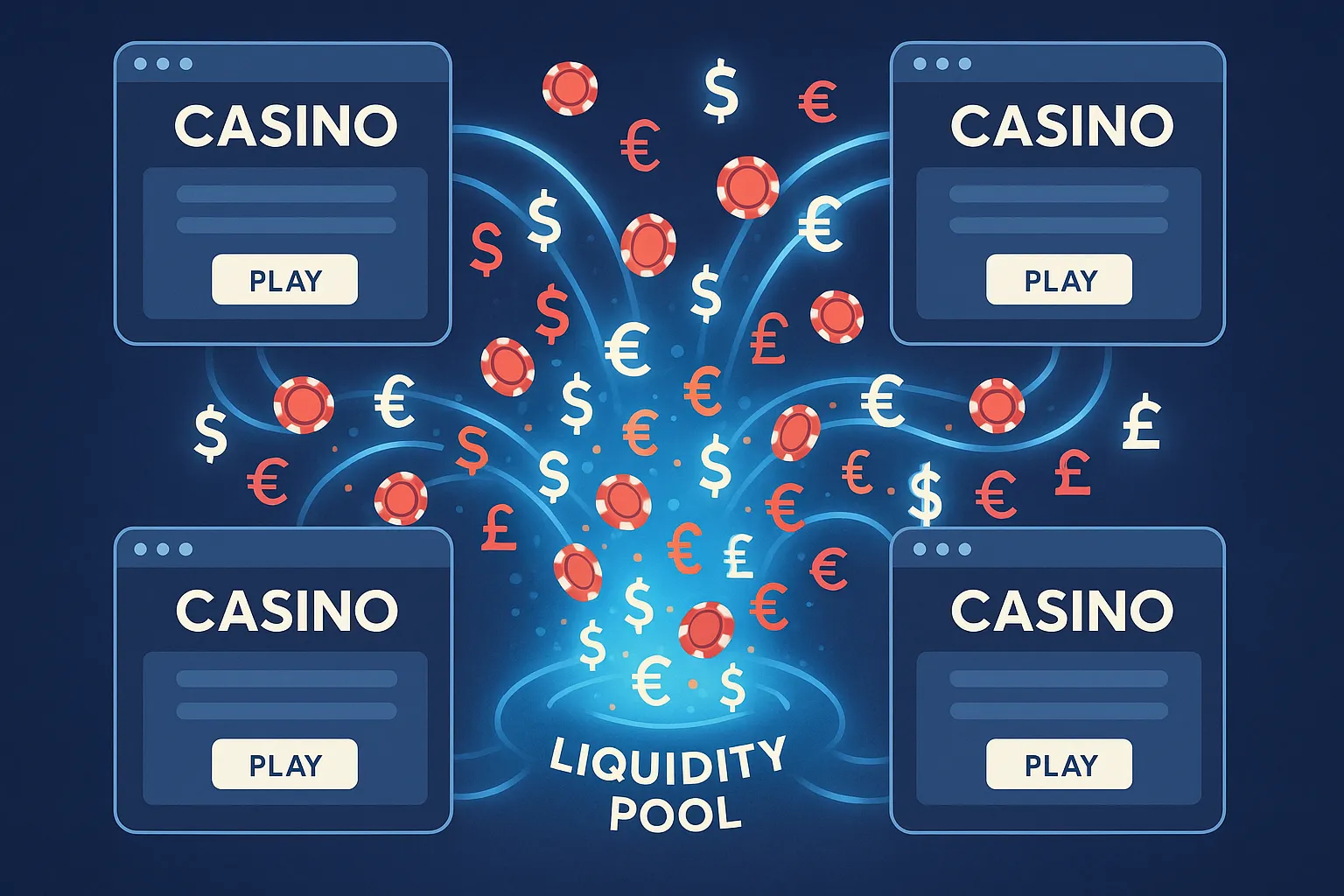
A shared liquidity pool (SLP) is a network arrangement where two or more operators connect their player bases and bankrolls so that everyone bets into the same real-money pot. The idea is simple: instead of your roulette wheel, crash game, poker table, or sportsbook market being limited to the traffic you alone can drive, all participating brands contribute stakes and benefit from a larger, more attractive pool.
Shared liquidity became mainstream in online poker during the late 2000s, and today it is rapidly expanding to live-dealer table games, multiplayer crash titles, prediction markets, and even progressive slot jackpots. For emerging or niche operators, it can be the fastest way to make a room feel busy from day one.
The upside: Why operators join forces
-
Instant critical mass
Nothing kills conversion like an empty lobby. By pooling liquidity, you can advertise full tables, million-dollar jackpots, and 24/7 action without spending a fortune on paid acquisition. -
Bigger jackpots = higher engagement
Pragmatic Play’s €30 million Drops & Wins or the Mega Moolah network have proven that eye-watering top prizes lift session time and retention. According to EGBA, progressive jackpot slots see 27 % higher spin volume than their fixed-payout twins. -
Improved RTP through shared risk
When a massive win hits, the blow is softened across multiple ledgers. This lets you offer more generous return-to-player percentages (RTP) or lower rake without jeopardizing your balance sheet. -
Cross-border reach
The combined pool can be denominated in multi-currency balances—fiat, stablecoin, or volatile crypto—increasing your appeal to high-value crypto whales who jump between brands. -
Operational efficiency
Marketing, game provisioning, and risk management costs are shared. In a typical poker network, individual rooms spend 35–40 % less on promo spend than stand-alone sites, according to internal Spinlab benchmarking.
The downside: Know the trade-offs
Nothing in iGaming is free money. Before you flip the switch, weigh the following:
- Brand dilution – Players may not instinctively recognize who hosts the game. That can hurt loyalty programs or VIP club differentiation.
- Revenue-share complexity – A three-party deal based on rake is straightforward; a dozen brands with multi-wallet crypto balances is not. Mismatched accounting calendars or tax jurisdictions only add layers.
- Regulatory patchwork – While the EU now permits cross-market poker liquidity (see France/Spain/Portugal/Italy agreement), many regulators still insist on ring-fenced player funds. Violate one jurisdiction and the entire pool can be frozen.
- Operational risk contagion – If one partner fails its AML checks or gets hacked, negative press will splash over everyone.
- Technical bottlenecks – Latency spikes or a single point of failure in the game server can disrupt all integrated brands simultaneously.
Regulatory snapshot – July 2025
| Region | Position on shared liquidity | Key requirements |
|---|---|---|
| EU (cross-liquidity poker agreement) | Allowed among licensed entities in France, Spain, Portugal, Italy | Segregated accounting per jurisdiction, player-level responsible gaming tracking |
| UKGC | Case-by-case approval | Daily pooled AML reports; jackpot contribution caps |
| Ontario (Canada) | Not yet permitted | Must ring-fence players; pending consultation |
| Curaçao & Malta B2C | Generally allowed | Player balance must remain in Tier-1 bank or custodial wallet |
| US interstate poker (NJ, NV, MI, DE) | Allowed for poker only | STMP (Shared Traffic Management Plan) filing |
Regulations change fast. Always consult a specialist or your compliance-as-a-service provider before signing any pool agreement.
Building versus joining: Three models
-
Network-based (join an existing pool)
- Examples: iPoker, GGNetwork, Pragmatic Play Drops & Wins
- Business model: Fixed participation fee + rev share (often 35–45 % of net gaming revenue)
- Fastest go-live; minimal tech lift
- Least branding control
-
Operator consortium (peer-to-peer Liquidity-as-a-Service)
- 3–8 mid-size casinos sign a multilateral liquidity pact
- Shared wallet smart contract or escrow handles payouts
- Governance via DAO-style voting or traditional contract
- Medium time-to-market; legal architecture required
-
DIY network (be the hub)
- You create the game server and invite skins/white labels
- Highest revenue upside; you collect platform fees
- Requires game certification, 24/7 ops, and deep liquidity on day one
Key technical pillars (and how Spinlab solves them)
-
Real-time data bus
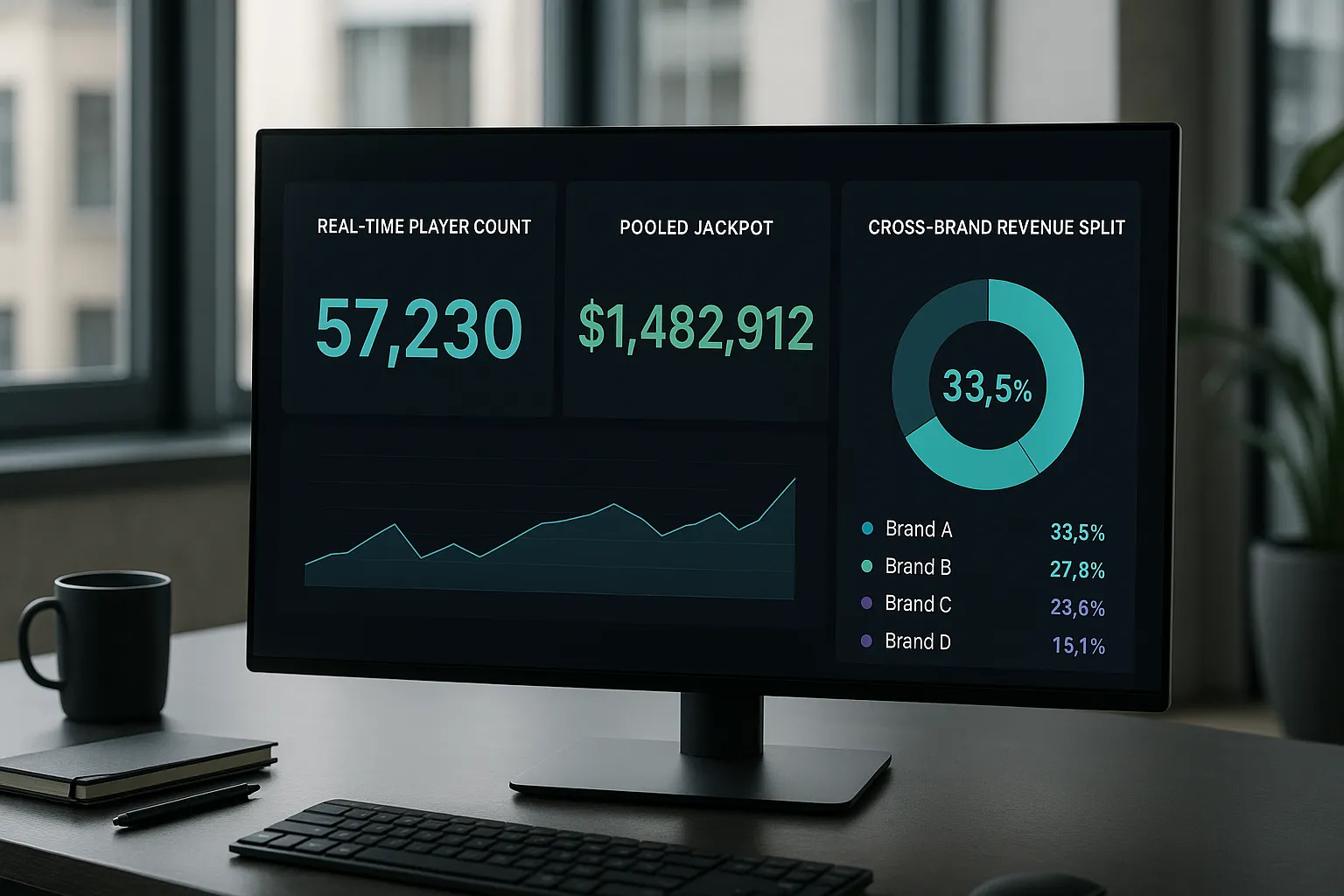
Every bet, contribution, and payout must be broadcast within milliseconds to all partners. Spinlab’s event-streaming architecture (Kafka + ClickHouse) was built for >100,000 TPS and underpins our real-time analytics module. -
Multi-wallet cashier
One player deposits USDT; another uses Apple Pay in EUR. Our hybrid cashier normalizes each stake into pool currency on the fly, referencing live FX and on-chain oracles. -
Secure custodial accounts
Merchant funds sit in segregated custody wallets, with programmable thresholds that automatically top-up jackpot reserve accounts when contributions fall short. -
Latency-optimized game servers
Edge nodes in Europe, Asia, and LATAM cut round-trip time for live casino streams to sub-80 ms, ensuring simultaneous card reveals look perfectly synced. -
Dynamic risk and fraud scoring
Shared liquidity multiplies collusion vectors. Our AI fraud module (Graph Neural Nets + Snowflake) flags chip dumping, seating collusion, or arbitrage within 200 ms.
Implementation checklist
Use this ten-step cheat sheet to avoid the most common pitfalls:
- Map regulatory overlap – Confirm that every jurisdiction you and your partners operate in allows pooling for the specific game vertical.
- Define pool economics – Contribution percentage, rake split, jackpot seed funding, and withdrawal periods.
- Select settlement currency – Single (USDC) or multi-currency ledger. Decide who eats FX slippage.
- Draft governance rules – Dispute resolution, forced withdrawals, mandatory KYC/AML standards.
- Integrate webhook/API endpoints – Test bet placement, cancelation, settlement. Spinlab offers open Swagger docs and Postman collections.
- Synchronize player IDs – Use anonymous hashed UUIDs to avoid GDPR headaches while still tracking duplicates.
- Deploy real-time monitoring – Set red-line alerts for liquidity imbalance, suspicious win streaks, and node health.
- Stress test payout spikes – Simulate a €10 million jackpot hit across currencies and gateways.
- Prepare customer support macros – Players will ask why a competitor’s logo appears on the live stream.
- Launch with a cross-network promotion – Shared leaderboards or matched-deposit bonuses to ignite traffic.
Case snapshot – Fullhouse Casino’s hybrid pool
When Fullhouse migrated to Spinlab in 2024, it negotiated a semi-private liquidity pool for its newly launched crash game. Three regional skins fed players into the same rounds. Results after six months:
- Average concurrent users: +310 %
- Jackpot contribution per stake: +18 %, enabling a headline €500k top prize
- Player LTV: +27 % compared with non-pooled RNG games (source: Fullhouse case study)
Frequently Asked Questions (FAQ)
Is shared liquidity only for poker?
No. Any game where multiple players bet into a common pot—crash, bingo, prediction markets, progressive slots—can benefit.
Can I opt out during big sporting events?
Yes. Spinlab’s admin panel lets you ring-fence liquidity for specific markets or time windows with one click.
How are responsible gaming limits enforced across brands?
Limits are stored at player-ID level in the pool ledger. If a user self-excludes on Brand A, that exclusion propagates network-wide in real time.
What happens if one partner goes bankrupt?
Player balances remain segregated in the custodial wallet. Smart contracts redistribute the failing partner’s stored contributions back to the pool automatically.
Does pooling slow down my website?
No. Game state travels via WebSocket streams; Spinlab’s edge CDN keeps latency flat even during peak UEFA Champions League matches.
Ready to plug into deeper liquidity?
Spinlab’s Fullhouse platform includes out-of-the-box shared liquidity connectors, hybrid fiat/crypto cashier, and instant compliance tooling—priced 30 % below the next cheapest white-label solution. Book a 30-minute discovery call and see how fast your games can fill up.