

“Modular” is one of the most overused words in casino software. Vendors use it to describe everything from a configurable theme to a full enterprise architecture. For operators, that creates a real problem: two platforms can both claim to be modular, yet one lets you swap a payment provider in days while the other needs weeks of custom development for every change.
A truly modular casino platform is not just a collection of features. It is an operating system for an online casino where the major business functions are separated, connected through stable interfaces, and managed without constantly touching the core codebase.
That distinction matters because iGaming is never static. Markets change. Payment methods come and go. Game providers release new content. Compliance expectations evolve. Bonus strategies shift. Crypto users expect faster cashier experiences. Affiliates demand better tracking. If your platform cannot adapt without expensive rebuilds, growth starts to feel like technical debt.
What “modular” should mean in casino software
A modular iGaming platform is built around independent functional components that can be configured, upgraded, replaced, or extended without breaking the rest of the system.
In practical terms, this means the platform separates key casino operations into clear domains such as player accounts, wallet and ledger, payments, KYC and AML, fraud prevention, game aggregation, bonuses, affiliates, analytics, front end, and backoffice administration.
The important part is not that these modules exist. Most modern platforms have versions of them. The important part is how they interact.
If the bonus engine depends on custom database changes every time you add a new provider, that is not truly modular. If payment routing is hardcoded into one cashier flow, that is not truly modular. If a new game provider integration forces a front-end rebuild, that is not truly modular. Real modularity means each part has a defined role, a defined interface, and a defined relationship to the platform core.
For a deeper comparison of packaging models, Spinlab has a separate guide on modular casino platforms vs all-in-one platforms. This article focuses on the architecture and operating signals that show whether a platform is genuinely modular.
The core must be stable, not bloated
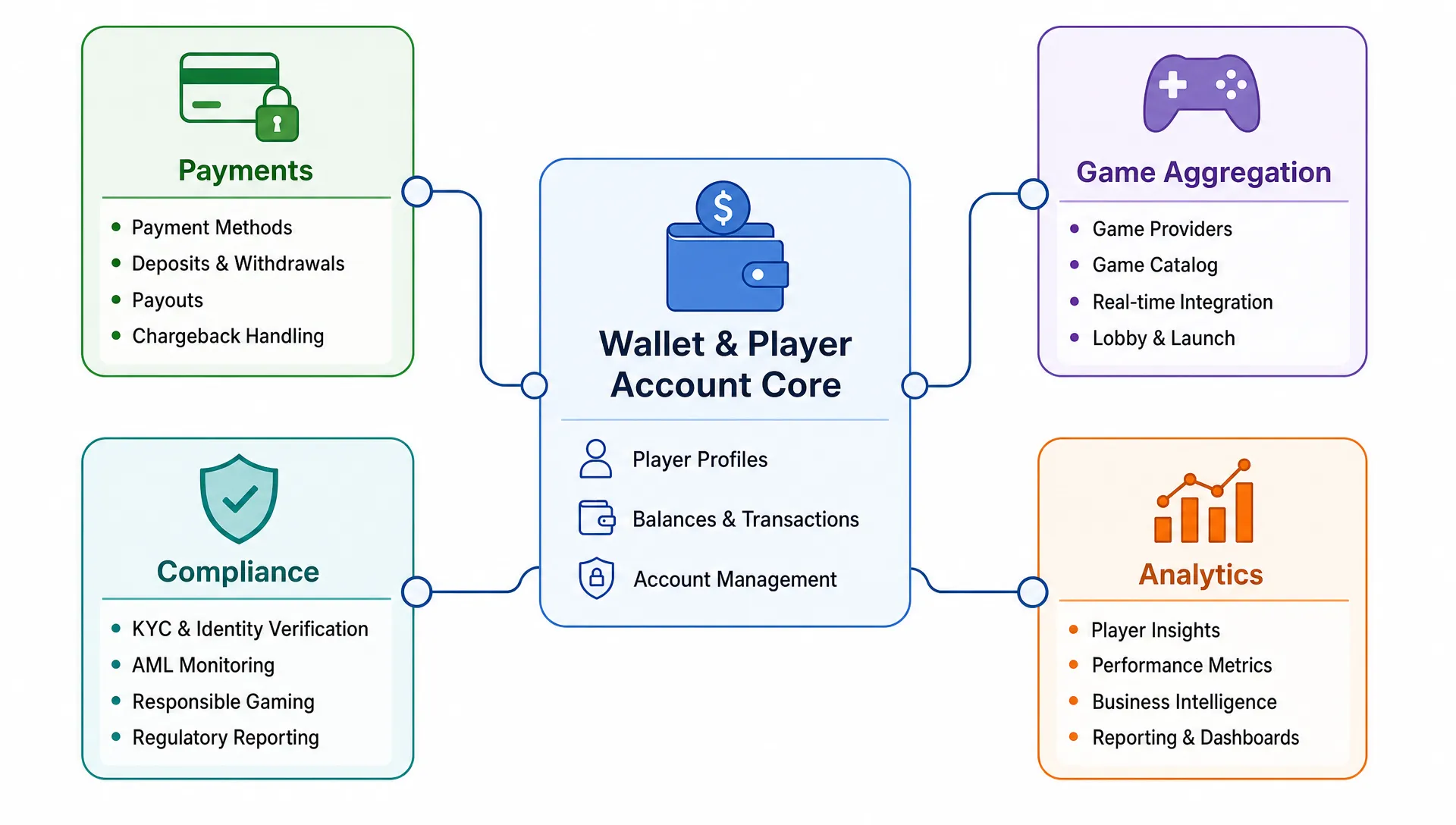
The first sign of a truly modular casino platform is a stable core. The core should handle the non-negotiable parts of the business: player identity, account state, wallet balances, transaction records, audit logs, permissions, and the rules that keep money movement consistent.
This core should not be overloaded with every possible feature. When too much logic is packed into the central system, changes become risky. A small update to bonuses can affect wallet behavior. A new game integration can create reporting inconsistencies. A payment provider change can create unexpected KYC issues.
A modular platform keeps the core focused and reliable. It then lets specialized modules interact with that core through controlled interfaces. This gives operators flexibility without sacrificing integrity.
The wallet and ledger are especially important. In real-money gaming, every bet, win, deposit, withdrawal, bonus credit, refund, and adjustment must be traceable. If modularity creates fragmented balances or inconsistent reporting, it is not an advantage. It is a liability.
Modules need clear boundaries
A casino platform is only modular if each module has a clear job. This sounds simple, but many platforms blur responsibilities in ways that make future changes painful.
For example, a payment module should manage payment gateway integrations, cashier flows, payment method availability, transaction status updates, and reconciliation data. It should not be the hidden place where player segmentation, fraud scoring, and bonus eligibility are all patched together.
A game aggregator should manage provider integrations, game metadata, availability, launch URLs, session handling, and provider status. It should not require custom changes to the wallet every time new slot games or live casino games are added.
A bonus engine should define promotional rules, eligibility, wagering requirements, and campaign behavior. It should not be inseparable from one affiliate system or one front-end template.
The cleaner the boundaries, the easier it is to improve one part of the casino without destabilizing another.
A truly modular platform has more than feature toggles
Feature toggles are useful. They let teams switch products, payment methods, bonuses, currencies, or regions on and off. But toggles alone do not make a platform modular.
A toggle controls visibility or availability. Modularity controls dependency.
If you can turn a feature on but cannot change how it works, connect it to another provider, localize it by market, or report on it cleanly, you have configuration, not modularity. That may be enough for a small launch, but it becomes restrictive when the business grows.
The strongest modular platforms usually combine three layers:
- Configuration: Operators can adjust settings, currencies, markets, game categories, bonus rules, limits, and permissions without developer involvement.
- Integration: The platform can connect to external services such as payment providers, KYC vendors, affiliate tools, analytics systems, and game suppliers.
- Extension: The platform can support new workflows, custom front-end experiences, or proprietary games without forcing a full rebuild.
A white label casino platform can still be modular if it offers these layers in a controlled way. A turnkey casino solution can also be modular if the prebuilt foundation does not trap the operator inside rigid workflows.
APIs are the connective tissue
Open, documented APIs are one of the strongest indicators of real modularity. They allow different systems to communicate without requiring every change to happen inside one monolithic application.
For casino operators, APIs matter because the business depends on external services. Payment gateways, crypto onramps, KYC tools, fraud systems, affiliate platforms, CRM systems, and data warehouses all need reliable ways to exchange information.
A modular casino platform should support APIs for the operational areas that frequently change or need integration. This includes player account data, wallet transactions, payment events, game sessions, bonus events, affiliate attribution, compliance status, and reporting exports.
Security is just as important as flexibility. API access should be permissioned, monitored, rate-limited, and designed around least privilege. The OWASP API Security Top 10 is a useful reference for understanding common API risks, including broken authorization and excessive data exposure.
If API access is central to your evaluation, Spinlab’s guide to why an open API casino platform matters explains the operational benefits in more detail.
Payments should be modular by design
Payments are one of the clearest tests of casino platform modularity. A platform may look modern in the lobby, but if adding a new payment gateway takes months, the architecture is probably not as flexible as it appears.
A modular payment layer should support multiple providers, multiple currencies, payment method rules by market, transaction status tracking, reconciliation workflows, and risk checks. For crypto-ready solutions, it should also handle the added complexity of wallet flows, onramps, custody considerations, confirmations, and conversion logic where applicable.
This does not mean every operator needs every payment option on day one. It means the platform should not force a rebuild when the operator expands into a new market, adds fiat rails, introduces crypto deposits, or changes payment partners.
Payment modularity also affects compliance and security. If card payments are involved, operators and vendors need to understand PCI DSS responsibilities. The PCI Security Standards Council provides the official framework for card payment data security.
A strong modular architecture lets the cashier evolve without compromising the wallet ledger, player experience, or operational reporting.
Game aggregation should not lock the brand in place
Casino content changes constantly. Operators want access to new releases, popular slot games, live casino games, crash games, table games, and sometimes casino original games designed for their brand. A modular game aggregation layer makes this possible without turning every provider change into a technical project.
The game aggregator should normalize provider differences so the rest of the platform can work consistently. Providers may use different launch formats, session rules, metadata structures, reporting formats, or promotional tools. The aggregator’s job is to absorb that complexity and expose a cleaner operational layer to the casino.
This matters for both speed and strategy. If a market responds well to a specific content category, the operator should be able to adjust the lobby, promote relevant games, and test new suppliers quickly. If a provider has downtime or commercial terms change, the operator should not be trapped.
Compliance must be configurable, not bolted on
Compliance is often treated as a checklist, but in modular casino architecture it should be a living system. KYC, AML, responsible gaming, market restrictions, player limits, sanctions screening, audit logs, and reporting requirements can vary by jurisdiction and business model.
A truly modular casino platform allows compliance logic to work across the platform without being hardcoded into each feature. For example, a player’s verification status should affect withdrawals, bonus eligibility, deposit limits, risk review, and account access in a consistent way.
This requires shared data and clear event flows. If the KYC module updates a player status, the cashier, bonus engine, fraud tools, and backoffice should all reflect that status correctly. Operators should not have to reconcile conflicting rules across disconnected systems.
For crypto-enabled casinos, the compliance picture can be even more complex. Onramps, transaction monitoring, wallet risk checks, and AML workflows need to align with the operator’s target markets and licensing strategy. Platform flexibility is valuable, but it does not replace legal and regulatory guidance. Operators should always validate requirements with qualified counsel and relevant licensing advisors.
The backoffice is where modularity becomes real
A platform can be technically modular and still hard to run. That is why the backoffice is one of the best places to evaluate whether modularity benefits the operating team.
A modular backoffice should let teams manage the casino without relying on developers for routine changes. This includes payment settings, game visibility, bonus campaigns, player reviews, affiliate activity, fraud flags, permissions, and reporting.
The backoffice should also reflect how real teams work. Payments teams need transaction views and reconciliation tools. Compliance teams need verification status, risk notes, and audit trails. Marketing teams need campaign controls and player segments. Support teams need safe access to player account information without unnecessary permissions.
If all of these workflows are buried in one generic admin panel with unclear permissions, the platform may be flexible in theory but inefficient in practice. Spinlab’s article on what makes a casino platform easy to run explores this operational side in more depth.
A useful test: can you change one thing without breaking five others?
The easiest way to judge modularity is to ask what happens when the business changes. A truly modular platform should absorb common changes with minimal disruption.
| Business change | Weak modularity | True modularity |
|---|---|---|
| Add a new payment gateway | Requires custom cashier and wallet changes | Connects through a defined payment layer with consistent transaction tracking |
| Launch in a new market | Requires duplicated platform setup | Uses configurable currencies, limits, language, KYC rules, and content availability |
| Add a game provider | Requires front-end and wallet changes | Integrates through a game aggregator with normalized sessions and reporting |
| Change bonus strategy | Needs developer support for each campaign | Uses a configurable bonus engine tied to player, wallet, and game events |
| Add crypto onramp | Creates separate user and accounting flows | Fits into existing cashier, wallet, compliance, and reporting structures |
| Build a custom front end | Risks breaking core platform logic | Uses APIs and separated presentation layers |
The more often a vendor says “that requires custom work,” the less modular the platform probably is. Some custom work is normal, especially for unique brands or regulated workflows. But if routine business changes require deep platform development, modularity is limited.
Front-end freedom is part of modularity
Many operators think modularity is only about backend systems. But the front end matters too, especially in a competitive online casino market where user experience, mobile performance, brand identity, and localization affect conversion.
A modular casino platform should separate the presentation layer from the core business logic. This allows operators to adjust the lobby, navigation, landing pages, promotions, registration flows, and content layout without rewriting the wallet or game logic.
This is especially important for mobile-optimized casinos. The same platform core may need to support different user experiences across markets, devices, acquisition channels, and player segments. A rigid front end makes testing slow and expensive.
For lean teams, this is where a Shopify-like experience can be powerful. The goal is not to oversimplify the complexity of regulated gaming. The goal is to make everyday configuration, content management, and operational changes manageable without turning every update into an engineering sprint.
Analytics should unify the modules
Modularity should not create data silos. If each module produces separate reports that do not reconcile, operators lose trust in the numbers.
A truly modular casino platform should bring together data from payments, games, bonuses, affiliates, fraud, compliance, and player behavior into a usable analytics layer. The operator should be able to understand player value, campaign performance, deposit conversion, game revenue, withdrawal behavior, bonus cost, and risk signals from one reliable source of truth.
Real-time analytics are particularly valuable when operators are scaling. If a payment method starts failing, a game provider has issues, a bonus campaign attracts abuse, or a player segment behaves unexpectedly, the team needs to see it quickly.
Good modular analytics do more than display charts. They connect events across modules so teams can make decisions. For example, payment approval rates are more useful when combined with market, device, player segment, KYC status, and bonus activity.
Signs a casino platform is only “modular” in marketing
Some platforms use modular language while still operating as rigid systems. During vendor evaluation, watch for warning signs.
A platform may not be truly modular if:
- Every integration requires vendor-led custom development.
- Payment methods cannot be changed without editing wallet logic.
- Bonus rules are hardcoded or limited to a few templates.
- Game provider data is inconsistent across reports.
- The backoffice cannot control market-specific settings.
- API documentation is limited, unclear, or only available after contract signing.
- Compliance workflows depend on manual workarounds.
- The front end cannot be meaningfully customized without affecting core systems.
- Reporting changes require database-level intervention.
None of these signs automatically disqualify a platform. Early-stage operators may accept some limitations to launch faster. But they should understand the trade-off. The danger is believing you have a flexible foundation when you actually have a rigid product with a few configurable panels.
Questions to ask before choosing a modular casino platform
Vendor demos often show the best-case version of a product. To evaluate modularity, ask scenario-based questions instead of only feature questions.
Useful questions include:
- How long does it typically take to add a new payment provider?
- Can payment rules differ by country, currency, player segment, or risk status?
- How are wallet transactions recorded across fiat, crypto, bonuses, and game sessions?
- Can we add or remove game providers without changing the front end?
- What parts of the bonus engine can be configured by the operator?
- Does KYC status automatically affect withdrawals, bonuses, limits, and risk workflows?
- What API endpoints are available, and what permissions control them?
- Can we export event-level data for analytics or business intelligence?
- How are admin roles and permissions managed in the backoffice?
- What changes require vendor development rather than operator configuration?
The strongest vendors will answer with architecture, workflow examples, and realistic timelines. Be cautious if every answer is vague or if the vendor focuses only on the number of features included.
What Spinlab means by a modular casino platform
Spinlab is built for operators who want a flexible iGaming platform without starting from scratch. The platform combines the practical advantages of a turnkey casino solution with modular components for payments, game aggregation, compliance, fraud prevention, analytics, bonuses, affiliates, APIs, and backoffice operations.
That matters for founders and lean teams because the early challenge is not only launching. It is launching with a foundation that can adapt as the brand grows. A modular setup helps operators start with the features they need, then expand into more currencies, providers, markets, campaigns, and player experiences over time.
Spinlab supports crypto and fiat payments, multi-currency operations, crypto onramp solutions, game aggregation, real-time analytics, KYC and AML workflows, fraud prevention, mobile-optimized casino experiences, affiliate and bonus tools, open API integration, customizable backoffice controls, and custom-designed original games. The goal is to offer a flexible, cost-efficient route to launching and scaling an online casino without forcing operators into unnecessary complexity.
Frequently Asked Questions
What is a modular casino platform? A modular casino platform is an online gambling platform built from separate but connected components, such as payments, wallet, game aggregation, compliance, bonuses, analytics, and backoffice tools. Each module should be configurable or extendable without disrupting the whole system.
Is a modular platform the same as a white label casino platform? Not always. A white label casino platform can be modular if it allows meaningful configuration, integrations, and extensions. Some white label products are rigid, while others offer modular architecture behind a faster launch model.
Why does modularity matter for casino payments? Payments change frequently by market, currency, provider, and player preference. A modular payment layer lets operators add or replace payment gateways, support fiat and crypto flows, and manage transaction reporting without rebuilding core wallet systems.
How does game aggregation fit into modular casino software? A game aggregator acts as the content module that connects multiple game providers to the platform. A modular aggregator normalizes provider differences so operators can add new games, manage availability, and track performance more efficiently.
Can a turnkey casino solution still be modular? Yes. A turnkey casino solution can be modular if it provides a ready-to-launch foundation while still allowing operators to configure, integrate, and extend key parts of the business as they grow.
Build on a platform that can change with your casino
A truly modular casino platform gives operators room to move. It protects the core systems that must remain reliable while giving teams flexibility across payments, games, compliance, bonuses, analytics, and user experience.
If you are evaluating casino software for launch or growth, look beyond the feature list. Ask how the platform changes when your business changes.
Spinlab helps operators build, launch, and scale online casinos with a modular, crypto-ready platform designed for fast onboarding and flexible growth.