

Choosing between a modular casino platform and an all-in-one iGaming platform is not just a technical decision. It affects how fast you launch, how much control you keep, how easily you add payment methods, and how painful compliance becomes as you scale.
For many operators, the old debate was simple: buy a turnkey casino solution for speed, or build a custom stack for control. In 2026, the better question is more nuanced: how much modularity do you need without creating operational chaos?
The answer depends on your team, markets, budget, and growth plan. A startup launching its first online casino has different needs than an operator running five brands across multiple currencies and licensing regimes. This guide breaks down the pros and cons of modular and all-in-one casino platforms, then shows how to evaluate the right fit.
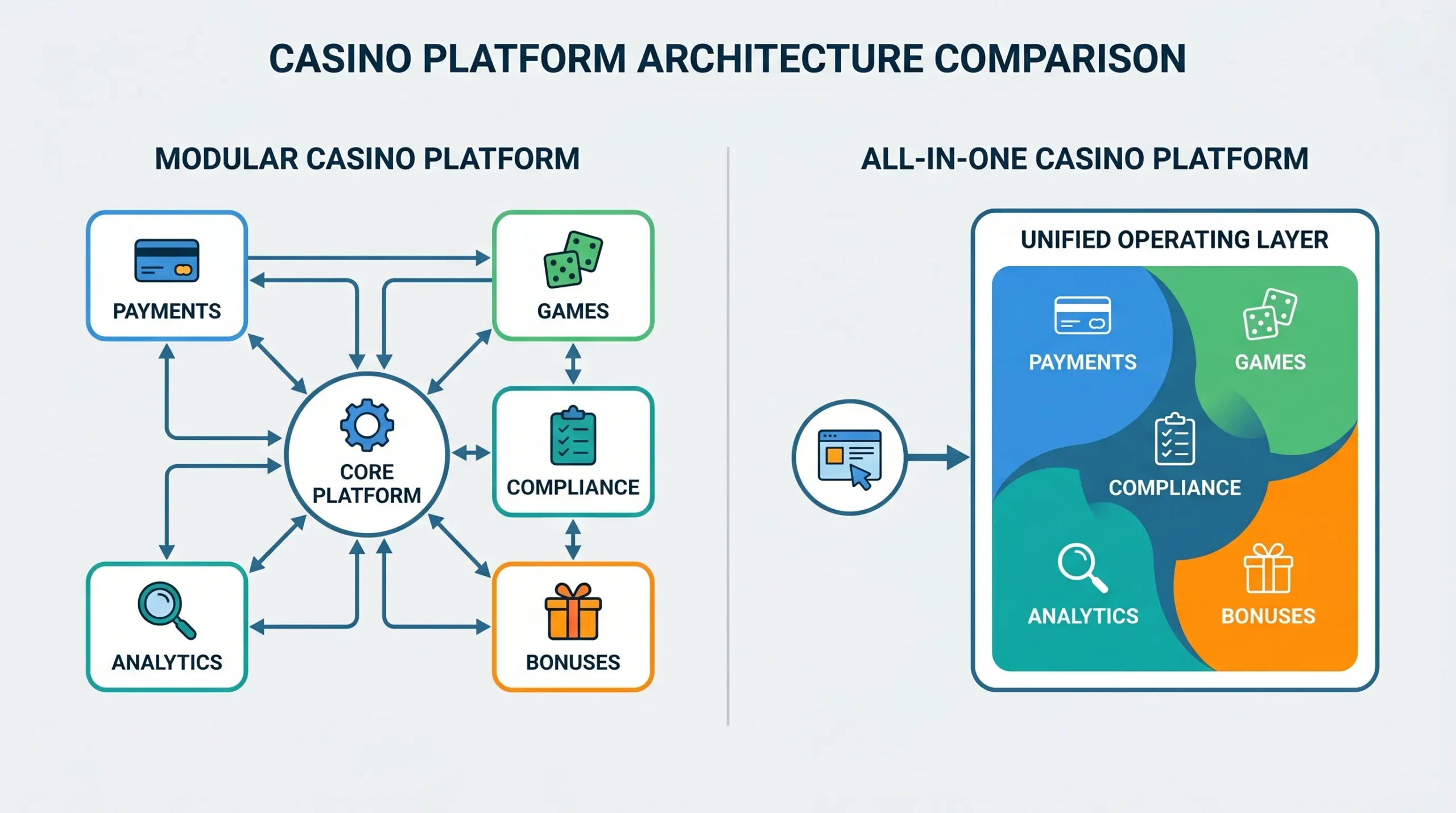
What is a modular casino platform?
A modular casino platform is built from separate but connected components. Instead of treating the casino as one fixed package, the operator can configure or swap modules such as:
- Game aggregation
- Payment gateway and cashier
- KYC and AML workflows
- Fraud prevention
- Bonus and affiliate engines
- Analytics and reporting
- Backoffice admin tools
- Frontend and CMS
- Wallet and ledger services
- Crypto onramp and custody options
The main advantage is flexibility. You can launch with the modules you need now, then add or replace parts as your business grows. For example, an operator might start with fiat payments, slot games, basic bonuses, and a standard lobby, then later add crypto payments, localized payment rails, live casino games, advanced segmentation, or custom casino original games.
A modular setup is especially useful when you want to differentiate your brand, enter multiple markets, or avoid being trapped inside one vendor’s roadmap. But the more modular the stack becomes, the more integration discipline you need.
What is an all-in-one casino platform?
An all-in-one casino platform bundles the core systems required to launch and operate an online casino in one integrated environment. A typical all-in-one white label casino platform may include the frontend, game aggregator, cashier, wallet, KYC/AML, bonuses, affiliates, backoffice, analytics, hosting, and support workflows.
The appeal is speed and simplicity. Instead of coordinating multiple vendors, your team works inside one platform with fewer moving parts. This is why all-in-one solutions are popular with startups, lean operators, and founders who want a faster route to market.
The trade-off is that not every all-in-one platform is equally flexible. Some are highly configurable. Others are rigid packages where adding a new payment gateway, changing bonus logic, or connecting an external CRM requires custom development or vendor approval.
In practice, the strongest modern iGaming platforms combine both ideas: an integrated core with modular controls. Spinlab’s approach, for example, is designed around an all-in-one operating layer with modular components for payments, game aggregation, compliance, analytics, affiliates, bonuses, crypto support, and backoffice operations.
Modular vs all-in-one casino platform: quick comparison
| Evaluation area | Modular casino platform | All-in-one casino platform |
|---|---|---|
| Time to market | Usually fast if modules are pre-integrated, slower if custom stitched | Usually fastest for launch and soft launch |
| Flexibility | High, especially for payments, frontend, data, and market-specific needs | Varies by provider, often lower unless APIs and configuration are strong |
| Cost structure | Can be efficient, but vendor and integration costs can multiply | Easier to forecast, but bundled pricing may hide margin trade-offs |
| Compliance | Strong if controls are centralized and auditable | Strong if compliance tools are native and well documented |
| Vendor lock-in | Lower when APIs, data exports, and module boundaries are open | Higher if core systems are closed or migration is difficult |
| Operations | More control, more coordination | Simpler day-to-day workflows |
| Scalability | Excellent when architecture is well designed | Good if provider has proven infrastructure and performance controls |
| Best fit | Growth teams, multi-market operators, differentiated brands | Startups, lean teams, faster launches, operators prioritizing simplicity |
The table shows the core tension: modularity gives control, while all-in-one platforms reduce operational burden. The right answer is not always one or the other.
Pros of a modular casino platform
1. More control over your growth roadmap
A modular casino platform lets you prioritize what matters for your business model. If your acquisition strategy depends on affiliates, you can invest early in tracking, attribution, bonus rules, and payout governance. If your market is payment-sensitive, you can prioritize local rails, crypto onramps, stablecoins, or multi-currency support.
This is valuable because online casino growth rarely follows a fixed plan. A brand may begin as a slot-focused site, then add live casino games, tournaments, crash games, localized lobbies, or crypto-native features. A modular platform gives you room to adapt without rebuilding the whole stack.
For a deeper look at the features that matter most, see Spinlab’s guide to must-have features in casino platform software.
2. Better localization by market
Global operators need local payment methods, currencies, languages, KYC rules, content restrictions, and bonus policies. A rigid platform can make every market feel like a compromise.
With a modular approach, you can tailor the stack by region. For example, one market may need open banking and localized bank transfers, while another may rely more on crypto deposits, e-wallets, or prepaid options. You can also adjust game catalogs by jurisdiction, player segment, or supplier availability.
This matters because localization is not just translation. It includes cashier experience, trust signals, compliance workflows, game ordering, currency display, and support operations.
3. Easier integration with specialist tools
No single casino software provider will be best at everything forever. A modular platform with open APIs makes it easier to connect external tools when needed, such as a CRM, fraud vendor, KYC provider, data warehouse, affiliate network, or payment gateway.
The key is not simply having an API. The API must support money movement, webhooks, identity, game sessions, bonuses, analytics, and compliance events in a reliable way. Spinlab covers this topic in detail in its open API checklist for iGaming platforms.
4. Reduced long-term vendor lock-in
Vendor lock-in becomes expensive when your platform controls your data, player wallet logic, game provider access, or payment routing in a way you cannot export or modify. A modular architecture can reduce that risk by defining cleaner boundaries between systems.
Operators should look for:
- Exportable player, payment, game, and bonus data
- Documented APIs and webhook events
- Clear ledger and wallet ownership rules
- Transparent game provider contracts
- Configurable payment routing
- Audit logs that remain accessible if you migrate
Modularity does not eliminate lock-in by itself. But it gives you more leverage if the provider supports open integration and data portability.
Cons of a modular casino platform
1. Integration complexity can grow quickly
A modular stack can become messy if each component has its own data model, user permissions, reporting format, and support process. The operator may end up managing a patchwork of vendors rather than a unified iGaming platform.
This is especially risky around wallets, bonuses, payments, and game sessions. If these systems are not tightly coordinated, you can create serious operational problems, including double credits, bonus abuse, failed withdrawals, and reconciliation gaps.
For casino operators, modularity must be governed by a single source of truth for the ledger, player identity, and compliance decisions.
2. More vendor management
A modular approach may require separate commercial agreements, service-level agreements, data processing agreements, support contacts, and certification documents. This can slow down procurement and create accountability gaps.
When something breaks, the operator needs to know who owns the incident. Was a failed deposit caused by the PSP, payment orchestration layer, fraud rules, wallet posting, KYC state, or frontend session timeout? If responsibilities are unclear, support tickets rise and player trust falls.
3. Compliance evidence can become fragmented
Regulators and banking partners increasingly expect operators to prove how decisions are made. This includes KYC results, AML monitoring, payment approvals, bonus restrictions, game availability, responsible gambling controls, and audit trails.
A fragmented stack makes it harder to produce a clean evidence pack. You may need to pull logs from several vendors and reconcile timestamps, IDs, and policy versions manually.
This is why modular systems need centralized logging, permissions, and audit exports. Compliance should not be an afterthought added after growth.
4. Total cost can be harder to forecast
At first glance, modular software can look cheaper because you only pay for what you use. But costs can rise through integration work, API overages, support fees, minimum guarantees, data exports, certification costs, and internal operations.
A fair comparison should model 24 months of total cost, not just setup fees. Spinlab’s guide to white label casino pricing explains how hidden costs often appear after launch.
Pros of an all-in-one casino platform
1. Faster launch and onboarding
The biggest advantage of an all-in-one casino platform is speed. If games, payments, KYC/AML, bonuses, fraud controls, analytics, and backoffice tools are already connected, the operator can focus on brand, licensing, marketing, and go-to-market execution.
This is especially useful for founders launching their first whitelabel casino or teams without a large technical department. A Shopify-like operating experience can reduce the need for developers in day-to-day configuration, campaign setup, payment management, and reporting.
2. Simpler operations for lean teams
All-in-one platforms reduce context switching. Instead of logging into separate dashboards for the payment gateway, game aggregator, KYC vendor, fraud tool, and affiliate system, operators can manage core workflows from one backoffice.
This improves daily execution in areas such as:
- Reviewing player accounts
- Monitoring deposits and withdrawals
- Creating bonuses and affiliate campaigns
- Checking KYC and AML status
- Tracking game performance
- Managing multiple currencies
- Reviewing fraud alerts
- Monitoring real-time analytics
For lean teams, the operational savings can be more important than theoretical architectural flexibility.
3. Cleaner accountability
When one provider owns the integrated platform, support escalation is usually easier. If a game launch fails, a deposit is stuck, or a bonus does not trigger correctly, the operator has one primary platform partner accountable for diagnosis.
This does not mean every issue is solved instantly. But it reduces the “vendor blame loop” that often happens in heavily stitched stacks.
4. More predictable compliance workflows
A well-designed all-in-one platform can enforce compliance consistently across the player lifecycle. KYC status can inform deposit limits, withdrawal rules, bonus eligibility, fraud scoring, and AML monitoring inside one operating model.
This is increasingly important as regulators expect stronger evidence around responsible gambling, AML, and payment controls. For example, the FATF guidance on virtual assets has shaped how crypto-related AML obligations are assessed globally, while PCI DSS remains central for card data environments through the PCI Security Standards Council.
The easier your platform makes audit evidence, the less time your team spends reconstructing decisions later.
Cons of an all-in-one casino platform
1. Flexibility depends heavily on the provider
Some all-in-one platforms are modern, API-first, and configurable. Others are closed systems with limited customization.
This distinction matters. If the platform cannot support the payment methods, game providers, affiliate model, bonus logic, or reporting structure your market needs, the convenience of an all-in-one setup can become a constraint.
Before choosing a provider, ask whether the platform supports open API integration, custom payment routing, flexible game aggregation, multi-currency wallets, crypto onramp options, and configurable backoffice workflows.
2. Bundled pricing can hide trade-offs
All-in-one pricing may look simpler, but simplicity does not always mean better economics. Some providers bundle services in ways that make it hard to see margins by module. Others add markups on game aggregation, payments, hosting, or compliance tools.
Operators should ask for a transparent breakdown of:
- Setup and onboarding fees
- Monthly platform fees
- Game aggregation costs
- Payment and withdrawal fees
- KYC and AML check costs
- Hosting or infrastructure fees
- Support or account management costs
- Revenue share or GGR-based fees
- Data export or API usage costs
If the vendor cannot explain how pricing scales with player volume, transaction count, and market expansion, treat that as a red flag.
3. Migration can be harder later
All-in-one platforms can become difficult to leave if the provider controls the wallet, frontend, game integrations, player data, analytics, and bonus history in a closed environment.
This does not mean operators should avoid all-in-one software. It means they should negotiate portability upfront. Your contract should define data exports, migration support, termination assistance, wallet reconciliation, domain control, and access to audit logs.
4. Differentiation may be limited
If many brands use the same turnkey casino solution with similar lobbies, game catalogs, bonuses, and cashier flows, it becomes harder to stand out. Differentiation requires control over theme, content, offers, payment methods, personalization, and proprietary games.
For operators competing on brand experience, a rigid all-in-one platform may not be enough. A modular all-in-one system gives more room to create a distinct player experience while keeping operations centralized.
Cost and time-to-market: what really changes?
The cost difference between modular and all-in-one casino software is not always obvious. A modular platform can be cheaper if it lets you start lean and add capabilities only when needed. It can be more expensive if you rely on custom integration work and multiple vendors.
An all-in-one platform can be cheaper if the provider has already solved the expensive parts, including payments, game aggregation, KYC/AML, fraud, analytics, and backoffice UX. It can be more expensive if bundled fees, revenue share, and limited flexibility reduce your margins as you grow.
| Cost factor | Modular platform impact | All-in-one platform impact |
|---|---|---|
| Initial setup | Lower if modules are pre-built, higher if custom integration is needed | Usually lower and faster when launch scope is standard |
| Engineering needs | Higher if modules are self-managed | Lower if configuration is no-code or low-code |
| Vendor fees | Can spread across several providers | Consolidated, but may include bundled margins |
| Operational workload | More coordination and monitoring | Simpler daily operations |
| Scaling cost | Can optimize module by module | Depends on provider pricing and infrastructure model |
| Exit cost | Lower if data and APIs are open | Higher if platform is closed |
Time-to-market follows the same logic. A pre-integrated modular platform can launch quickly. A do-it-yourself modular stack may take months. A mature all-in-one white label casino platform may support a soft launch in weeks, but regulatory approvals, payment onboarding, game approvals, and KYC setup can still affect timing.
For operators planning a launch, Spinlab’s 30-day launch plan for new online casinos provides a practical rollout framework.
Compliance, payments, and data are the deciding factors
When comparing a modular casino platform vs an all-in-one platform, operators often focus too much on frontend design and game count. Those matter, but the biggest long-term risks usually sit in three areas: compliance, payments, and data.
Compliance
Your platform should not just let you create policies. It should enforce and prove them. KYC/AML status, jurisdiction rules, responsible gambling controls, bonus restrictions, and content blocking need to work across the whole casino.
If compliance logic lives in separate tools that do not share real-time state, players can slip through gaps. For example, a user blocked from a promotion should not still receive an affiliate campaign or bonus email because the CRM is out of sync.
Payments
Payments are not just a cashier screen. They involve PSP routing, ledger posting, fraud scoring, limits, KYC triggers, reconciliation, withdrawals, chargebacks, crypto monitoring, and treasury controls.
A modular payment stack can be powerful if it is built around a unified ledger and clear payment intent model. An all-in-one platform can be safer for lean teams if the payment gateway, wallet, fraud prevention, and reconciliation are already integrated.
For more detail, see Spinlab’s guide to best payment methods for online casinos in 2026.
Data
The winning platform is the one that turns operational events into action. Registration, deposit attempts, KYC status, game sessions, bonus claims, withdrawals, fraud alerts, and affiliate attribution should feed analytics and automation.
If your data is trapped in disconnected dashboards, you will struggle to optimize player lifetime value, detect abuse, improve payment approval rates, or personalize the lobby. A modular architecture needs strong event governance. An all-in-one platform needs open exports and analytics depth.
The hybrid answer: modular all-in-one platforms
The best choice for many operators is not pure modular or pure all-in-one. It is a modular all-in-one iGaming platform: one integrated operating system with configurable modules and open integration points.
This model gives operators:
- Faster launch because core systems are already connected
- Lower operational complexity because teams work in one backoffice
- Flexibility to add modules, payment methods, games, or integrations over time
- Better compliance consistency because player, wallet, and risk state are centralized
- More room for differentiation through APIs, themes, bonuses, original games, and localized experiences
Spinlab is positioned around this model. The platform offers crypto and fiat payment support, game aggregation, real-time analytics, fraud prevention, KYC/AML workflows, mobile-optimized casino experiences, affiliate and bonus tooling, customizable backoffice operations, open API integration, multi-currency support, crypto onramps, custodial wallet support, and options for custom original games.
That combination matters because operators should not have to choose between speed and control. The goal is to launch quickly without giving up the ability to adapt.
When to choose a modular casino platform
A modular casino platform is usually the better fit when you have a clear differentiation strategy and enough operational maturity to manage configuration, integrations, and governance.
Choose modular if:
- You are entering several markets with different payment and compliance needs
- You need custom frontend, CRM, data, or affiliate integrations
- You want to add crypto-ready features without rebuilding fiat operations
- You have internal product or technical ownership
- You expect to negotiate direct provider deals over time
- You want to avoid long-term lock-in around data and APIs
This path works best when the platform still provides a strong integrated core. Pure “assemble everything yourself” architecture can become expensive and slow unless you have a capable engineering team.
When to choose an all-in-one casino platform
An all-in-one casino platform is usually the better fit when speed, simplicity, and predictable operations matter more than deep customization.
Choose all-in-one if:
- You are launching your first online casino
- You have a lean team with limited engineering capacity
- You need a fast soft launch or MVP
- You prefer one provider for support and accountability
- You want built-in payments, KYC/AML, game aggregation, and backoffice tools
- You need a Shopify-like operational experience for non-technical teams
The key is to avoid closed platforms that limit your future options. Even if you start all-in-one, you should still demand APIs, data exports, configurable workflows, and transparent pricing.
Vendor questions to ask before you decide
Before signing with any casino software provider, ask questions that reveal how the platform works under pressure.
| Question | Why it matters |
|---|---|
| Which modules are native, and which depend on third-party vendors? | Helps you understand accountability and support boundaries |
| Can we add or replace payment methods without custom development? | Shows whether the cashier is truly flexible |
| Is the wallet and ledger centralized across fiat and crypto? | Prevents reconciliation gaps and balance errors |
| What APIs and webhooks are available from day one? | Reveals integration and data portability strength |
| Can bonus rules use real-time player, payment, and risk signals? | Determines how well you can control promo costs and abuse |
| How are KYC, AML, fraud, and responsible gambling decisions logged? | Critical for audit readiness |
| Can we export player, transaction, bonus, and game event data? | Reduces lock-in and improves analytics control |
| What does pricing look like at 10x player volume? | Prevents surprise cost inflation |
| How do you support multi-currency and crypto onramp workflows? | Important for global and crypto-ready growth |
| What can non-technical operators configure in the backoffice? | Shows whether the platform will reduce developer dependency |
A polished demo is useful, but realistic workflow testing is better. Ask vendors to show a failed deposit, a KYC step-up, a bonus abuse rule, a game restriction by jurisdiction, a withdrawal review, and a data export. Those scenarios reveal more than a homepage preview.
Final verdict: control where it matters, integration where it saves time
The modular casino platform vs all-in-one debate is really about balance.
A modular platform gives control, adaptability, and room for differentiation. But without strong architecture, it can create integration complexity, vendor sprawl, and fragmented compliance evidence.
An all-in-one platform gives speed, simpler operations, and cleaner accountability. But if it is closed or rigid, it can limit growth, localization, and long-term economics.
For most operators, the best path is a modular all-in-one platform: integrated enough to launch and operate efficiently, flexible enough to adapt as markets, payments, games, and compliance requirements change.
That is the direction the iGaming platform market is moving. Operators want the speed of a turnkey casino solution, the control of modular architecture, and the usability of modern commerce software. The winners will choose platforms that reduce operational friction without trapping the business inside a fixed box.
Frequently Asked Questions
Is a modular casino platform better than an all-in-one platform? Not always. A modular casino platform is better when you need flexibility, market-specific customization, open APIs, and long-term control. An all-in-one platform is better when you prioritize speed, operational simplicity, and lower technical overhead.
Can an all-in-one casino platform still be modular? Yes. Many modern platforms combine an integrated core with configurable modules. This is often the best model because it gives operators fast onboarding while still supporting payments, game aggregation, compliance, analytics, and bonus customization.
Which option is cheaper for a new online casino? An all-in-one white label casino platform is often cheaper and faster for a startup because core systems are already connected. However, modular platforms can be cost-effective if they prevent vendor lock-in and allow you to pay only for the components you need.
What is the biggest risk of a modular iGaming platform? The biggest risk is fragmentation. If payments, wallets, KYC, bonuses, fraud, and analytics do not share reliable data, operators can face reconciliation issues, compliance gaps, and higher support workload.
What should I prioritize when comparing casino software providers? Prioritize wallet and ledger reliability, payment flexibility, KYC/AML workflows, game aggregation quality, fraud controls, backoffice usability, real-time analytics, open APIs, transparent pricing, and exportable data.
Is Spinlab modular or all-in-one? Spinlab is designed as an all-in-one, modular iGaming platform. It combines core casino operations such as payments, game aggregation, compliance, analytics, bonuses, affiliates, crypto support, and backoffice tools while keeping flexibility through modular configuration and open API integration.
Build faster without boxing in your casino brand
If you want the launch speed of a turnkey casino solution without giving up modular control, Spinlab was built for that middle ground.
Spinlab’s platform brings together crypto and fiat payments, game aggregation, KYC/AML, fraud prevention, real-time analytics, affiliate and bonus tools, multi-currency support, crypto onramps, customizable backoffice workflows, and mobile-optimized casino experiences in one operator-friendly environment.
Explore Spinlab’s modular iGaming platform at spinlab.studio or book a demo to compare your current launch plan, cost structure, and integration needs against a faster all-in-one setup.