

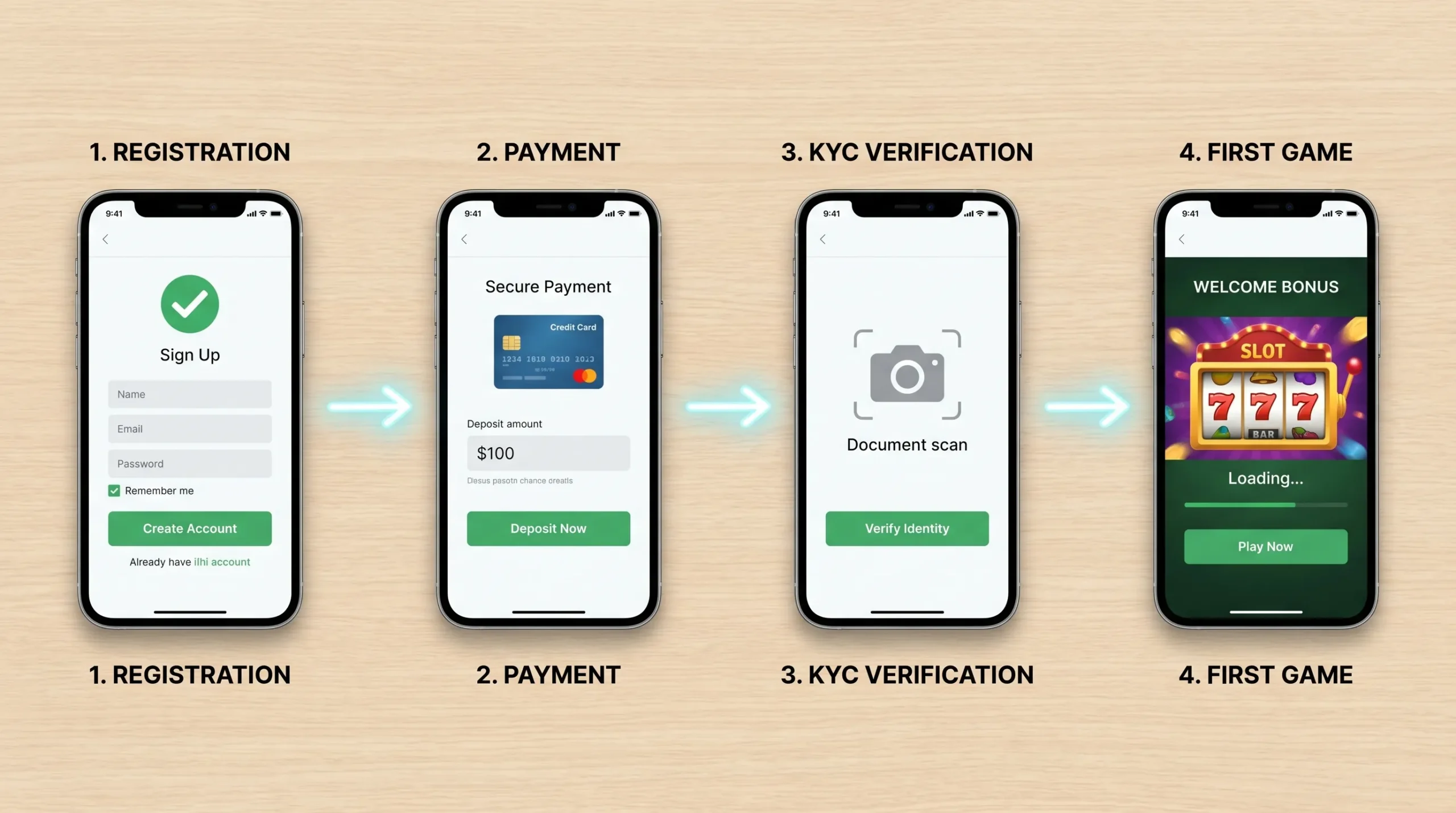
Mobile-first casino platforms convert better because they match how players actually discover, evaluate, register, deposit, and play today. For many operators, mobile is no longer a secondary channel. It is the main acquisition funnel, the primary cashier, the most common KYC device, and the place where retention is won or lost.
The mistake is treating mobile-first as a visual preference. A responsive theme that shrinks a desktop casino onto a phone is not the same as a mobile-first iGaming platform. True mobile-first design changes the full player journey, from page load and registration to deposits, identity checks, game launch, and in-session engagement.
For operators, that means one thing: higher conversion is not caused by prettier screens alone. It comes from removing friction at every revenue-critical moment.
What mobile-first really means in an online casino
A mobile-first casino platform is designed around the constraints and behaviors of mobile players from the beginning. Smaller screens, touch input, weaker networks, short sessions, biometric login, mobile wallets, camera-based KYC, and app-like expectations all shape the product.
A mobile-optimized online casino is not just a desktop site that works on mobile. It should be fast, thumb-friendly, cashier-first, KYC-aware, and instrumented with mobile-specific analytics.
| Area | Desktop-responsive approach | Mobile-first approach |
|---|---|---|
| Layout | Shrinks desktop pages | Designs for one-handed use and short sessions |
| Registration | Full forms copied from desktop | Progressive fields, smart defaults, fewer steps |
| Cashier | Payment page adapted to mobile | Mobile wallets, local rails, crypto onramp, clear status states |
| KYC | Upload flow added after signup | Camera-native capture with guidance and recovery |
| Game lobby | Large grids and filters | Personalized, swipeable, fast-loading recommendations |
| Analytics | Pageviews and deposits | Event-level funnel data from tap to first spin |
This distinction matters because conversion drops are usually cumulative. A slow landing page, confusing registration step, hidden payment fee, failed document upload, and delayed game launch may each look small in isolation. Together, they can erase a large share of paid traffic before it ever becomes revenue.
Mobile speed directly affects casino conversion
Speed is the first conversion lever. Before a player sees your welcome offer or slot lobby, they experience your load time.
Google's Core Web Vitals define good user experience thresholds for key metrics such as Largest Contentful Paint, Interaction to Next Paint, and Cumulative Layout Shift. Google also reported in its mobile speed research that as page load time increases from 1 second to 3 seconds, the probability of bounce increases by 32% (Think with Google).
For casino operators, the risk is even sharper because acquisition traffic is expensive and intent is fragile. If a player arrives from an affiliate link, streamer promo, paid search ad, or social campaign, every extra second before the page becomes usable increases the chance that the session dies before registration.
Mobile-first platforms improve this by prioritizing:
- Lightweight landing pages and lobbies
- Compressed media and optimized game thumbnails
- Fast authentication and session handling
- Deferred loading for non-critical scripts
- Real-user monitoring by device, region, and network type
The business metric is not speed for its own sake. It is speed to revenue action. The key question is: how quickly can a mobile player go from first tap to registered, funded, and playing?
For a deeper technical checklist, Spinlab's guide to Core Web Vitals for casino sites in 2026 breaks down the performance budgets operators should monitor.
Mobile-first onboarding reduces registration drop-off
Registration is where many casinos lose players who were already interested enough to click. On mobile, even small UX mistakes become expensive. Tiny fields, unclear error messages, password complexity issues, country code friction, and repeated OTP steps all create abandonment.
A mobile-first registration flow respects the context of the user. It asks for the minimum required information at the right moment, explains why sensitive data is needed, and uses device capabilities where appropriate. Autofill, passkeys, one-tap verification, clear progress states, and localized input formats all reduce cognitive load.
The best mobile onboarding flows also avoid asking compliance, marketing, and personalization questions all at once. A player should not feel like they are filling out a banking application before they have even seen the lobby. That does not mean weakening KYC or AML controls. It means sequencing checks intelligently, based on jurisdiction, risk, deposit behavior, and withdrawal requirements.
A practical way to evaluate onboarding is to track the full activation funnel:
| Funnel stage | What to measure | Why it matters |
|---|---|---|
| Landing page to registration start | Tap-through rate | Shows whether the first screen creates enough trust and intent |
| Registration start to completion | Form completion rate | Reveals field, OTP, password, and localization friction |
| Registration to first deposit | First-time depositor rate | Connects onboarding to actual revenue |
| Deposit to first spin | Time to first spin | Measures whether the player reaches entertainment quickly |
| First spin to second session | Day 1 return rate | Shows whether the first mobile session felt worth repeating |
If you only measure registrations, you may optimize the wrong thing. A mobile-first casino platform should help operators connect onboarding data to deposits, game launch, and retention.
The mobile cashier is where conversion is won
The cashier is the highest-intent screen in the casino. A player has decided to fund the account. Losing them there is especially costly.
Mobile-first cashier design is not just about making deposit forms fit on a phone. It means showing the right rails, in the right order, with the least possible uncertainty. Cards, Apple Pay, open banking, local APMs, e-wallets, crypto deposits, and crypto onramp flows all behave differently on mobile.
For example, a mobile wallet can outperform a card form when the player expects biometric confirmation. Open banking can work well when bank handoff states are clearly explained. Crypto deposits can convert better when the platform separates wallet-to-casino deposits from fiat-to-crypto onramp journeys and explains gas fees, network choice, and time-to-credit clearly.
A strong mobile-first casino cashier should include:
- Smart payment method ordering by country, currency, device, and risk score
- Clear deposit totals before confirmation
- Saved or tokenized methods where compliant
- Fast pending, success, and failure states
- Recovery flows for declined or abandoned deposits
- Ledger-safe event handling so retries do not create double credits
Spinlab has covered the payment side in more depth in Cashier Conversion Hacks: Optimizing Deposit Forms for 3-Second Checkout and Crypto Onramp vs Direct Deposit: Which Converts Better?. The common theme is simple: the cashier should feel instant to players while staying controlled, auditable, and fraud-aware behind the scenes.
Mobile KYC can protect compliance without killing momentum
KYC is unavoidable in regulated iGaming, but mobile-first platforms make it less painful. Since the phone already has a camera, location signals, biometric unlock, and document capture capability, mobile can actually be the best device for identity checks when the UX is designed correctly.
Problems appear when KYC is bolted on as a separate vendor screen with poor instructions, slow retries, and no useful pending state. Players may abandon not because they object to verification, but because they do not know what went wrong or how long it will take.
Mobile-first KYC improves conversion through better sequencing and clearer interaction design. Players should know which document is needed, how to photograph it, what happens after submission, and whether they can continue browsing while verification is pending. If resubmission is required, the recovery link should return them directly to the failed step, not to the beginning of the account journey.
This is especially important for emerging markets, where document types, lighting conditions, camera quality, and network reliability vary widely. A flexible iGaming platform should support localized KYC flows, risk-based step-ups, and integration with AML monitoring rather than treating verification as a single static gate.
For tactical examples, see Spinlab's guide to 11 UX Tweaks That Cut KYC Drop-Off by 30%.
Mobile-first game lobbies increase first-spin and repeat-session rates
Once the player is registered and funded, the next conversion goal is first spin. A desktop-style game lobby often works against this goal on mobile. Large grids, too many filters, slow thumbnails, and generic sorting force players to search instead of play.
A mobile-first casino lobby should behave more like a modern entertainment feed. It should load quickly, personalize ranking, surface recently played games, highlight trusted providers, and reduce the number of taps between intent and launch. Slot games, live casino games, crash games, and casino original games may all need different mobile presentation patterns.
The goal is not to overwhelm players with the biggest possible catalog. Game aggregation creates value only when content is discoverable. A game aggregator may provide thousands of titles, but mobile conversion depends on ranking, filtering, localization, and launch speed.
High-converting mobile lobbies often include:
- Recently played and continue playing sections
- Curated new-player rows with low-friction games
- Localized categories by market and language
- Provider rows for recognizable studios
- Fast search with typo tolerance
- Personalized recommendations based on behavior and session context
Mobile-first ranking also helps operators control economics. For example, new players can be guided toward games with fast load times and suitable volatility, while VIPs may see different recommendations based on preferences and responsible gambling controls.
Trust signals matter more on small screens
Casino conversion depends on trust. On mobile, trust has to be communicated faster because players see less context at once. If licensing information, payment expectations, bonus terms, support access, and security cues are hidden or hard to read, players hesitate.
Mobile-first trust design includes concise explanations at the point of decision. That means clear bonus terms near opt-in, recognizable payment logos in the cashier, visible responsible gambling links, status trackers for withdrawals, and plain-language KYC explanations.
Security should also feel native to mobile. Passkeys, biometric unlock, device-aware risk checks, and risk-based authentication can reduce login friction while improving protection. The best platforms combine this with fraud prevention, AML monitoring, and audit logging behind the scenes.
For operators, the balance is crucial. A platform that removes every security check may convert more in the short term but creates chargebacks, bonus abuse, account takeover, and licensing risk. A platform that adds too much visible friction may protect itself at the cost of player acquisition. Mobile-first conversion means applying the right control at the right moment.
Retention is increasingly mobile-native
Conversion does not stop at first deposit. The higher-value question is whether mobile players return.
Mobile-first platforms support retention through fast re-entry, personalized offers, installable web experiences, push or email triggers, and session-aware promotions. Progressive Web Apps are especially relevant because they can offer app-like installability without forcing every operator into native app distribution.
A PWA casino can make re-engagement easier with home-screen access, faster repeat loads, and controlled notification patterns where permitted. But installability only works if the core product is already strong. A slow cashier, confusing KYC flow, or generic lobby will not convert better simply because it has an icon on the player's phone.
Spinlab's article on PWA Casinos: Installable Web Apps That Convert explores this channel in more detail.
Retention also needs responsible gambling by design. Mobile access makes it easy to play frequently, so operators should build reality checks, limits, cool-off flows, and risk-aware CRM rules into the product. Conversion that ignores player safety is not sustainable growth.
Why mobile-first improves operator economics
Mobile-first platforms convert better because they improve multiple parts of the revenue equation at once. They reduce wasted acquisition spend, increase first-time depositor rates, speed up time to first spin, improve repeat sessions, and lower support pressure by making states clearer.
The economic impact usually appears in several places:
| Business lever | Mobile-first impact |
|---|---|
| Paid acquisition ROI | More clicks become registrations and deposits |
| Affiliate profitability | Mobile traffic converts with fewer funnel leaks |
| Payment success | Cashier flows match device, country, and preferred rail |
| Support volume | Clear KYC, deposit, and withdrawal states reduce tickets |
| Retention | Faster re-entry and personalized lobbies encourage repeat play |
| Compliance operations | Risk checks are embedded into the journey instead of added manually |
This is why mobile-first should be a platform decision, not a theme decision. If your frontend is mobile-friendly but your payment gateway, KYC vendor, bonus engine, analytics, and backoffice are disconnected, players will still feel the seams.
A modular, all-in-one iGaming platform can solve this by connecting the mobile frontend to payments, game aggregation, fraud prevention, KYC/AML, bonuses, affiliates, and analytics through a single operating layer.
How to evaluate a mobile-first casino platform
When comparing casino software providers, do not rely on screenshots. Test the full journey on real devices, real networks, and realistic player scenarios. A polished demo on desktop tells you little about mobile conversion.
Use a short evaluation checklist:
- Can a new player register, deposit, pass required checks, and launch a game smoothly on a mid-range phone?
- Does the platform support fiat and crypto payment journeys without confusing the player?
- Are KYC, AML, fraud, and responsible gambling checks integrated into the flow?
- Can operators change lobby content, promotions, and payment ordering without waiting on developers?
- Does the analytics dashboard show funnel drop-off by device, region, payment method, and game category?
- Are Core Web Vitals and time-to-first-spin monitored in production?
- Does the backoffice make mobile conversion issues visible to operations, payments, compliance, and marketing teams?
Spinlab's modular platform is designed for operators that want this kind of connected mobile journey. It combines a mobile-optimized casino platform with crypto and fiat payment support, game aggregation, KYC/AML compliance, fraud prevention, real-time analytics, a bonus and affiliate engine, open API integration, multi-currency support, and a customizable backoffice. For lean teams, the goal is a Shopify-like operating experience without giving up the controls needed to run a real-money online casino.
Frequently Asked Questions
Why do mobile-first casino platforms convert better than responsive casino sites? Mobile-first platforms are built around mobile behavior from the start. They optimize speed, thumb-friendly navigation, cashier flows, KYC capture, game discovery, and re-engagement, while responsive sites often only resize a desktop experience.
What is the most important mobile casino conversion metric? Time to first spin is one of the most useful metrics because it connects registration, payment, KYC, game launch, and UX performance into one player-centered outcome. Operators should also track first-time depositor rate, cashier abandonment, KYC completion, and repeat-session rate.
Does mobile-first design reduce compliance quality? It should not. A strong mobile-first platform uses risk-based KYC, AML monitoring, fraud controls, responsible gambling tools, and audit logs inside the journey. The goal is to reduce unnecessary friction, not remove required controls.
Are PWAs better than native apps for online casinos? PWAs can be a strong option because they offer installability and app-like re-engagement while preserving web distribution. Native apps may still fit some markets, but many operators start with a high-performing mobile web or PWA experience because it is faster to launch and easier to update.
What should operators ask a casino software provider about mobile performance? Ask for real-device performance data, Core Web Vitals monitoring, cashier completion rates by device, KYC drop-off reports, game launch latency, and mobile funnel analytics. A provider should be able to demonstrate the full player journey, not just the homepage.
Build a mobile-first casino journey with Spinlab
Mobile-first conversion is the result of many connected systems working together: frontend speed, payment routing, crypto onramp UX, KYC/AML, fraud prevention, game aggregation, bonus logic, analytics, and backoffice operations.
If you are launching or upgrading an online casino, Spinlab gives you a modular, crypto-ready iGaming platform built for fast onboarding and scalable operations. You can start with the components you need, keep control through open APIs and a customizable admin panel, and optimize the player journey from first tap to repeat deposit.
Book a Spinlab demo to see how a mobile-first white label casino platform can help you launch faster, reduce friction, and convert more of your mobile traffic into active players.