

Deposits are not just a payment feature, they are your fastest revenue lever. If a player wants to deposit and your cashier makes them think, wait, or second-guess, you lose them to inertia, a competitor, or “I’ll do it later.” That is why the crypto onramp vs direct deposit decision is really a conversion architecture question: which path gets your players to a playable balance with the least friction, while keeping compliance and risk under control.
This guide breaks down what typically converts better, when, and how to measure it properly.
Definitions (so we compare the right things)
In iGaming, teams often use these terms loosely. Here’s the clean distinction.
What is a crypto onramp?
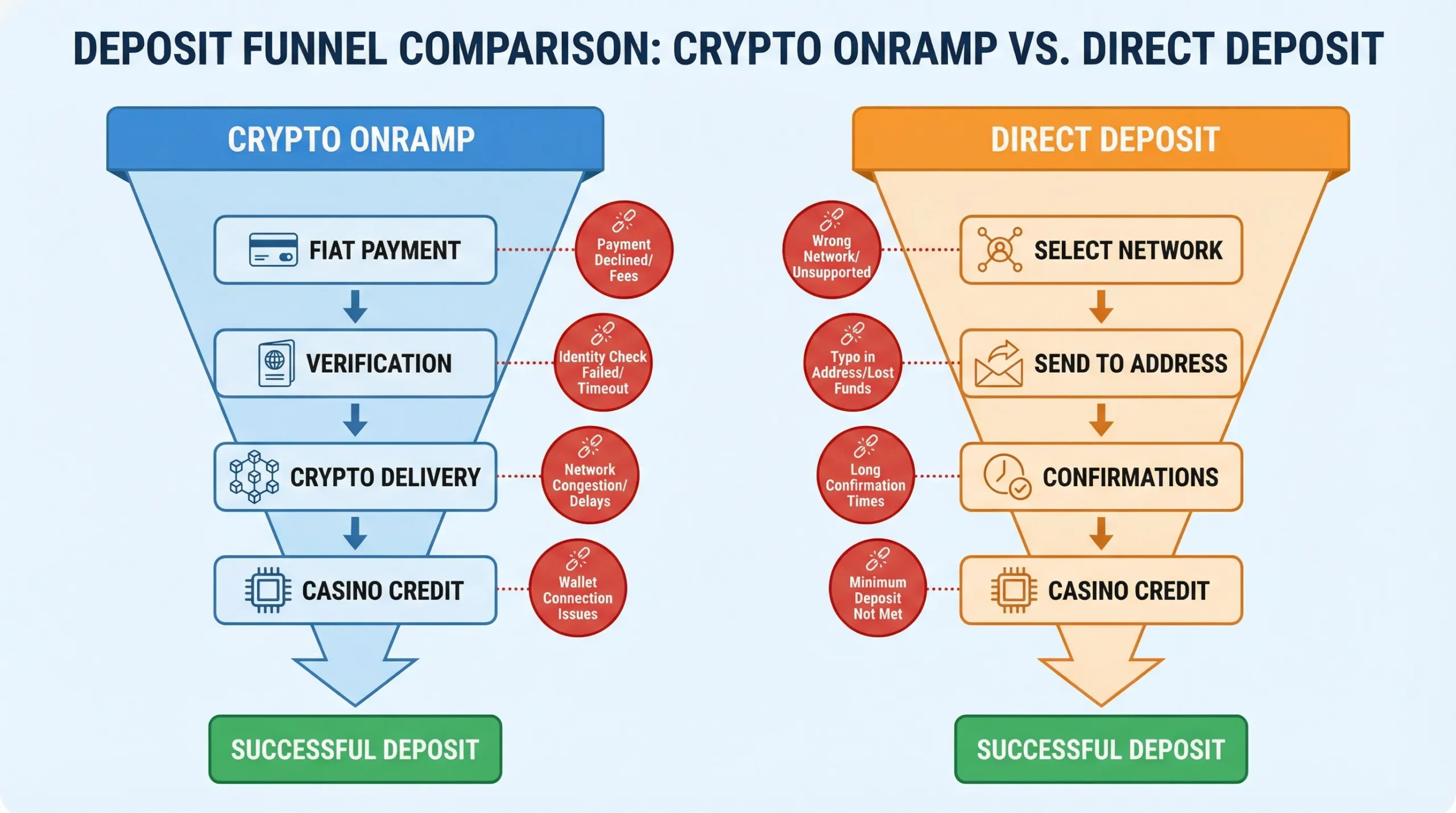
A crypto onramp lets a player buy crypto (often a stablecoin) with fiat inside your cashier, then deposit it into their casino wallet. The onramp flow is usually powered by an embedded provider and may include identity checks, bank/card authorization, and a crypto delivery step.
This is best thought of as a fiat-to-crypto acquisition funnel inside the deposit journey.
What is direct deposit?
A direct deposit in this context means the player already has crypto in a wallet or exchange and sends it directly to the casino (wallet-to-casino). The conversion challenge is mainly about network selection, address accuracy, confirmations, and trust.
This is best thought of as a crypto-native transfer flow.
If your team also uses “direct deposit” to mean bank transfer rails (ACH/SEPA/Faster Payments), treat that as a third category and evaluate it separately. Spinlab has a dedicated breakdown of bank transfer speed trade-offs in Direct Bank Transfer vs Open Banking.
The short answer: which converts better?
Neither wins universally.
- Direct deposit tends to convert better for crypto-native traffic (players with existing wallets, exchange users, players accustomed to networks and confirmations).
- Crypto onramps tend to convert better for fiat-native traffic (players who want “buy and play” without leaving the site), but only if the onramp UX is tuned and the identity checks do not become a surprise.
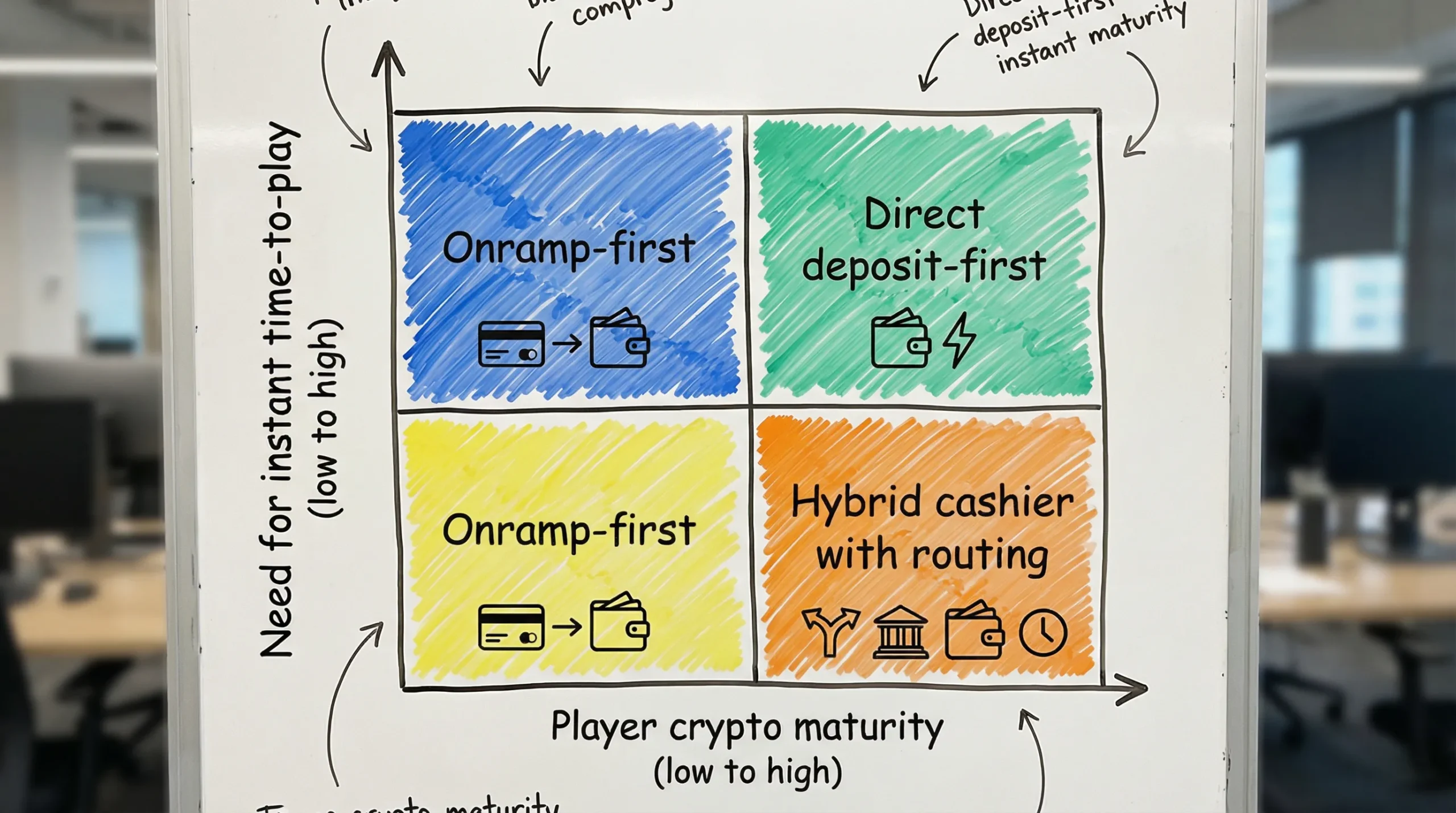
The real goal is usually not picking one, it is building a hybrid cashier that routes players into the flow they are most likely to complete.
Spinlab’s own payments content consistently points to hybrid strategies as a practical path, for example in Crypto vs Fiat: Which Payment Gateway Drives Higher Player Lifetime Value?.
Why conversion differs: the three frictions that matter most
Most deposit drop-off comes from some combination of:
- Cognitive friction: “What do I do next?” (network choice, memo tags, unfamiliar terms)
- Time friction: waiting (KYC, approvals, confirmations, pending states)
- Trust friction: “Will this work?” (fees, failed attempts, unclear status, fear of losing funds)
In broader checkout research, abandonment is often driven by unexpected complexity and unclear costs. Even though iGaming differs from retail, the psychology is similar. Baymard’s long-running checkout research is a useful baseline reference for how sensitive conversion is to friction and surprises (Baymard Institute).
Crypto onramp vs direct deposit: side-by-side conversion realities
Here is what typically changes when you move players between the two paths.
| Factor that impacts conversion | Crypto onramp (fiat to crypto) | Direct deposit (wallet to casino) |
|---|---|---|
| Best for | Fiat-native players, first-time crypto depositors | Crypto-native players, repeat depositors |
| Biggest drop-off risk | KYC inside onramp, bank/card declines, unclear fees/spreads | Wrong network, wrong address, missing memo/tag, confirmation anxiety |
| Time-to-play | Can be fast, but can also be gated by checks and approvals | Often predictable, but depends on chain finality and your credit policy |
| Trust cues needed | “Is this provider legit?” and “why do I need extra verification?” | “Did it arrive?” and “when will you credit it?” |
| Support ticket drivers | “My purchase is pending,” “I failed verification,” “my card was declined” | “I sent to the wrong network,” “it’s confirmed but not credited” |
| Risk profile | Higher chargeback and fraud exposure if card-funded | Lower chargebacks, higher AML/KYT sensitivity (source of funds) |
A practical takeaway
If your acquisition mix is influencer-heavy or crypto-community-heavy, direct deposit can outperform quickly.
If your acquisition mix is mainstream, paid social, or SEO landing pages targeting casual players, onramp often unlocks more first deposits, but only if you treat it like a product funnel and not a plugin.
For tactical onramp improvements, see Onramp UX Tactics That Boost Crypto Deposits. This article goes deeper into UX patterns, here we focus on the conversion comparison and measurement.
Where crypto onramps win (and how to make them actually convert)
Onramps win when they remove “tab switching.” The player stays in your cashier, completes a purchase, and sees funds land.
But onramps lose badly when they introduce surprise identity checks or confusing fee presentation.
Conversion patterns to watch in onramp flows
1) Verification surprise
If the onramp introduces KYC late (after the player has already decided to deposit), drop-off spikes. A strong pattern is progressive disclosure: clearly state early if verification is likely, and show what it unlocks.
2) Payment method mismatch
If the player expects card but only sees bank transfer, or they expect a local method but see none, the onramp becomes a dead end.
3) “Where is my crypto?” anxiety
Onramp purchases can be approved while crypto delivery lags. If you do not show a clear tracker (and what is happening), players assume failure and churn.
If you want to design for speed, Spinlab’s cashier UX principles in Cashier Conversion Hacks: Optimizing Deposit Forms for 3-Second Checkout map well to onramp UX, especially around progressive field loading, smart defaults, and strong pending states.
Where direct deposits win (and why “simple” often converts)
Direct deposit wins because it aligns with what crypto-native users already do: copy an address, send, wait for confirmations.
However, the flow is deceptively fragile. A single wrong choice (network mismatch) can create unrecoverable user error or a costly manual recovery process.
Conversion patterns to watch in direct deposit flows
1) Network confusion
If you show too many networks without context, first-time users freeze. If you show too few, you force detours.
2) Fees and confirmation uncertainty
Players abandon when they do not understand why the amount credited differs (network fees) or why it is taking time. Clear communication matters.
A good companion read is Designing a Crypto Cashier That Explains Gas Fees Clearly, because gas-fee confusion is a conversion killer in direct deposits.
3) Credit policy mismatch
If you only credit after many confirmations without telling the player upfront, you create time friction that looks like failure. If you credit too early without risk controls, you open yourself to double-spend, reorg, or fraud edge cases depending on chain and policy.
Compliance and risk: conversion is not the only KPI
A deposit method that “converts” but creates chargebacks, fraud, or compliance exposure will erase its gains downstream.
Onramp risk considerations
- Card-funded onramps can inherit card-like fraud dynamics.
- You may see more disputes and “not received” support issues if provider statuses are not exposed cleanly.
- Depending on jurisdictions, you may need clearer disclosures around who provides the onramp service and what checks are performed.
Direct deposit risk considerations
- Direct crypto deposits reduce chargeback exposure, but increase AML sensitivity around source of funds, sanctions exposure, and transaction monitoring.
- If you operate in Travel Rule applicable contexts, deposits and withdrawals may require additional messaging and data handling.
For a practical overview of Travel Rule expectations in casino flows, see Travel Rule Compliance for Crypto Casinos.
How to measure “converts better” (the operator-grade way)
Teams often compare methods using only “deposit completed.” That hides the real story.
You want to measure conversion as a funnel with time and cost.
The minimum KPI set to compare onramp vs direct deposit
| KPI | What it tells you | Why it matters |
|---|---|---|
| Deposit initiation rate | Do players choose this method? | Indicates method preference and UI prominence |
| Method completion rate | Do they finish once started? | The core “conversion” metric |
| Time-to-credit (P50/P95) | How long until playable balance? | Strong predictor of churn and support load |
| Failure reason breakdown | What blocks completion? | Drives roadmap and routing logic |
| First-time depositor (FTD) lift | Does it increase funded accounts? | Business outcome, not just payments |
| Cost per successful deposit | Fees plus operational overhead | Prevents “high conversion, negative margin” |
A key operational tip: log deposit attempts as events with explicit states (initiated, pending, failed, completed) so you can distinguish “abandoned” vs “blocked.” If your analytics is real-time, you can even trigger recovery flows.
The decision framework: which should you emphasize?
Use this as a practical prioritization matrix.
Emphasize crypto onramp when
- You acquire in markets where players are predominantly fiat-native.
- Your brand is targeting casual players who want to start in minutes.
- You can keep verification expectations clear and predictable.
Emphasize direct deposit when
- You acquire crypto-native traffic (Telegram, Discord, influencer communities, Web3 audiences).
- Your players value control, privacy, and speed more than hand-holding.
- You can provide strong deposit tracking and network clarity.
Build both when you want sustainable growth
Most serious operators end up with both, because conversion is segment-dependent.
The best implementation pattern is routing + UX specialization, not a long list of rails.
- If a player shows crypto-native signals, default them into direct deposit.
- If a player shows fiat-native signals, default them into onramp.
(You can infer this from behavior and context, for example prior method usage, geo, device, or whether they arrived on a “crypto casino” landing page. Just keep responsible gambling and privacy requirements in mind.)
Implementation notes for platforms: what to ask your casino software provider
If you are evaluating a casino software provider or upgrading your cashier, ask questions that map to conversion outcomes:
- Can you show pending states and trackers (onramp purchase pending, crypto confirmations pending) inside the cashier?
- Can you support multiple currencies and assets while still keeping the UI simple?
- Do you have built-in fraud prevention, KYC/AML support, and configurable compliance rules?
- Can you instrument the funnel end-to-end (events, analytics, cohort reporting)?
- Can you integrate and iterate quickly (open APIs, modular components)?
Spinlab Studio positions itself as a modular iGaming platform built for fast onboarding and iteration, with crypto and fiat support, integrated compliance tooling, fraud prevention, analytics, and API-based integrations. If you want to validate fit for your market and traffic mix, a short walkthrough is usually the fastest way.
Frequently Asked Questions
Is crypto onramp better for first-time depositors? Often yes, because it reduces the need to leave your site to buy crypto. But it can underperform if verification is unexpected or if payment authorization fails frequently.
Do direct crypto deposits convert better for VIPs? Commonly yes for crypto-native VIPs and repeat depositors, because the flow is familiar and can be fast. The key is providing clear confirmation and credit tracking.
Should I offer both onramp and direct deposit? In most mixed-traffic casinos, yes. A hybrid cashier with smart routing usually beats forcing one method on all players.
What is the most important metric to compare the two? Start with method completion rate, then add time-to-credit and failure reasons. A method that completes but takes too long can still lose you revenue through churn.
How do Travel Rule and AML affect conversion? Compliance can add friction if it is triggered late or inconsistently. The best approach is predictable requirements, risk-based step-up, and clear messaging so players are not surprised.
Want to see which flow wins for your traffic mix?
If you are building or scaling an online casino and want a cashier that supports both crypto onramps and direct deposits, the fastest path is to instrument both flows, route players intelligently, and iterate based on real data.
Spinlab Studio provides a modular iGaming platform with crypto-ready payments, compliance (KYC/AML), fraud prevention, analytics, and API integrations designed for fast launches. Explore the platform at spinlab.studio or book a demo to review your deposit funnel and identify the highest-impact conversion wins.