

Fraud in online casinos is no longer limited to stolen cards and suspicious withdrawals. Modern attackers probe every profitable edge in the player journey: registration bonuses, payment gateways, affiliate payouts, crypto withdrawals, VIP perks, password resets, and even customer support workflows.
That is why casino fraud prevention tools should not sit in one isolated “risk” tab. The best operators build a layered system that detects abuse early, challenges risky behavior at the right moment, and keeps legitimate players moving toward deposit, gameplay, and withdrawal without unnecessary friction.
Below is a practical tool stack every operator should evaluate, whether you are launching a new whitelabel casino, upgrading an existing iGaming platform, or expanding into crypto-ready markets.
Why casino fraud prevention has become a platform problem
A casino used to be able to buy a KYC provider, add payment gateway rules, and call the fraud program “done.” That approach breaks down quickly in 2026.
Today, risk signals are spread across many systems. A bonus abuser may look normal in KYC, suspicious in device history, profitable in affiliate tracking, risky in wallet behavior, and borderline in payment data. If those signals are not connected, your team only sees fragments.
The most effective fraud programs connect four things:
- Identity and account data
- Payment, wallet, and withdrawal events
- Gameplay, bonus, and affiliate behavior
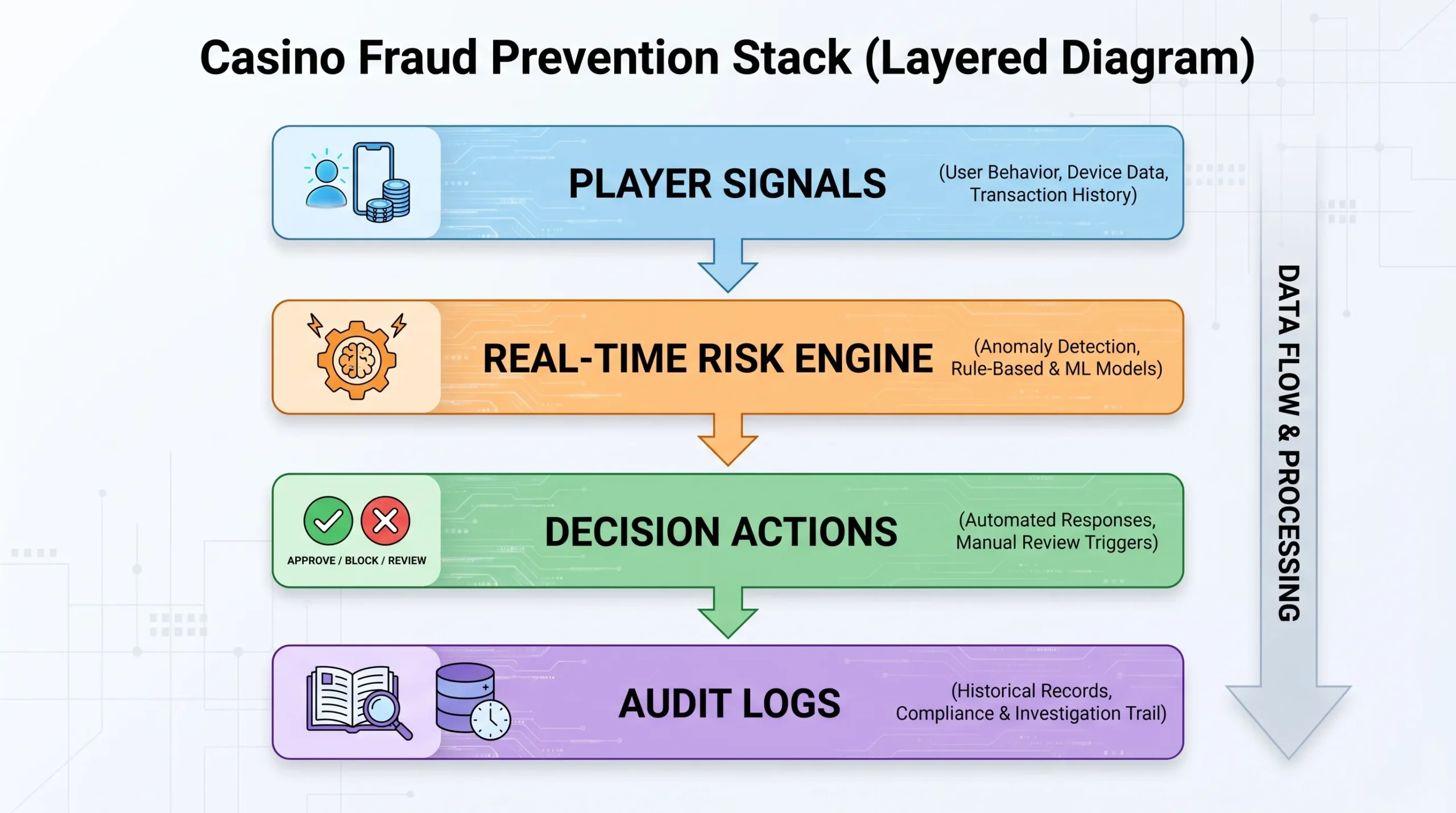
- Real-time decisioning with audit-grade logs
This matters commercially, not only operationally. Overblocking reduces first-time deposits and frustrates loyal players. Underblocking creates chargebacks, promo leakage, AML exposure, support costs, and reputational damage. The goal is not “maximum blocking.” The goal is risk-adjusted growth.
The essential casino fraud prevention tool stack
A strong fraud stack combines prevention, detection, response, and evidence. The table below summarizes the core tools most operators should have before scaling traffic.
| Tool category | Primary risk reduced | Where it should act | Must-have output |
|---|---|---|---|
| KYC and identity verification | Underage users, fake identities, sanctioned players | Registration, deposit, withdrawal, VIP review | Verified identity, risk level, evidence log |
| Device intelligence | Multi-accounting, bonus abuse, account takeover | Registration, login, bonus claim, cashier | Device graph and explainable links |
| Bot protection | Mass registrations, credential stuffing, scraping | Registration, login, promo pages, cashier | Bot score, rate limits, challenge results |
| Payment fraud controls | Stolen cards, chargebacks, card testing | Deposit and withdrawal flows | Risk score, gateway action, dispute evidence |
| Bonus abuse detection | Promo farming, arbitrage, coordinated abuse | Bonus eligibility, wagering, withdrawal | Eligibility decision and rule triggers |
| AML and transaction monitoring | Money laundering, mule activity, risky crypto flows | Deposits, gameplay, withdrawals, account reviews | Alerts, cases, suspicious activity evidence |
| Account security tools | Account takeover and credential compromise | Login, password reset, device change, payout change | Step-up action and session history |
| Affiliate fraud detection | Fake FTDs, incentivized traffic, partner abuse | Attribution, registration, deposit, payout | Partner risk score and payout hold evidence |
| Ledger and wallet anomaly detection | Double credits, negative balances, settlement mismatch | Cashier, wallet, reconciliation, payouts | Exception queue and reconciliation trail |
| Case management and audit logs | Slow reviews, inconsistent decisions, weak evidence | Backoffice, compliance, support | Case timeline, reason codes, exportable evidence |
1. KYC and identity verification tools
KYC is the foundation of casino fraud prevention, but it should not be treated as a one-time document upload. A modern online casino needs risk-based identity checks that adapt to the player’s behavior and jurisdiction.
At minimum, your KYC tooling should support document verification, age checks, liveness checks where appropriate, sanctions and PEP screening, address checks, and clear retry flows for failed verification. For higher-risk segments, operators may also need source-of-funds checks or enhanced due diligence.
The key is timing. Asking every player for heavy verification before they understand the product can damage conversion. Waiting until after a suspicious withdrawal can create compliance and player-trust issues. The best pattern is progressive verification: collect enough information to satisfy legal requirements and risk level, then step up when transaction value, geography, payment method, or behavior requires it.
If you are comparing vendors, focus on completion rate, mobile capture quality, latency, localization, audit exports, and fallback options. A tool that verifies accurately but causes a high drop-off rate can become a growth bottleneck.
2. Device intelligence and account-link analysis
Device fingerprinting is one of the most important tools for stopping multi-accounting, free spins abuse, account takeover, and coordinated fraud rings. It helps operators understand whether “new” players are truly new or are linked by device, browser, IP behavior, emulator usage, VPN patterns, or other technical signals.
The important point is that device intelligence should be used as a risk signal, not as an absolute identity. Browsers change, privacy features limit signal quality, and legitimate households can share devices or networks. Strong systems combine device signals with KYC, payment instruments, wallet addresses, gameplay behavior, and affiliate source.
A good device graph should answer questions like:
- Has this device created many accounts recently?
- Does this account share a device with previously banned players?
- Is the player switching devices only at withdrawal?
- Are multiple accounts claiming the same promotion from similar environments?
- Is a high-risk device also linked to the same affiliate or payment method?
For a deeper technical primer, see Spinlab’s guide to device fingerprinting for casino fraud prevention.
3. Bot protection and traffic filtering
Bots are not just a cybersecurity issue. In casinos, bots create fake accounts, scrape bonuses, test credentials, abuse promo endpoints, and overload payment forms. They also pollute analytics, making acquisition channels look better or worse than they really are.
Bot protection should cover more than the login page. Operators should protect registration, password reset, bonus claim, referral forms, game launch endpoints, and cashier flows. The goal is to stop automated abuse without forcing every legitimate player through frustrating CAPTCHA challenges.
Look for tools that support invisible challenges, adaptive rate limits, IP and ASN intelligence, behavioral analysis, token validation, and server-side verification. Pair this with operational dashboards that show attack spikes by endpoint, market, affiliate source, and campaign.
This is especially important during bonus launches, influencer drops, major sports events, or jackpot campaigns, when fraud pressure rises at the same time as legitimate traffic.
4. Payment fraud and chargeback prevention tools
Payment fraud is one of the most expensive surfaces for casino operators because it creates direct losses, dispute fees, operational workload, and potential payment gateway restrictions.
Your payment fraud stack should include velocity rules, BIN and issuer analysis, 3DS step-up logic, payment method reputation, deposit amount profiling, geo consistency checks, and chargeback evidence capture. For card rails, the system should distinguish between hard declines, soft declines, suspected fraud, issuer friction, and technical failures. Treating all declines the same leads to poor routing and weak recovery.
For a crypto-ready solution, payment risk also includes wallet screening, address clustering, chain risk scoring, Travel Rule workflows where applicable, custody controls, and withdrawal velocity limits. Stablecoins can reduce chargeback exposure, but they do not remove AML or sanctions risk.
Payment controls should connect directly to the casino ledger. If a payment webhook is delayed, duplicated, or reversed, the wallet should not double-credit the player or lose the audit trail. Idempotency, reconciliation, and clear transaction states are fraud controls, not just engineering hygiene.
5. Bonus abuse detection tools
Bonuses are designed to increase conversion and retention, but they also create an economic target for fraud. Abuse can include multi-accounting, coordinated free spins farming, low-risk wagering patterns, VPN-based geo manipulation, payment cycling, affiliate-driven fake users, and exploiting unclear terms.
A strong bonus engine should enforce eligibility before the offer is shown, not only after the player tries to withdraw. It should understand player risk, device links, payment history, wagering status, game contribution rules, max bet rules, country restrictions, bonus stacking, and cooldowns.
The best systems use graduated responses. A suspicious player may be excluded from a promotion, asked for step-up verification, restricted to lower-risk offers, routed to manual review, or blocked entirely. Not every trigger should produce the same action.
For operational playbooks, Spinlab’s article on bonus abuse detection rules, signals, and playbooks breaks down practical controls in more detail.
6. AML, KYT, and transaction monitoring
AML tools are often discussed separately from fraud tools, but in practice they share many of the same data sources. The difference is the objective. Fraud controls protect the operator from direct abuse. AML controls help detect and report suspicious financial behavior and meet regulatory obligations.
An iGaming AML system should monitor deposits, withdrawals, gameplay patterns, payment method changes, account links, jurisdiction risk, KYC status, and velocity across fiat and crypto rails. For crypto casinos, KYT (Know Your Transaction) adds blockchain-specific signals such as risky source of funds, mixer exposure, sanctioned addresses, high-risk counterparties, and wallet reuse patterns.
The best AML systems are risk-based. They do not rely only on static thresholds like “withdrawals over X amount.” They consider behavior in context. A player who deposits and withdraws repeatedly with little gameplay, changes payment methods before every cashout, or routes funds through high-risk wallets should be treated differently from a long-term player with consistent behavior.
If you are designing AML monitoring at scale, Spinlab’s guide to risk-based AML for iGaming is a useful next read.
7. Account takeover prevention tools
Account takeover (ATO) is especially damaging in casinos because compromised accounts can be used to drain balances, claim bonuses, change withdrawal details, or launder funds through gameplay.
ATO prevention should start with login intelligence: device changes, impossible travel, credential stuffing patterns, password reset anomalies, new payout destination alerts, and sudden session behavior changes. Operators should also support step-up authentication for sensitive actions, such as changing email, changing withdrawal method, requesting a large payout, or logging in from a new device after a long dormancy period.
Passkeys, app-based 2FA, SMS fallback, session revocation, and device binding can all help, but usability matters. If account security is too heavy at every login, players will abandon sessions. If it is too light at payout, attackers will exploit the weakest point in the journey.
A risk-based approach is usually best: low-friction access for trusted behavior, stronger checks for unusual or high-value actions.
8. Affiliate fraud detection tools
Affiliate fraud is often missed because it sits between marketing, risk, finance, and compliance. A partner can send traffic that looks profitable at first, then reveals itself through chargebacks, duplicate accounts, bonus abuse, fake FTDs, low retention, or suspicious sub-affiliate patterns.
Operators should monitor affiliate quality before the first payout. Useful signals include registration-to-deposit ratio, KYC failure rate, shared devices, payment reuse, withdrawal speed, promo cost per NGR, chargeback ratio, country mismatch, and abnormal conversion spikes by subID.
Marketing velocity also changes the fraud equation. As brands increasingly use automation to create and test campaigns, including tools for AI-powered marketing workflows, casino operators need equally fast controls for attribution, partner vetting, creative compliance, and traffic quality. Faster campaign execution is only valuable if the underlying users are real, allowed, and economically viable.
Affiliate fraud prevention should connect to payout rules. If a cohort fails quality checks, the system should hold commission, request evidence, downgrade terms, or escalate the partner for KYB review.
9. Wallet, ledger, and reconciliation anomaly detection
Some of the most expensive casino fraud incidents look like accounting problems at first. Double credits, negative balances, missing reversals, PSP webhook duplicates, crypto confirmation errors, and settlement mismatches can all create exploitable gaps.
That is why your fraud stack should include ledger anomaly detection. The system should flag impossible balance movements, repeated failed deposits followed by successful withdrawals, duplicate payment intents, inconsistent settlement states, abnormal FX outcomes, and wallets that move value faster than expected.
For multi-currency and crypto-ready casinos, this becomes even more important. You need a reliable ledger of record, clear wallet states, and reconciliation that matches the casino ledger, payment gateway reports, bank statements, and blockchain confirmations where relevant.
When payment and wallet controls are disconnected, fraud teams discover issues too late. When they are integrated, operators can stop suspicious withdrawals, fix ledger bugs, and preserve evidence before losses scale.
10. Case management, audit logs, and review workflows
Detection is only half the program. Operators also need tools to investigate, decide, document, and learn.
A proper fraud case management system should include risk alerts, player timeline, device and payment links, bonus history, KYC status, affiliate source, support notes, decision reason codes, reviewer actions, SLA timers, and exportable evidence. Without this, teams end up working in spreadsheets, chat threads, and fragmented admin panels.
Audit logs matter for disputes, regulator questions, partner reviews, and internal governance. Every block, hold, challenge, bonus exclusion, withdrawal review, and account closure should have a reason, timestamp, actor, and supporting data.
This is where a customizable backoffice becomes a strategic advantage. Fraud teams need fast queues and clear decisions. Compliance teams need traceability. Support teams need player-friendly explanations. Finance teams need settlement evidence.
How these tools should work together
The biggest mistake operators make is buying point tools without a decision layer. A KYC provider, device vendor, bot solution, and payment gateway can each produce risk signals, but someone still has to decide what happens next.
A mature casino fraud prevention architecture looks like this:
| Layer | What it does | Example output |
|---|---|---|
| Event collection | Captures registration, login, deposit, gameplay, bonus, affiliate, and withdrawal events | Standardized player timeline |
| Signal enrichment | Adds KYC, device, payment, geo, affiliate, and crypto risk data | Unified risk profile |
| Risk scoring | Combines rules and models into explainable scores | Low, medium, high, critical risk |
| Decision engine | Applies allow, step-up, hold, limit, block, or review actions | Real-time player outcome |
| Case and audit layer | Stores reason codes, evidence, reviewer actions, and exports | Defensible case history |
| Analytics loop | Measures fraud loss, false positives, conversion impact, and rule performance | Weekly tuning dashboard |
This is also why fraud prevention should be evaluated when choosing an iGaming platform, not bolted on after launch. Spinlab’s modular platform combines crypto and fiat payments, KYC and AML compliance, advanced fraud prevention, real-time analytics, open API integration, and a customizable backoffice, giving operators a single place to connect risk signals to operational decisions.
Vendor evaluation checklist
When you evaluate casino fraud prevention tools, ask for proof rather than feature names. A vendor saying “AI fraud detection” is not enough. You need to know what data it uses, what actions it can trigger, and how your team will tune it.
| Question to ask | Why it matters | Evidence to request |
|---|---|---|
| Can risk rules run before registration, deposit, bonus claim, and withdrawal? | Fraud appears at different journey stages | Demo of real-time decision points |
| Can the system explain why a player was flagged? | Reviewers need defensible decisions | Sample case with reason codes |
| Does it link device, identity, payment, wallet, and affiliate data? | Single-signal tools miss coordinated abuse | Player graph or event timeline |
| Can actions be graduated rather than only block or allow? | Good UX requires proportional controls | Allow, step-up, hold, limit, review examples |
| Are false positives measured? | Overblocking hurts revenue | Dashboard showing challenge and appeal outcomes |
| Does it support fiat and crypto risk workflows? | Hybrid cashiers need unified controls | Card, APM, stablecoin, and wallet examples |
| Are audit logs exportable? | Disputes and regulators require evidence | Evidence pack export sample |
| Can business users tune rules safely? | Ops teams need speed without developer dependency | Backoffice rule management demo |
A 30-day rollout plan for better casino fraud prevention
You do not need to implement every tool at once. A practical rollout should focus on the highest-loss surfaces first, then expand into automation and tuning.
| Phase | Timeline | Main work | Success signal |
|---|---|---|---|
| Map the risk surface | Days 1-3 | Identify top fraud losses by payments, bonuses, ATO, affiliates, and AML | Ranked fraud backlog |
| Instrument core events | Days 4-10 | Standardize registration, login, KYC, deposit, bonus, gameplay, withdrawal, and affiliate events | Complete player timeline |
| Add priority controls | Days 11-17 | Deploy velocity rules, device checks, bonus eligibility, payment risk, and withdrawal holds | Reduced obvious abuse |
| Build review workflows | Days 18-24 | Create queues, reason codes, escalation paths, and evidence exports | Faster and more consistent reviews |
| Tune and measure | Days 25-30 | Track losses, false positives, conversion, manual review rate, and rule performance | Weekly risk dashboard |
After the first month, focus on continuous improvement. Fraud tactics change as attackers learn your rules. The operators that win are the ones that treat fraud prevention as a living system, not a launch checklist.
For dashboard design, review Spinlab’s template for casino fraud KPIs that matter.
Common mistakes to avoid
The most common failure is relying on a single control. KYC alone will not stop bonus rings. Device fingerprinting alone will not prove AML risk. Payment gateway rules alone will not understand affiliate fraud. Each tool is useful, but only in combination.
Another mistake is blocking first and measuring later. If you cannot track false positives, player friction, and appeal outcomes, you may be reducing fraud by silently reducing revenue. Every control should be evaluated against both loss reduction and legitimate-player impact.
Operators also underestimate manual review design. A review queue with no SLA, no reason codes, and no evidence pack becomes a backlog machine. Fraud prevention should make teams faster, not bury them in alerts.
Finally, many teams ignore the connection between promotions and risk. If your bonus engine, affiliate system, and fraud tools do not share data, you will keep paying for users who were never economically valid.
The KPIs every fraud team should track
A weekly fraud dashboard should balance loss, pressure, control health, and player friction.
| KPI | What it tells you | Direction you want |
|---|---|---|
| Confirmed fraud loss rate | Direct losses relative to accepted activity | Down |
| Chargeback ratio | Card dispute pressure and gateway risk | Down |
| Bonus abuse cost | Promo value captured by abusive users | Down |
| ATO incident rate | Account compromise pressure | Down |
| Manual review rate | How much volume needs human handling | Controlled |
| Median and P95 review time | Operational speed and queue health | Down |
| False positive rate | Legitimate players affected by controls | Down |
| Step-up completion rate | Whether challenges are usable | Up |
| Fraud-adjusted approval rate | Clean deposits accepted after risk controls | Up |
| Affiliate cohort quality | Whether partners send durable, compliant users | Up |
The best dashboards also segment by market, payment method, device type, affiliate, bonus, and player lifecycle stage. A global average can hide a severe issue in one channel.
FAQ
What are the most important casino fraud prevention tools for a new operator? Start with KYC, device intelligence, bot protection, payment risk controls, bonus abuse rules, AML monitoring, and a clear backoffice review workflow. These cover the highest-risk areas for most new online casinos.
Should fraud tools block players automatically? Some high-confidence cases can be blocked automatically, but most operators should use graduated actions such as step-up verification, bonus exclusion, withdrawal hold, or manual review. This reduces false positives while still controlling risk.
How does crypto change casino fraud prevention? Crypto reduces chargeback risk, but it adds wallet screening, custody, transaction monitoring, Travel Rule considerations, and withdrawal controls. Operators need KYT and wallet risk tools in addition to standard KYC and fraud monitoring.
How can operators reduce fraud without hurting conversion? Use risk-based controls, not blanket friction. Challenge players only when signals justify it, measure false positives, keep KYC mobile-friendly, and allow trusted players to move quickly through deposits and withdrawals.
Is fraud prevention better as standalone software or part of the casino platform? Standalone tools can work, but they need strong integration. Platform-native fraud prevention is often easier for lean teams because payments, KYC, bonuses, analytics, wallet events, and backoffice actions already share the same operational layer.
Build fraud prevention into the casino from day one
Fraud prevention is not a single vendor, a static rule set, or a manual review queue. It is a connected operating system for risk-adjusted growth.
Spinlab helps operators launch and scale online casinos with integrated payments, crypto-ready workflows, KYC and AML compliance, advanced fraud prevention, real-time analytics, game aggregation, and a customizable backoffice. For founders and operators who want a Shopify-like way to run a whitelabel casino without stitching together fragmented tools, Spinlab provides a modular foundation built for speed, flexibility, and control.
If you are planning a new online casino or upgrading an existing stack, book a Spinlab demo to see how fraud prevention, payments, compliance, and analytics can work together from day one.