

If you operate a crypto casino, “custody” is not just a wallet integration decision. It is a business-critical control system that determines whether you can (1) move funds safely, (2) prove governance to auditors, (3) survive incidents, and (4) keep withdrawals fast enough to protect retention.
Three approaches dominate crypto casino custody architectures:
- Multisig (multiple private keys, on-chain approval rules)
- HSM-based signing (keys held inside tamper-resistant hardware)
- MPC (multi-party computation, keys are never assembled in one place)
Below is a practical, operator-focused explanation of how each works, what tends to break in production, and how to choose the right model for hot wallets, warm wallets, and treasury.
What “custody” really means in a crypto casino
In iGaming, custody is rarely a single wallet. It is a set of policies and components that turn deposits into playable balances and then into withdrawals, while staying audit-ready.
At minimum, custody touches:
- Signing: who (or what) can authorize a blockchain transaction.
- Key management: generation, storage, rotation, backup, recovery, and destruction.
- Transaction policy: limits, approvals, allowlists, time locks, and “break-glass” rules.
- Operational workflow: what happens at 2am when a withdrawal queue spikes, or a signer is unavailable.
- Evidence: logs that prove who approved what, when, and under which policy.
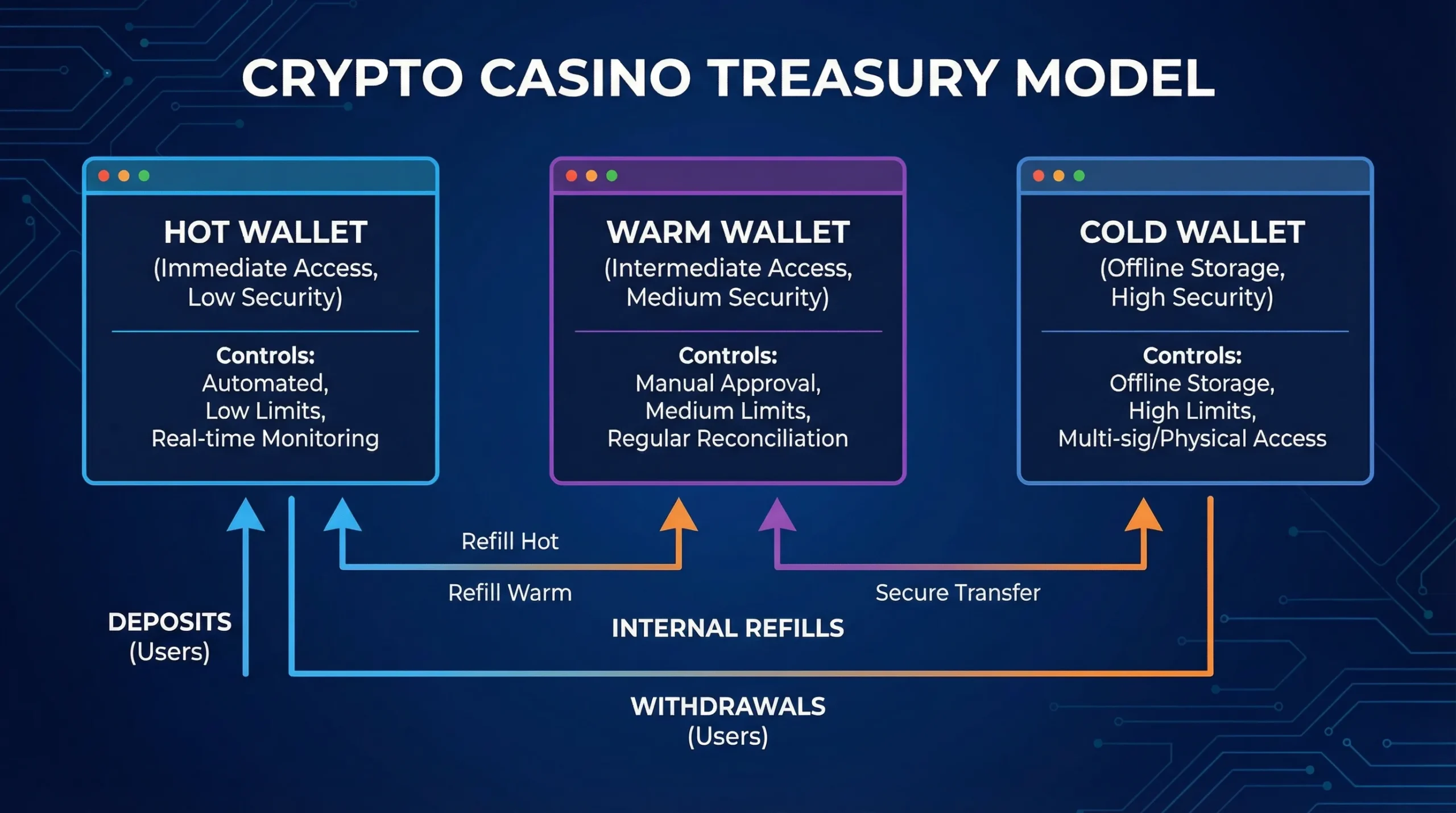
Most casinos end up with a tiered treasury model:
- Hot: smallest balance, highest speed requirement (instant or near-instant payouts).
- Warm: refill wallet, controlled payouts, batch operations.
- Cold: treasury, long-term storage, strict approvals.
Different tiers can use different custody methods, and that is often the best answer.
The threat model you should assume (even if you are “small”)
Crypto custody failures in gambling typically come from a short list of causes:
- Single point of compromise: one leaked seed phrase, one admin account takeover, one exposed signing server.
- Insider risk: an employee (or contractor) with enough access to bypass approvals.
- Policy bypass: “temporary” exceptions that become permanent, or automation that can be tricked.
- Operational errors: wrong chain, wrong address, wrong nonce, wrong gas settings, wrong token contract.
- Vendor concentration risk: one custody provider outage blocks withdrawals.
A useful way to frame it is: you are not only choosing cryptography, you are choosing how failures behave.
Multisig custody explained (and where it fits)
How multisig works
A multisig wallet requires multiple independent approvals to spend funds. The chain enforces the rule.
- Example: a 2-of-3 multisig means any 2 of 3 keys can authorize a transaction.
- On Ethereum and EVM chains, multisig is commonly implemented via smart contracts (for example, “safe” style contracts).
- On Bitcoin-like chains, multisig is implemented at the script level.
Multisig strengths for casinos
- On-chain enforceability: the approval rule is enforced by the network.
- Clear governance story: easy to explain to compliance and auditors.
- Good for treasury: slower is acceptable, security is the priority.
- Flexible approval policies: you can require finance plus compliance sign-off for large moves.
Multisig weaknesses in production
- Signer availability becomes a UX risk: if one key holder is asleep, traveling, or locked out, withdrawals can stall.
- Key loss can be catastrophic (depending on threshold): lose enough keys and funds are stuck.
- Automation is harder: fully automated hot-wallet payouts often clash with human approvals.
- Smart-contract risk (EVM multisig): contract bugs or misconfiguration can be fatal.
Where multisig usually fits best
- Cold treasury: 2-of-3, 3-of-5, or higher thresholds.
- Warm refills: controlled refills to hot wallets, with scheduled signing windows.
HSM custody explained (and why “FIPS” keeps coming up)
How HSM-based signing works
An HSM (Hardware Security Module) is a dedicated device designed to generate and store cryptographic keys and perform signing operations inside hardened hardware. In a typical design:
- The private key is created in the HSM.
- The key is not exportable (by policy and hardware controls).
- Signing requests are sent to the HSM, which returns signatures if policy allows.
When people reference “HSM compliance,” they often mean FIPS 140-3 validation, a widely recognized standard for cryptographic modules published by NIST (FIPS 140-3 overview).
HSM strengths for casinos
- Strong protection against key extraction: malware on an app server is less likely to steal a key that never leaves the HSM.
- Low-latency signing: good for high-throughput hot wallet workloads.
- Operationally familiar: many fintech and payments teams already use HSM patterns.
- Clear security controls: separation of duties, role-based access, and auditable admin actions.
HSM weaknesses in production
- It can still become a single point of failure if you run one HSM cluster in one region.
- Integration complexity: you need well-designed signing services, policy layers, and secure admin workflows.
- Supply chain and lifecycle management: provisioning, patching, HA design, hardware replacement.
Where HSM usually fits best
- Hot wallets: high volume signing with strict policy controls.
- Warm operations: controlled batch signing, especially when paired with policy engines and monitoring.
MPC custody explained (and why so many teams are moving to it)
How MPC works (in plain English)
With MPC (Multi-Party Computation), the private key is never stored in one place. Instead, it is split into “shares” held by different parties or systems.
When a transaction needs signing:
- Multiple parties collaborate to produce a valid signature.
- No single party ever reconstructs the full key.
Many MPC custody systems use threshold signatures, meaning you can require M-of-N parties to sign, similar in spirit to multisig, but the final signature often looks like a normal single-signature transaction on-chain.
MPC strengths for casinos
- Reduces single-key compromise risk: stealing one share is not enough.
- Can support automation without putting one key on one server.
- Cleaner on-chain footprint in some implementations: can look like a standard account, depending on chain and scheme.
- Flexible governance: shares can be distributed across devices, teams, or even independent providers.
MPC weaknesses and trade-offs
- Vendor and architecture risk: you are trusting an MPC implementation to be correct, resilient, and well-operated.
- Operational debugging can be harder: failures can look like “signing ceremony failed” rather than a clear on-chain rejection.
- Share backup and recovery must be designed: otherwise recovery becomes your weak link.
Where MPC usually fits best
- Hot and warm wallets where you want strong security without fully manual approvals.
- Operators scaling globally who need geo-distributed resilience.
MPC vs multisig vs HSM: side-by-side comparison
This table is intentionally practical, it focuses on how systems behave during real incidents and during peak withdrawal load.
| Dimension | Multisig | HSM | MPC |
|---|---|---|---|
| On-chain enforceability | Strong (rule enforced by chain) | Not on-chain (enforced by your systems) | Usually not on-chain (enforced by MPC protocol) |
| Speed for hot wallet payouts | Often slower if humans must co-sign | Fast | Fast to medium (depends on ceremony and networking) |
| Failure mode | Signer unavailable can block spends | HSM outage can block signing | Ceremony or party outage can block signing |
| Key compromise risk | Compromise of enough keys breaks security | Strong vs extraction, but app-layer misuse is still possible | Strong vs single-node compromise |
| Best fit | Cold treasury, high-value moves | Hot wallet signing at scale | Hot and warm wallets with strong governance |
| Governance clarity for audits | High | High if policies and logs are strong | High if role separation and evidence are strong |
| Chain compatibility | Varies by chain and wallet type | Broad (signing is signing, chain logic is separate) | Broad, but depends on MPC scheme and chain tooling |
How to choose custody for a crypto casino (decision patterns that work)
The best custody choice depends on your withdrawal promise, your licensing posture, and how your team actually operates.
Pattern A: Instant withdrawals (marketing promise) with controlled risk
If you advertise fast payouts, you need predictable signing throughput and low manual dependency.
Common choice:
- Hot wallet: HSM or MPC (with tight policy limits)
- Warm wallet: MPC or multisig
- Cold treasury: multisig
Key control that makes or breaks this pattern is automated limits. For example, you can allow auto-signing under a per-transaction cap and require step-up approvals above it.
Pattern B: Compliance-first, slower payouts, higher manual assurance
If your license, banking partners, or risk posture demands strict human approvals:
- Warm and cold: multisig
- Hot: small balance, HSM optional
This is also common for newer operators that want maximum audit clarity before optimizing UX.
Pattern C: Multi-brand, multi-jurisdiction operations
As soon as you operate multiple brands or regions, you need to isolate risk and prove segregation.
- Use separate wallet clusters per brand or jurisdiction.
- Use custody controls that support role-based approvals and evidence export.
This is where MPC can be attractive, but only if you design evidence and recovery correctly.
The controls auditors and regulators expect (regardless of custody type)
Your custody mechanism is only the cryptographic core. Regulators and auditors tend to care more about whether you can prove control, prevention, and response.
A strong baseline control set includes:
- Segregation of duties: no single person can create a payee, approve a transaction, and release funds.
- Policy engine: limits by asset, chain, risk score, player tier, and destination type.
- Address allowlisting: especially for treasury moves and partner payments.
- Identity and access management: MFA, device binding, least privilege, just-in-time access.
- Immutable audit logs: who requested, who approved, what was signed, what policy applied.
- Incident runbooks and drills: not just documents, practiced exercises.
For crypto flows, these controls often connect to Travel Rule and AML obligations. FATF Recommendation 16 is the root of most Travel Rule regimes (FATF recommendations).
Implementation checklist: what to build around custody
1) Separate “signing” from “decisioning”
A common failure mode is letting a signing service decide what is allowed. Better:
- Decisioning service evaluates policy (KYC state, AML risk, withdrawal holds, limits, sanctions/KYT signals).
- Signing service only signs if it receives a short-lived, scoped authorization.
This makes audits easier and reduces blast radius.
2) Design for idempotency and replay protection
Crypto withdrawal systems hit retries, webhook duplication, and chain reorg edge cases.
Minimum requirements:
- Idempotency keys for every payout request.
- Deterministic nonce management per wallet.
- A reconciliation job that can prove “requested equals broadcast equals confirmed.”
3) Build “break-glass” without creating a permanent backdoor
Every operator needs an emergency mode, but it must be governed:
- Time-limited elevated privileges.
- Separate emergency signers.
- Mandatory incident ticket and post-mortem.
Operationally, this is similar to why you keep reliable emergency vendors in other domains, for example having a vetted same-day service provider when something critical breaks at home, such as a dependable plumbing and drain cleaning team that can stop a small issue from turning into a flood. In crypto custody, your equivalent is a rehearsed incident response path that prevents small anomalies from turning into catastrophic loss.
4) Treat recovery as a first-class product
For multisig: how do you replace a signer who leaves the company?
For HSM: how do you restore if an HSM cluster is lost?
For MPC: how do you recover shares without concentrating power?
If you cannot answer these cleanly, you do not have custody, you have a future outage.
Common mistakes when implementing MPC, multisig, or HSM in casinos
Mistake 1: Overfunding the hot wallet
Hot wallets should be treated like a cash register, not a vault.
Fix: enforce automated refills from warm wallets and maintain strict caps.
Mistake 2: No policy link between AML decisions and signing
If the signing layer cannot be stopped by AML flags in near real time, you will eventually pay out to a bad destination.
Fix: make “sign authorization” depend on policy evaluation outputs, and log the policy decision.
Mistake 3: No evidence pack for disputes, audits, and investigations
When a regulator, banking partner, or internal investigator asks “why did this payout happen,” you need more than blockchain explorers.
Fix: store a signed, immutable event trail, including request metadata, approvals, risk signals, and transaction hash.
Mistake 4: Assuming one model must cover everything
Many teams force MPC everywhere, or multisig everywhere, and then fight the operational trade-offs.
Fix: split by tier (hot/warm/cold) and by business need (speed vs assurance).
Where Spinlab fits (without locking you into one custody philosophy)
Casino operators rarely want a custody tool in isolation. They want custody integrated with cashier UX, limits, KYC and AML workflows, fraud prevention, and backoffice operations.
Spinlab is built as a modular iGaming platform with crypto-ready payments and merchant custodial wallets designed to help operators implement secure funds flows alongside compliance controls. If you are evaluating custody approaches as part of a wider platform decision, it helps to map custody choices directly to your withdrawal policies, risk engine, and audit logging needs.
For related operational guidance, see Spinlab’s resources on:
Frequently Asked Questions
Is MPC always better than multisig for a crypto casino? Not always. MPC often improves security and automation for hot and warm wallets, but multisig can be simpler to reason about for cold treasury governance, especially when human approvals are desired.
Do I need an HSM if I use MPC? Not necessarily. They solve overlapping but different problems. HSMs protect a single key from extraction, MPC avoids having a single key at all. Some architectures still use HSM-like hardening for MPC components, but it depends on your design.
Which custody model is easiest for audits and licensing? Auditors typically care most about governance, separation of duties, and evidence. Multisig is often easiest to explain, but HSM and MPC can be equally audit-friendly if policies, approvals, and logs are well-implemented.
Can I mix custody methods across hot, warm, and cold wallets? Yes, and it is common. Many operators use MPC or HSM for hot signing, then multisig for treasury. Mixing can reduce operational friction while keeping strong governance for high-value funds.
What is the biggest operational risk across all custody types? Recovery and incident handling. If you have not designed signer replacement, share recovery, regional outages, and break-glass procedures, you will eventually face blocked withdrawals or unsafe emergency workarounds.
Want a custody architecture that supports fast withdrawals and audit-grade control?
If you are choosing between MPC, multisig, and HSM because you are launching or scaling a crypto casino, the fastest way to de-risk the decision is to map custody to your real operating model: withdrawal SLAs, approval policies, KYC and AML gating, and treasury refills.
Explore Spinlab’s crypto-ready iGaming platform at spinlab.studio and request a walkthrough to discuss a custody setup that fits your wallet tiers, compliance needs, and growth plan.