

Headless casino frontends are becoming the default choice for operators who want more than “pick a theme and launch.” If you are competing on speed, conversion, and brand differentiation, decoupling the UI from the platform can turn the frontend into a growth lever instead of a constraint.
But headless is not automatically cheaper, simpler, or safer. In iGaming, the frontend touches regulated flows (KYC, payments, responsible gambling prompts, geo/age checks), high-risk abuse surfaces (bonus fraud, card testing, multi-accounting), and performance-sensitive game launch paths. So the real question is not “headless or not,” it’s whether you can capture the upside without absorbing hidden complexity.
What “headless” means in an online casino
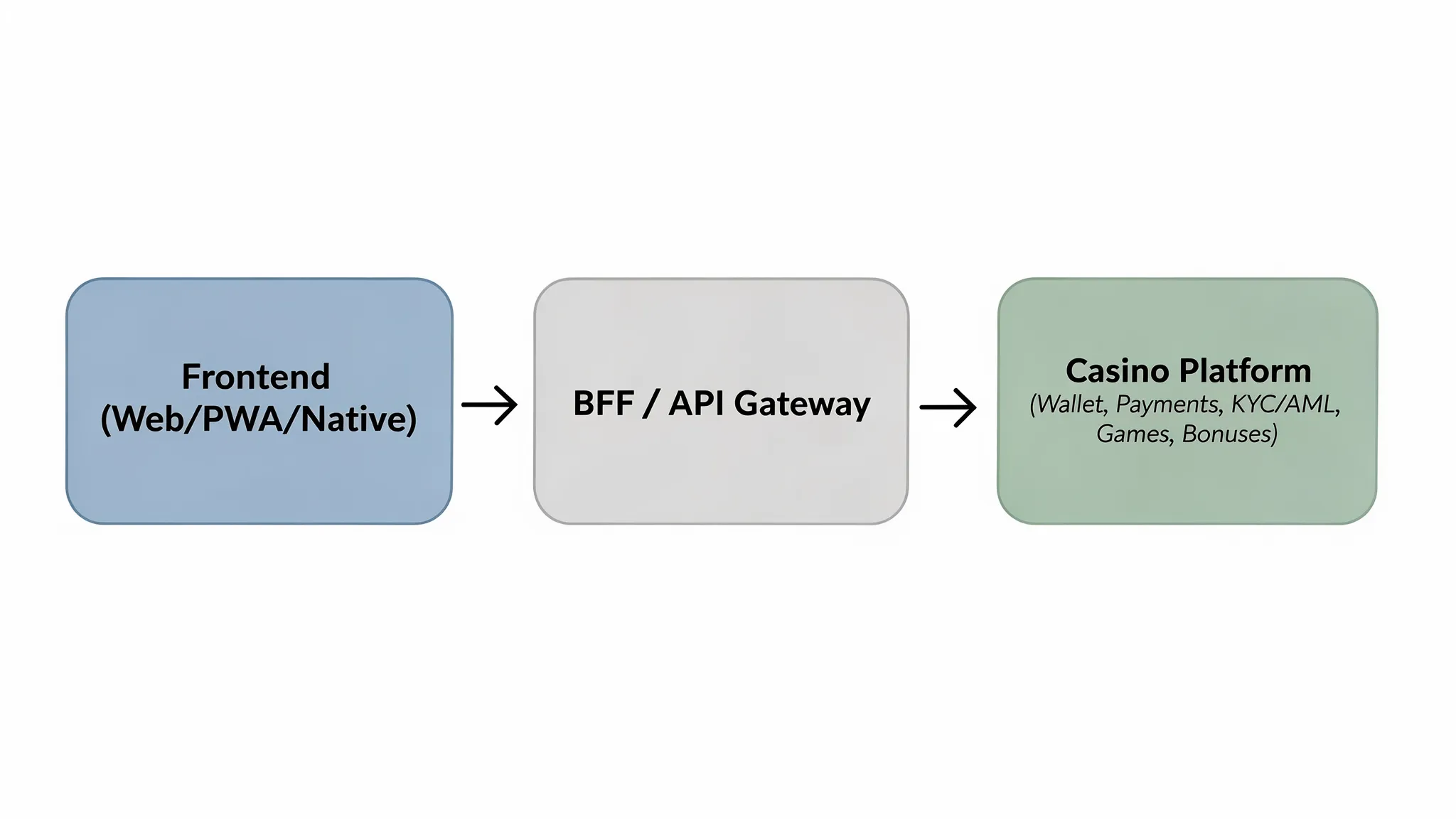
A headless casino frontend is a user interface (web, PWA, native app, or even embedded widgets) that communicates with your casino platform through APIs, instead of being tightly coupled to a built-in UI.
In practical terms:
- The casino platform provides core capabilities: player accounts, wallet, payments (fiat/crypto), KYC/AML, fraud controls, bonuses, affiliate tracking, game aggregation, reporting, and compliance hooks.
- The frontend is a separate codebase owned by your team (or an agency), free to implement your UX, SEO pages, personalization, and experiments.
- Between them, many teams add a BFF (backend-for-frontend) or API gateway layer to tailor payloads, handle caching, and reduce frontend complexity.
This differs from a traditional turnkey or white-label UI where:
- UI changes are limited to templates, theme settings, or vendor-defined components.
- Release cycles are tied to the vendor’s roadmap.
- Deep UX and performance optimizations can be difficult because the frontend and platform are fused.
Pros: Where headless frontends pay off
Faster experimentation on conversion and retention
In casinos, small UX shifts can have outsized effects on funded registration, deposit conversion, and repeat deposits. Headless makes it easier to run rapid A/B tests on:
- Registration and login flows
- Cashier UX (fiat and crypto onramp paths)
- Lobby ordering, search, and recommendations
- Promotion presentation (bonus clarity, wagering rules, progress)
If your platform exposes the right APIs and events, headless lets you iterate without waiting for vendor UI releases.
Performance and Core Web Vitals control
Casinos are unusually “heavy” sites: large lobbies, many images, third-party tags, embedded games, and real-time widgets. A headless approach can improve perceived speed by giving you full control over:
- Rendering strategy (SSR, SSG, streaming, partial hydration)
- Asset loading and caching policies
- CDN edge behavior
- Script discipline (especially affiliate and analytics tags)
If performance is a priority for acquisition and conversion, it is worth pairing this topic with a Core Web Vitals plan. (Related: Core Web Vitals for Casino Sites in 2026.)
Multi-brand and multi-channel scaling
Headless shines when you are running multiple brands, markets, or device experiences:
- One platform, multiple frontends (or skins)
- Market-specific UX and localization (including layout differences, currency presentation, and compliance messages)
- Multiple delivery surfaces (web, PWA, native wrappers)
This is especially helpful when your growth depends on rapid regional iteration, while keeping platform governance centralized.
SEO control for content-heavy casino strategies
If your strategy includes game pages, provider hubs, promo landing pages, or editorial SEO content, headless is a major advantage because you can structure templates and metadata exactly how you need.
A common pattern is to combine headless UI with structured content management. For example, typed CMS fields (metafields) help maintain consistent, SEO-friendly game and promo pages at scale. (Related: Metafields for Casino CMS: Structuring Content for SEO and Speed.)
Cleaner long-term architecture (if you do it right)
With a well-designed API boundary, you can evolve the UI without rewriting your platform, and vice versa. This reduces the “everything is intertwined” problem that slows many casinos down after launch.
Cons: The trade-offs that catch teams off guard
More things become your responsibility
In a headless setup, the vendor is no longer responsible for large parts of UX correctness. You own:
- Frontend security posture (XSS, session handling, CSP, dependency risk)
- Performance budgets and regression monitoring
- Cross-browser/device QA
- Accessibility and content compliance presentation
This is not theoretical. Casino frontends are high-value targets, and the cost of mistakes can be financial, regulatory, and reputational.
For baseline web app security guidance, OWASP is a good reference point (see OWASP Top 10).
Higher integration complexity (especially around state)
Casinos are stateful:
- Wallet balances update frequently
- Bonus state changes mid-session
- KYC status gates withdrawals or bet limits
- Fraud controls can step-up verification in real time
Headless frontends often require careful handling of:
- Idempotency (especially in payments and bonus redemption)
- Real-time updates (webhooks, sockets, polling strategies)
- Caching and “stale UI” risk
Game launch constraints still exist
Even with a headless lobby, many games are delivered via iframes or provider launch URLs. That means:
- You might not fully control the in-game experience
- Some performance and UX issues come from provider assets, not your frontend
- Compliance messaging and responsible-gambling links must still be accessible and consistent
Headless improves the lobby and surrounding UX a lot, but it does not magically solve every third-party constraint.
Bigger QA matrix and release governance
Headless tends to increase combinations:
- More devices and browsers
- More locales and currencies
- More payment rails and edge cases
- More “policy differences” per jurisdiction
If you do not invest in test automation and release discipline, you can end up shipping slower than a white-label UI.
Costs: What headless really adds (and what it can reduce)
Headless is best understood as a cost shift, not automatically a cost reduction.
You typically spend more on frontend engineering, but you can reduce costs elsewhere (vendor UI customization fees, slow iteration costs, poor conversion from rigid UX, and long-term rebuild risk).
The main cost buckets
| Cost area | What you pay for | What drives it up | How to control it |
|---|---|---|---|
| Frontend build | Design system, lobby, SEO pages, cashier UI, auth, promo surfaces | Multiple brands, heavy animations, bespoke UX | Reuse components, define a strict “MVP lobby” |
| BFF/API layer | Aggregating APIs, caching, session handling, edge security | Many integrations, real-time data needs | Keep BFF thin, standardize payloads |
| QA & compliance validation | Device coverage, regression, jurisdictional UX checks | Many locales, fast release cadence | Automated smoke tests, feature flags |
| Performance & observability | RUM, error tracking, performance budgets | Third-party scripts, heavy assets | Performance budgets, tag governance |
| Ongoing iteration | A/B tests, new promos, content templates, new payment flows | Unclear ownership, ad hoc work | Roadmap discipline and product ops |
The “hidden” cost most teams miss: operational load
A headless frontend becomes a living product. Plan for ongoing work like:
- Updating KYC and payments UI when regulations or flows change
- Handling new fraud patterns (front-end rate limiting, bot defenses, step-up UX)
- Keeping affiliate tracking accurate across releases
- Maintaining SEO templates as content scale grows
If you are budgeting, treat headless as an ongoing capability, not a one-time project.
Headless vs white-label vs fully custom: a practical comparison
Most teams are choosing between three realistic approaches:
| Approach | Best for | Limitations | Typical risk |
|---|---|---|---|
| White-label UI (themed) | Fastest launch, smallest team | UX and performance constrained by vendor UI | Vendor lock-in, slower iteration |
| Headless frontend on a modular platform | Brand differentiation + faster iteration without rebuilding core platform | Requires frontend ownership and strong API boundary | Integration complexity, QA surface area |
| Fully custom platform + UI | Unique product, deep control | Highest build and compliance effort | Time-to-market and long-term maintenance |
If you already know you want a white-label casino platform for speed, but you also want differentiation and performance control, headless on top of a modular platform is often the middle path.
For broader platform selection context, see: White Label vs Custom Casino: How to Choose.
When headless is the right choice (decision triggers)
Headless tends to be a strong fit when at least a few of these are true:
- You plan to run multiple brands or frequent market-specific launches
- Your acquisition relies heavily on SEO landing pages and fast content production
- Your roadmap requires constant UX iteration (cashier optimization, personalization, gamification)
- You have (or can hire) a team that can own frontend engineering and releases
- You want to minimize vendor UI constraints while still using a proven iGaming platform for payments, compliance, and game aggregation
Headless is usually a poor fit if you want a hands-off launch with minimal technical ownership, or if your team cannot support a real release cadence.
Implementation strategy: how to reduce risk and cost
The safest way to adopt headless is to avoid “big bang” rewrites.
Common phased rollout patterns
Phase 1: Headless marketing + SEO pages
Start with acquisition surfaces (home, provider pages, game detail pages, promo pages). This delivers value early and lets you harden analytics, tracking, SEO, and performance.
Phase 2: Headless lobby and navigation
Move the lobby and discovery experience next. This is where speed and personalization typically pay off.
Phase 3: Cashier and account area
This is the highest risk and highest leverage area. Approach it with strong QA, clear observability, and fraud/security review.
If your team is also thinking about installable web experiences, headless pairs well with PWAs. (Related: PWA Casinos: Installable Web Apps That Convert.)
What to ask a casino software provider before going headless
Not every casino software provider is truly “headless-friendly.” Before you commit, pressure-test the platform with questions like:
- Do you provide open APIs that cover the full player lifecycle (auth, wallet, games, bonuses, KYC status, payments)?
- How do you handle webhooks or real-time events for wallet, bonus, and risk state changes?
- Can you support multi-currency and (if relevant) crypto flows cleanly in APIs?
- What is the approach to fraud prevention when UI is custom (rate limits, velocity rules, step-up requirements)?
- How do you support compliance requirements that affect frontend UX (jurisdictional blocking, responsible gambling messaging, audit logs)?
If a vendor answers these vaguely, headless becomes expensive fast.
Frequently Asked Questions
Is a headless casino frontend the same as a white-label casino platform? No. White-label describes a ready-to-launch packaged casino experience, usually including a built-in UI. Headless describes an architectural choice where the UI is decoupled and built separately, typically on top of a platform via APIs.
Does headless reduce total cost of ownership (TCO)? It can, but not automatically. Headless often increases frontend engineering cost while reducing vendor UI constraints and improving iteration speed. The ROI usually comes from better conversion, faster experimentation, and avoiding future replatforming.
What are the biggest technical risks in headless iGaming frontends? State consistency (wallet/bonus/KYC), security hardening, and QA scale across devices, locales, and payment rails. Release governance and observability are critical.
Can you still use a game aggregator with a headless frontend? Yes. Headless typically changes the lobby and launch flow UX, but most game aggregation still relies on provider integrations and launch mechanisms behind the scenes.
How long does a headless casino frontend take to build? It depends on scope (brands, locales, cashier complexity, SEO templates, personalization). Many teams start with a phased approach to deliver value early and reduce risk.
Build a headless frontend without rebuilding the whole casino
If you want the flexibility of a headless casino frontend but do not want to rebuild payments, compliance, game aggregation, and risk tooling from scratch, Spinlab is designed for that middle path.
Spinlab offers an all-in-one, modular iGaming platform for building, launching, and scaling online casinos, including crypto and fiat payment support, game aggregation, KYC/AML compliance, fraud prevention, multi-currency support, and open API integration. It is also built for fast onboarding with a Shopify-like operator experience and UI.
Explore the platform at spinlab.studio and book a demo to discuss whether headless is the right frontend strategy for your brands, markets, and budget.