

Choosing between a white label platform and a custom build is one of the most consequential decisions an online casino team will make. It sets your time to market, spend profile, operational complexity, and the ceiling for differentiation. The right answer depends on your goals, timeline, target markets, and the capabilities you already have in house. This guide gives you a practical framework to decide, with clear trade offs, a 24 month TCO model, and a migration path that avoids lock in.
What do we mean by white label, custom, and the middle ground
- White label, a ready to launch iGaming platform that includes the core stack, game aggregation, payments, compliance, and back office. You configure brand, content, bonuses, and workflows, then go live in weeks. Ongoing costs are mostly OpEx.
- Custom build, your team or an agency builds and operates the platform. You choose the architecture, integrate providers, and own the roadmap. Time to market is longer, up front investment is higher, and you carry ongoing engineering, security, and compliance overhead.
- Modular white label, a modern category that combines speed with control, where a vendor offers a full stack but exposes open APIs, a customizable admin, and options like original games to create differentiation without rewriting the platform.
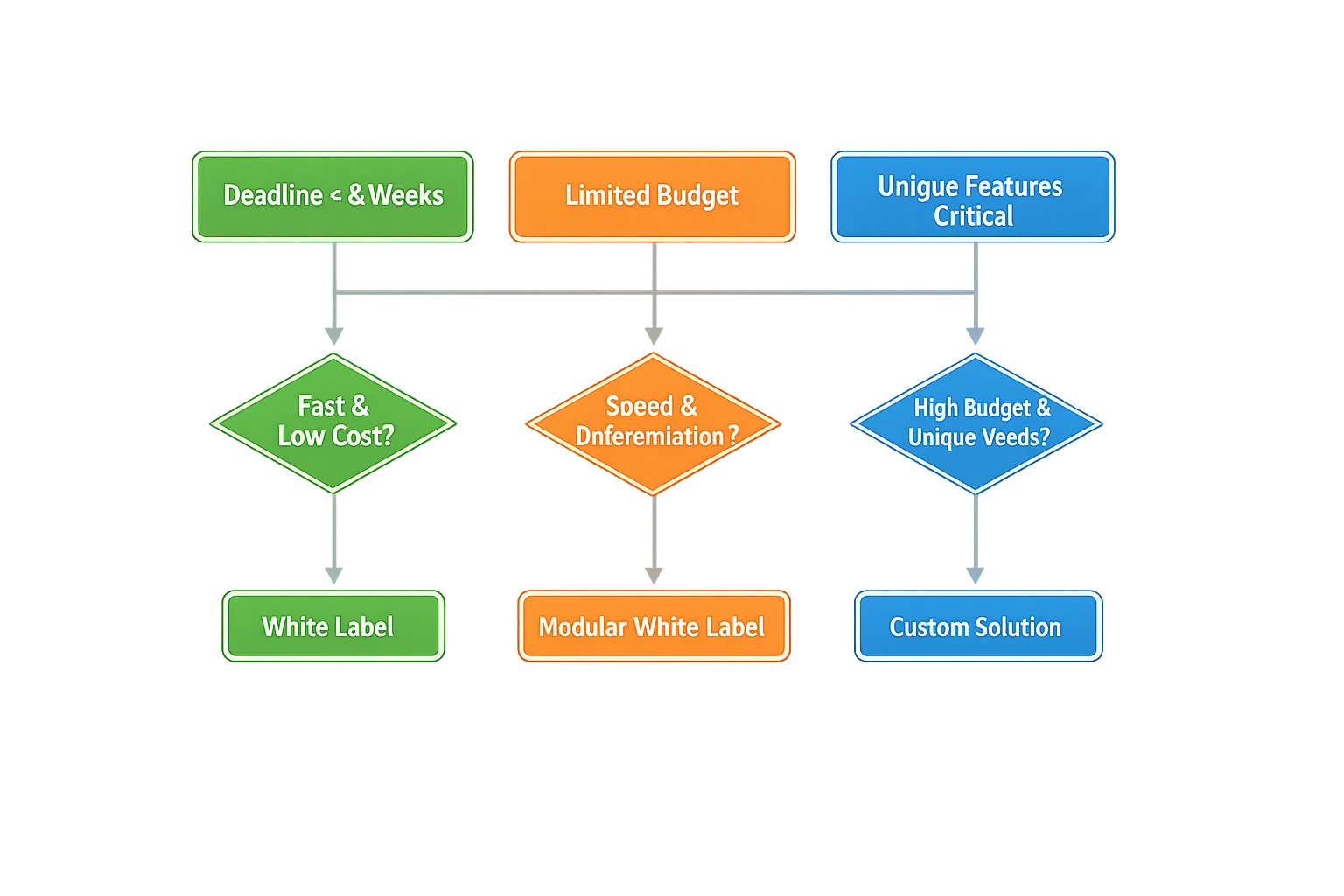
Quick comparison, white label vs custom
| Dimension | White Label | Custom Build |
|---|---|---|
| Time to market | Weeks, often 2 to 8 | Months, often 6 to 18 |
| Upfront investment | Low setup, mostly OpEx | High CapEx for build and certification, often several hundred thousand |
| Ongoing costs | Predictable platform and content fees | Engineering payroll, infrastructure, vendor contracts, certifications |
| Compliance and payments | Pre integrated KYC, AML, cashier, multiple APMs and crypto | You integrate PSPs, handle PCI scope, monitoring, audits |
| Game content | Aggregated catalog out of the box | Direct studio contracts or aggregator integrations you maintain |
| Differentiation | Theming, bonus and affiliate engines, configurable UX, original titles with some vendors | Full control of product roadmap and math, more room for novel mechanics |
| Scalability and reliability | Proven patterns, shared hardening across operators | You design and operate scaling, observability, and failover |
| Data and analytics | Built in dashboards and events | You design data pipelines and real time analytics |
| Risk and speed of iteration | Fast feature adoption via vendor releases | Release speed depends on your team capacity |
| Ownership and IP | Limited platform IP, potential for custom game IP | Full platform and game IP if built in house |
If you need a decision today, pick the column that best matches your top three constraints. If speed to revenue and predictable OpEx matter most, white label wins. If you have a funded product thesis that truly requires new mechanics or compliance models, custom can pay off. Many operators choose a modular white label first, then layer custom work where it actually moves the needle.
For a deeper feature checklist to evaluate white label vendors, see the companion guide, 15 Essential Features Every White Label Casino Platform Should Offer.
Cost realism in 2025, how to model 24 month TCO
Instead of debating preferences, model the full cost of both paths over 24 months. Build a simple worksheet with the line items below, then compare scenarios for conservative, base case, and aggressive growth.
- Setup and licensing, platform setup, compliance onboarding, jurisdictional licensing where relevant. For regulated markets, our launch blueprint cites mid tier budgets in the hundreds of thousands, see How to Launch an Online Casino from Scratch in 2025.
- Game content, aggregator fees, studio rev share, certification uplifts, premium content surcharges. Hidden extras add up, review this before you sign, see The True Cost of a Game Aggregator.
- Payments, PSP setup, per transaction fees, chargebacks, crypto onramp costs, settlement, treasury. Choice of rails affects LTV and cost to serve, see Crypto vs Fiat, Which Payment Gateway Drives Higher Player Lifetime Value?.
- Engineering and DevOps, platform team, on call coverage, QA automation, release tooling, security patching. Custom builds require sustained staffing even after launch.
- Compliance and risk, KYC and AML tools, sanctions and crypto screening, audit logging, policy work, external audits. Poor funnels raise drop off, see 11 UX Tweaks That Cut KYC Drop Off by 30%.
- Infrastructure, hosting, CDNs, observability, backups, HSMs or wallet infra if crypto, disaster recovery tests.
- Analytics, event collection, stream processing, dashboards, experimentation tooling. Real time data is now table stakes, see Real Time Analytics in iGaming.
- Operations, customer support, CRM, VIP, content ops, fraud analysts, affiliate management.
A white label consolidates many of these into transparent OpEx. A custom build externalizes them into separate contracts and payroll. Either way, include them in your model to avoid surprises.
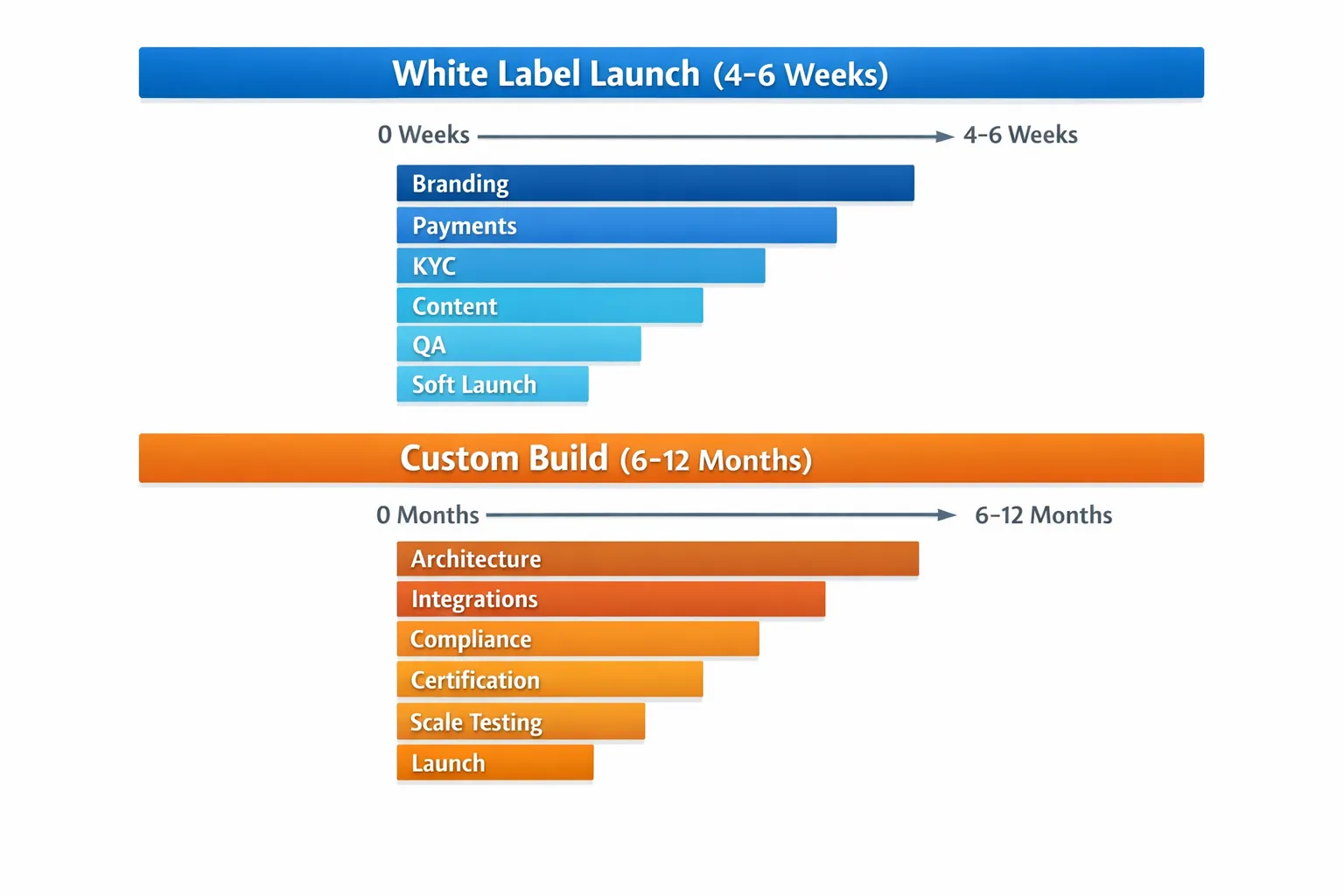
When a white label is the better choice
- You need to launch in a matter of weeks, for market timing, seasonal campaigns, or to validate CAC and payback before doubling down.
- You prefer OpEx and cash flow flexibility over heavy CapEx, common for bootstrapped teams or affiliates upgrading to operator status.
- You target multiple payment methods including crypto, APMs, and cards without managing dozens of PSP contracts.
- You value operational maturity out of the box, KYC, AML, fraud prevention, dashboards, affiliate and bonus engines, and mobile optimization.
- You plan to differentiate with smarter marketing, localized lobbies, and original game IP rather than inventing a new platform.
When a custom build is the better choice
- Your product requires mechanics or compliance models that do not exist yet and cannot be reasonably adapted in a vendor stack.
- You have a senior in house team ready to own security, scaling, payments, and certifications, not just the front end.
- You prioritize full IP ownership for the platform itself and you can afford longer timelines before revenue.
- You operate in jurisdictions with unique requirements that push you into bespoke solutions.
The pragmatic middle, modular white label
Many operators want speed and control. This is where a modular white label fits. Instead of committing to a blank page build, you start with a proven core, then use APIs, custom admin workflows, and original games to express your brand.
Spinlab’s platform is designed for this middle path. It combines an all in one iGaming stack with open API integration, a customizable backoffice, mobile optimized front ends, and a game aggregator. Payments cover fiat and crypto with multi currency support, crypto onramp, and merchant custodial wallets for safekeeping funds. The platform bundles KYC and AML compliance, advanced fraud prevention, real time analytics, and an affiliate and bonus engine. Spinlab also offers original games that can be custom designed, which is a fast track to differentiation without building a platform from scratch. Spinlab positions itself as the cheapest option on the market for white label casino software and it delivers a Shopify like experience for operators who want a modern, friendly admin.
If you are scaling beyond MVP, review how a fast growing operator used a modular migration to handle orders of magnitude more traffic, Scaling from 1,000 to 1,000,000 Players, Fullhouse Case Study.
Avoiding lock in, a safe migration path
You can start with a white label and keep doors open for future custom work. Bake these requirements into your vendor selection and contract.
- API first thinking, ensure the platform exposes stable APIs for wallets, bonuses, KYC events, and reporting so you can attach custom services.
- Data access, confirm export policies for events and historical data so you can feed your own warehouse and models.
- Original content, use custom designed game IP to create moats that travel with your brand.
- Compliance clarity, understand licensing scope and what it takes to add or switch jurisdictions. For a side by side view, see Choosing Between Curacao and Anjouan.
- Roll off clauses, define timelines and obligations if you ever move parts of the stack in house.
A simple scorecard to decide
Create a one page scorecard, score each criterion 1 to 5, then choose the option with the higher weighted total. This keeps debates objective.
| Criterion | Weight if pre launch | Weight if scaling | How to score |
|---|---|---|---|
| Deadline pressure | High | Medium | 1 means flexible, 5 means must launch in weeks |
| Need for unique mechanics | Medium | High | 1 means standard casino works, 5 means novel gameplay required |
| Budget profile (CapEx tolerance) | High | Medium | 1 means high CapEx available, 5 means prefer OpEx |
| Internal team maturity | Medium | High | 1 means no platform team, 5 means senior platform team in place |
| Market compliance complexity | Medium | High | 1 means one permissive license, 5 means multi license, strict audits |
| Differentiation strategy | Medium | High | 1 means brand and CRM led, 5 means platform led |
White label options usually win when deadline pressure and OpEx preference are weighted high. Custom wins when unique mechanics and internal team maturity carry most of the weight. Modular white label often ties or wins by offering enough control without the build burden.
Common pitfalls to avoid
- Underestimating payments work, APMs, open banking, crypto onramps, payout orchestration, and treasury management are complex. If you build, budget months and dedicated staff. If you buy, verify coverage against your target markets. For speed and lower cost to credit, review Direct Bank Transfer vs Open Banking.
- Treating KYC as a checkbox, poor KYC UX can kill conversion. Plan it as a product, not a policy. Start with small wins from 11 UX Tweaks That Cut KYC Drop Off by 30%.
- Ignoring real time data, you cannot defend margins without live visibility into risk and value. Bake in streams and dashboards from day one. See Real Time Analytics in iGaming.
- Forgetting aggregator costs, headline rev share rarely equals true cost once surcharges and overages hit. Read The True Cost of a Game Aggregator.
- Building what you could configure, many features you want already exist in mature platforms, especially bonus engines, affiliate tracking, and cashier logic. Validate before committing to code.
Putting it together, a practical decision workflow
- Define your must haves, markets, payments, content, compliance constraints, and differentiation thesis. Be specific.
- Build the 24 month TCO for both paths with conservative, base, and aggressive scenarios.
- Run a two week proof, one vendor sprint to configure brand, cashier, KYC, and a personalized lobby, and one internal spike to test the riskiest custom components. Compare speed, quality, and cost.
- Decide with the scorecard, choose white label, modular white label, or custom based on weighted scores, not anecdotes.
If you decide white label or modular is your path, Spinlab offers an all in one iGaming platform with crypto and fiat payment support, seamless game aggregation, real time analytics, advanced fraud prevention, KYC and AML compliance, a mobile optimized front end, an affiliate and bonus engine, a customizable backoffice admin panel, open API integration, multi currency support, crypto onramp, and merchant custodial wallets for safekeeping funds. You can also commission original games to match your brand and strategy. Spinlab positions itself as the cheapest white label option on the market and aims for a Shopify like operator experience.
Ready to pressure test your decision with your numbers and deadlines, book a 30 minute discovery call at spinlab.studio. We will map your requirements, build a side by side TCO, and show how a modular white label can get you live fast without painting you into a corner.