

An iGaming platform’s “open API” can mean anything from a handful of read-only endpoints to a complete integration surface that lets you run payments, wallets, bonuses, affiliates, compliance, and analytics without vendor workarounds.
If you are evaluating a white label casino platform or modular iGaming platform, a strong API is not a nice-to-have. It is the difference between:
- Shipping integrations in days (CRM, BI, payment orchestration, fraud tooling)
- Being able to prove compliance with audit-grade logs
- Avoiding vendor lock-in when you add markets, brands, or new payment rails
Below is a practical open API checklist for iGaming platforms, written for CTOs, product leads, and operators who need to know what to demand, what “good” looks like, and what evidence to request before you sign.
What an “open API” should cover in a real-money casino stack
Before you get into specs and security, confirm the API covers the systems that actually create operational leverage.
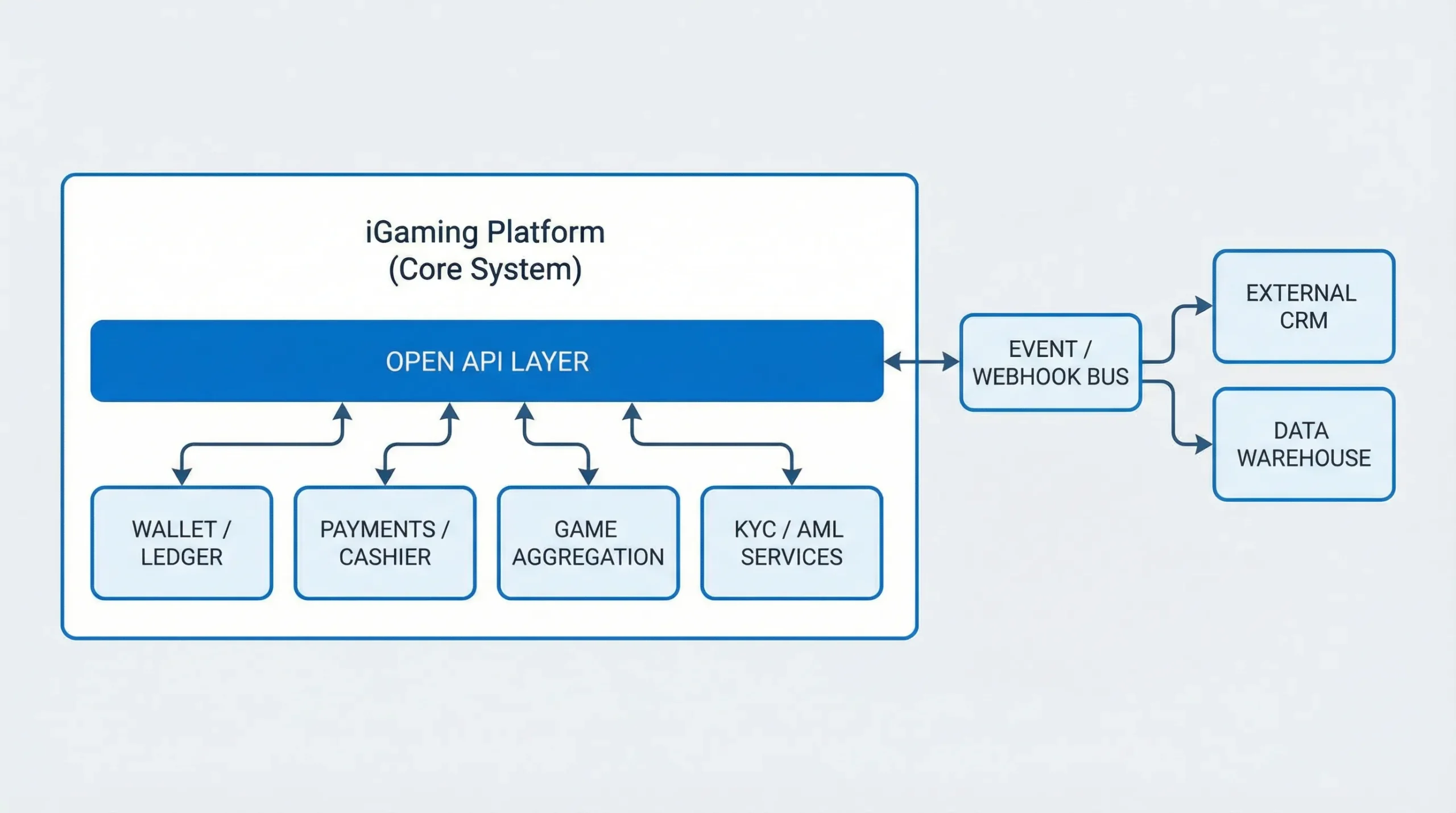
At minimum, an iGaming platform’s API surface typically needs to support:
- Identity and player accounts: registration, profile, limits, exclusions, verification states
- Wallet and ledger: balances, debits/credits, holds, settlement, refunds, adjustments
- Payments and cashier: deposits, withdrawals, rail selection, provider state, reconciliation artifacts
- KYC/AML: KYC status changes, evidence metadata, risk events, case management hooks
- Bonuses and promotions: eligibility, issuance, wagering progress, abuse controls
- Affiliates and attribution: click/visit events, postbacks, commission states
- Games and aggregation: catalog, launch/session creation, jurisdiction and device capabilities
- Analytics and event export: player and transactional events to your warehouse or CDP
If a vendor can only expose part of this, you are buying a platform that will force “side databases,” manual ops work, or custom vendor tickets as soon as you scale.
The evidence pack to request (before the first demo call ends)
Ask for these artifacts early. If the vendor cannot provide them, their “open API” is probably marketing.
| What to request | Why it matters in iGaming | What good looks like |
|---|---|---|
| OpenAPI spec (OAS) | Proves endpoint completeness and data models | Published OpenAPI docs, versioned, downloadable |
| Auth documentation | Casinos need strict least-privilege access | OAuth2 scopes or signed requests, RBAC, rotation |
| Webhook/event catalog | Real-time operations require push signals | Signed webhooks, replay, clear event schemas |
| Changelog + deprecation policy | Prevents breaking production cashier/wallet | Clear versioning, dates, migration notes |
| Sandbox guide | Integration speed depends on testability | Seed data, mocks, deterministic test flows |
| Rate limit and SLO statement | Protects you from random throttling | Explicit quotas, error codes, uptime targets |
| Audit logging and export options | Regulatory and dispute defense | Immutable audit trails, searchable, exportable |
| Data export/exit plan | Avoid lock-in | Bulk export, retention terms, termination support |
Checklist 1: API design and lifecycle (versioning, compatibility, documentation)
1) A real OpenAPI spec, not just a web page
Demand a machine-readable OpenAPI file (JSON/YAML), not only human docs. Your team will use it to:
- Generate clients/SDKs
- Validate request and response shapes
- Diff versions for breaking changes
Good sign: the vendor treats the spec as a contract and ships it with releases.
2) Versioning rules you can build around
In iGaming, breaking changes in wallet, payment status, or bonus eligibility are revenue incidents.
Ask:
- How do you version APIs (URI versioning like
/v1/vs header-based)? - What is the minimum deprecation window?
- Do you support parallel versions during migration?
A credible answer includes a written policy and examples of past deprecations.
3) Predictable error format
Your integrations need to fail safely and explain what happened.
Look for a consistent error schema such as RFC 9457 (Problem Details for HTTP APIs) or an equivalent, with:
- Stable error codes (not only strings)
- Human-readable messages
- Field-level validation errors
- Correlation IDs for support
4) Data dictionaries and enums
Game status, payment states, KYC states, and bonus states must be unambiguous.
Require a public data dictionary for:
- State machines (for example:
PENDING,APPROVED,SETTLED,REVERSED) - Enumerations and their meanings
- “Terminal” vs “non-terminal” states
If the platform cannot define state transitions, your ops team will end up guessing, and your support tickets will spike.
Checklist 2: Authentication, authorization, and key management
Real-money gaming APIs are high-value targets. Use this part of the checklist to separate serious vendors from “startup-grade” security.
5) Least-privilege access (scopes, roles, and environment separation)
Demand:
- Separate credentials per environment (sandbox, staging, production)
- Scope-based permissions (for example, read-only analytics vs write access to wallet adjustments)
- Optional IP allowlisting or mTLS for server-to-server endpoints
If the platform supports a customizable backoffice, confirm that admin panel permissions map cleanly to API permissions so your internal tools cannot silently bypass governance.
6) Secure webhook delivery
If webhooks exist, they must be authenticated, not “security by obscurity.”
Expect:
- HMAC signatures with timestamped headers
- Replay protection (timestamp tolerance, nonce, or delivery IDs)
- Documented verification code
You can use OWASP’s guidance as a baseline when assessing controls, see the OWASP API Security Top 10.
Checklist 3: Wallet and money movement correctness (idempotency, ordering, reconciliation)
This is the part that most “open APIs” get wrong.
7) Idempotency on all money-moving operations
For deposits, withdrawals, credits, debits, adjustments, and bonus grants, demand idempotency keys.
Why it matters: network retries and timeouts are normal, and without idempotency you get:
- Duplicate credits
- Incorrect balances
- Manual reconciliation work
Ask to see examples where the same request returns the same result when replayed.
8) A ledger model you can audit
Even if you never expose raw ledger tables, the API should expose enough to reconcile and prove disputes.
At minimum, request:
- A unique transaction identifier per ledger entry
- Timestamps with timezone
- Before and after balances (or a deterministic way to compute)
- References to the “source” (game round, payment, bonus, manual adjustment)
If you care about audit readiness, connect this to your reconciliation process. Spinlab has a helpful overview on three-way matching in Casino Payments Reconciliation: Ledger, PSP, and Bank Match.
9) Clear semantics for holds, pending states, and reversals
Payments and withdrawals are not always instant. Your API must represent:
- Pending deposit states (especially for bank transfers, open banking, and some APMs)
- Withdrawal holds (KYC pending, AML review, velocity checks)
- Reversals and chargeback-related adjustments
A platform that only supports “SUCCESS/FAILED” is not ready for real operations.
Checklist 4: Webhooks, events, and real-time integration patterns
In iGaming, polling is expensive and slow. You want push-based events for player lifecycle, payments, risk, and bonuses.
10) Event taxonomy with stable schemas
Demand a webhook catalog that includes:
- Event name and description
- Trigger conditions (what exactly causes the event)
- Payload schema and sample payloads
- Backward compatibility rules
If you are building automation, also verify delivery semantics:
- At-least-once delivery (common) with deduplication support
- Ordering guarantees (global ordering is rare, but per-entity ordering is sometimes feasible)
For a concrete iGaming use case, see how webhooks are used to sync loyalty tiers in Using Webhooks to Sync Player Tiers With External CRMs.
11) Replay and dead-letter support
When your endpoint is down, you need recovery. Ask:
- How long does the platform retry webhooks?
- Can you replay events for a time window?
- Is there a dead-letter queue or failed delivery log visible to ops?
Without replay, your “real-time CRM integration” becomes a manual support process.
Checklist 5: Performance, rate limits, and operational safety
12) Rate limits that match casino workloads
Ask for rate limits by endpoint class. Casino traffic is bursty (promos, influencer spikes, jackpot weekends), and limits need to be engineered, not guessed.
At minimum, rate limit docs should specify:
- Limits per API key and per IP
- Burst vs sustained behavior
- HTTP status and headers used when throttled
13) Pagination, filtering, and incremental sync
Operators regularly need to sync players, transactions, and events into a warehouse.
Demand:
- Cursor-based pagination for large lists
- Filtering by
updated_ator event time - Deterministic sorting
If the platform only supports page numbers, you will eventually miss or duplicate records.
14) Ids, correlation IDs, and traceability
Every request and webhook should include:
- A unique request ID
- A correlation ID you can pass end-to-end
This is essential for debugging cashier issues, bonus disputes, and fraud investigations.
Checklist 6: Compliance and data governance (built into the API)
An open API that ignores compliance becomes your liability.
15) Audit logs and admin action trails
Demand API access to audit logs or an export mechanism that captures:
- Admin actions (bonus changes, manual credits, KYC overrides)
- Policy changes (limits, RG settings)
- Credential usage and permission changes
This is a recurring requirement across regulated environments, and it is also critical for internal controls.
16) Data protection and deletion workflows
Even if you are not asking for legal advice, you should require technical support for privacy obligations:
- Data subject request workflows (export, delete, restrict processing)
- Configurable retention windows
- Clear separation of PII vs operational logs
If you operate across regions, this becomes even more important. For a practical comparison of data rules, see GDPR vs LGPD: Data Rules Every Transatlantic Casino Must Know.
17) PCI and payments scope clarity
If the platform touches card data, require a clear statement of PCI scope and responsibilities. A useful baseline is to align on PCI DSS 4.0 expectations, see PCI DSS for iGaming: A Plain-English Compliance Guide for 2025.
Checklist 7: Sandbox quality and developer experience
A strong API that is painful to test will still slow your launch.
18) A sandbox that matches production behavior
Demand a sandbox environment that supports:
- Realistic state transitions (pending, settled, reversed)
- Test payment instruments and stubs
- Crypto testnet support if you plan to be crypto-ready
If you are doing serious payments and crypto QA, this guide is a good reference point: Creating a Sandbox Environment for PSP Test Cards and Crypto Faucets.
19) SDKs are optional, but examples are not
Even if the vendor does not ship official SDKs, demand:
- Copy-paste integration examples
- Postman collections
- Webhook verification samples
This is especially important when you want a Shopify-like onboarding experience for internal teams, because good docs reduce engineering involvement.
Checklist 8: Commercial and contract terms tied to API reality
This is where many operators get surprised.
20) API usage pricing and overage clauses
Ask explicitly:
- Are there API call limits?
- Are there overage fees?
- Are webhooks counted as calls?
Tie this to your forecasted traffic, especially if you plan to export events to analytics.
21) Data ownership, export, and exit
Demand contractual clarity that:
- You own your data (player, transaction, event data)
- You can export it in bulk on request
- You have an exit timeline and vendor obligations on termination
This is one of the simplest ways to prevent lock-in while still using a turnkey casino solution.
22) SLAs for the API, not just “the platform”
“99.9% uptime” is meaningless if it excludes API endpoints you depend on.
Ask for:
- SLOs per critical endpoint group (auth, wallet, payments, game launch)
- Incident communication expectations
- Service credits that are meaningful
A quick scoring rubric (use this to compare vendors)
To keep procurement objective, score each vendor 0 to 2 on these categories:
- Coverage: Does the API cover wallet, payments, compliance, bonuses, affiliates, games, analytics?
- Correctness: Idempotency, ledger model, reversals, pending states
- Security: Auth, scopes, webhook signing, key rotation
- Operability: Correlation IDs, logs, replay, sandbox realism
- Governance: Versioning, changelog, deprecation windows
- Commercial safety: Data rights, exit plan, API pricing clarity
A vendor that scores “2” on docs but “0” on money movement correctness is a risky choice for any online casino.
How Spinlab fits into an Open API-first evaluation
Spinlab Studio positions its platform as a modular, all-in-one iGaming platform with open API integration, integrated payments (crypto and fiat), compliance tooling, game aggregation, and a customizable backoffice.
If you are comparing platforms and want to validate API depth quickly, use the checklist above as your agenda, then ask for the evidence pack (OpenAPI spec, webhook catalog, sandbox guide, deprecation policy) so your engineering and compliance teams can review before you commit.
You can explore Spinlab at spinlab.studio and, if you are in active platform selection mode, pair this API checklist with their broader procurement guide: 15 Essential Features Every White Label Casino Platform Should Offer.