
Geo-blocking is one of those controls that only gets attention when it fails. A regulator flags out-of-territory traffic, a payment provider escalates “restricted jurisdiction” transactions, or an affiliate campaign quietly starts sending players from markets you cannot legally serve.
In 2026, geo is no longer just a marketing toggle. For online casinos, it is a compliance control, a fraud control, and a payments control. The question is not “should we geo-block?”, it is which signal should be authoritative, where should enforcement live, and how do you prove what happened later.
This guide compares the three most common approaches:
- IP-based geo-blocking (GeoIP)
- GPS / device location (mobile SDKs, browser geolocation)
- Edge rules (CDN/WAF enforcement close to the user)
…and shows how serious operators combine them.
Geo-blocking vs geo-fencing (and why casinos care)
People use the terms interchangeably, but it helps to separate intent:
- Geo-blocking: deny access based on location (hard stop).
- Geo-fencing: allow access only within an approved boundary, sometimes with higher granularity and stronger proof.
Casinos typically need both, depending on what is being controlled:
- Site access: block obviously restricted countries at the edge.
- Registration and KYC: enforce jurisdiction eligibility with stronger evidence.
- Deposits and withdrawals: prevent “it slipped through” by applying geo rules to payment initiation too.
- Bonuses and affiliate offers: show or hide promotions by territory.
If you want a deeper automation angle on this topic, Spinlab previously covered the idea of jurisdiction policy engines in Compliance Whitelists: Automating Jurisdictional Content Blocking.
1) IP geo-blocking: the default, and why it is not enough alone
How IP geo-blocking works
IP geo-blocking maps a client’s public IP address to an estimated location using commercial GeoIP databases. Most stacks implement it in one of three places:
- CDN/WAF: block before requests hit your origin
- Backend: evaluate GeoIP in an API gateway or middleware
- Application: show “not available in your country” messaging in the UI
What IP geo-blocking is good at
- Low friction: users do not need to grant permissions.
- Fast and cheap: especially at the edge.
- Great for coarse rules: blocking entire countries, OFAC-sanctioned regions, or clearly excluded territories.
- Useful as a risk signal: mismatches (IP vs KYC country) are valuable fraud indicators.
Where IP geo-blocking breaks down
IP-based location is probabilistic. Casinos hit several recurring issues:
- VPN and proxy evasion: A player can appear to be in an allowed region while physically elsewhere.
- Carrier-grade NAT (CGNAT) and mobile networks: the exit IP can be registered far from the player.
- IPv6 and corporate networks: location can resolve to headquarters, not the user.
- GeoIP database lag: IP ranges get re-assigned, location accuracy can drift.
If you operate in strict jurisdictions, IP-only enforcement is usually treated as insufficient because it is too easy to bypass.
Practical hardening for GeoIP
You can improve IP geo-blocking outcomes without turning it into a false-positive machine:
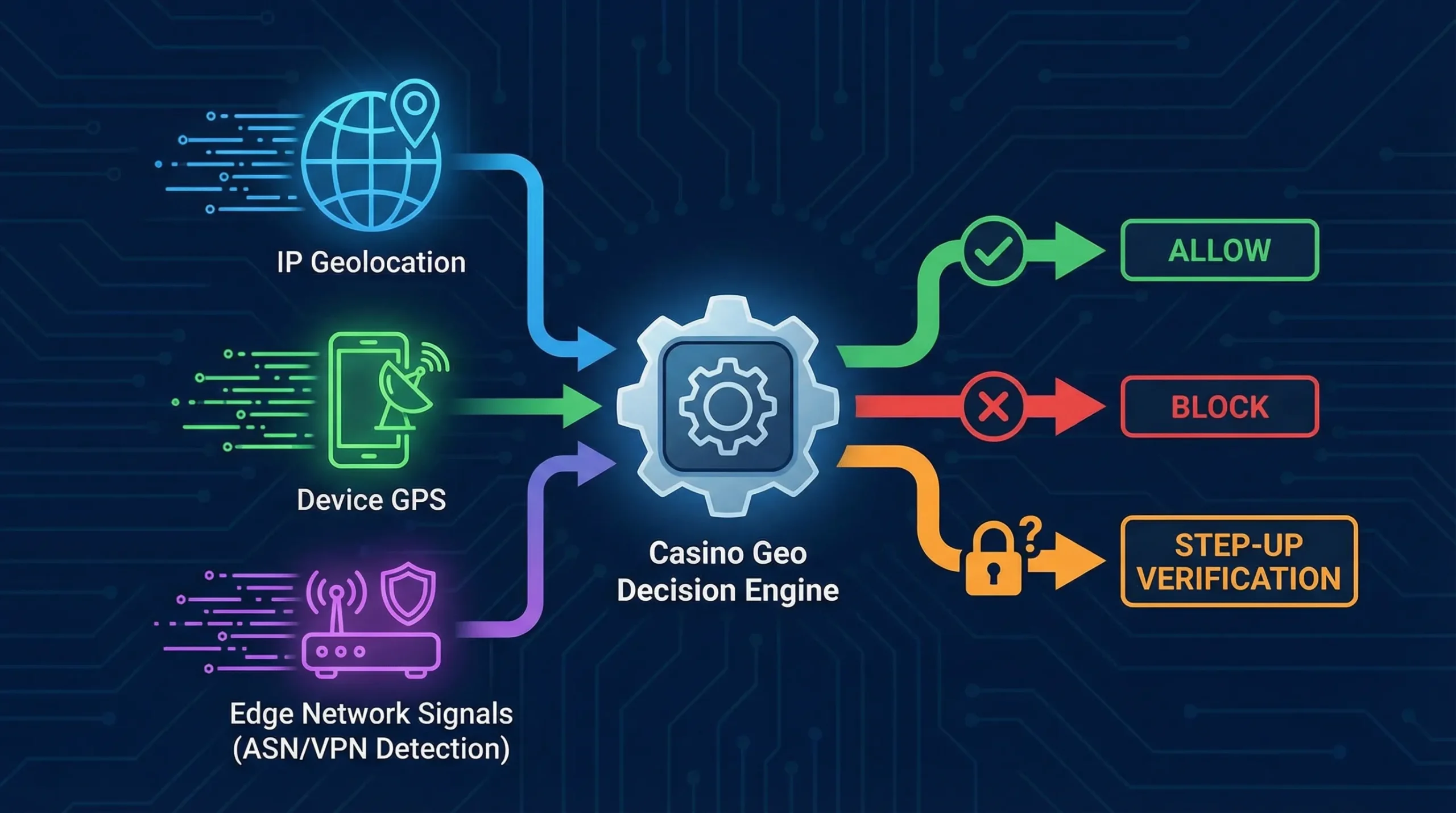
- Use multiple signals, not just “country”: city/region confidence, ASN (network), hosting detection.
- Detect data center IPs and known VPN providers: treat them as higher risk, step-up (for example, require stronger verification) rather than always blocking.
- Log the full decision context: GeoIP result, database version, rule version, timestamp.
For edge-based IP geo capabilities, CDNs document typical approaches and trade-offs (example: Cloudflare’s guidance on IP geolocation and headers and similar vendor docs).
2) GPS and device location: the strongest signal, with real-world caveats
What “GPS geo-blocking” really means
On the web and in apps, location is usually derived from a combination of:
- GPS (when available)
- Wi‑Fi positioning
- Cell tower triangulation
Browsers typically expose this through the W3C Geolocation API, and mobile apps through platform APIs.
Why GPS-level enforcement is attractive
- Higher accuracy than IP in many cases, especially for in-country border enforcement.
- Harder to bypass than basic VPN use (but not impossible).
- Better aligned with “physical presence” requirements in some regulated markets.
The operational downsides casinos underestimate
Even when GPS is “the best signal,” shipping it into a production casino funnel has costs:
- Permission friction: players may deny location access, especially on web.
- Spoofing exists: rooted/jailbroken devices, mock-location apps, emulator farms.
- Indoors accuracy and device variability: not all devices report equally.
- Privacy and data minimization: collecting precise location can raise regulatory and data-protection obligations.
A common compromise is to request precise location only at high-risk moments, such as registration, deposit initiation, or first withdrawal, while using IP and edge rules for general browsing.
A safer pattern: “proof of presence” without storing raw coordinates
If you need strong evidence but want to reduce privacy risk:
- Evaluate a geofence result (inside/outside allowed region) server-side.
- Store the decision and metadata (time, method, accuracy radius), not the raw latitude/longitude unless you truly need it.
3) Edge rules: enforcement close to the user (and why it changes everything)
“Edge rules” means enforcing geo (and related constraints) at the CDN/WAF/edge compute layer before traffic reaches your casino application.
Why edge rules are a big deal for casinos
- Lower latency: decisions happen near the user.
- Lower blast radius: blocked traffic never touches your origin, wallet services, or game servers.
- Better DDoS posture: geo rules can reduce attack surface during region-targeted attacks.
- Centralized policy: you can enforce consistent rules across marketing pages, lobby, auth, and API.
What edge rules can evaluate
Depending on vendor and setup, you can base decisions on:
- IP-derived location (country/region)
- ASN or hosting classification
- Request headers and client hints
- TLS and bot signals
- Rate limits and anomaly rules
Edge rules are especially effective when combined with bot controls (for example, Spinlab’s post on Cloudflare Turnstile for Casinos shows how “front door” controls reduce abuse without destroying UX).
The main limitation of edge rules
Edge rules do not magically solve location truth. Most edge geo is still GeoIP-derived unless you are feeding verified device location into the edge (which is possible, but adds complexity).
Think of the edge as the best place to enforce fast, consistent policy, not as a perfect location oracle.
IP vs GPS vs edge rules: a decision-oriented comparison
The most useful comparison is not “which is best,” but “which failure mode can you tolerate.”
| Dimension | IP geo-blocking | GPS / device location | Edge rules (CDN/WAF/edge compute) |
|---|---|---|---|
| Accuracy | Medium (varies by network) | High (when granted, when not spoofed) | Depends on the underlying signal (often GeoIP) |
| UX friction | Low | Medium to high (permission prompts) | Low |
| Bypass resistance | Low to medium (VPNs) | Medium to high (spoofing still possible) | Medium (strong at blocking obvious evasion, still GeoIP-limited) |
| Best for | Country-level blocks, risk signal | Strict physical-presence checks | Fast, consistent enforcement and traffic reduction |
| Operational cost | Low | Medium to high (SDK, QA, edge cases) | Medium (rules governance, deployments, vendor config) |
| Auditability | Medium (depends on logging) | High (if logged correctly) | High (if rule versions and request context are stored) |
The approach that works in practice: layered geo enforcement
Most compliance failures happen because geo is implemented as a single gate, in a single place.
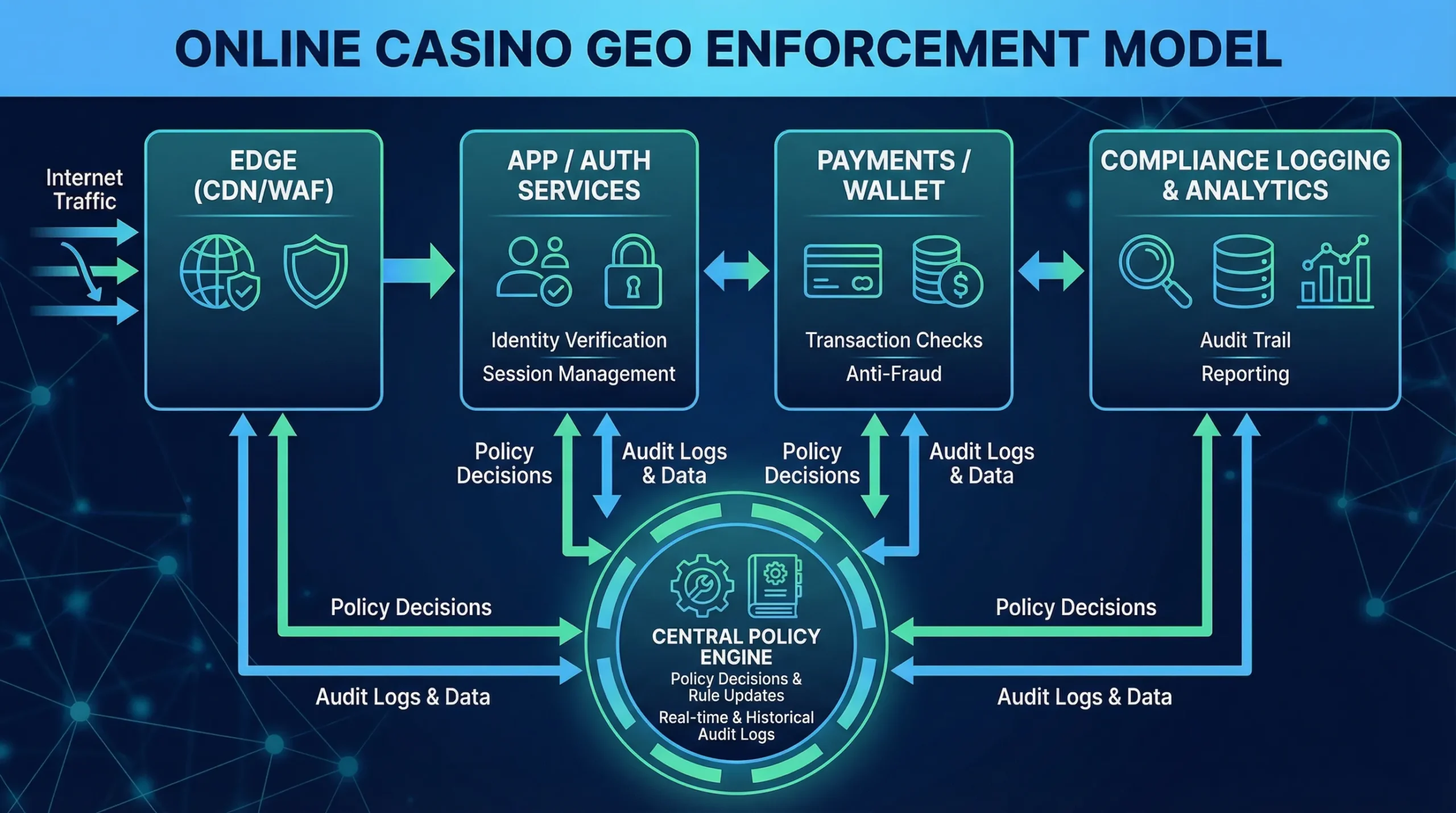
A more resilient approach is layered geo:
- Layer 1 (Edge): block clearly disallowed jurisdictions, flag suspicious networks (hosting/VPN), throttle obvious abuse.
- Layer 2 (App and Auth): enforce eligibility at registration and login, handle user messaging, reduce false positives.
- Layer 3 (Payments): re-check geo at deposit and withdrawal initiation (this is where “oops” becomes expensive).
- Layer 4 (KYC/AML and RG): reconcile geo signals with identity, monitor mismatches as risk events.
Why payments need their own geo gate
A common anti-pattern is allowing deposits because the lobby was accessible. In a modern stack, deposits can be initiated via:
- cashier UI
- native app flows
- deep links
- API clients (including automated abuse)
So your Payment Hub or payment gateway integration should enforce the same jurisdiction policy (or stricter), ideally using the same policy source.
This also pairs naturally with fraud tooling and device signals. For example, mismatches between device fingerprint, IP country, and declared country are strong indicators (see Device Fingerprinting 101 for Casino Fraud Prevention).
Governance: treat geo rules as “policy-as-code,” not ad hoc toggles
Geo rules change frequently: licensing updates, PSP constraints, affiliate targeting, sanctions lists, internal risk posture.
If geo is implemented as scattered conditionals across frontend, backend, and payment services, you get inconsistent behavior and weak audit trails.
A more mature pattern:
- Centralize jurisdiction rules in a policy service (or policy module).
- Version the policy (for example,
policy_version=2026-02-01.3). - Deploy rules to edge and backend from the same source.
- Emit a GEO_DECISION event for every critical action (register, login, deposit, withdraw).
What to log for audit-grade geo decisions
At minimum, capture:
timestampaction(view, register, deposit, withdraw)decision(allow, block, step_up)matched_rule_idandpolicy_versionip_country,ip_region(and GeoIP DB version if available)asn(optional but very useful)device_location_used(yes/no), plusaccuracy_metersif useduser_declared_countryandkyc_countrywhen available
This turns geo-blocking for casinos from a fragile gate into a defensible control.
Handling false positives without creating loopholes
Aggressive geo blocking can backfire, especially in border regions, mobile users, travelers, and corporate networks.
Good operators design an explicit “step-up” path:
- Block when you are confident the request is disallowed.
- Allow when you are confident it is allowed.
- Step-up when the signals conflict, meaning request additional proof (for example, request device location, require completion of KYC before deposit, or restrict withdrawals until verification completes).
The key is that step-up must be:
- fast (few screens)
- consistent (same behavior across web and app)
- logged (so you can explain why a user was challenged)
Implementation notes: where each method fits best
IP geo-blocking: make it your baseline, not your only lock
Use IP geo-blocking for:
- marketing pages
- lobby browsing
- broad “country not supported” enforcement
Do not rely on it alone for:
- strict intrastate or province-only compliance
- high-value withdrawals
- situations where incentives exist to bypass (bonus abuse, arbitrage)
GPS/device location: deploy it selectively
Ask for location when:
- you must prove physical presence
- you detect a high-risk condition (VPN suspicion, KYC mismatch)
- a player triggers sensitive actions (first deposit, first withdrawal)
To reduce conversion loss, avoid requesting location on the very first page load unless regulation forces it.
Edge rules: use them to make everything else cheaper
Edge rules are ideal for:
- removing obviously non-eligible traffic
- blocking data center abuse early
- standardizing behavior across multiple brands and skins
They also help performance by reducing origin load and keeping restricted traffic away from wallet and game services.
A simple selection framework for operators
Use this to align method to your risk level:
| Operator situation | Recommended geo pattern |
|---|---|
| Early-stage, limited markets, mostly SEO and affiliates | Edge country blocks + backend GeoIP, log everything, step-up for mismatches |
| Multi-jurisdiction casino with frequent market changes | Central policy service + edge distribution + payments geo gate + strong auditing |
| Strict physical-presence requirement | Device location at key actions + VPN/hosting detection + audited decision events |
| High fraud pressure (bonus abuse, multi-accounting) | Geo + device fingerprinting + payment routing controls + real-time anomaly monitoring |
Where Spinlab fits (without overpromising)
Spinlab positions itself as an all-in-one, modular iGaming platform built for fast onboarding and global operations, including compliance tooling, integrated payments (fiat and crypto), game aggregation, and an open API.
For geo-blocking and jurisdiction control specifically, look for a platform that can:
- enforce consistent jurisdiction policy across edge, app, and payments
- support KYC/AML workflows that incorporate geo mismatches as risk signals
- provide audit-grade logging and real-time analytics for compliance operations
If you are designing your next geo enforcement layer (or untangling a fragmented one), it is often worth reviewing your broader compliance architecture alongside geo controls. Related Spinlab resources include:
- Compliance Whitelists: Automating Jurisdictional Content Blocking
- Curacao Reform 2025: What Operators Need to Change
- KYC Vendor Comparison: How to Choose Without Killing UX
The takeaway
- IP geo-blocking is essential and low-friction, but easy to evade.
- GPS/device location is the strongest proof of presence, but introduces UX and operational complexity.
- Edge rules are the best enforcement point for speed, consistency, and attack-surface reduction, but they still need good underlying signals.
The best geo-blocking for casinos is almost always layered, policy-driven, and audit-ready: enforce early at the edge, verify at key moments with stronger signals, and never let payments be the weak link.