

Curaçao has historically been the “fast lane” jurisdiction for launching an online casino. The 2025 reforms change that positioning. The direction is clear: fewer shortcuts, more governance, more auditable compliance, and tighter supervision.
If you operate (or plan to operate) under a Curaçao license, the question is no longer “Can we get live quickly?” It is “Can we stay live, keep payment access, and pass scrutiny when the regulator asks for evidence?”
What Curaçao reform in 2025 is really trying to achieve
The reforms are designed to modernize Curaçao’s gambling framework and improve international credibility. In practical terms, that usually means:
- A more centralized licensing and supervisory model (less reliance on the old master license structure).
- Clearer operator accountability for AML, player protection, and third-party risk.
- More reporting, more auditability, and more enforcement.
For operators, this creates a predictable pattern: the winners are not just the teams with the best acquisition engine, they are the teams that can prove control across payments, identity, fraud, and responsible gambling.
For official updates and guidance, start with the Curaçao Gaming Authority (CGA) website and publications.
The biggest operator-level changes to plan for
You can think of Curaçao Reform 2025 as five system upgrades you need to make: licensing readiness, AML maturity, payment controls, responsible gambling controls, and evidence-grade operations.
1) Treat licensing as an ongoing operating standard, not a one-time milestone
Under a more supervision-forward regime, “we have a license” stops being the finish line. Expect closer attention to:
- Corporate governance: clear UBO visibility, decision-maker accountability, and documented controls.
- Vendor and outsourcing oversight: you remain responsible for what PSPs, KYC providers, game suppliers, and affiliates do on your behalf.
- Policy-to-production traceability: written policies that match what your platform actually enforces.
A practical shift for many teams is building a “compliance operating system” that maps each regulatory obligation to (1) a platform control, (2) an owner, and (3) a piece of evidence you can export.
2) Upgrade AML from basic onboarding checks to continuous, risk-based monitoring
A common legacy setup in gray-market operations is “KYC at withdrawal” or “KYC only after a threshold.” Even when permitted in some form, regulators increasingly expect risk-based KYC and ongoing monitoring, especially when crypto is involved.
Operationally, you should plan to strengthen:
- Customer risk scoring at registration and after key events (deposit spikes, device changes, unusual play patterns).
- Ongoing transaction monitoring, not only point-in-time checks.
- Sanctions and PEP screening with audit logs.
- Case management discipline: who reviewed what, when, and what action was taken.
If you want a quick way to stress test your current approach, compare it to the failure modes covered in Spinlab’s guide: 10 Common KYC & AML Mistakes New Casino Operators Make and How to Fix Them.
3) Payments, custody, and reconciliation need “audit-grade” design
Payments are where compliance, fraud, and player trust collide. Under tighter supervision, the expectation is not merely that you can process deposits, but that you can explain every balance movement end-to-end.
Focus areas to harden:
- Source of funds visibility: being able to link deposits to a verified player and a coherent risk profile.
- Chargeback and dispute evidence (especially for cards): you need logs that win representment, not just a PSP dashboard screenshot. See: Chargeback Representment for Casinos: Win More Disputes.
- Crypto custody controls: clear wallet governance, segregation logic, and access control. Even if you use custodial infrastructure, you need documented controls and monitoring. Spinlab’s checklist is a good baseline: Custodial Wallet Security Checklist for Casinos.
- Travel Rule readiness where applicable to your flows and counterparties: Travel Rule Compliance for Crypto Casinos.
The key change is philosophical: your cashier is no longer just a conversion funnel, it is a regulated system of record.
4) Responsible gambling must be enforceable, not just “policy text”
Responsible gambling (RG) controls are increasingly evaluated based on whether they are real, measurable, and hard to bypass.
What that means at implementation level:
- Limits (deposit, loss, session) that are actually enforced in the wallet layer.
- Self-exclusion and cooling-off flows that propagate across brands and skins when relevant to your setup.
- Player messaging and “reality checks” that are logged.
- Internal escalation playbooks for high-risk behavior.
From a product and engineering standpoint, treat RG controls like fraud controls: they need instrumentation, alerting, and an evidence trail.
5) Operational evidence becomes a first-class deliverable
The “new” requirement many teams underestimate is evidence packaging. Under stronger supervision, it is not enough to do the right thing, you need to show it.
Build your internal evidence model around three categories:
- Controls: what the system enforces.
- Logs: what happened, by whom, and from where.
- Exports: how quickly you can produce regulator-ready proof.
Here is a practical table you can use to guide your internal gap analysis.
| Compliance area | What you should be able to demonstrate | What to change in practice |
|---|---|---|
| Identity (KYC) | When KYC was triggered, outcome, and reviewer trail | Instrument KYC events, store decision logs, enforce risk-based routing |
| AML monitoring | Alerts, investigations, and actions taken | Add continuous monitoring, case queues, escalation rules, retention |
| Payments and wallet | Full ledger traceability per player | Use a unified ledger, idempotent transactions, strict reconciliation routines |
| Fraud prevention | Detection rules, outcomes, false-positive tuning | Implement real-time rules, device and payment signals, and review workflows |
| Responsible gambling | Limits, exclusions, and user acknowledgements | Enforce at wallet level, log RG interventions, test bypass attempts |
| Vendor oversight | What third parties do, and how you control them | Formalize vendor due diligence, SLAs, and compliance attestations |
The “hidden” changes: affiliates, content, and geo controls
Curaçao reform conversations often fixate on licensing mechanics, but enforcement pressure frequently shows up through marketing and distribution.
If you run affiliates, streamers, or influencer-driven acquisition, treat this as a compliance surface area:
- Document affiliate onboarding and partner identity checks.
- Keep proof of ad disclosures, targeting restrictions, and takedown response time.
- Enforce geo restrictions consistently across landing pages, registration, deposits, and gameplay.
On the technical side, many teams implement geo blocking only at the front door. Under scrutiny, you want layered controls (geo, content, payments, and marketing). For an architecture approach, see: Compliance Whitelists: Automating Jurisdictional Content Blocking.
A 90-day action plan for Curaçao reform readiness
If you want a timeline that fits most operators (without boiling the ocean), use a 90-day plan built around gap analysis, remediation, and audit rehearsal.
Days 1 to 15: Map obligations to systems and owners
- Inventory your current licensing status, entities, domains, brands, PSPs, game suppliers, and key vendors.
- Write a one-page control map: KYC, AML monitoring, fraud rules, RG limits, geo controls, ledgering, incident response.
- Define evidence outputs you can produce today (and how long it takes).
Days 16 to 45: Fix the highest-risk operational gaps
Typical high-impact fixes include:
- Moving from “manual AML reviews” to a queue with documented dispositions.
- Hardening wallet and payment reconciliation, including negative-balance edge cases.
- Deploying fraud velocity rules around deposit attempts, bonus abuse, and withdrawal spikes.
Days 46 to 75: Make it auditable
- Centralize logs (KYC decisions, admin actions, payment state changes).
- Define retention and access control for audit data.
- Create a regulator-ready evidence pack template (PDF exports, CSV extracts, screenshots only where appropriate).
Days 76 to 90: Run a mock audit
- Simulate requests: “Show the full history for Player X,” “Explain this chargeback,” “Prove geo restrictions are enforced,” “Show your RG interventions last month.”
- Time how long it takes to produce each artifact.
- Patch the bottlenecks.
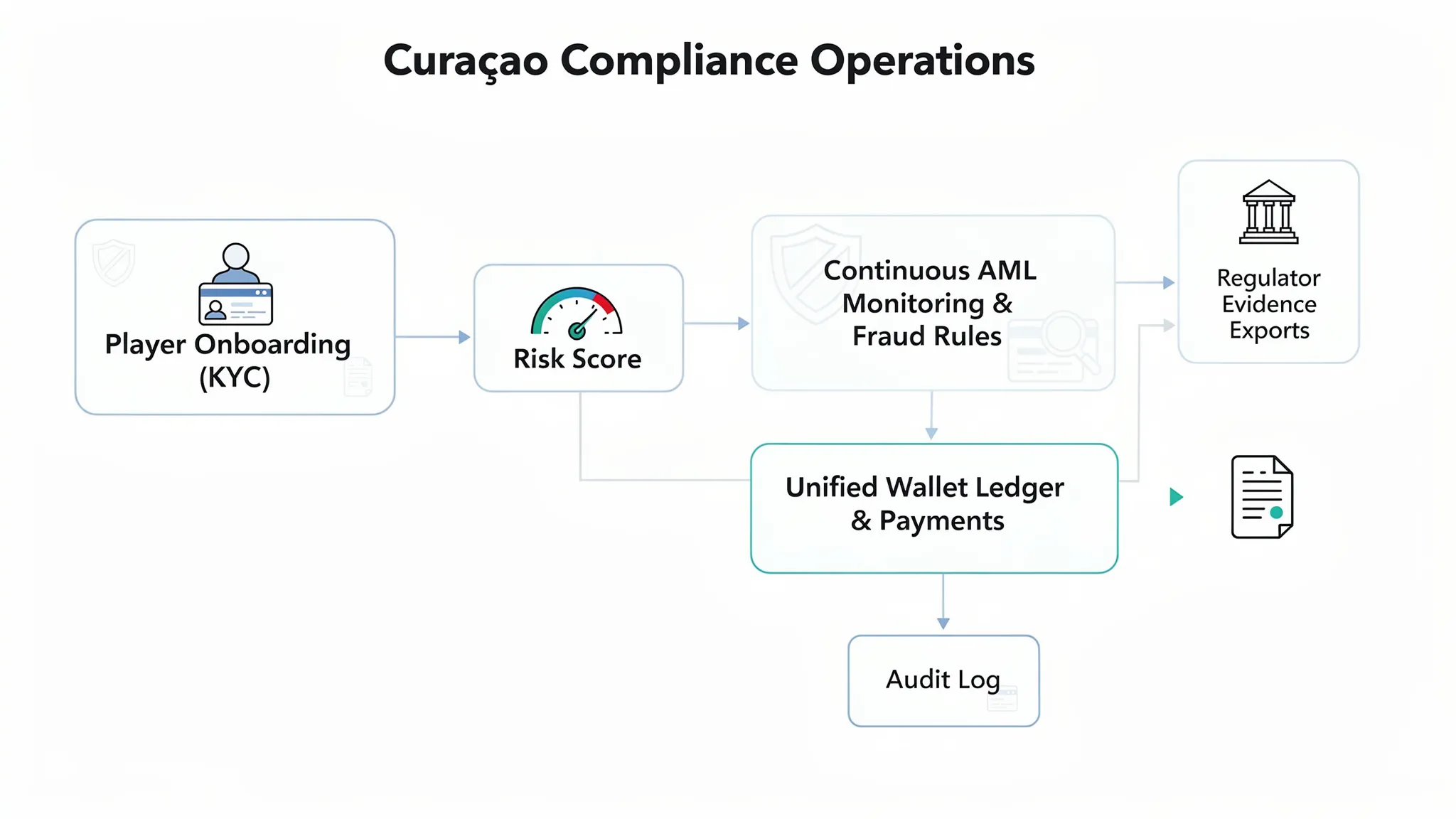
How a modular platform reduces Curaçao reform risk
Curaçao Reform 2025 pressures operators in two ways: it increases the number of controls you need, and it increases the burden of proof.
This is where modular, all-in-one iGaming infrastructure can be a strategic advantage. With Spinlab’s platform positioning (payments that support fiat and crypto, KYC/AML tooling, fraud prevention, real-time analytics, and a customizable backoffice), operators can consolidate systems that are otherwise fragmented across vendors.
The practical benefits of consolidation are:
- Fewer data gaps between KYC decisions, payment events, and wallet state.
- Faster investigation workflows because evidence lives in one admin surface.
- More consistent enforcement of geo, risk, and RG policies across brands.
If you are evaluating platform architecture as part of your reform readiness, these related guides can help frame decisions:
- Choosing Between Curacao and Anjouan: A Side-by-Side Licensing Showdown
- 15 Essential Features Every White Label Casino Platform Should Offer
What to do next
If you operate in Curaçao (or plan to), treat 2025 as the year to professionalize three things: risk-based compliance, audit-grade payments, and evidence readiness.
A good next step is a structured gap assessment: list your controls, map them to system enforcement, then validate you can export proof quickly. If you are rebuilding parts of the stack anyway, consider whether moving to a consolidated, crypto-ready iGaming platform reduces both compliance risk and operational overhead.
To see how Spinlab approaches payments, KYC/AML, fraud prevention, analytics, and backoffice workflows in one modular system, explore spinlab.studio and evaluate it against your Curaçao reform checklist.