

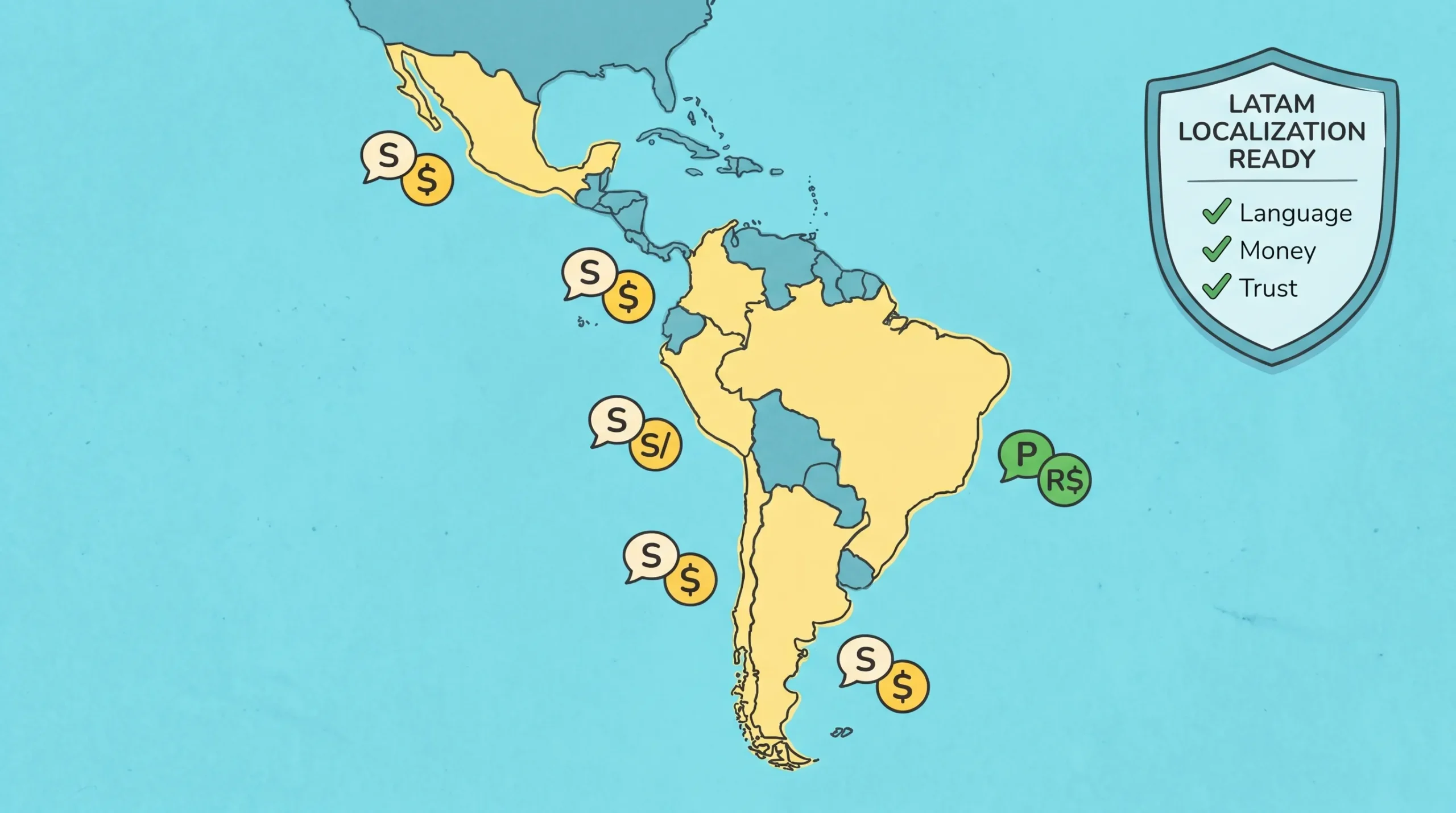
LATAM is one of the most competitive regions for online casino growth, but it is also one of the easiest places to lose conversion if you “translate the UI” and call it done. In practice, localization for LATAM is a three-part product problem:
- Language (what people understand and what feels native)
- Money (how deposits, withdrawals, and balances behave)
- Trust (what signals reduce risk perception and support tickets)
Below is a practical casino localization checklist for LATAM you can use in planning, QA, and launch readiness.
Before the checklist: define “LATAM” for your roadmap
Treating LATAM as one market is the fastest way to ship a cashier that looks correct but converts poorly.
At minimum, define your initial launch set by:
- Country and regulator reality (what you can legally offer and how you must present it)
- Primary language (Spanish variants vs Brazilian Portuguese)
- Payments and rails (instant bank transfers, cash vouchers, local wallets, crypto rails)
- Currency strategy (single local currency vs multi-currency wallet)
- Trust expectations (KYC timing, proof-of-funds expectations, payout messaging)
A simple rule: if payments and withdrawals are not local-first, everything else is decoration.
1) Language localization checklist (beyond translation)
Language is not just “Spanish vs Portuguese.” It is tone, vocabulary, formatting, and support.
Spanish variants and Brazilian Portuguese
- Choose a baseline per market: for example, Spanish (Mexico) vs Spanish (Argentina), plus Portuguese (Brazil).
- Avoid “neutral Spanish” for money flows unless you validate it with real users. Cashier microcopy is where regional phrasing matters most.
- Localize key verbs that impact user confidence: “deposit,” “withdraw,” “verify,” “pending,” “rejected,” “refunded,” “chargeback/dispute.”
High-risk microcopy: the words that change conversion
Prioritize professional localization (and legal review) for:
- Registration and consent checkboxes
- KYC instructions (photo capture, document types, retries)
- Cashier errors and decline reasons
- Bonus and wagering terms (especially max bet, eligible games, withdrawal rules)
- Responsible gambling content (limits, self-exclusion, reality checks)
If you want a quick heuristic: anything that can trigger a support ticket should not be machine-translated.
Locale formatting (numbers, dates, names)
- Currency and number formatting must match local expectations (thousands separators, decimal separators).
- Dates and time zones must match the user’s locale.
- Name fields must support common structures (multiple given names, two surnames) without causing KYC mismatches.
SEO and content localization (acquisition + trust)
- Localize your “money pages” first: Payments, Withdrawals, KYC, Responsible Gambling, Terms.
- Create localized casino content templates (game pages, promos) so you are not editing HTML per language.
If you need an example of how localized Spanish copy + clear booking flows can reduce hesitation, look at a non-gambling site that depends on trust to convert, like this Spanish-language wellness booking experience. The industry is different, but the principle is the same: clarity and reassurance win.
2) Money localization checklist (currency, payments, and cashier UX)
LATAM players are extremely sensitive to deposit friction, FX surprises, and unclear payout states. “Money localization” is where conversion and retention are won.
Currency strategy
Decide upfront:
- Single local currency wallet per country, or multi-currency support across brands
- Whether you will support USD display as a reference (common for some cross-border cohorts)
- Your approach to stablecoins (if you run crypto rails): what assets you accept, how you explain them, and how you manage volatility
Your UX must answer, without ambiguity:
- What currency is my balance in?
- What fees (if any) apply?
- How long until funds are playable?
- How long until withdrawals are paid?
For a deeper operational view of multi-currency decisions, see Spinlab’s guide on multi-currency pricing strategies for global casinos.
Local payment rails (deposit and withdrawal)
A LATAM-ready cashier typically needs local rails “where available and permitted,” such as:
- Brazil: Pix, local bank transfer options
- Mexico: SPEI, cash voucher flows (commonly used in ecommerce)
- Colombia: PSE
- Chile: Webpay
- Peru: local bank transfer and voucher-style methods
Not every operator will use all of these, but your checklist should include:
- Local-first routing: present the most trusted local methods first
- Pending states: instant-looking UX even when settlement is asynchronous
- Clear failure reasons: “bank rejected,” “name mismatch,” “limit reached,” “verification required”
- Withdrawal rail matching: avoid offering withdrawal methods that a player cannot realistically use
Cashier UX requirements that matter in LATAM
- Auto-detect language and currency from geo and device signals (with a visible manual override)
- Mobile-first forms (minimize typing, use correct keypad types)
- Fast KYC escalation: progressive verification is fine, but do not surprise users at withdrawal
- Receipt-grade receipts: players want a transaction reference, timestamp, and status timeline
Spinlab has a practical cashier optimization playbook here: Cashier conversion hacks: optimizing deposit forms for 3-second checkout.
FX, fees, and “surprise cost” prevention
Even if your fees are competitive, confusion kills trust. Your checklist should include:
- Show total cost before confirmation (including third-party fees where possible)
- If you apply FX, define a single rate authority and consistent rounding rules
- Log FX rates used per transaction so support can explain discrepancies
A simple internal QA table helps align product, payments, and support teams:
| Cashier element | What to verify | Why it matters |
|---|---|---|
| Balance currency | Clearly labeled everywhere (lobby, cashier, withdrawal) | Prevents “missing funds” tickets |
| Fees disclosure | Total shown before confirm, same in receipt | Prevents disputes and churn |
| Pending status | Timeline + expected SLA shown | Reduces abandonment and support load |
| Failure reason codes | Human-readable message + internal code | Speeds resolution and PSP debugging |
| Withdrawal eligibility | KYC, limits, bonus rules visible before request | Reduces angry “blocked withdrawal” tickets |
3) Trust localization checklist (KYC, compliance, and player confidence)
Trust is not a branding layer. In iGaming, trust is a system of proof.
KYC and AML: make it predictable
Operators often lose players by treating verification as a single pop-up rather than a journey.
Checklist items:
- Localize document guidance (examples, acceptable formats, lighting tips)
- Explain why you need data in plain language (reduce drop-off)
- Use “pending” states that explain what is happening and what the player should do next
- Ensure your KYC process supports mobile capture reliably
If you are evaluating verification partners, Spinlab’s KYC vendor comparison guide is a useful scoring framework.
Responsible gambling and regulatory expectations
Even in markets with lighter enforcement, players increasingly expect:
- Deposit limits and loss limits that are easy to set
- Self-exclusion options that are actually enforced
- Reality checks that are not buried
Localize these screens and flows with the same care as your cashier. A poorly translated self-exclusion flow is both a compliance risk and a trust killer.
Fraud prevention without punishing legitimate users
LATAM traffic mixes can include:
- Higher prepaid usage in some cohorts
- Cross-border users (especially with crypto)
- Higher exposure to promo abuse in fast-growing brands
Your checklist should require:
- Risk-based step-ups (verify more when risk is higher)
- Clear player messaging when actions are blocked (do not say “error” if it is policy)
- Audit logs for every funds-related decision (payout holds, KYC triggers, bonus restrictions)
Player support localization (the hidden trust lever)
Trust collapses when support cannot explain payment and withdrawal states.
Checklist items:
- Local-language macros for top 20 cashier issues
- A shared internal glossary for payment status terms (so chat and UI match)
- Clear escalation paths for PSP incidents
- Visible SLAs and status tracking for withdrawals
(If you want a measurable target, many operators start by reducing “Where is my withdrawal?” tickets with better status UX. Spinlab covers tactics in How to reduce withdrawals support tickets by 40%.)
A practical launch QA matrix for LATAM localization
Use this as a go/no-go readiness snapshot per country.
| Area | Pass criteria | Owner |
|---|---|---|
| Language | Cashier, KYC, bonus terms, RG pages fully localized and reviewed | Product + Legal |
| Currency | Correct format everywhere, consistent rounding, receipts show currency explicitly | Payments + QA |
| Payments | At least 2 to 3 local-preferred deposit rails (where available), withdrawal path tested end-to-end | Payments + Ops |
| Trust UX | KYC expectations clear before withdrawal, support macros ready, SLAs visible | Compliance + Support |
| Fraud controls | Velocity rules and step-ups enabled, with player-friendly messaging | Risk |
| Reporting | Per-locale conversion funnel and payment failure reasons visible | Data |
Frequently Asked Questions
Is Spanish localization enough to launch across LATAM? No. You typically need market-specific Spanish variants plus Brazilian Portuguese, and you must localize money flows (payments, currency, withdrawals) per country.
What is the biggest localization mistake LATAM casinos make? Shipping a translated UI with a non-local cashier. Players judge legitimacy and convenience primarily through deposits, withdrawals, and clear transaction status.
Should LATAM casinos support crypto from day one? It depends on your acquisition mix, compliance posture, and payment acceptance. Many operators succeed with a hybrid approach (local rails plus crypto-ready options) rather than choosing only one.
How do you measure whether localization is working? Track per-locale funnel metrics (registration-to-FTD, deposit initiation-to-success, time-to-credit), payment failure reasons, withdrawal ticket volume, and repeat deposit rate by country.
Build LATAM-ready localization faster with Spinlab
If you are building or expanding an online casino in LATAM, the fastest path is a platform that treats localization as a first-class capability: multi-currency support, crypto and fiat payments, compliance tooling (KYC/AML), fraud prevention, and a customizable backoffice.
Spinlab Studio is an all-in-one, modular iGaming platform designed for fast onboarding and global scaling, with a Shopify-like operating experience for teams that want to launch quickly without stitching together dozens of vendors.
Explore the platform at spinlab.studio and map your LATAM rollout checklist to a live demo.