

Global casino expansion usually sounds like a marketing challenge: translate the site, buy traffic, add local slot games, and recruit affiliates. In practice, many launches succeed or fail much earlier in the player journey, at the moment a player asks a simple question: “Can I deposit, play, and withdraw in money I understand?”
That is why multi-currency support is not a backoffice checkbox. For an online casino moving into new markets, it affects deposit conversion, payment approval rates, bonus economics, compliance reporting, VIP management, treasury operations, and player trust.
A global iGaming platform can have the best game aggregator, fast mobile UX, and strong acquisition funnel, but if the cashier forces players to think in a foreign currency or accept unclear FX costs, expansion becomes harder and more expensive.
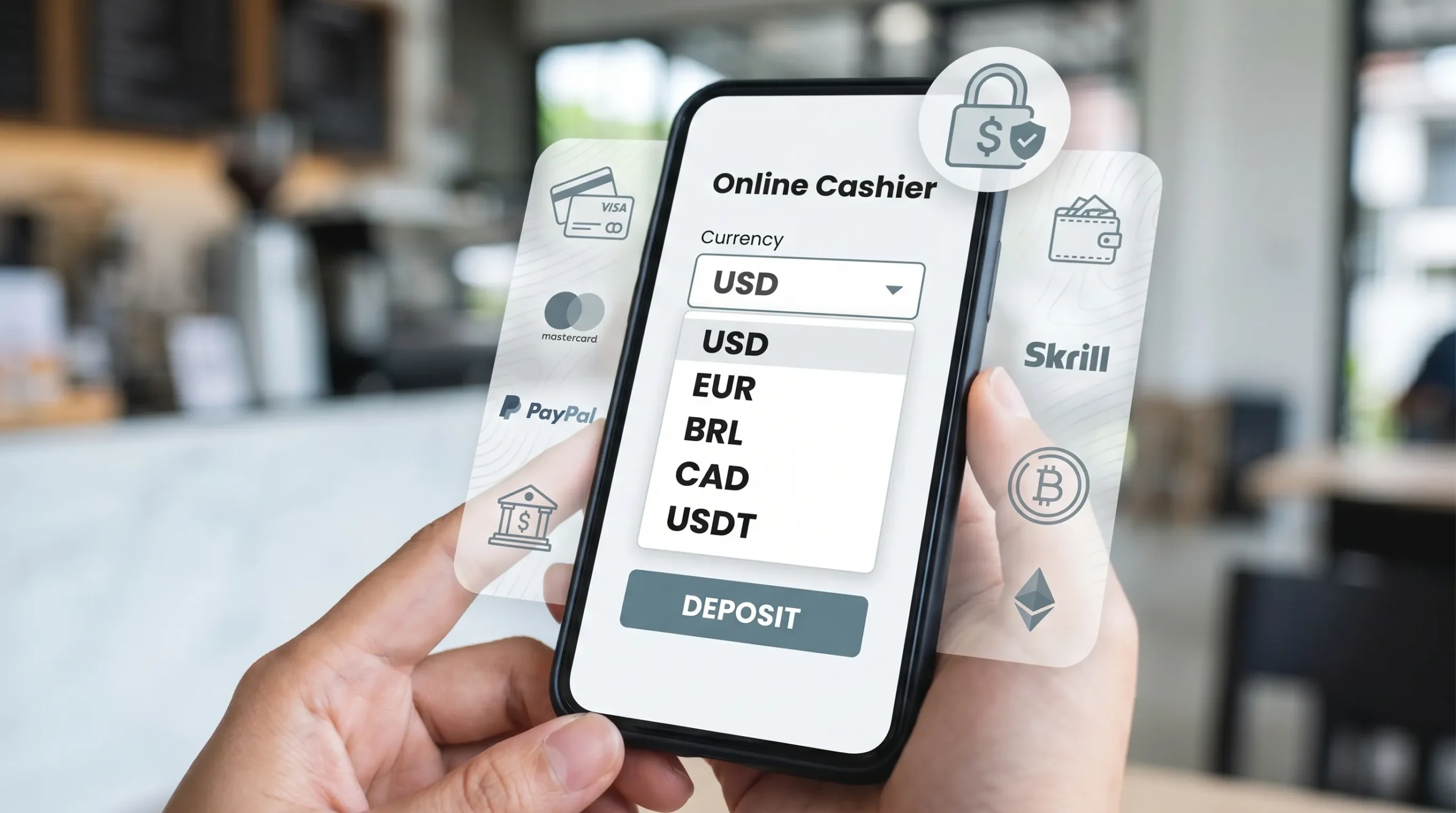
What multi-currency support really means in iGaming
Multi-currency support is often misunderstood as “showing prices in different currencies.” Display localization helps, but it is only the first layer. A serious casino expansion strategy needs currency support across the full money lifecycle.
| Layer | What it does | Why it matters for expansion |
|---|---|---|
| Display currency | Shows balances, deposits, bonuses, limits, and game values in the player's currency | Reduces confusion and improves trust |
| Payment acceptance | Lets players deposit through local rails, cards, APMs, bank transfers, e-wallets, or crypto where supported | Improves approval rates and market fit |
| Wallet and ledger | Records balances, conversions, fees, refunds, bonuses, and withdrawals accurately | Prevents reconciliation gaps and disputes |
| FX governance | Defines rate sources, spreads, rounding, conversion timing, and treasury rules | Protects margin and prevents arbitrage |
| Reporting and compliance | Converts thresholds, limits, AML signals, and financial reports into auditable formats | Helps operations scale across jurisdictions |
For a startup casino, the temptation is to launch with one base currency and “add more later.” That can work for a narrow domestic launch. It becomes risky when the roadmap includes LATAM, Europe, Africa, Canada, or crypto-first segments where player payment habits vary dramatically.
The World Bank Global Findex highlights how financial access and digital payment adoption differ by region. For casino operators, the takeaway is simple: global growth requires local payment behavior, not a one-size-fits-all cashier.
Why local currency improves player trust
Players do not evaluate a casino cashier like finance teams do. They evaluate it emotionally and quickly.
If a player in Brazil sees a welcome bonus in EUR, a minimum deposit in USD, and a withdrawal fee that is unclear after conversion, they may not assume the operator is global. They may assume the operator is risky. The same happens when players cannot estimate wager size, bonus value, or loss limits in familiar denominations.
Local currency improves trust because it makes value obvious. A player can understand:
- How much they are depositing
- How much a bonus is worth
- What a minimum bet means
- Whether a withdrawal fee is acceptable
- How much they have won or lost in real terms
This matters even more on mobile. A mobile-first player is unlikely to stop and calculate exchange rates in the middle of onboarding. They either complete the deposit or abandon the flow.
Across commerce, the best payment products remove unnecessary friction. For example, Tap to Phone payment apps let merchants accept contactless card payments with a device they already use. The iGaming equivalent is giving players a cashier that works with the currency and payment behavior they already understand.
How multi-currency support lifts deposit conversion
The cashier is one of the highest-leverage pages in an online casino. Multi-currency support improves conversion by removing three kinds of friction.
First, it reduces cognitive friction. Players do not need to convert prices mentally or second-guess bonus value. A €20 deposit, a R$100 deposit, and a CAD 25 deposit may represent similar intent in different markets, but they feel very different when shown to the wrong audience.
Second, it reduces payment friction. Local currencies often map better to local payment methods, issuer expectations, and PSP routing. A player paying in their domestic currency through a familiar rail is more likely to complete the transaction than a player pushed into a cross-border card flow with unfamiliar fees.
Third, it reduces support friction. When deposits, withdrawals, bonuses, and fees appear in a player's expected currency, there are fewer “Where did my money go?” tickets. That helps operators scale without support costs growing linearly with new market entries.
If your expansion plan depends on first-time depositor growth, multi-currency support should be measured directly in the funnel. Useful metrics include cashier open-to-deposit rate, deposit approval rate by currency, abandoned deposit rate, time to credit, withdrawal ticket rate, and FX-related complaints.
For a deeper payment stack view, Spinlab's guide to the best payment methods for online casinos in 2026 explains why operators need a market-specific mix rather than simply adding more payment logos.
Multi-currency makes market testing cheaper
Expanding a casino brand does not always mean launching a full localized operation on day one. Many operators test markets in phases: landing pages, payment availability, localized lobbies, targeted affiliates, and small retention campaigns.
Multi-currency support makes those tests cleaner. Instead of forcing every test market into the same base currency, the operator can observe real behavior in a more natural environment.
| Expansion test | Without multi-currency | With multi-currency support |
|---|---|---|
| Paid acquisition test | Conversion data may be distorted by unfamiliar pricing | Deposit behavior reflects local willingness to pay |
| Bonus test | Bonus value may feel too high or too low after conversion | Offers can be sized to local purchasing power |
| Payment rail test | Cross-border declines may hide real demand | Local rails can be compared fairly |
| VIP test | High-value behavior is harder to benchmark | VIP thresholds can be normalized by market |
| Support test | Currency confusion increases tickets | Support data reflects real product issues |
This matters for lean operators. A white label casino platform with strong multi-currency controls can help teams launch smaller, learn faster, and avoid overinvesting in markets where payment conversion or compliance cost is not yet proven.
It protects margins from FX leakage
Multi-currency expansion can increase revenue, but it can also create hidden losses if FX is not governed properly.
Margin leakage usually appears in small places: rate timing differences, rounding errors, bonus conversions, manual refund handling, treasury settlement gaps, and mismatches between PSP reports and internal ledgers. At low volume, these issues look like noise. At scale, they become material.
Common FX leakage points include:
- Deposits authorized in one currency and settled in another
- Bonuses issued in local currency but costed in base currency incorrectly
- Withdrawals processed after unfavorable rate changes
- Rounding rules that consistently favor players or the operator without documentation
- Crypto deposits converted at unclear timestamps
- PSP fees hidden inside exchange rates
The solution is not just “better exchange rates.” It is an FX policy that is encoded into the platform. Operators need a single rate authority, clear conversion triggers, audit logs, spread rules, and reporting that shows profit by currency.
Spinlab covers this operational layer in more detail in multi-currency wallet FX policies that prevent margin leaks. The key point for expansion is that FX should be managed like a product and risk function, not left to ad hoc finance cleanup.
Multi-currency support improves compliance readiness
Every market has its own regulatory expectations, reporting norms, AML risk patterns, and responsible gambling requirements. Currency touches all of them.
An operator may need to show deposits, withdrawals, bonus credits, losses, refunds, chargebacks, and suspicious activity in both local currency and a reporting currency. AML thresholds may need conversion. Responsible gambling limits must be understandable to players. Audit evidence must show how a wallet balance changed and why.
Multi-currency support helps by making money movement traceable. A good setup should show:
- The original transaction currency
- The settlement currency
- The FX rate used
- The rate source and timestamp
- The fee and spread applied
- The resulting wallet credit or debit
- The user, system, or provider event that triggered the change
This is particularly important when casino operators combine fiat and crypto. A crypto-ready solution may support stablecoins, direct wallet deposits, onramps, custodial wallets, and fiat withdrawals, but those rails still need KYC, AML, sanctions screening, transaction monitoring, and reconciliation.
Multi-currency support does not replace licensing advice or compliance counsel. It does, however, make expansion more defensible because the operator can produce a clearer evidence trail.
It enables better localization beyond language
Localization is often reduced to translation, but currency is one of the strongest localization signals in a casino product.
A localized casino lobby should not only display the right language. It should make the player feel the product was built for their market. That includes deposit presets, bonus names, wager denominations, withdrawal thresholds, VIP tier targets, tournament prize pools, and responsible gambling limits.
Consider a welcome offer. “Deposit $20 and get 50 free spins” may be clear in one market, weak in another, and confusing in a third. Multi-currency support lets CRM and bonus teams set values that match local behavior while keeping cost controls consistent in the backoffice.
This is where multi-currency support connects to retention. Players are more likely to respond to offers that feel relevant, realistic, and transparent. Operators are more likely to protect margin when those offers are tied to live analytics and proper currency-level reporting.
For broader strategy, Spinlab's guide to multi-currency pricing strategies for global casinos explains how display, acceptance, wallet, and governance decisions come together in pricing.
Crypto and stablecoins expand the currency map
For many operators, multi-currency no longer means only USD, EUR, GBP, CAD, and local fiat. It also includes BTC, ETH, USDT, USDC, and other assets where legal and commercially appropriate.
Crypto can support expansion in markets where card access is weak, cross-border payments are expensive, or crypto adoption is high. Stablecoins can reduce volatility compared with purely speculative assets, but they also introduce treasury, custody, chain selection, Travel Rule, and sanctions-screening requirements.
A practical crypto-ready multi-currency setup should avoid treating digital assets as a separate casino. Instead, fiat and crypto should feed into the same operational control layer: one player identity, one risk model, one ledger of record, one analytics view, and one support workflow.
That is the difference between adding a crypto wallet plugin and operating a real multi-currency casino platform.
What operators should demand from a multi-currency casino platform
When evaluating an iGaming platform for expansion, operators should not ask only, “How many currencies do you support?” A better question is, “How does your platform control money movement across currencies from deposit to withdrawal?”
| Requirement | Why it matters |
|---|---|
| Fiat and crypto payment support | Lets operators serve different player segments and market conditions |
| Multi-currency wallet or ledger model | Keeps balances, bonuses, fees, and withdrawals auditable |
| Payment orchestration | Routes deposits by currency, geography, provider health, and risk |
| Real-time analytics by currency | Shows conversion, approval, LTV, margin, and support issues per market |
| KYC and AML integration | Connects currency activity to identity, risk, and compliance workflows |
| Backoffice controls | Lets ops teams manage limits, fees, currencies, and reports without constant engineering work |
| Open APIs | Allows integration with PSPs, CRMs, data tools, and local market services |
| Reconciliation tooling | Matches ledger, PSP, bank, and blockchain activity accurately |
A modular platform is especially useful for expansion because operators rarely enter every market with the same stack. One region may need local bank transfer and fiat wallets. Another may need stablecoin deposits and crypto onramps. Another may prioritize card approvals, Apple Pay, or open banking.
Spinlab's all-in-one modular iGaming platform is designed around these needs, including crypto and fiat payment support, multi-currency support, game aggregation, real-time analytics, KYC and AML workflows, fraud prevention, a customizable backoffice, open API integration, crypto onramps, and merchant custodial wallets. The practical benefit is that operators can launch and adapt markets without stitching together every core system from scratch.
Common mistakes that slow casino expansion
Multi-currency support can create leverage, but only if it is implemented carefully. The most common mistakes are predictable.
One mistake is adding currencies before defining settlement and reconciliation rules. This creates messy reporting and support issues later.
Another mistake is showing local currency in the UI while actually processing everything in a foreign base currency with unclear FX. Players may tolerate this once, but it damages trust when withdrawals or refunds differ from expectations.
A third mistake is ignoring bonus arbitrage. If deposit matches, cashback, tournaments, and VIP thresholds are not normalized by currency and market, players can exploit mispriced offers.
Operators also underestimate customer support localization. If a player asks why a withdrawal amount changed after conversion, the support team needs a clear, auditable answer. “FX moved” is not enough.
Finally, some teams treat crypto as an expansion shortcut. Crypto can be powerful, but without custody controls, KYT, Travel Rule readiness, withdrawal policies, and ledger reconciliation, it can create more operational risk than growth.
A simple rollout plan for multi-currency expansion
A sensible rollout starts with a small number of high-intent markets rather than a huge currency list. Choose markets based on licensing feasibility, payment access, acquisition cost, content fit, and operational readiness.
Then define the currency operating model. Decide which currencies are display-only, which are accepted for deposits, which are held as wallet balances, and which are supported for withdrawals. Not every currency needs the same depth of support on day one.
Next, set FX governance. Document rate sources, conversion moments, spreads, rounding, refunds, bonus conversion, and treasury settlement. Make sure these rules are visible in backoffice reporting and player-facing terms where relevant.
After that, connect payments and analytics. Measure each currency as its own funnel, not as an aggregate number. A blended approval rate can hide the fact that one market is working and another is failing.
Finally, run a controlled launch. Start with deposit limits, monitored cohorts, clear support scripts, and daily reconciliation. Expand only when conversion, fraud, support, and margin metrics are stable.
For operators comparing broader platform requirements, Spinlab's guide on how to choose casino software for global markets offers a useful evaluation framework.
Frequently Asked Questions
What is multi-currency support in an online casino? Multi-currency support lets a casino display, accept, store, convert, report, and reconcile money in multiple fiat or crypto currencies. In a mature setup, it covers the cashier, wallet, bonus engine, payments, compliance, analytics, and backoffice reporting.
Is displaying local currency enough for casino expansion? No. Displaying local currency helps players understand value, but expansion also requires payment acceptance, wallet accuracy, FX governance, withdrawal handling, and reconciliation. Otherwise, the operator may create hidden costs and player confusion.
Do casinos need separate wallets for every currency? Not always. Some operators use a single base-currency wallet with display conversion, while others use true multi-currency wallets. The right model depends on markets, payment rails, treasury strategy, compliance requirements, and player expectations.
How does crypto fit into multi-currency support? Crypto adds digital assets such as BTC, ETH, and stablecoins to the currency mix. A crypto-ready casino should connect these assets to the same ledger, compliance, fraud, custody, and reporting controls used for fiat payments.
Which KPIs should operators track by currency? Key KPIs include deposit initiation rate, approval rate, cashier abandonment, time to credit, withdrawal completion time, FX margin, chargeback rate, bonus cost, player LTV, support ticket rate, and reconciliation exceptions.
Build multi-currency expansion on a platform designed for it
Multi-currency support helps casino expansion because it makes new markets feel local while giving operators the control needed to protect margin, manage risk, and scale operations.
If you are planning a new market launch, upgrading a white label casino, or adding crypto-ready payments, Spinlab Studio gives operators a modular foundation with multi-currency support, fiat and crypto payments, game aggregation, compliance workflows, analytics, fraud prevention, and an operator-friendly backoffice.
Explore the platform at Spinlab Studio and see how a flexible iGaming stack can help you launch, localize, and scale faster.