

Global casino growth rarely fails because of games. It fails because the cashier does not feel local.
If a player in Mexico sees deposits denominated in USD, a player in Poland sees unclear FX fees, and a player in the UAE is pushed into a currency they do not use, you are effectively adding friction at the single moment that matters most: funding the wallet.
Multi-currency pricing is not just “show prices in more currencies.” For online casinos, it is a set of commercial, UX, treasury, and compliance decisions that determine:
- Deposit conversion and first-time deposit (FTD) rate
- Net gaming revenue (NGR) after payment costs and FX leakage
- Fraud and chargeback exposure
- How easily you can expand into new jurisdictions without rewriting your stack
Below is a practical playbook for building multi-currency pricing strategies that scale globally, including where operators typically lose margin and how to avoid it.
What “multi-currency pricing” means in an online casino
In iGaming, multi-currency pricing usually includes four layers that get conflated:
Currency display
You show game stakes, bonuses, and cashier amounts in a player’s preferred currency, but you still settle everything into one base currency behind the scenes.
Currency acceptance
You actually accept deposits in multiple currencies via card, bank transfer, APMs, and potentially crypto, and you handle conversion at the gateway or in your own wallet layer.
Multi-currency wallet
Players can hold balances in multiple currencies (and sometimes multiple assets), and you apply deterministic rules for how wagering, bonuses, and withdrawals behave per currency.
Currency governance
You define FX sources, spreads, rounding rules, limits, fees, bonus eligibility, reporting currency, and reconciliation logic per jurisdiction.
A casino can “support multi-currency” and still leak margin if governance is weak. The goal is to treat pricing as a controlled system, not a collection of one-off exceptions.
Why multi-currency strategy is a profit lever (not a localization checkbox)
Two economic realities make this worth serious attention:
- Players are highly price-sensitive at the cashier. Small frictions (surprise fees, unclear FX, unfamiliar denominations) cause abandonment, and abandonment is expensive because you already paid to acquire that click.
- Cross-border payment and FX complexity is a direct margin tax. Even when conversion “works,” hidden spreads, scheme fees, routing choices, and operational overhead quietly reduce NGR.
On top of that, FX markets are huge and volatile. The Bank for International Settlements (BIS) Triennial Survey is the standard reference for FX market structure and confirms the scale and multi-currency nature of global flows. For casino operators, the takeaway is simple: FX risk is not rare edge behavior, it is constant background noise.
The four core multi-currency pricing models (and when to use each)
Most casinos fall into one of the models below. The “best” model depends on market mix, regulatory constraints, and how crypto-forward your player base is.
| Model | What players see | What you settle | Best for | Typical failure mode |
|---|---|---|---|---|
| Single base currency | USD/EUR only | USD/EUR | Early MVP, single-country launch | Low conversion in non-base markets, high support volume |
| Local display, base settlement | Local currency UI | Base currency ledger | Testing new markets quickly | FX surprise at deposit, inconsistent bonus values |
| True multi-currency wallet | Local currency balances | Multi-currency ledger + FX rules | Multi-market operators | Negative balances, reconciliation gaps, promo abuse |
| Hybrid fiat + crypto rails | Fiat + stablecoins/crypto | Multi-asset settlement | Regions with high crypto usage or card friction | Compliance/Travel Rule gaps, unclear fee disclosure |
A useful heuristic: if you are serious about multi-market scale (more than two meaningful geos), you eventually need a real multi-currency wallet policy, even if you phase it in market by market.
Strategy 1: Choose currencies based on player “payment reality,” not language
Operators often map currencies to languages (Spanish = EUR, Arabic = USD) and then wonder why conversion stalls.
Instead, define a currency and rails matrix for each target market:
- Primary salary and spending currency (what players think in)
- Dominant deposit rails (cards, pay-by-bank, local APMs, crypto)
- Typical deposit sizes and frequency
- Likely withdrawal preference (same rail, bank, wallet)
This can change even within the same language region. It also changes over time. For example, stablecoins can behave like “digital dollars” in some economies, and they frequently coexist with local fiat rails rather than replacing them.
If you are operating a hybrid cashier, currency selection and rail selection should be designed together, not in separate roadmaps. If you want a deeper payments angle, Spinlab’s overview on why you need cards plus alternatives is a helpful starting point: APMs: Why Businesses Need More than Just Cards.
Strategy 2: Price in familiar denominations (and avoid conversion sticker shock)
Even if your FX is mathematically fair, you can still lose deposits because the amount “feels wrong.” This is especially common when:
- A player is shown USD-equivalent amounts in a local market
- A cashier shows a converted total after the player commits to an amount
- Fees are bundled in a way that looks like you changed the deposit amount
Practical denomination rules
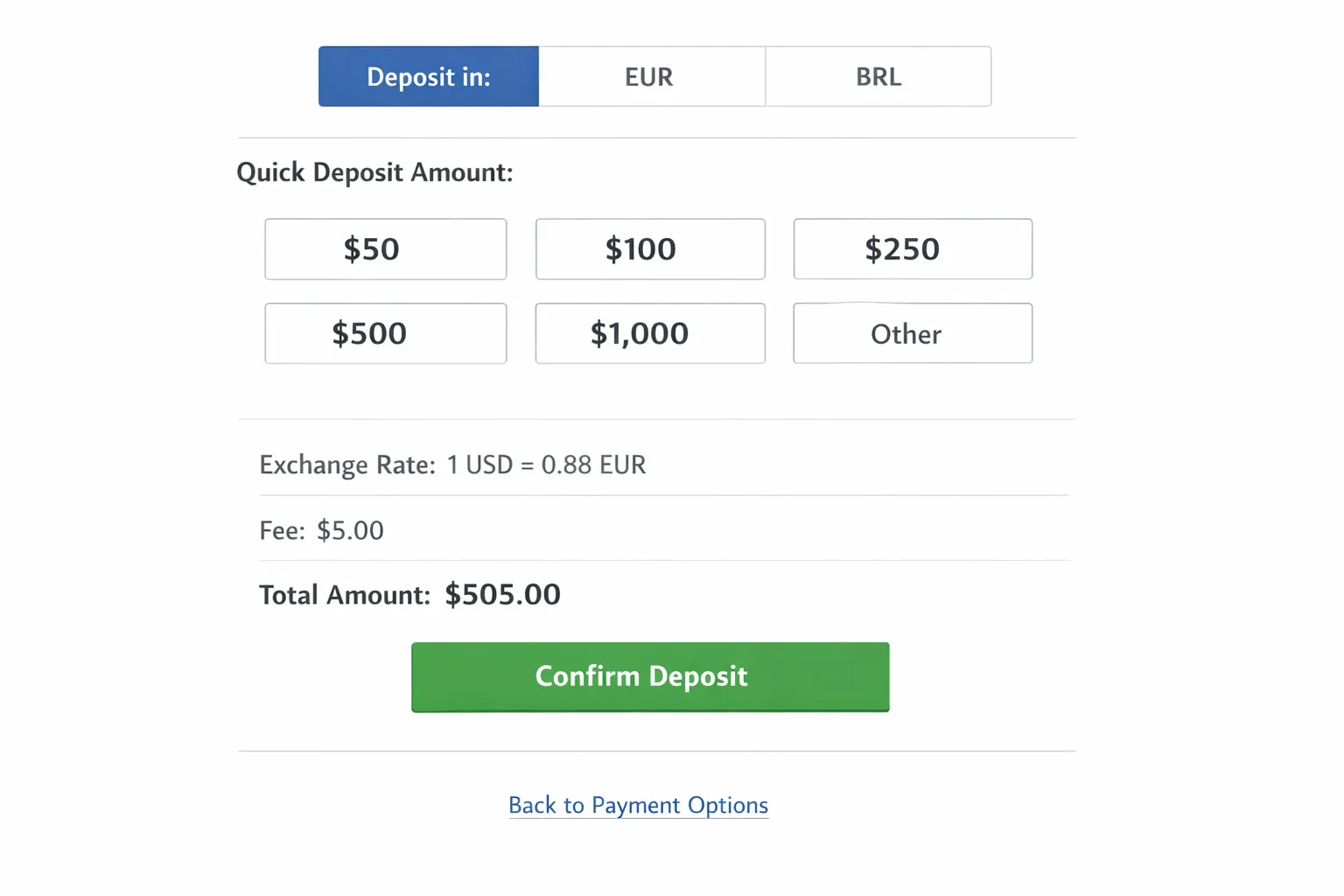
Use a consistent set of “local anchor amounts” per currency (and per rail) for your quick-select buttons.
- Anchors should map to common cash or bank transfer amounts in that market.
- Keep the list short, and tune it by conversion data.
- Round in the player’s favor on display, then enforce exact settlement rules in the ledger.
This is one of the highest ROI experiments you can run because it affects the most valuable funnel event.
Strategy 3: Define your FX policy like a product, not like accounting
FX is where multi-currency strategies quietly die. You need explicit answers to these questions:
Where does the exchange rate come from?
Options include PSP-provided rates, a treasury provider, or a market data feed. Whatever you use, document it and make it consistent.
Who pays the spread?
There is no free lunch. You either:
- Bake the spread into the rate you show players
- Add an explicit conversion fee
- Absorb the spread as a cost of acquisition/retention
Your choice should depend on market competitiveness and payment mix.
Do you lock the rate, and for how long?
If a player starts a deposit and completes it 90 seconds later, do they get the same quote? Rate-lock windows reduce disputes and support tickets. They also reduce “FX surprise,” which is a trust killer.
How do you handle rounding?
Rounding rules should be deterministic and auditable. In gambling environments, “invisible rounding” becomes a compliance and reputation risk.
A tight FX spec is also one of the simplest ways to reduce negative-balance incidents in multi-currency systems. If your platform team is already dealing with deficits caused by FX swings and race conditions, Spinlab’s guide on the operational side is worth reading: How to Handle Negative Balances in Multi-Currency Wallets.
Strategy 4: Align deposit fees with local expectations (and test the framing)
Multi-currency pricing is not only about the amount, it is also about how costs are framed.
In some markets, players accept a small explicit fee on certain rails. In others, “no-fee deposits” is table stakes, and the fee has to be absorbed or offset elsewhere.
The right answer is rarely global. The correct approach is to create a per-market pricing policy and then test it.
A practical way to structure experiments:
- Variant A: No fee, slightly wider FX spread
- Variant B: Explicit fee, tighter FX rate
- Variant C: Fee waived above a threshold (in local currency anchors)
Spinlab has already explored the psychology and measurement approach in Surcharge vs No-Fee Deposits: Pricing Psychology Experiments. The key is to treat fee policy as an experimentable variable with strict guardrails, not as a permanent decision made in a finance spreadsheet.
Strategy 5: Use stablecoins strategically (especially for “digital dollar” demand)
For global casinos, stablecoins can be less about being “crypto-native” and more about:
- Offering a USD-like unit of account in markets where USD demand is high
- Reducing friction where card acceptance is poor
- Improving payout speed when supported by your withdrawal stack
But stablecoin pricing needs the same discipline as fiat pricing:
- Clear asset naming and risk disclosure (USDT vs USDC is not a cosmetic difference)
- Explicit network fee handling and UX clarity
- Strong AML controls and jurisdiction gating
If you offer crypto deposits, your cashier UI must make costs legible. Otherwise, players experience “random fees” and churn. A good UX reference point is Designing a Crypto Cashier That Explains Gas Fees Clearly.
For operators thinking about performance and LTV outcomes, it can also be useful to evaluate cohort behavior by rail type, as described in Crypto vs Fiat: Which Payment Gateway Drives Higher Player Lifetime Value?.
Strategy 6: Make bonus value consistent across currencies (or you will create arbitrage)
Multi-currency environments create a predictable abuse pattern: players migrate to whichever currency produces the highest bonus value after conversion, rounding, and wagering rules.
To prevent promo arbitrage, define bonus policy in one of these ways:
Base-currency pegged bonuses
Bonuses are defined in a base currency value and converted at redemption time with clear rounding rules.
Localized bonus ladders
Bonuses are defined separately per currency, tuned to local purchasing power and deposit anchors.
Rail-specific bonuses
Bonuses differ by payment method (for example, pay-by-bank vs card), used carefully to manage processing costs and fraud risk.
Whichever approach you choose, align it with your VIP and loyalty economics so that “VIP level” means the same thing across markets. If your platform includes a bonus engine and real-time analytics, this is far easier to police and iterate.
Strategy 7: Build a “currency risk checklist” for compliance and disputes
Multi-currency strategy touches regulated outcomes: affordability, responsible gambling thresholds, audit trails, and dispute resolution.
At a minimum, have documented answers to:
- Which currency is the reporting currency for regulators and financial statements?
- How do you store the FX rate used for each wallet movement?
- How do you present rate and fee disclosure in the cashier?
- Which currencies are allowed per jurisdiction, and how is that enforced?
- How do limits work, per currency, per day, per month?
If you operate in the EU or serve EU players indirectly, keep an eye on regulatory changes that impact payments and dispute processes. Spinlab’s explainer on PSD3 and PSR Explained for iGaming Payments is a practical overview of what to plan for on the payments side.
Strategy 8: Operationalize multi-currency with real-time analytics (not monthly reconciliation)
Multi-currency pricing will drift unless you monitor it like any other revenue system.
Track these KPIs per currency and per rail:
| Metric | Why it matters | Early warning signal |
|---|---|---|
| Deposit conversion rate | Measures cashier friction | Drop after FX/fee change |
| Cost per successful deposit | Direct margin impact | PSP routing shift, fraud spikes |
| FX leakage (effective vs expected) | Detects spread creep | Large gaps by currency or hour |
| Withdrawal success time | Impacts retention and support | Bottlenecked rails per market |
| Bonus cost as % of NGR | Prevents promo overspend | Arbitrage behavior across currencies |
This is where real-time instrumentation matters. If you only see these deltas at month-end, you end up making blunt global changes that hurt good markets and fail to fix bad ones.
Spinlab’s perspective on using live data to drive profit levers is covered in Real-Time Analytics in iGaming: Turning Live Data into Bigger Profits.
A practical 30-day rollout plan (without boiling the ocean)
You do not need to launch 20 currencies at once. A controlled rollout typically outperforms a “big bang” launch.
Week 1: Define currency and FX policy
Finalize your rate source, spread approach, rounding rules, and rate-lock behavior.
Week 2: Implement localized cashier anchors
Set quick-select deposit amounts per currency, plus clear disclosure lines for rate, fees, and total.
Week 3: Align bonus rules and limits
Ensure bonus ladders, wagering requirements, and deposit limits behave consistently across currencies.
Week 4: Launch with measurement and guardrails
Ship with dashboards and alerting for conversion, FX leakage, chargebacks, and negative-balance risk.
This phased approach also helps you avoid common failure modes like adding currencies without updating your support scripts, dispute logic, and reconciliation tooling.
Where Spinlab fits if you are scaling multi-currency globally
If you are building or upgrading a global casino, multi-currency pricing becomes dramatically easier when your platform already supports:
- Multi-currency wallets and cashier flows, including fiat and crypto-ready rails
- Integrated payments and crypto onramp options, so you can expand payment coverage without stitching together a fragile stack
- KYC and AML compliance tooling, so new markets do not create compliance regressions
- Fraud prevention, especially around multi-accounting and promo abuse
- Real-time analytics, so FX and payment costs are visible as they happen
- Bonus and affiliate engines, so promotions remain coherent across currencies
Spinlab Studio positions its modular white label casino platform as a cost-efficient, Shopify-like way to launch and scale while keeping flexibility via APIs and a customizable backoffice.
If you want to pressure-test your current multi-currency approach (FX rules, bonus consistency, fee framing, and wallet risk), explore Spinlab’s platform at spinlab.studio and request a demo to map a rollout plan to your target markets.