

VIP programs are one of the highest-ROI retention levers in iGaming, and one of the fastest ways to accidentally torch margin, create fraud exposure, or attract regulator attention. The difference between a “VIP engine” and a “VIP liability” is rarely the tier names or the cashback rate. It’s the economics, the controls, and the operational discipline behind them.
This playbook breaks VIP design into three operator-ready parts: how to structure tiers, which perks actually compound LTV, and the traps that quietly turn loyalty into a cost center.
What a VIP program is supposed to do (and what it often becomes)
A good VIP program does three things at once:
- Protects margin by aligning rewards to incremental value, not vanity metrics.
- Improves experience by removing friction for your best players (support, withdrawals, limits, access).
- Reduces operational noise by codifying rules, eligibility, and audit trails.
A bad VIP program usually becomes “cashback with branding,” where players learn to optimize rewards rather than enjoy the product. That’s when you see:
- Tier inflation (everyone becomes “VIP”).
- Bonus abuse and multi-accounting.
- Host discretion that can’t be audited.
- Responsible-gambling risk, especially if incentives intensify during loss-chasing.
Regulators have also tightened expectations around high-value player schemes. In the UK, for example, the regulator has repeatedly emphasized stronger controls and accountability around VIP management (see the UK Gambling Commission for guidance and enforcement context).
Tiers: how to design them without breaking unit economics
Start with the comp budget, not the tier ladder
Before you decide how many tiers you want, define how much you can afford to give back.
A simple way to frame it is a VIP comp rate (how much value you return to a segment as a share of net value). Different operators compute “net” differently, but the discipline is the same: your VIP program should have a hard ceiling tied to profitability.
A practical internal model:
- Player value base: Net Gaming Revenue (or your preferred net metric after provider fees, payment costs, bonuses, and fraud losses).
- Reward cost: Cashback, bonuses, free spins, fee waivers, gifts, tournament overlays, host hours, and any withdrawal rail costs you subsidize.
- Target: Reward cost stays below a fixed percentage of incremental net value for that cohort.
If you can’t explain where the money comes from, the VIP program will eventually “borrow” it from your margin.
Pick tier metrics that are hard to game
Common tier inputs (and why they can fail):
- Deposit volume: easy to inflate, especially if players can recycle funds with low wagering.
- Wager volume: can be manufactured via low-edge play if you don’t control game eligibility.
- Net losses: incentivizes the worst behavior and raises RG risk.
Stronger options are usually hybrids:
- Net value plus quality gates (KYC completed, no fraud flags, no chargeback history).
- Time-based consistency (e.g., “must qualify in 2 of last 3 months,” not one spike).
- Risk-adjusted scoring (value minus expected costs, including payment fees and promo burn).
If you’re moving toward predictive segmentation, you can combine traditional tiers with model-driven treatment selection (Spinlab has a deeper guide on this approach in How to Use Predictive LTV Models to Segment VIP Nurture Flows).
Use tier “hysteresis” to stop churn gaming
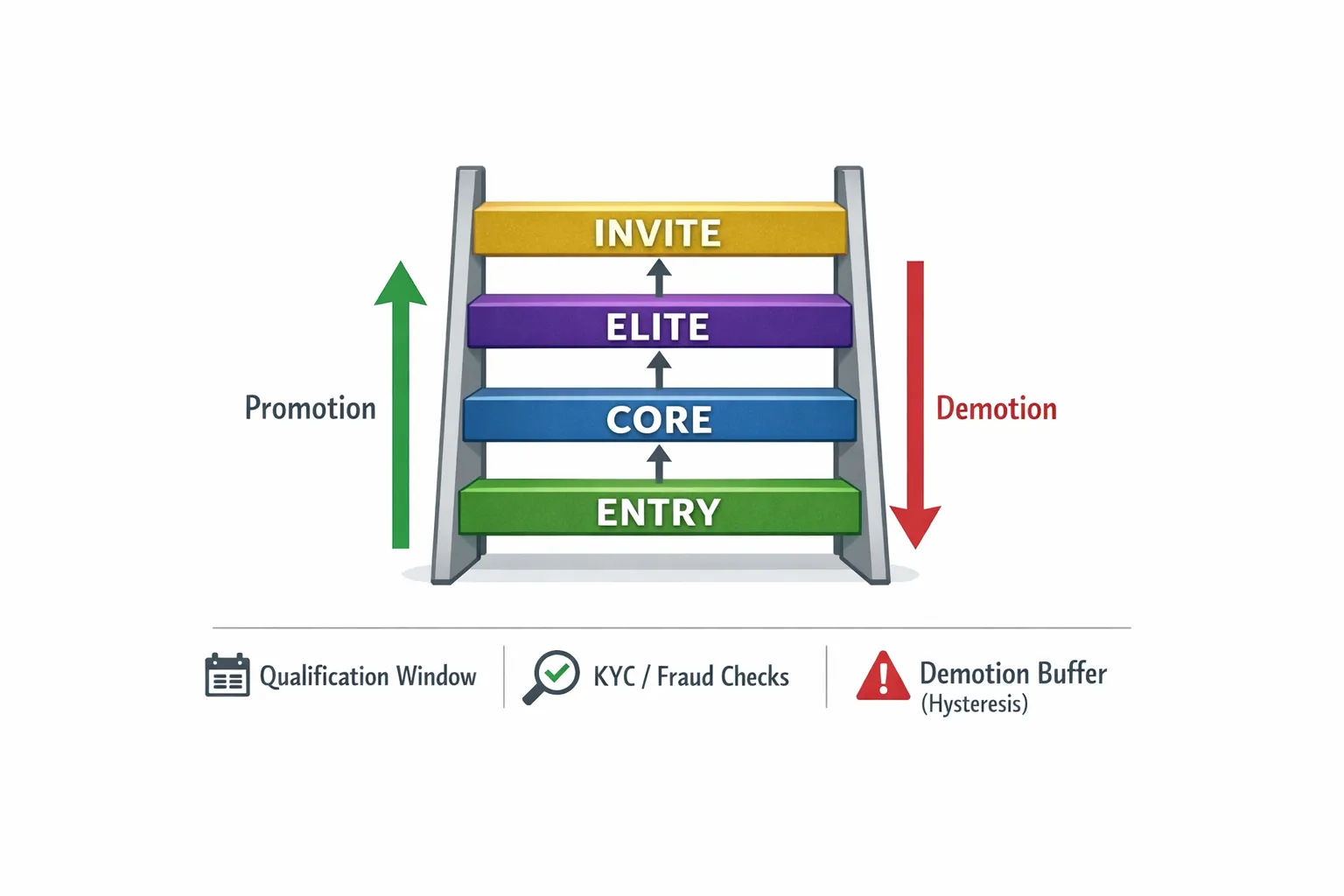
Players will optimize thresholds if the ladder is rigid. A common fix is hysteresis, meaning you require a player to fall meaningfully below a threshold (or stay below it for time) before demoting.
Operationally, this reduces:
- End-of-month “manufactured play” to retain status.
- Angry support tickets from demotions due to variance.
- Host pressure to manually override tiers.
A tier template you can steal (structure, not numbers)
The thresholds below are intentionally expressed as relative measures so you can map them to your own unit economics.
| Tier | Qualification window | Primary metric (example) | Quality gates | Demotion rule | Best fit |
|---|---|---|---|---|---|
| Entry | Rolling 30 days | Consistent activity | KYC completed | 30-day inactivity | New depositors you want to retain |
| Core | Rolling 60–90 days | Net value percentile | Fraud risk low | Must underperform for 2 windows | Your profit engine cohort |
| Elite | Rolling 90 days | Net value + consistency | Payment risk low, no chargebacks | Under threshold for 2 windows | High-value, lower-volatility cohort |
| Invite | Manual + rules | Risk-adjusted value | Enhanced review, RG checks | Case-by-case, logged | True whales, tightly controlled |
Notice what’s missing: “VIP because you lost a lot this week.”
Perks: what to offer, what it costs, and what gets abused
VIP perks work best when they do two things:
- Feel valuable to the player.
- Cost less than they feel (or pay for themselves via lift).
That’s why operational perks often outperform pure bonus spend.
A practical perk catalog (with hidden costs and risk)
| Perk category | Examples | Why it works | Real cost drivers | Common trap |
|---|---|---|---|---|
| Friction removal | Faster withdrawals, higher limits, fewer clicks in cashier | Converts “trust” into more frequent play | Payment rail fees, liquidity ops, fraud exposure | Speeding up bad actors, not just VIPs |
| Status + access | Early access to new games, exclusive lobbies, invite tournaments | Creates belonging without heavy promo burn | Content ops, segmentation accuracy | Giving exclusivity to too broad a cohort |
| Tailored offers | Personalized reloads, missions, comped entries | Higher relevance, better ROI | Analytics, experimentation discipline | Overfitting to short-term spikes |
| Service | Dedicated support line, VIP hosts | Reduces churn moments | Staffing, training, audit trails | Host discretion without governance |
| Monetary rewards | Cashback, rakeback-like offers, free spins | Simple and understood | Direct margin impact | Becomes “expected,” then escalates |
Two rules of thumb for perk selection:
- Use cash-like perks as the smallest part of the package, especially at lower tiers.
- Give operational perks only when your fraud stack can support them (velocity limits, device intelligence, KYC/AML, withdrawal risk scoring).
If you want a dedicated deep dive on abuse controls, Spinlab’s guide on Bonus Abuse Detection pairs well with VIP design, because VIP perks increase the upside for abusers.
Crypto-specific VIP perks (high upside, high responsibility)
If you’re crypto-ready, VIP perks can extend into the cashier experience, but you need tighter governance:
- Fee framing and transparency: players will notice network fees and slippage. Poor UX looks like you’re “taxing” VIPs (see Designing a Crypto Cashier That Explains Gas Fees Clearly).
- Faster withdrawals: feels premium, but increases fraud loss if you don’t have real-time controls.
- Custody and safety: if you operate custodial wallets, VIPs often receive higher limits, so your security posture must scale with them (Spinlab has a useful checklist in Custodial Wallet Security Checklist for Casinos).
Spinlab’s platform positioning is naturally aligned here because it supports crypto and fiat payments, crypto onramp solutions, and merchant custodial wallets, which lets you design VIP experiences without stitching together multiple vendors.
The operating model: how VIP works day-to-day (where most programs fail)
VIP programs usually fail operationally, not conceptually. The “deck” looks great, but the underlying system can’t enforce it.
You need four systems, even if you buy one platform
- Eligibility and tiering logic: rules, windows, demotion buffers, and exceptions.
- Offer engine: perks, bonuses, missions, cashback, and throttling.
- Risk controls: fraud checks, payment velocity, KYC/AML, device signals.
- Measurement: cohorts, holdouts, incrementality, and alerts.
If those are fragmented across vendors, VIP becomes slow and manual.
Spinlab’s approach (as described on the site) is an all-in-one modular iGaming platform with real-time analytics, advanced fraud prevention, KYC/AML compliance, and a customizable backoffice admin panel. That’s the tooling mix you need to run VIP as a controlled system instead of a spreadsheet.
Treat “VIP exceptions” like production changes
Every VIP program eventually faces exceptions: a manual upgrade, a discretionary comp, a special withdrawal arrangement.
The trap is letting exceptions happen in DMs.
Set a policy that exceptions require:
- A reason code (retention save, service recovery, goodwill, error correction).
- A defined expiration date.
- An audit trail.
- A measurable outcome (did it change retention or deposit frequency?).
If your backoffice makes it easy to log and review these actions, you prevent “silent comp creep.”
Traps: the three ways VIP programs quietly go negative
Trap 1: tier inflation and reward escalation
If a large share of actives become “VIP,” the badge loses meaning and the cost becomes structural.
Common causes:
- Tier thresholds set from ego, not economics.
- One-way promotions (hard to demote).
- Monthly spikes qualifying too many players.
Mitigations:
- Use rolling windows and hysteresis.
- Tie tiers to relative distribution (percentiles) or a capped VIP population.
- Enforce quality gates (KYC completion, payment risk limits).
Trap 2: perks that create fraud and bonus abuse profit loops
VIP perks increase attacker payout. Typical patterns:
- Multi-accounting to harvest tier-based cashback.
- “Fast withdrawal” exploited before risk systems catch up.
- Bonus laundering through low-edge games if eligibility isn’t controlled.
Mitigations:
- Require KYC completion before meaningful VIP monetary value.
- Use device and payment signals, and apply step-up verification for tier jumps.
- Add real-time rules around abnormal tier acceleration.
If you’re building your detection stack, it helps to define a clear playbook and response cadence (again, Bonus Abuse Detection is a solid reference point).
Trap 3: “VIP at all costs” creates responsible-gambling risk
This is the trap that can cost you the most long-term.
Avoid:
- Incentives that intensify specifically during loss runs.
- Host scripts that push additional deposits after markers of harm.
- Tier criteria tied too closely to net losses.
Mitigations:
- Build RG flags directly into VIP eligibility (VIP is a privilege, not an entitlement).
- Add cooling-off logic, offer throttling, and proactive support referrals.
- Ensure hosts have clear boundaries and training, and everything is logged.
For broader regulatory expectations, keep an eye on your target jurisdiction’s guidance, and consider industry codes like the EGBA (Europe-focused) as an additional reference point.
Measurement: prove VIP is incremental (or it will become permanent spend)
VIP analytics often stops at “VIP players have higher LTV.” That’s almost always true, and also almost always incomplete.
What you need to know is: did the VIP treatment cause lift, or did you simply reward players who would have stayed anyway?
A KPI set that actually answers the question
| KPI | What it tells you | How it gets misread |
|---|---|---|
| Incremental NGR lift | Whether VIP rewards generate profit, not just activity | Confused with total NGR from VIP cohort |
| Retention (D7/D30/D90) | Stickiness and habit formation | Inflated by selection bias (VIPs already sticky) |
| Deposit frequency | Whether VIP reduces friction and increases repeat behavior | Can rise from bonus cycling |
| Bonus cost rate | Reward spend as a share of net value | Looks “fine” until it compounds across tiers |
| Fraud and chargeback rate | Whether perks increase exploitability | Underestimated if only reviewed monthly |
| Time-to-withdrawal and support tickets | Whether experience perks are working | Improved metrics can hide new abuse pathways |
A practical operating rhythm is to run VIP changes as controlled experiments whenever possible, even if it’s simple holdouts inside a tier.
If you’re already using real-time analytics, you can also set alerts for:
- Sudden tier acceleration.
- Unusual withdrawal velocity after tier upgrades.
- Bonus redemption patterns that deviate from cohort norms.
(Spinlab has covered how live data turns into actions in Real-Time Analytics in iGaming: Turning Live Data into Bigger Profits.)
Implementation notes for modern stacks (especially multi-tool CRM setups)
Many operators want VIP tiers in the casino platform, but messaging and journeys in an external CRM.
That’s workable if you treat tier changes as real-time events, not nightly CSVs. A clean approach is:
- Tier-up and tier-down events emitted from your platform.
- Webhooks to update CRM traits and trigger flows.
- A single source of truth for tier state to avoid “double VIP.”
Spinlab has a practical guide on this exact pattern: Using Webhooks to Sync Player Tiers With External CRMs.
Building a VIP program that scales (without host chaos)
If you want VIP to scale from dozens of high-value players to thousands, design it like a product system:
- Rules first: tiers, demotion buffers, quality gates.
- Perks as a catalog: clear eligibility and caps.
- Controls always on: fraud, KYC/AML, withdrawal governance.
- Measurement baked in: holdouts, incrementality, alerting.
Spinlab is built around that modular, operator-controlled approach. If you’re evaluating platforms for a new build or migration, you can explore Spinlab’s all-in-one iGaming platform at spinlab.studio and map your VIP requirements to capabilities like integrated payments (fiat and crypto), compliance, fraud prevention, real-time analytics, and a customizable backoffice.