

Backoffice software is where an online casino either scales cleanly or turns into a mess of spreadsheets, manual approvals, and missed risk signals. The player sees the lobby, bonuses, cashier, and games. Your operations team sees everything behind that experience: KYC queues, payment statuses, fraud alerts, game availability, affiliate performance, bonus liability, withdrawal holds, and compliance evidence.
That is why the best backoffice tools for online casino operators are not just admin panels. They are control systems. They help teams move faster while keeping money movement, player safety, and regulatory obligations under control.
For a startup operator, the right backoffice stack can reduce launch complexity. For a scaling brand, it can prevent revenue leakage and support-ticket overload. For a multi-market casino, it can be the difference between confident expansion and operational chaos.
This guide breaks down the backoffice tool categories that matter most, what each one should do, and how to evaluate whether you need separate tools or an integrated iGaming platform.
What makes a casino backoffice tool worth using?
A strong casino backoffice tool should help teams make the right decision quickly, document that decision, and trigger the correct downstream action. If a withdrawal needs review, the tool should show why. If a bonus is blocked, the operator should see the eligibility rule. If a payment fails, the team should know whether the issue came from the player, PSP, ledger, bank, crypto network, or fraud rule.
The best tools share a few qualities:
- They connect to live operational data, not stale exports.
- They support role-based permissions and approval workflows.
- They create audit logs for sensitive actions.
- They integrate with payments, KYC, AML, fraud, games, bonuses, affiliates, and analytics.
- They make routine work simple enough for non-technical teams.
- They expose APIs or webhooks so operators are not trapped in a closed system.
For a deeper definition of the backoffice layer, see Spinlab’s guide to casino platform backoffice software. In this article, we will focus on which tools belong in a modern operator stack and how to prioritize them.
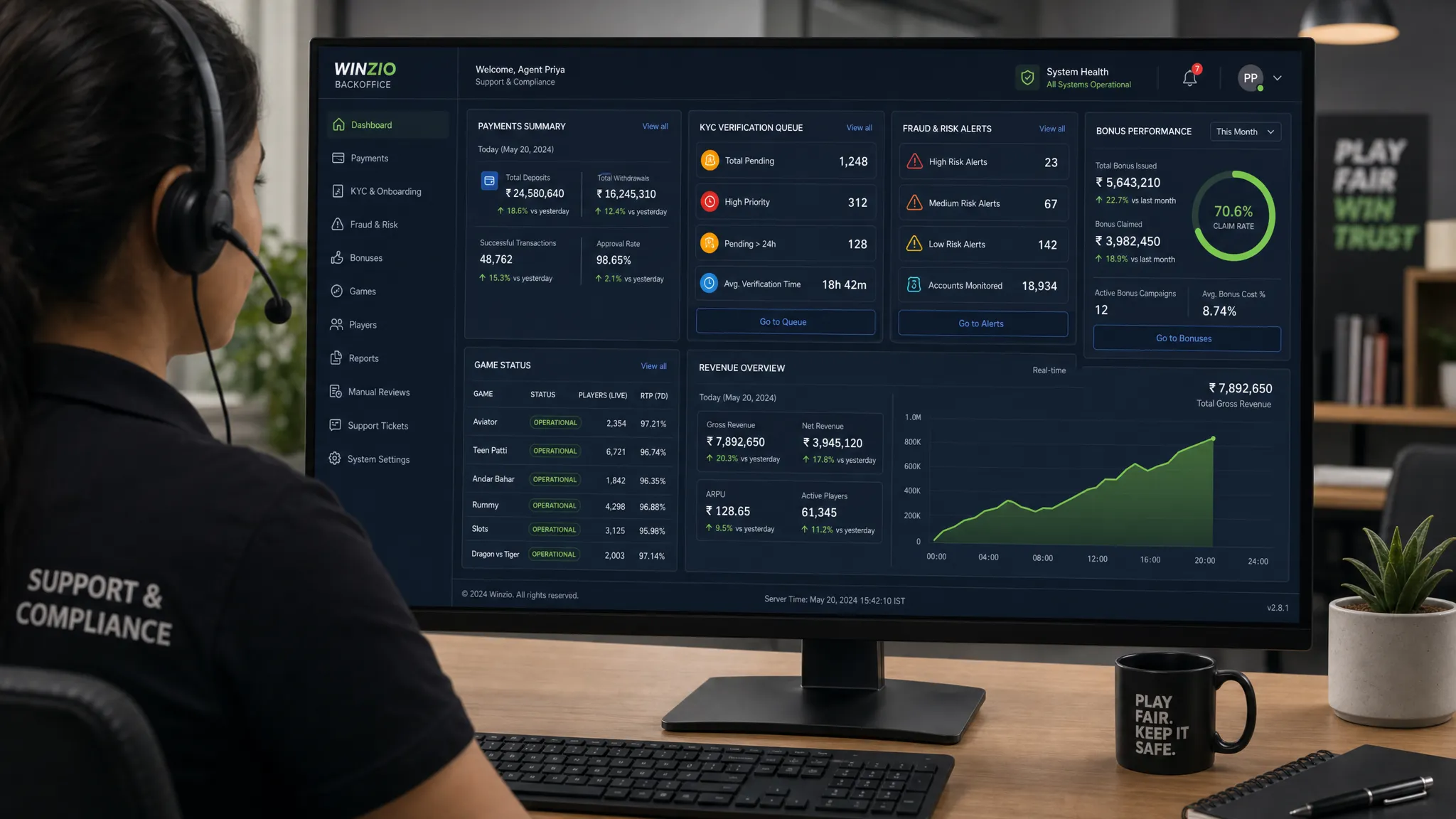
Quick comparison: the backoffice tools operators need most
| Tool category | Primary job | Must-have capabilities | Red flag |
|---|---|---|---|
| Player management | Give support, risk, and CRM teams a single player view | Account status, wallet history, KYC state, sessions, bonuses, RG flags | Player data spread across multiple panels |
| Payments and wallet | Control deposits, withdrawals, balances, and settlement | Ledger view, payment gateway statuses, crypto and fiat rails, reconciliation | PSP portal treated as the source of truth |
| KYC and AML | Verify players and monitor risk continuously | Document checks, sanctions screening, risk scores, case queues, audit logs | One-time KYC with no ongoing monitoring |
| Fraud prevention | Detect abuse before it reaches withdrawals | Device signals, velocity rules, bot controls, bonus abuse rules, risk scoring | Manual review only after loss occurs |
| Bonus engine | Create, enforce, and measure promotions | Eligibility, wagering rules, caps, abuse controls, cost reporting | Marketing can launch offers without risk controls |
| Affiliate management | Track partners, attribution, payouts, and compliance | CPA/rev share tracking, fraud checks, traffic source evidence | Affiliate data disconnected from player quality |
| Game operations | Manage content availability and performance | Provider status, jurisdiction controls, game metadata, RTP versions | Games enabled without compliance checks |
| Analytics dashboard | Turn events into operational decisions | Real-time KPIs, cohort views, alerts, funnel metrics | Static daily reports only |
| Support and case management | Resolve player issues with context | Tickets, timelines, templates, evidence packs, SLAs | Agents ask players for data the system already has |
| Security and audit | Protect admin access and prove controls | RBAC, SSO, MFA, four-eyes approvals, immutable logs | Shared admin accounts or weak permissions |
1. Player management tools: the single player timeline
Every operator needs a single view of the player. This should not be a basic profile page with name, email, and balance. It should be a timeline that connects registration, login history, KYC attempts, payment activity, bonuses, gameplay sessions, support tickets, responsible gambling interactions, device changes, and risk decisions.
A good player management tool helps support agents answer questions quickly, but it also helps compliance and fraud teams understand context. For example, a withdrawal review is easier when the reviewer can see the deposit rail, bonus attached, gameplay pattern, KYC status, linked devices, prior chargebacks, and recent account changes in one place.
The single player timeline is especially important for crypto-ready casinos because identity, wallet addresses, on-chain behavior, and internal ledger events must be understood together. If these views sit in different systems, investigation quality drops and review times increase.
Operators should look for fast search, clear status labels, permissioned actions, reason codes, and exportable evidence. The goal is simple: any team member with the right permissions should understand the current state of a player account without asking another department for screenshots.
2. Payments, wallet, and reconciliation tools
The cashier is one of the highest-value areas of an online casino, and the backoffice tools behind it must be excellent. Operators need to see deposits, withdrawals, pending statuses, failed attempts, chargebacks, refunds, crypto confirmations, PSP responses, and ledger postings from the same operational layer.
Payment gateway dashboards are useful, but they are not enough. The casino ledger should remain the source of truth for balances. PSP reports, bank statements, and blockchain activity should reconcile back to that ledger, not replace it.
For fiat-heavy casinos, the backoffice should support card payments, open banking, local APMs, bank transfers, and payout statuses. For crypto casinos, it should support address monitoring, transaction confirmations, custody states, stablecoin flows, and wallet risk checks. For global casinos, multi-currency support and FX visibility become essential.
The best payment backoffice tools include exception queues. Instead of forcing finance teams to hunt through CSV files, the system should highlight unmatched deposits, delayed payouts, duplicate webhook events, negative balances, settlement mismatches, and failed reconciliation rules. Spinlab covers these concepts in more detail in its guide to casino payments reconciliation.
3. KYC, AML, and responsible gambling operations
KYC and AML tools should not feel like bolt-ons. They should sit directly inside player operations, cashier decisions, withdrawals, CRM suppression rules, and compliance reporting. A player’s verification state affects what they can do, what offers they can receive, which payment rails they can use, and whether a withdrawal can be auto-paid.
At minimum, operators need identity verification, age checks, document review, sanctions and PEP screening, adverse media checks where required, and risk-based escalation. For AML, the toolset should monitor deposits, withdrawals, gameplay, bonus use, linked accounts, source of funds triggers, and unusual movement between rails.
Responsible gambling controls also belong in the backoffice. Admin teams should be able to view limits, self-exclusion status, cooling-off periods, reality-check events, and risk alerts. Sensitive player protection actions need strong permissions and clear audit trails.
The best approach is risk-based. Low-risk players should move through quickly. Higher-risk cases should enter structured queues with reason codes, evidence requirements, SLA timers, and escalation paths. This protects conversion without weakening compliance.
4. Fraud prevention tools: from rules to real-time risk scoring
Fraud prevention in iGaming is broader than stolen cards. Operators also face bonus abuse, multi-accounting, affiliate fraud, bot activity, chargeback abuse, account takeover, chip dumping, self-exclusion evasion, card testing, and crypto-related risk.
A modern fraud backoffice should combine deterministic rules with flexible risk scoring. Deterministic rules catch obvious cases, such as too many failed card attempts from one device. Risk scoring helps prioritize patterns that are suspicious but not automatically conclusive, such as a new player using a clean identity but sharing behavioral traits with previous bonus abusers.
Useful signals include device fingerprinting, IP reputation, payment velocity, withdrawal velocity, KYC retry patterns, wallet address history, affiliate source, gameplay style, bonus claim behavior, and account-change events. The best systems show why a player was flagged so reviewers can make consistent decisions.
Fraud tooling should also connect to operational playbooks. A high-risk deposit might require step-up verification. A suspicious bonus claim might remove promo eligibility but leave the account open. A withdrawal with strong abuse signals might enter manual review. Spinlab’s overview of casino fraud prevention tools explains why fraud defense works best as a layered system rather than a single vendor box.
5. Bonus, affiliate, and CRM tools
Bonuses can drive activation and retention, but poorly controlled promotions can destroy margin. The backoffice needs a bonus engine that gives marketing teams flexibility while giving risk and finance teams control.
Strong bonus tools should support eligibility rules, wagering requirements, game contribution percentages, max bet rules, country restrictions, deposit requirements, expiration rules, cashout caps, and abuse prevention. They should also show cost and performance, not just redemption volume.
Affiliate management needs similar discipline. Operators should track registrations, first-time deposits, NGR, player value, fraud rates, chargebacks, compliance flags, and payout obligations by partner. Affiliate dashboards that only show FTD count can encourage low-quality growth.
CRM tools should connect to player segments and suppression logic. A player who is self-excluded, showing responsible gambling risk, blocked by compliance, or under fraud review should not receive standard promotional messages. The best backoffice tools make these guardrails automatic, so teams can scale campaigns without manually checking every edge case.
6. Game operations and game aggregator controls
Game aggregation is not just a content library. It is an operational system that affects compliance, revenue, performance, and player experience. Backoffice teams need to control which games are available in which jurisdictions, currencies, brands, lobbies, and campaigns.
Game operations tools should show provider status, game launch errors, latency, certification files, RTP versions, volatility tags, bonus compatibility, blocked territories, and content metadata. This helps operators avoid promoting a game that is unavailable, uncertified, slow to launch, or not eligible for a specific bonus.
For operators offering slot games, live casino games, crash games, or casino original games, game controls also support merchandising. Teams should be able to curate lobbies, feature new releases, test ranking logic, and monitor game-level revenue. The more markets and providers you add, the more valuable a clean game operations panel becomes.
If your platform uses a game aggregator, ask whether game metadata, compliance gating, session launch logs, and reporting are visible inside the casino backoffice. If the answer is no, your content team will eventually rely on spreadsheets.
7. Real-time analytics dashboards
Analytics dashboards are often treated as executive reporting tools. In a modern casino backoffice, they should be operational tools. The difference is actionability.
A finance analyst needs deposit approval rate, settlement exceptions, payout timing, and reconciliation status. A CRM manager needs cohort retention, offer cost, bonus liability, and player LTV. A fraud lead needs suspicious account clusters, blocked withdrawals, chargeback trends, and false-positive rates. A product lead needs registration drop-off, time to first spin, game load errors, and cashier abandonment.
Real-time analytics matter because the highest-value decisions are time-sensitive. A broken payment method should be spotted before it kills a campaign. A bonus abuse pattern should be contained before withdrawals begin. A game provider outage should be visible before support tickets spike.
The best dashboards combine live metrics, alerting, drilldowns, and permissioned views. They should also make metrics consistent. If marketing, finance, and leadership define NGR differently, the backoffice becomes a source of arguments rather than decisions.
8. Support, case management, and workflow tools
Support tools are often bought separately from the casino platform. That can work, but only if the support system receives the right operational context. Agents should not need five browser tabs to answer a basic withdrawal question.
Good case management tools show the player timeline, ticket history, payment status, KYC state, current restrictions, bonus terms, and relevant internal notes. They should support templates, escalation queues, SLA tracking, and evidence packs for disputes or compliance reviews.
This is also where backoffice UX matters. Admin tools are used by humans under pressure, often during payment disputes, failed deposits, or identity reviews. Good design should be plain, structured, and accessible. Even outside iGaming, service organizations such as Ons Plekske’s clear overview of work, study, sport, and relaxation activities show the value of organizing information around real user needs. Casino backoffice tools should take the same lesson: make the next step obvious, reduce jargon, and avoid hiding important actions behind confusing menus.
For more on operational usability, Spinlab’s article on casino backoffice UX explains why admin design directly affects speed, compliance, and team morale.
9. CMS, localization, and multi-brand controls
Operators expanding across markets need backoffice tools for content and localization. This includes banners, landing pages, lobby sections, promotion pages, SEO content, legal copy, language variants, currency display, and geo-specific trust messaging.
A strong casino CMS should allow non-technical teams to update content safely while preserving performance, compliance, and brand consistency. Approval workflows are important because the wrong bonus text, payment claim, or responsible gambling message can create regulatory risk.
For multi-brand operators, brand-level controls matter even more. Teams should be able to manage themes, currencies, payment methods, game catalogs, promotions, affiliate tags, and reporting by brand without duplicating every workflow. If a platform requires separate admin panels for every casino, operations become slower and reporting becomes less reliable.
The best multi-brand backoffice tools provide shared infrastructure with brand-specific permissions and configuration. That allows one operations team to scale several casino brands without losing control.
10. Security, permissions, and audit tools
Casino backoffice access is highly sensitive. Admin users may be able to approve withdrawals, change player status, view identity documents, adjust bonuses, disable games, export reports, or alter risk rules. That means security is not optional.
Operators should require role-based access control, SSO support, MFA, IP allowlists where appropriate, admin session controls, action previews, approval workflows for sensitive changes, and immutable audit logs. High-risk actions, such as manual balance adjustments or withdrawal overrides, should require reason codes and sometimes four-eyes approval.
Audit tooling should answer key questions quickly: who changed this rule, when did they change it, why did they change it, what data did they see, and what downstream action happened? If your team cannot answer those questions, your backoffice is not audit-ready.
Security also includes vendor access. Platform partners, PSPs, support contractors, and affiliates should not have broader access than their role requires. The best backoffice tools make least-privilege access practical rather than theoretical.
Best backoffice setup by operator stage
There is no universal stack that fits every operator. A lean whitelabel casino has different needs than a multi-market casino with custom games and several payment processors. The key is to match your tooling to your operating model.
| Operator type | Recommended backoffice setup | What to avoid |
|---|---|---|
| Lean startup | Integrated white label casino platform with player, payments, KYC, fraud, games, bonuses, analytics, and support context | Buying separate enterprise tools before product-market fit |
| Crypto-first casino | Unified ledger, merchant wallets, on-chain monitoring, KYT, Travel Rule readiness, crypto cashier controls | Treating crypto deposits as a simple wallet plugin |
| Affiliate-led casino | Strong attribution, partner scoring, payout controls, fraud checks, campaign reporting | Paying affiliates only on registration or FTD volume |
| Multi-brand operator | Multi-brand admin, shared reporting, brand-level permissions, centralized fraud and compliance queues | One disconnected admin panel per brand |
| Regulated expansion brand | Policy controls, audit logs, jurisdictional content rules, payment and KYC evidence packs | Manual compliance checks inside spreadsheets |
| Custom game operator | Game operations, math/version control, testing logs, RTP and volatility reporting, certification evidence | Launching original content without operational visibility |
Separate tools vs integrated iGaming platform
Some operators prefer a best-of-breed stack: a dedicated KYC vendor, a separate CRM, a standalone fraud tool, an external BI layer, and multiple PSP dashboards. This can work for mature teams with strong technical resources. The benefit is flexibility. The cost is integration complexity, inconsistent data, and higher operational overhead.
For many startups and growing operators, an integrated iGaming platform is more practical. The ideal model is modular all-in-one: core casino functions are connected by default, but APIs and integrations remain open. This gives teams speed without locking them out of future customization.
Spinlab is built around that modular all-in-one approach. Its platform supports crypto and fiat payments, game aggregation, real-time analytics, fraud prevention, KYC and AML workflows, a mobile-optimized casino experience, affiliate and bonus tools, a customizable backoffice, open API integration, multi-currency operations, crypto onramp solutions, merchant custodial wallets, and custom-designed original games. It is designed for operators who want a lower-cost, Shopify-like experience rather than a heavy enterprise build.
For teams comparing white label options, Spinlab’s guide to best white label casino software for startups can help frame the buying decision.
Demo checklist: how to evaluate backoffice tools before buying
A polished demo can hide weak operations. Instead of asking vendors to show dashboards, ask them to run real workflows. The goal is to see whether the platform handles messy casino operations, not just ideal states.
Use these demo tasks:
- Find a player who deposited by card, claimed a bonus, failed KYC once, and requested a withdrawal.
- Explain why the withdrawal is approved, held, rejected, or escalated.
- Show the ledger entry for a deposit and match it to the payment gateway status.
- Disable a game in one jurisdiction while keeping it live elsewhere.
- Create a bonus with max bet rules, game contribution rules, and country restrictions.
- Show the audit log for a manual admin action.
- Export an evidence pack for a payment dispute or compliance review.
- Create a risk rule and show how false positives are monitored.
- Segment players by deposit behavior and suppress anyone with RG or compliance restrictions.
- Show what happens when a PSP webhook arrives twice or a crypto transaction is delayed.
If the vendor cannot complete these workflows in the admin panel, your operations team will likely need manual workarounds after launch.
Frequently Asked Questions
What is the most important backoffice tool for an online casino? The most important tool is the single player view because it connects support, payments, KYC, AML, fraud, bonuses, and responsible gambling decisions. Without it, every team works from partial context.
Should a new casino buy separate tools or use an integrated platform? Most new operators benefit from an integrated iGaming platform because it reduces launch complexity and keeps core workflows connected. Separate best-of-breed tools can make sense later if you have the technical team to integrate and govern them properly.
Do crypto casinos need different backoffice tools? They need additional capabilities, especially wallet monitoring, custody visibility, KYT, blockchain confirmations, stablecoin support, Travel Rule workflows, and crypto reconciliation. These should still connect to the same player, ledger, risk, and compliance views.
How do backoffice tools reduce support tickets? They reduce tickets by giving players clearer statuses and giving agents better context. Withdrawal trackers, payment status visibility, proactive notifications, and support timelines prevent players from asking the same questions repeatedly.
What should operators check in a backoffice software demo? Ask vendors to show real workflows: a delayed withdrawal, a failed deposit, a bonus abuse alert, a KYC escalation, a game restriction by jurisdiction, and a manual admin action with audit logs. Workflow proof is more valuable than dashboard screenshots.
Run your casino backoffice from one connected platform
The best backoffice tools for online casino operators are the ones that keep money, risk, players, games, campaigns, and compliance connected. If those systems are split across disconnected panels, your team will eventually pay for it through slower reviews, missed fraud signals, support volume, and reporting gaps.
Spinlab gives operators a modular, crypto-ready iGaming platform with integrated payments, game aggregation, fraud prevention, KYC and AML workflows, real-time analytics, bonus and affiliate tools, open APIs, and a customizable admin experience built for fast onboarding.
If you want a lower-cost, Shopify-like way to launch or scale a whitelabel casino, explore Spinlab Studio and see how a connected backoffice can simplify daily operations from day one.
The login process is seamless and I haven’t encountered any lag during peak hours. It is rare to find such a stable platform these days. Give senopati2login a try.
Best betting options for local players. The odds are competitive and the app is very user friendly. Big thumbs up for ph1xbetph.
We are launching a website and need infrastructure. Can you provide us with information?