

Giving players the freedom to curate their own rewards might sound risky at first glance, yet the data tells a different story. A 2025 Eilers & Krejcik Gaming panel survey of 72 real-money casinos found that operators offering self-service bonus hubs saw a median 18 % increase in day-30 retention and a 12 % reduction in bonus cost-to-revenue compared with traditional “spray-and-pray” campaigns. In short, when customers pick the carrot, they value it more—and waste less of your promo budget.
What Is a Bonus Marketplace?
A bonus marketplace (sometimes called an offer store or reward hub) is an in-app section where verified players browse a live catalogue of promotions—welcome packages, reloads, free spins, cashback, quests, raffles—and redeem the ones that match their current goals. The catalogue can be personalised in real time by balance, preferred games, VIP tier, geolocation, risk score, and more.
Unlike a one-way push campaign that blasts the same code to thousands of wallets, a marketplace flips the power dynamic:
- The operator sets the rules, inventory limits, and pricing (wagering, expiry, max win).
- The player decides which offer, when to claim it, and on which device.
That subtle shift creates powerful downstream effects on acquisition, retention, and compliance.
Five Reasons to Let Players Choose Their Bonuses
| Driver | Push-Style Campaigns | Bonus Marketplace | Impact on KPIs |
|---|---|---|---|
| Personalisation | Segment-based at best | 1-to-1 in real time | Higher engagement, lower spam fatigue |
| Cost Efficiency | Flat cost per send | Dynamic pricing based on risk/value | ‑8 – 15 % promo cost (Spinlab client benchmarks) |
| Conversion Control | Player must opt-in via support or link | Instant self-service redemption | +3 – 6 pp deposit conversion |
| Responsible Gaming | Hard to block vulnerable users | Eligibility gate per user and offer | Up to 28 % fewer RG flag breaches (UKGC data, 2024) |
| Operational Overhead | Manual list uploads, CS tickets | Rules run automatically via API | ‑35 % campaign labour (Fullhouse case study) |
1. Hyper-Targeted Relevance
Players hate irrelevant promos. A live hub combines event streaming (bets, deposits, session time) with smart filters so a roulette fan does not scroll through slot-only free spins. According to Google’s 2025 Mobile UX Report, relevant offers lift session time by 20 %.
2. Budget Discipline
Because each offer carries a cost score (expected value minus breakage), finance teams can pre-approve a daily budget cap. The engine throttles availability once the cap is met, without manual intervention.
3. Faster Conversion Paths
A push email → click → login → opt-in loop can take minutes—plenty of time for drop-off. A native bonus storefront reduces that to two taps: Claim → Confirm. In Spinlab’s 3-Second Checkout research, shorter paths consistently shaved seconds off time-to-credit and boosted deposit approval rates.
4. Built-In Responsible-Gaming Controls
Because eligibility checks fire before display, excluded or high-risk profiles never even see restricted offers, reducing regulator headaches and potential fines.
5. Lower Support Volume
“Where is my bonus?” tickets clog help desks. A self-serve balance clarifies active, completed, and expired offers—cutting promo-related tickets by up to 40 % in Spinlab operator trials.
How a Bonus Marketplace Works Under the Hood
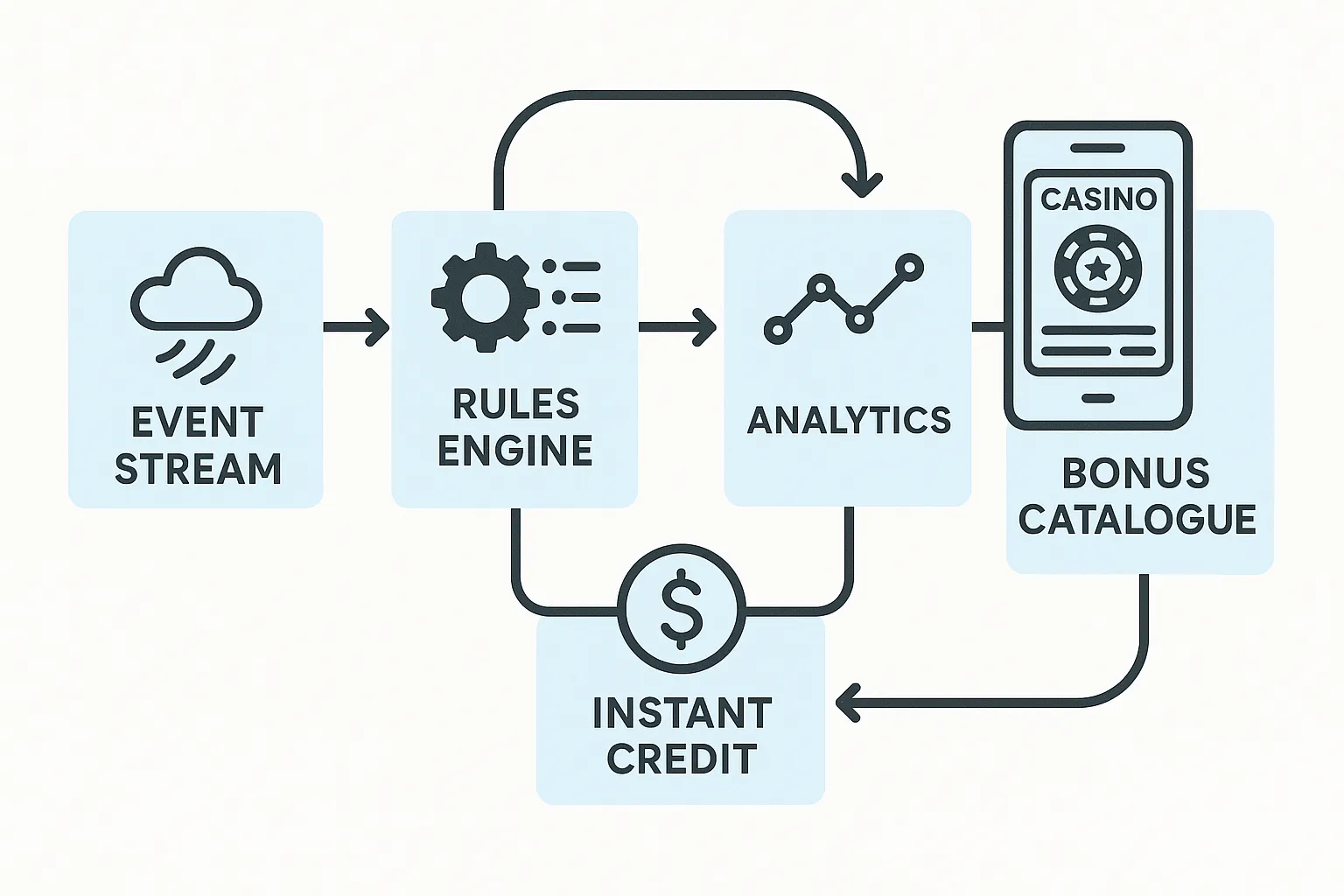
- Event Stream: Game rounds, deposits, withdrawals, and KYC updates publish to Kafka/Pulsar topics.
- Rules Engine: Real-time logic scores each player against offer requirements (RTP preference, lifetime value, RG flags).
- Dynamic Catalogue: Eligible offers are assembled with live inventory counters and localised text.
- Redemption: Player taps Claim; the cashier locks funds (if deposit-matched) and writes a ledger entry.
- Tracking & Settlement: Wagering progress updates; on completion the system auto-releases winnings or clawbacks.
- Analytics Loop: Results feed dashboards for optimisation (see Real-Time Analytics in iGaming).
Core Building Blocks You’ll Need
- Modular Bonus Engine
- Supports percentage match, tiered reload, free spins, cashback, quests.
- No-code rule editor so CRM teams—not devs—create offers.
- Real-Time Player 360
- Unified profile with game affinity, payment habits, risk score, device graph.
- Inventory & Throttling Layer
- Global or segmented caps (e.g., 5,000 free-spin bundles per day).
- Dynamic Wagering Calculator
- Adjusts requirements on the fly by volatility or margin.
- Compliance Guardrails
- Jurisdiction tags, RG status, self-exclusion, age checks.
- Self-Service UI Components
- React/Vue widgets or Web Components that drop into web and native wrappers.
- API & Webhook Fabric
- For marketing tools, ESPs, affiliate portals, and external game servers.
Spinlab’s Fullhouse platform ships most of these out of the box—bonus rules, inventory limits, jurisdiction flags, and open APIs—so operators can prototype a marketplace without months of custom code.
Designing a Marketplace UX That Converts
- Home Tab or Separate Hub? Early testing suggests a dedicated Rewards tab drives higher engagement than burying offers in the cashier, but A/B it.
- Above-the-Fold Filters: Game type, deposit size, wagering multiple—let users narrow quickly.
- Live Counters: “423/1,000 bundles left” triggers urgency; keep it honest to avoid regulator backlash.
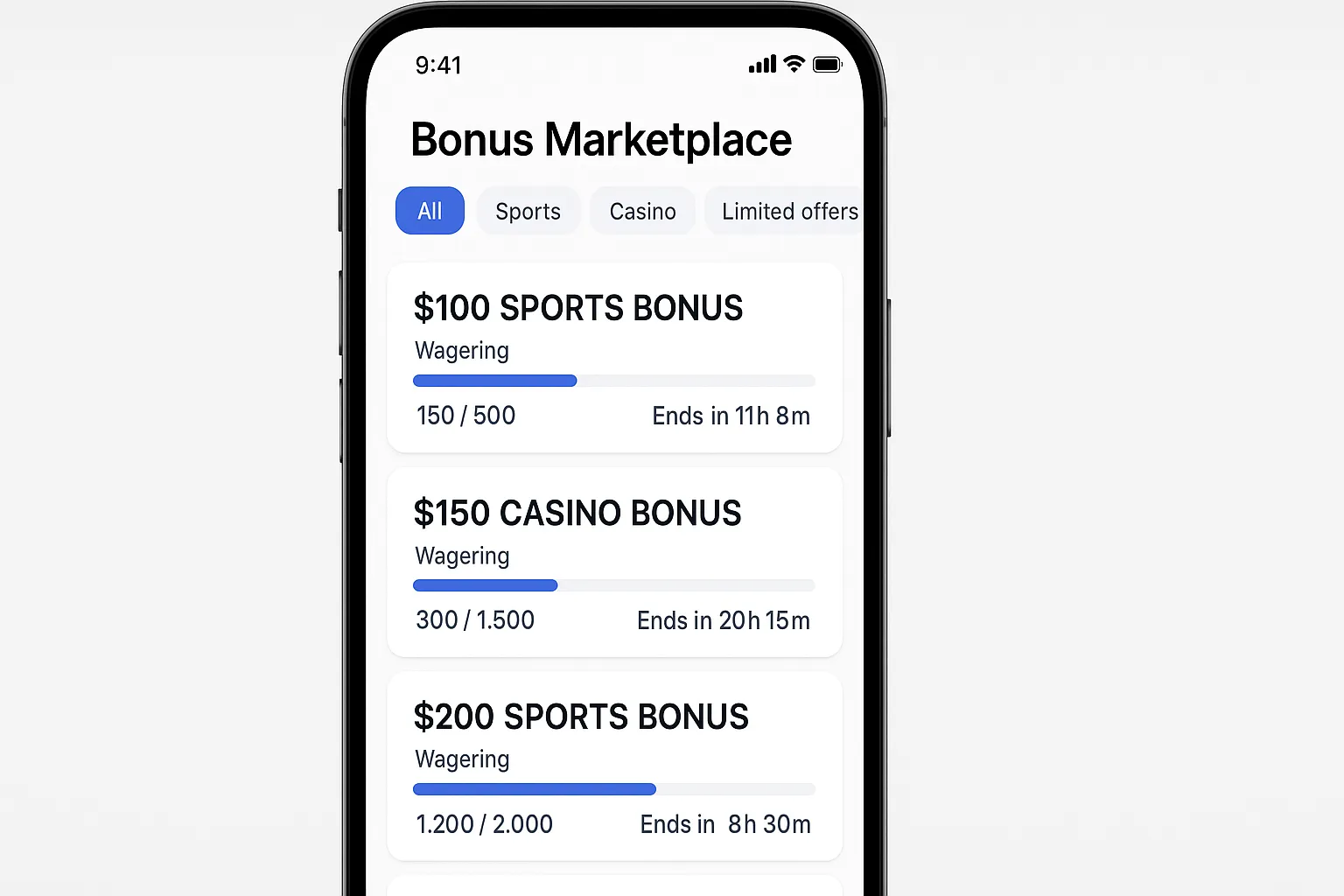
- Progress Visuals: A ring or progress bar showing wagering completion is more motivating than small text.
- One-Click Auto-Deposit: Pre-fill the cashier with the required amount when the user claims a deposit-match offer.
- Localised Copy & Currency: Display wagering in the player’s base currency and language. Spinlab’s LATAM lobby playbook covers fast localisation tactics.
KPI Framework to Measure Success
| Metric | Why It Matters | Benchmark (Marketplace vs Push) |
|---|---|---|
| Bonus Activation Rate | Claimed offers / displayed offers | 24 – 38 % vs 8 – 15 % |
| Wager Completion Rate | Completed / activated | 70 – 85 % vs 55 – 65 % |
| Net Gaming Revenue (promo-adj.) | Real profit impact | +6 – 12 % uplift |
| Bonus Cost-to-NGR | Promo cost / net gaming revenue | 18 – 26 % vs 30 – 40 % |
| RG Incident Rate | Breaches per 1k promos | -25 – 35 % |
| Support Tickets | Promo-related tickets per 10k MAU | -30 – 45 % |
Compliance & Risk Considerations
- Transparent T&Cs: Show wagering, expiry, max cash-out in the promo card—no hidden surprises.
- Age & Location Gates: Geofence restricted bonuses (e.g., free spins in DE) via IP and successful KYC only.
- Anti-Abuse Rules: Velocity checks, device fingerprinting, and deposit source mapping curb multi-accounting.
- Budget Locks: Daily promo spend caps enforced at engine level to avoid overspend by rogue operators or bugs.
- Audit Logging: Store immutable bonus state changes for regulator access (ISO 27001 logs + hash chains).
For a broader risk-control framework, review Spinlab’s guide on Building a Risk Matrix.
60-Day Implementation Roadmap
| Week | Milestone | Key Tasks |
|---|---|---|
| 1-2 | Tech Assessment | Map current bonus flows, identify data gaps, activate Spinlab Bonus API sandbox |
| 3-4 | MVP Rules & Catalogue | Set up 5-10 offers, configure eligibility filters, load translations |
| 5-6 | Front-End Integration | Embed React/Vue components, wire claim endpoint, QA on desktop/mobile |
| 7-8 | Soft Launch | Roll out to 10 % of traffic, monitor KPIs, A/B UI tweaks |
| 9-10 | Full Launch | Expand to 100 %, activate budget guardrails, enable affiliate deep-links |
| 11-12 | Optimisation Cycle | Analyse cohort data, refine pricing, add quests and streaks |
Case Snapshot: Fullhouse Casino
When Fullhouse migrated to Spinlab (see full scaling case study), it replaced weekly email codes with a bonus marketplace. Results after 90 days:
- Deposit Conversion: 17 % relative lift among new registrants.
- Promo Cost-to-NGR: Dropped from 34 % to 23 %.
- Support Tickets: –41 % promo-related inquiries.
- RG Flags: –29 % breaches due to real-time eligibility gating.
Beyond Bonuses: Bundling Missions & Loot Boxes
Once the core marketplace is live, consider layering missions (task-based challenges) and loot boxes (randomised rewards). Spinlab’s analysis in Gamification vs Traditional Loyalty shows that gamified elements can further push LTV by 15-40 % when combined with a bonus hub.
Ready to Build Your Marketplace?
Player choice no longer threatens margin—it protects it. By turning promotions into a real-time, self-service marketplace, operators drive higher retention, cut waste, and stay ahead of tightening compliance regimes.
Spinlab’s modular Bonus & Quest Engine, unified player wallet, and real-time analytics give you every building block described above without months of bespoke development. If you’d like to see a live demo—or benchmark your current promo cost-to-NGR against marketplace best-in-class—book a 30-minute session with our team today.