

Casino growth rarely comes from one giant change. It comes from hundreds of small decisions made at the right moment: which payment rail to show, which game tile to rank first, when to step up KYC, when to suppress an offer, and when to help a player before they abandon a session.
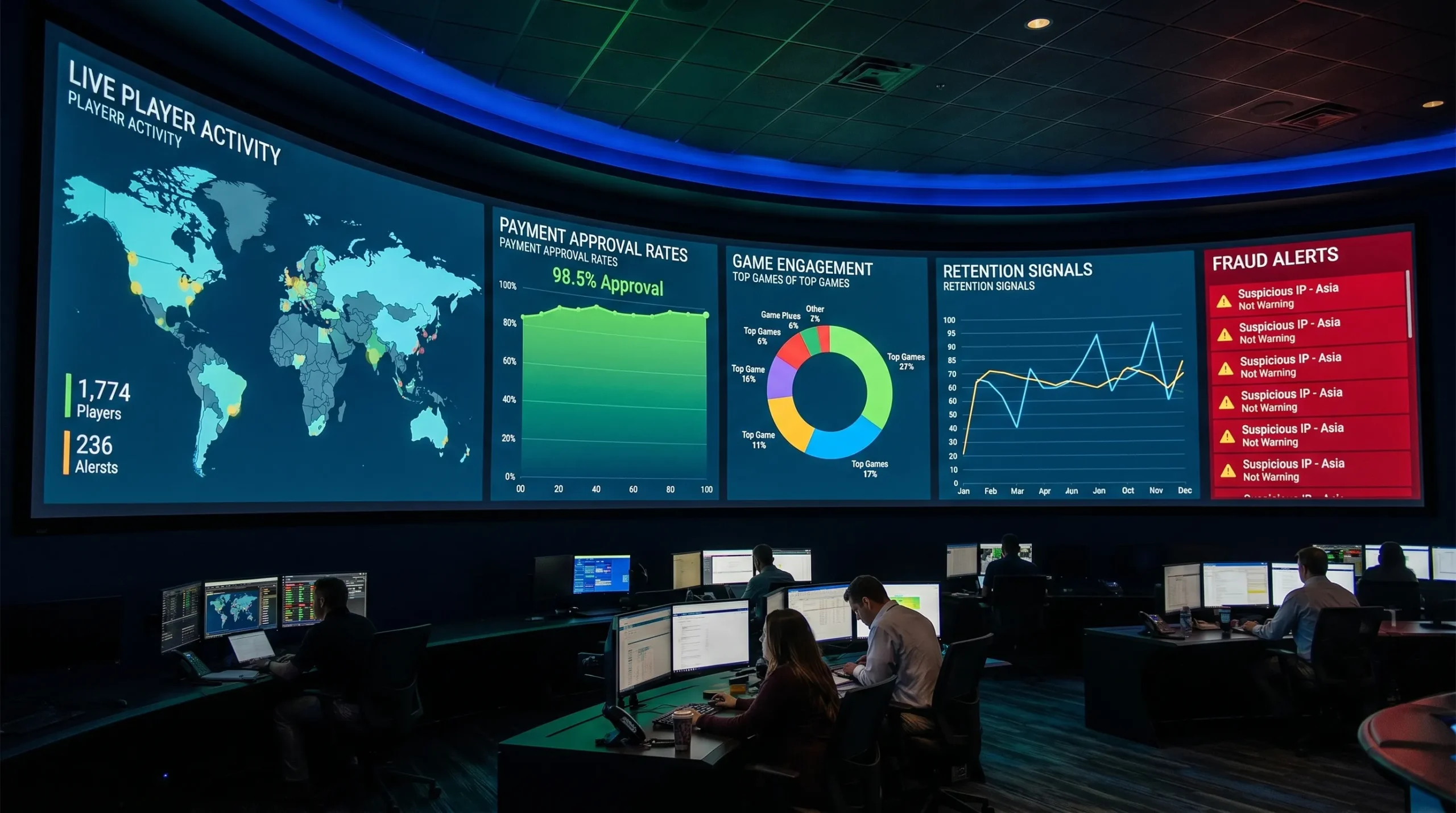
That is why real-time analytics has become a core growth capability for online casino operators. Static monthly reports can tell you what happened. Real-time analytics shows what is happening now, while there is still time to act.
For a modern iGaming platform, the value is not just a prettier dashboard. The real value is connecting live events from games, payments, bonuses, affiliates, KYC, fraud, and player behavior into faster growth decisions.
What real-time analytics means in online casinos
Real-time analytics is the ability to collect, process, and act on player and operational data within seconds or minutes. In a casino context, that data usually includes events such as registrations, KYC steps, deposit attempts, payment approvals, game launches, bets, bonus claims, withdrawals, affiliate clicks, device changes, and risk signals.
Not every decision needs millisecond latency. A live dealer stream issue may need an instant alert. A churn-prevention journey may be effective if triggered within the same session. A supplier ROI report may only need to refresh every few minutes. The key is that the data is fresh enough to influence the next operational action.
A useful real-time analytics setup has three layers:
- Live event capture from the player journey, cashier, game aggregator, wallet, bonus engine, affiliate system, and compliance tools.
- Decision-ready dashboards that show conversion, revenue, cost, and risk by market, channel, segment, provider, payment rail, and device.
- Activation workflows that trigger actions such as alerts, bonus eligibility, cashier routing, CRM messages, fraud reviews, and responsible gambling checks.
Without the activation layer, analytics becomes passive reporting. With it, analytics becomes a growth engine.
The casino growth equation real-time analytics improves
Casino growth is often discussed as traffic, deposits, and gross gaming revenue. Those matter, but they are not enough. Operators need to understand how revenue is created, where margin leaks, and which players or channels are profitable after bonuses, fees, fraud, and support costs.
A practical growth equation looks like this:
Qualified traffic x registration completion x first deposit conversion x retained player value x margin control = sustainable growth
Real-time analytics improves each part of that equation. It helps marketing teams acquire better traffic, product teams reduce friction, CRM teams retain players, and risk teams protect the margin that growth depends on.
| Growth lever | Key real-time signal | Example action | Business impact |
|---|---|---|---|
| Registration | Form errors, OTP failures, country mismatch | Fix the failing step or trigger assisted onboarding | Higher account creation rate |
| First deposit | Payment decline reason, rail availability, time to credit | Recommend another payment method or retry safely | Higher first-time depositor conversion |
| Game engagement | Lobby clicks, failed launches, time to first spin | Re-rank games or remove broken titles from priority positions | More sessions and wagers |
| Bonus efficiency | Offer claim, wagering progress, abuse signals | Adjust eligibility, caps, and targeting | Lower bonus waste |
| Retention | Session frequency drop, failed deposits, withdrawal friction | Trigger relevant, compliant reactivation journeys | Higher lifetime value |
| Risk control | Device clusters, AML flags, chargeback patterns | Step up checks or block high-risk actions | Better risk-adjusted NGR |
The best operators do not use analytics only to increase volume. They use it to increase profitable, compliant, risk-adjusted growth.
1. Faster onboarding and higher first deposit conversion
The first major growth benefit is activation. If a player registers but never reaches their first spin, the acquisition spend is wasted. Real-time analytics helps operators see exactly where new players stall.
For example, if mobile users from one market are failing at document upload, the issue may be KYC UX, file size, language, or vendor latency. If card deposits are failing for a specific issuer range, the problem may be routing, 3DS friction, or PSP configuration. If players reach the cashier but do not submit a deposit, the issue may be trust, payment method coverage, fees, or unclear bonus terms.
A static report might reveal the problem days later. Real-time analytics can surface it during the campaign, before thousands of paid clicks are lost.
Important activation metrics include:
- Registration start to completion rate
- KYC start to approval rate
- First deposit initiation rate
- First deposit approval rate
- Median time to playable balance
- Time to first spin
- Deposit abandonment by payment rail, currency, market, and device
This is especially important for operators running paid acquisition or affiliate campaigns. A campaign can look successful at the click level while failing at the funded-player level. Real-time analytics connects the marketing funnel to payment and product outcomes, so teams can stop low-quality traffic and double down on channels that create real value.
For deeper payment optimization, Spinlab has also covered casino payment orchestration for higher approval rates, which pairs naturally with real-time cashier analytics.
2. Smarter personalization without wasting bonus budget
Personalization is one of the clearest ways real-time analytics improves casino growth. Players differ by game preference, risk profile, payment method, bonus sensitivity, device, session timing, and value potential. Treating every player the same usually means overpaying some, under-serving others, and missing the right moment to engage.
According to McKinsey research on personalization, faster-growing companies generate 40 percent more of their revenue from personalization than slower-growing peers. In iGaming, the same principle applies, but operators need stricter guardrails because offers involve real money and regulated activity.
Real-time analytics enables personalization across several casino surfaces:
| Surface | What analytics observes | Growth action |
|---|---|---|
| Game lobby | Recent plays, skipped categories, volatility preference, device | Rank games more likely to get a click and first spin |
| Bonus engine | Offer history, deposit intent, wagering progress, bonus cost | Show targeted offers instead of blanket bonuses |
| Cashier | Currency, payment failures, preferred rail, country | Default to the best available deposit method |
| CRM | Session behavior, churn signals, failed deposit attempts | Trigger timely email, SMS, or in-app journeys |
| Affiliate reporting | Player quality, retention, fraud indicators by source | Adjust CPA or rev-share exposure |
The goal is not to push offers constantly. The goal is to match the player, the moment, and the margin. A high-value player who prefers live casino games may need a different journey than a casual slot player who deposits small amounts on payday. A crypto-first player may need clearer onramp messaging. A bonus-sensitive player may need lower-cost missions instead of a large match bonus.
Real-time analytics also helps operators avoid harmful or non-compliant personalization. If a player shows responsible gambling risk signals, offer suppression and protective messaging should take priority over promotion. Real-time systems should make those guardrails enforceable, not optional.
For operators focused on content ranking, see Spinlab’s guide to game lobby personalization and slot ranking.
3. Better retention through live churn signals
Retention is where real-time analytics often delivers the biggest long-term impact. Casino churn does not happen only when a player has been inactive for 30 days. It often starts earlier, with small behavioral signals that appear during normal play.
A player may fail a deposit twice, request a withdrawal and feel uncertain about status, stop launching a favorite game after repeated errors, lose interest after a bonus expires, or reduce session frequency after a negative experience. These moments are visible in event data long before the player disappears from the database.
Real-time retention analytics helps teams identify patterns such as:
- A player who usually plays three times per week has not returned after a failed deposit.
- A new depositor completed KYC but has not launched a game within the expected time window.
- A VIP has shifted from high-engagement sessions to short check-ins.
- A segment acquired from a specific affiliate has strong deposits but weak day-seven retention.
- A player repeatedly opens the withdrawal page but does not complete the request.
The response should be relevant and measured. Sometimes the right action is a helpful product message, not a bonus. For example, a withdrawal tracker can reduce support anxiety. A game launch failure can trigger a fallback recommendation. A deposit failure can trigger a safe retry path. A player showing risk signals should be excluded from promotional journeys.
This is the difference between retention and pressure. Good analytics helps operators build long-term relationships by solving friction, improving relevance, and respecting compliance boundaries.
4. Stronger game portfolio decisions
Game aggregation gives casinos a wide content library, but more games do not automatically mean more growth. Operators need to know which titles drive profitable engagement, which suppliers create technical friction, and which content works for each market.
Real-time game analytics can track:
- Game launch success rate
- Time to first spin
- Session length by title and category
- Bet frequency and average stake
- GGR and NGR by provider
- Bonus cost by game contribution rules
- RTP variance and unusual exposure patterns
- Lobby click-through rate by tile position
- Device-specific errors or latency
This helps teams make faster content decisions. If a newly released slot has strong lobby clicks but poor game starts, the issue may be loading speed or provider latency. If a live casino table performs well in one region but not another, localization or streaming performance may be the bottleneck. If a supplier has high GGR but also high fees and support issues, the true ROI may be weaker than the headline revenue suggests.
Real-time analytics also improves negotiations. Operators can use accurate data to evaluate fixed-fee game deals, revenue share terms, provider SLAs, and promotional commitments. Instead of relying on generic provider claims, the operator sees actual contribution to margin and retention.
For teams building the data foundation behind this, Spinlab’s guide to a casino analytics stack from events to profit actions gives a deeper architecture view.
5. Higher payment performance and lower margin leakage
Payments are one of the most important growth surfaces in an online casino. A player who cannot deposit cannot play. A player who does not trust withdrawals may not deposit again. A cashier with poor routing can quietly destroy acquisition ROI.
Real-time analytics helps operators monitor the cashier as a live revenue system. Instead of looking only at total deposits, teams can track approval rates, decline reasons, payment costs, retries, settlement delays, chargebacks, and reconciliation exceptions by provider and market.
This makes it possible to answer practical growth questions:
| Question | Why it matters |
|---|---|
| Which PSP is underperforming right now? | Prevents approval drops from becoming revenue losses |
| Which payment method converts best for first-time depositors? | Improves activation and marketing ROI |
| Are crypto deposits completing faster than fiat for a segment? | Supports better cashier defaults |
| Are withdrawals creating support tickets or churn? | Protects trust and repeat deposits |
| Are chargebacks rising from one campaign or affiliate? | Prevents margin loss before payout cycles |
Real-time cashier analytics is especially useful for multi-currency and crypto-ready casinos. Operators can compare fiat and crypto flows, track time to credit, monitor onramp completion, and detect failed webhook or ledger events quickly.
Spinlab’s modular iGaming platform includes crypto and fiat payment support, multi-currency capabilities, crypto onramp solutions, and real-time analytics, allowing operators to manage payments and performance inside a unified operational environment.
6. Growth protected by fraud, AML, and responsible gambling analytics
The fastest-growing casino is not always the healthiest one. If growth brings bonus abuse, chargebacks, AML exposure, or responsible gambling failures, the business can lose money and regulatory trust quickly.
Real-time analytics improves growth by protecting it. It helps risk and compliance teams identify suspicious behavior while decisions are still reversible.
Examples include:
- Multiple accounts using related devices, IP patterns, wallets, or payment instruments.
- Sudden deposit spikes followed by withdrawal attempts with little gameplay.
- Bonus claims clustered around one affiliate source or device group.
- Card testing patterns at the cashier.
- High-risk crypto wallet exposure or unusual transaction flows.
- Gameplay and deposit patterns that require responsible gambling intervention.
In regulated markets, operators are expected to monitor customer risk and intervene appropriately. The UK Gambling Commission customer interaction guidance is one example of how regulators increasingly expect operators to identify and act on risk indicators, not simply document them after the fact.
Real-time analytics supports this by making risk signals visible inside the same operational flow as growth metrics. A promotion engine should know when to suppress offers. A cashier should know when to step up verification. A support team should see relevant context. A backoffice should keep an audit trail of decisions.
This is why fraud prevention, KYC, AML, payments, and analytics should not be isolated tools. They need to work together.
The KPIs every operator should monitor in real time
A strong casino analytics dashboard should not overwhelm teams with vanity metrics. It should connect live signals to decisions. The table below is a practical starting point.
| Area | Primary KPI | Useful breakdowns | Action when it moves |
|---|---|---|---|
| Acquisition | Funded player rate | Affiliate, campaign, market, device | Pause poor traffic, increase high-quality sources |
| Registration | Completion rate | Step, error type, language, device | Fix UX friction or field validation |
| KYC | Approval rate and time to verify | Vendor, country, document type | Tune flows, add fallback, improve instructions |
| Deposits | Approval rate and time to credit | PSP, rail, BIN, currency, risk score | Route, retry, or escalate provider issues |
| Gameplay | Time to first spin | Game, provider, device, region | Re-rank or troubleshoot content |
| Bonuses | Bonus cost to NGR | Offer, segment, affiliate, game | Reduce waste, adjust eligibility |
| Retention | Day-one, day-seven, and day-thirty return | Segment, cohort, source, payment rail | Trigger compliant lifecycle journeys |
| Risk | Fraud-adjusted approval and loss rate | Rule, source, rail, geography | Tune controls and review queues |
| Support | Tickets per active player | Topic, payment method, journey step | Productize the biggest support drivers |
For leadership, one useful top-line metric is risk-adjusted NGR. Internal definitions vary, but a practical version is:
Risk-adjusted NGR = GGR minus bonuses, provider fees, payment costs, chargebacks, fraud losses, and support-heavy operational costs
This metric keeps teams honest. It prevents growth teams from celebrating volume that disappears through cost, abuse, or operational friction.
How to implement real-time analytics without creating dashboard chaos
Real-time analytics fails when teams instrument everything but decide nothing. The rollout should begin with business questions, not charts.
- Start with three growth decisions: Choose a few decisions that matter, such as improving first deposit conversion, reducing payment failures, and increasing day-seven retention. Build analytics around actions, not curiosity.
- Define a clean event taxonomy: Standardize events such as REGISTRATION_STARTED, KYC_APPROVED, DEPOSIT_INITIATED, DEPOSIT_APPROVED, GAME_LAUNCHED, BET_PLACED, BONUS_CLAIMED, WITHDRAWAL_REQUESTED, and RISK_FLAGGED. Consistent naming prevents reporting disputes.
- Stitch identity across the journey: Connect anonymous visits, registered accounts, devices, wallets, payment methods, affiliate IDs, and player IDs where legally permitted. Growth analysis breaks when identity is fragmented.
- Separate dashboards from alerts: Dashboards are for exploration. Alerts are for action. A payment approval drop needs an alert. A weekly content trend may only need a scheduled review.
- Connect analytics to operations: Insights should flow into cashier routing, bonus eligibility, CRM journeys, fraud queues, support tools, and backoffice workflows. Otherwise, teams still act manually and slowly.
- Use experiments and holdouts: Measure incrementality. A triggered offer may increase deposits but reduce margin. A lobby ranking change may lift clicks but hurt retention. Holdouts help prove what actually works.
- Add compliance guardrails early: Build suppression rules, audit logs, responsible gambling exclusions, and role-based access before scaling automation.
This approach keeps real-time analytics practical. The goal is not to become a data company for its own sake. The goal is to make better casino decisions faster.
What to look for in an iGaming platform with real-time analytics
If you are evaluating a white label casino platform or turnkey casino solution, analytics should be treated as a core operating system, not an add-on report.
Look for capabilities such as:
- Real-time dashboards across players, payments, games, bonuses, affiliates, and risk.
- Drilldowns by market, currency, payment rail, provider, campaign, device, and player segment.
- Event-level data that can be exported or accessed through APIs.
- Integration with the bonus engine, affiliate tools, fraud prevention, KYC, AML, and backoffice workflows.
- Audit logs and role-based permissions for sensitive operational decisions.
- Multi-currency and crypto-ready reporting for deposits, withdrawals, onramps, and wallet activity.
- Mobile-first performance monitoring, including onboarding and cashier friction.
Spinlab is built around this connected model. Its modular iGaming platform combines real-time analytics with game aggregation, crypto and fiat payments, fraud prevention, KYC and AML compliance, affiliate and bonus tooling, multi-currency support, and a customizable backoffice. For operators that want a Shopify-like way to launch and manage a casino brand, this reduces the gap between insight and action.
If you are still comparing platform options, Spinlab’s guide on how to choose a white label casino platform is a useful next read.
Common mistakes that limit analytics ROI
Real-time analytics can improve growth only if it is trusted and operationalized. The most common mistakes are predictable.
| Mistake | Why it hurts growth | Better approach |
|---|---|---|
| Tracking too many vanity metrics | Teams see activity but not profit | Focus on conversion, retention, margin, and risk |
| Using delayed or incomplete data | Issues are found after players leave | Prioritize live events for critical journeys |
| Keeping payments, CRM, and fraud data separate | Teams optimize one area while harming another | Use a unified player and event view |
| Triggering bonuses without guardrails | Bonus cost and abuse increase | Add eligibility, risk, and responsible gambling rules |
| Ignoring experiment design | Teams cannot prove causality | Use holdouts, cohorts, and pre-defined success metrics |
| Over-automating too early | Bad rules scale quickly | Start with alerts, then controlled automation |
The operators that win with analytics tend to be disciplined. They build fewer dashboards, but make them more actionable. They automate gradually. They combine revenue data with cost and risk data. Most importantly, they make analytics part of daily operations, not a report reviewed after the month closes.
Frequently Asked Questions
How fast does casino analytics need to be to count as real-time? For most growth use cases, analytics should refresh within seconds or a few minutes. Critical areas such as payment failures, fraud spikes, game outages, and responsible gambling alerts may need near-instant detection.
Which casino growth metric should operators improve first? Start with the highest-friction point closest to revenue. For many operators, that is first deposit conversion, deposit approval rate, time to playable balance, or time to first spin. Improving these often increases ROI across acquisition channels.
Can real-time analytics reduce bonus costs? Yes. By tracking offer eligibility, claims, wagering, player value, and abuse signals in real time, operators can target bonuses more precisely and suppress offers where the expected margin or compliance risk is poor.
Is real-time analytics only for large casinos? No. Smaller operators can benefit quickly because they often have less room to waste traffic or bonus spend. A modular platform with built-in analytics can make live reporting accessible without building a large data team.
How does real-time analytics support responsible gambling? It can identify risk indicators such as unusual deposit patterns, chasing behavior, rapid session escalation, or repeated limit interactions. The platform can then trigger interventions, suppress promotions, or route cases for review according to the operator’s policy.
Turn live casino data into controlled growth
Real-time analytics improves casino growth because it shortens the distance between signal and action. It helps operators convert more new players, personalize more responsibly, optimize game and payment performance, retain valuable cohorts, and protect margin from fraud and compliance risk.
Spinlab gives operators an all-in-one, modular iGaming platform with real-time analytics built into the operational stack. From game aggregation and crypto-ready payments to KYC, AML, fraud prevention, bonuses, affiliates, and backoffice control, Spinlab helps casino teams move from reporting what happened to acting on what is happening now.
Explore Spinlab at spinlab.studio and see how a modern white label casino platform can help you launch, optimize, and scale with live data at the center of every growth decision.
Solid platform with very stable servers. No crashes during big wins which is the most important part for me. ph666zk
I really enjoy spending my free time here. The games are smooth and the payouts are surprisingly fast. Highly recommended for everyone! ph63ph
Best experience so far! The interface is very user friendly and I had no issues with my registration. Five stars for sure. ph633ph