

Payment failures are one of the few iGaming problems that hit revenue, compliance, and player trust at the same time. A declined deposit is not just a lost transaction, it is often a lost first-time depositor, a support ticket, and a downstream retention problem. Worse, many “payment failures” are not actually payment problems, they are identity, risk, routing, or ledger-state problems that only show up in the cashier.
This guide breaks down the most common causes of payment failures in iGaming (cards, APMs, and crypto), how to diagnose them quickly, and the fixes that consistently move approval rates and time-to-credit in the right direction.
Start by defining “payment failure” (because fixes depend on the stage)
Operators often treat anything that ends with “Deposit failed” as one bucket, but failures cluster by stage. If you do not label failures by stage, you cannot route them to the correct owner (payments, fraud, KYC, devops, backend, PSP) or pick the right experiment.
Here is a practical failure taxonomy you can implement without rebuilding your stack.
| Stage | What players see | Typical root cause domains | What you need to log to fix it |
|---|---|---|---|
| Method selection | “My method isn’t available” | Geo rules, currency, KYC state, PSP coverage | Player geo, currency, KYC tier, method eligibility decision |
| Initiation | “Something went wrong” before redirect/wallet | Frontend errors, SDK issues, bot blocks | Client error, request ID, WAF/bot decision, device/network info |
| Authorization | “Declined” or “3DS failed” | Issuer declines, 3DS/SCA, fraud rules, acquirer config | Decline reason bucket, 3DS outcome, BIN, acquirer/PSP, risk score |
| Pending | “Pending” too long | APM async states, webhook loss, bank processing delays | Provider status timeline, webhook receipt, polling fallback, TTL rules |
| Credit to casino wallet | “Paid but balance not updated” | Ledger mapping, idempotency bugs, callback ordering | Ledger entry IDs, idempotency keys, event ordering, reconciliation links |
| Settlement or chargeback later | “Reversed” days later | Chargebacks, reversals, AML holds, negative balances | Dispute events, evidence pack pointers, AML case ID, reserve logic |
If you only do one thing after reading this article, do this: tag every cashier attempt with a stage and a reason bucket that can be aggregated daily.
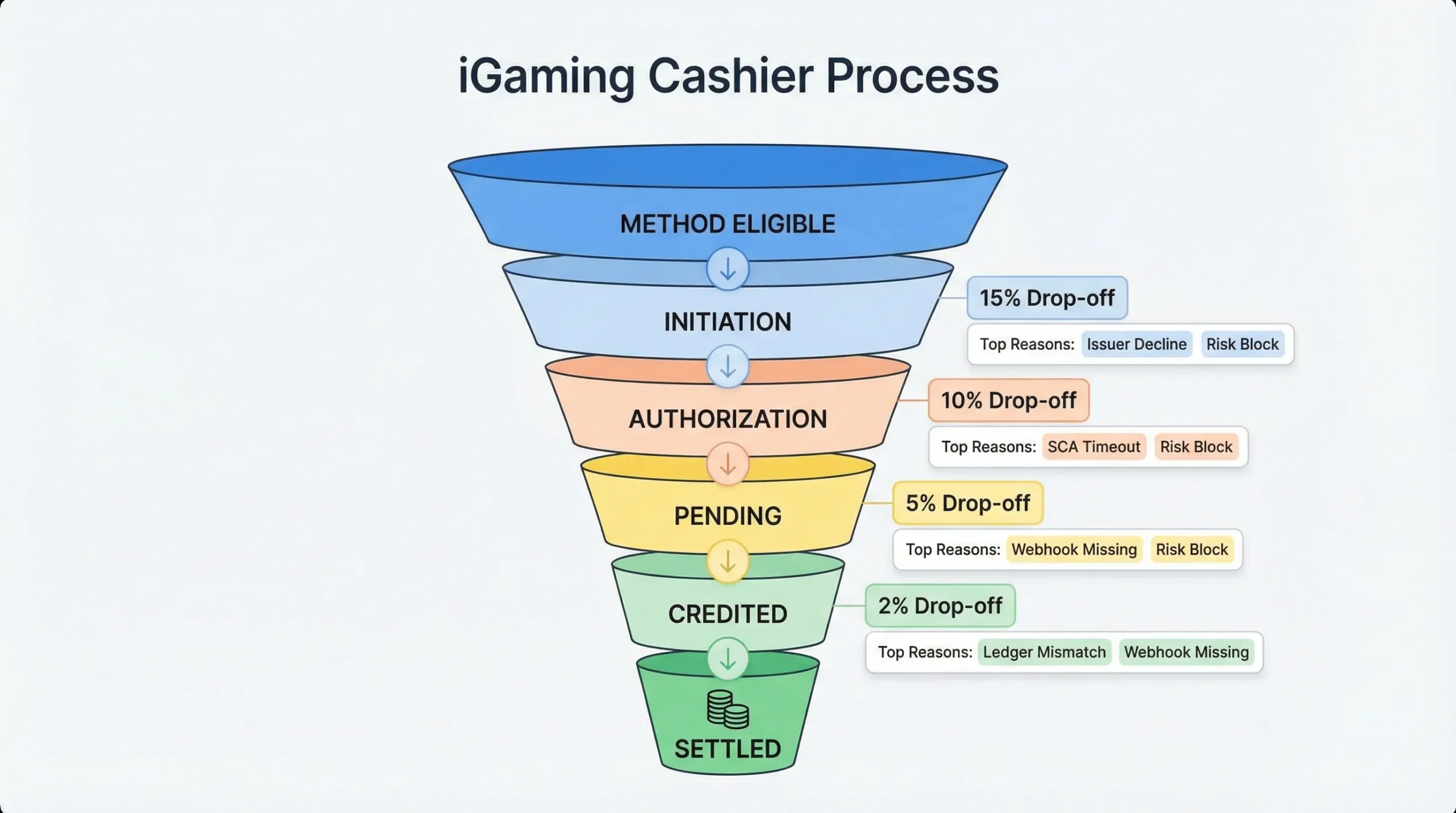
Top causes of payment failures in iGaming (and how to fix each)
1) Issuer declines and “false declines” on cards
Card declines are not one problem, they are many. In iGaming, issuers often apply conservative controls because of fraud and dispute risk. That creates a large class of declines where the player is legitimate but the issuer blocks anyway.
Common causes
- Issuer risk models flag gambling MCC patterns, especially for cross-border traffic.
- Poor local acquiring coverage (issuer does not like the acquiring country or route).
- Descriptor mismatch, brand unfamiliarity, or abrupt first deposit size.
- Excessive retries that look like card testing.
Fixes that work
- Local-first routing: route by BIN country and currency to a local acquirer where possible.
- Controlled cascading: retry to a second PSP only for specific soft-decline buckets and only once or twice. Blind cascading can increase declines and fraud flags.
- Network tokenization and account updater where supported by your PSPs (reduces failures on stored cards).
- Clean retry UX: suggest alternatives after one failed attempt, do not encourage rapid-fire retries.
If you want a deeper routing framework (signals, guardrails, and KPIs), Spinlab’s primer on casino payment orchestration is a useful companion.
2) 3DS/SCA friction, step-up loops, and timeouts
Strong Customer Authentication can raise approval rates when implemented well, but it can also create failures that look like “payment declined.” In iGaming, the user is often on mobile, in-app browsers, or unstable networks, which makes challenge flows fragile.
Common causes
- Challenge pages failing to load in embedded webviews.
- Excessive step-up triggered by your own risk rules (you force 3DS, issuer forces 3DS again).
- Players abandon because the cashier does not explain what is happening.
Fixes that work
- Prefer frictionless 3DS for low-risk cohorts, and reserve challenges for genuinely elevated risk.
- Add a clear pending state with an explicit timer and guidance (“You may need to approve in your banking app”).
- Implement return-path hardening: deep links back to the cashier, robust session restoration, and explicit “resume payment” support.
3) PSP configuration errors and “it works in staging” failures
Many payment failures are self-inflicted by configuration drift or mismatched assumptions.
Common causes
- Wrong environment keys, webhook secrets, or callback URLs after a release.
- Currency mappings and amount formatting errors (minor units, rounding, FX conversions).
- Incorrect MCC, mid, or risk profile settings at the PSP.
Fixes that work
- Add configuration health checks to your release pipeline (webhook reachability, signature verification, test auth).
- Use idempotency keys for payment creation, authorization, and ledger crediting.
- Version your payment adapters like an API, and use canary deployments for cashier changes (Spinlab’s approach to safe wallet rollouts is covered in their post on canary releases for iGaming wallet code).
4) Fraud prevention blocks that are too aggressive
In iGaming, fraud controls are non-negotiable, but it is easy to overshoot and create a conversion-killer.
Common causes
- Velocity rules that punish legitimate behavior (multiple attempts during a network hiccup).
- Device and IP rules that are too coarse for mobile carriers and NAT.
- Bot defenses that break payment SDKs.
Fixes that work
- Shift from binary blocks to graduated actions: allow, step-up (3DS, extra verification), delay, manual review.
- Measure false positives explicitly: approved later via alternative rail, support-confirmed legitimate, or successful after KYC.
- Treat card testing separately from real-player deposits. A focused defense can reduce collateral damage (see Spinlab’s playbook on preventing card testing attacks).
5) KYC and AML gating at the wrong moment
Some operators block deposits too early, others allow deposits and then surprise users at withdrawal. Both approaches can cause “payment failures,” either directly or via support escalation.
Common causes
- KYC required but messaged as a payment problem.
- AML policies applied inconsistently across rails (fiat vs crypto).
- Manual review queues become a bottleneck, turning real-time payments into “pending forever.”
Fixes that work
- Use progressive verification: allow low-risk deposits with limits, then step up KYC based on thresholds.
- Make the reason explicit in the cashier (“Verification required before you can deposit”), not “Transaction failed.”
- Track time-in-queue for compliance reviews as a payments KPI because it affects deposit conversion.
6) Asynchronous APM payments stuck in “pending”
APMs like bank transfers, pay-by-bank flows, and some e-wallets have asynchronous states. The payment may be authorized externally, but your platform does not receive the callback or fails to reconcile it.
Common causes
- Webhook delivery failures, signature verification bugs, or callbacks blocked by WAF rules.
- Missing polling fallback for providers that are not webhook-reliable.
- Cashier UX with no expectation setting.
Fixes that work
- Implement a webhook + polling hybrid: webhooks for speed, polling for correctness.
- Build a payment state machine with a strict TTL (time-to-live) and clear auto-expiry rules.
- Provide a player-facing “payment tracker” (this same pattern reduces withdrawal tickets too, as described in Spinlab’s guide on reducing withdrawals support tickets).
7) Crypto-specific failures (wrong chain, missing memo, confirmations, KYT)
Crypto is fast when everything is aligned, but crypto failures tend to be brutally confusing for players.
Common causes
- Deposits sent on the wrong network (for example, sending an asset via an unsupported chain).
- Missing memo/tag for exchanges.
- Chain congestion or finality delays.
- On-chain risk scoring flags funds, triggering manual review.
Fixes that work
- In the cashier, show chain selection as a first-class choice, not hidden text.
- Make memo/tag impossible to miss, and allow easy copy actions.
- Show a real-time confirmation tracker and expected time-to-credit per chain.
- Define a transparent policy for what happens when KYT flags a deposit (hold, review, refund) and message it consistently.
If you operate a hybrid cashier (fiat + crypto), make sure your ledger and custody model can handle both without reconciliation chaos. Spinlab positions its platform as crypto-ready with integrated payments, compliance, and merchant custodial wallets, which is the kind of consolidation that tends to reduce “lost deposit” incidents caused by disconnected systems.
8) Ledger and wallet crediting bugs (the most expensive “payment failure”)
A payment can succeed at the PSP and still fail for the player if the casino wallet is not credited correctly. These incidents have outsized reputational impact.
Common causes
- Missing idempotency on credit events, leading to duplicates or suppressed credits.
- Race conditions between authorization, capture, and wallet crediting.
- Partial failures during retries (PSP succeeded, your service timed out).
Fixes that work
- Design for exactly-once wallet crediting even when upstream is at-least-once (use idempotency keys and a durable event log).
- Store a complete payment timeline that support can see in one screen.
- Add automated “gap detectors” that alert when PSP success has no corresponding ledger credit after X minutes.
9) Cross-border, FX, and amount formatting issues
Global iGaming growth multiplies failure modes. Multi-currency support is not only about showing prices in local currency, it is about correct minor units, FX, and provider capability.
Common causes
- Minor-unit bugs (for example, treating cents as dollars).
- Unsupported currency at a specific provider route.
- FX rate mismatches causing settlement discrepancies.
Fixes that work
- Maintain a currency capability matrix per PSP, per method, per jurisdiction.
- Validate amount formatting at the boundary with contract tests.
- Reconcile daily by currency and rail, not just in aggregate.
10) Operational failures: reconciliation, reserves, and “mysterious reversals”
Some payment failures appear days later as negative balances, reversals, or settlement mismatches. This often becomes a finance and compliance fire drill.
Common causes
- PSP reports do not match ledger states (timing differences, chargebacks, refunds, partial captures).
- Dispute windows and reserves are not modeled into available balance.
Fixes that work
- Implement a three-way reconciliation: ledger vs PSP vs bank statements, with an exception queue.
- Treat reconciliation as a product surface: it reduces support load and protects against fraud losses.
Spinlab has a detailed operator-focused walkthrough of casino payments reconciliation that maps common mismatch patterns and the minimum data model needed.
A fast diagnostic workflow for payment failures (what to check first)
When payments break, teams often jump to “PSP is down” or “fraud is blocking.” A faster approach is to answer a short sequence of questions.
Check 1: Is it localized or global?
Look at failure rate deltas segmented by:
- Method (card vs APM vs crypto)
- PSP route and acquirer
- Country, currency, and BIN country
- App version, device type, and network ASN
A global spike usually points to your own release, shared infrastructure, or a PSP outage. A localized spike usually points to routing, issuer behavior, or geo rules.
Check 2: Is it a stage shift or a reason shift?
If method eligibility is fine but authorization drops, it is likely routing, issuer, 3DS, or risk. If authorization is fine but crediting drops, it is likely ledger, callbacks, or idempotency.
Check 3: Are you losing callbacks?
Webhook failures are disproportionately common in iGaming because cashiers sit behind WAFs, bot tools, and strict TLS. Validate:
- Webhook receipt rates
- Signature verification failures
- Retry counts and dead-letter queues
Check 4: Are you over-blocking real players?
Overlay payment failures with:
- Risk score distribution
- Step-up rates (3DS challenge, manual review)
- Support-confirmed legitimate cases
If risk blocks rise sharply, review recent rule changes and velocity thresholds.
The KPI set that actually helps you reduce failures
Teams often monitor only “approval rate.” You need a small set of KPIs that separate payment performance from risk and compliance.
| KPI | Why it matters | What to segment by |
|---|---|---|
| Deposit initiation rate | Detects UX and eligibility issues | Country, device, method |
| Authorization approval rate | Core revenue lever | BIN country, route, issuer bucket |
| 3DS challenge rate and completion | Measures SCA friction | Issuer, device, webview vs browser |
| Time-to-credit (median, P95) | Correlates with abandonment and tickets | Method, PSP, chain (crypto) |
| Pending timeout rate | Detects async state failures | Provider, callback health |
| False-decline recovery rate | Shows routing and UX effectiveness | Method, cohort, retry path |
| Manual review rate | Measures compliance and fraud workload | Geo, method, amount band |
| Chargeback rate and win rate | Long-term cost control | BIN, affiliate source, route |
A practical tip: tie alerts to change over baseline, not absolute numbers. What matters operationally is when something shifts.
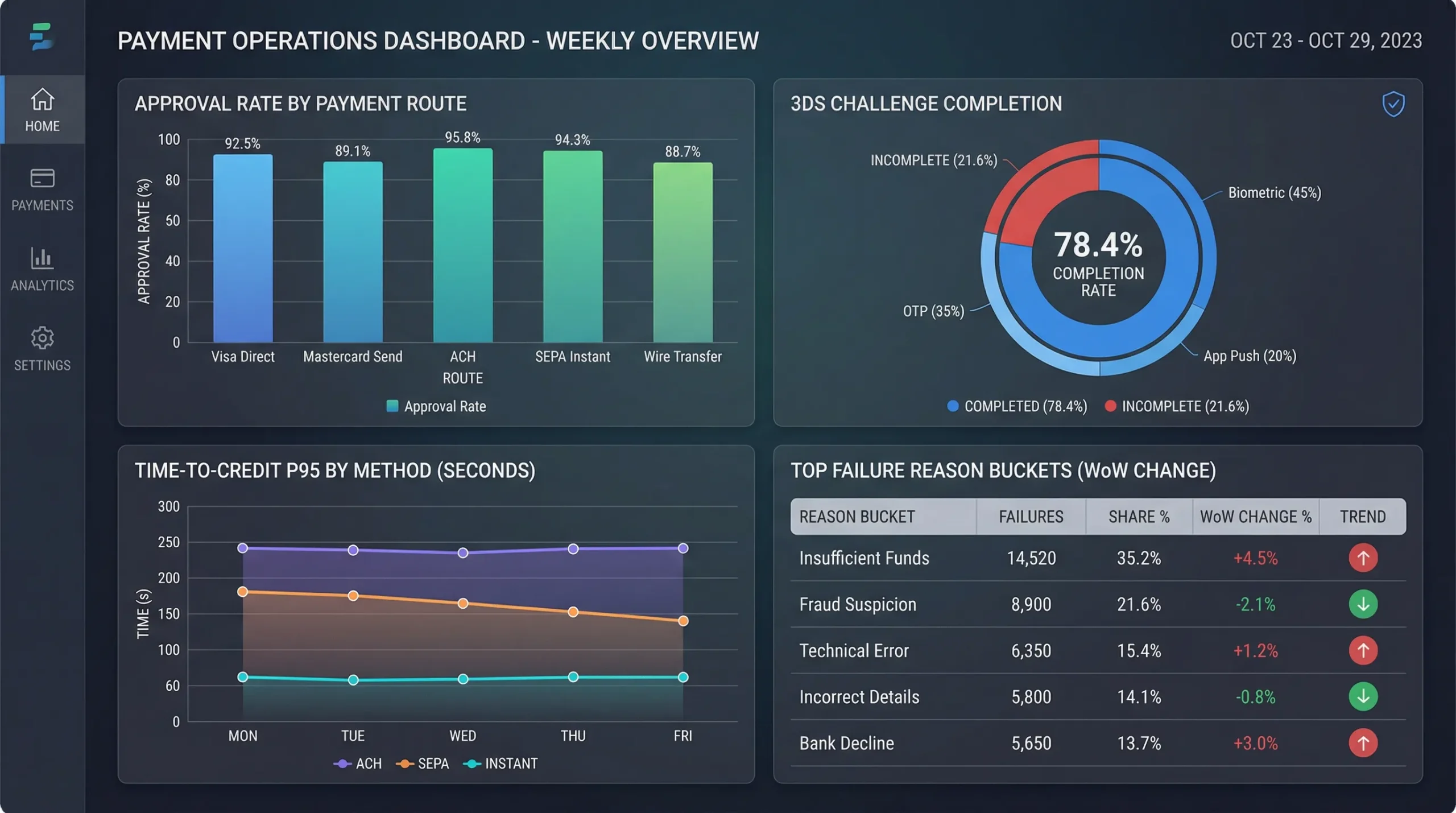
Fix patterns that improve approval without increasing risk
Payment fixes are often trade-offs. The goal is not “more approvals at any cost,” it is more net approvals that survive disputes and compliance scrutiny.
Use “rail switching” in the UI, not just behind the scenes
If a card attempt fails, do not only cascade invisibly. Offer an alternative method that fits the player’s context (local APM, pay-by-bank, crypto) and prefill what you already know. This is one reason APM coverage matters beyond “more logos in the cashier.”
Build a reason-aware retry strategy
Retries should differ by failure bucket:
- Soft decline: allow one retry with a different route, or ask for 3DS.
- Hard decline: do not loop, suggest a different rail.
- Pending: provide a tracker and a “resume” action, not a new payment.
Make payments observable end-to-end
“PSP says success” is not enough. You need traceable links from:
- Cashier attempt ID
- PSP transaction ID
- Webhook event IDs
- Ledger entries
- Reconciliation line items
This is where integrated platforms tend to win operationally: fewer joins across systems, fewer missing IDs, faster incident resolution.
A quick note on learning from other industries
High-risk, high-velocity commerce sectors outside iGaming fight similar battles around declines, fraud, and fulfillment mismatches. For example, liquidation marketplaces selling bulk pallets for sale have to balance payment acceptance with fraud prevention and post-payment operational verification. The lesson that carries over is simple: instrument the full lifecycle, not just the authorization event, and treat operational proof (delivery, settlement, reconciliation) as part of the payment system.
How Spinlab approaches payment failures (without pretending there is a single “magic” fix)
Payment reliability is usually the result of a few platform capabilities working together:
- A modular cashier that can support fiat and crypto and switch rails when a route underperforms.
- Built-in KYC and AML gating that is explicit in UX (so compliance does not masquerade as payment failure).
- Fraud prevention that supports step-up flows instead of blanket blocks.
- Real-time analytics so you can see approval, pending, and time-to-credit shifts quickly.
- A wallet and ledger model that can handle multi-currency and crypto flows without crediting gaps.
Spinlab Studio positions its offering as a cost-effective, Shopify-like white label casino platform with integrated payments, compliance, analytics, and game aggregation. If you are currently stitching together PSPs, KYC vendors, risk tools, and a separate wallet, consolidating those boundaries is often the fastest way to reduce payment failures that come from missing callbacks, mismatched IDs, and inconsistent policy enforcement.
What to do in the next 14 days (a realistic improvement sprint)
You do not need a full replatform to reduce payment failures. A two-sprint plan can produce measurable lift.
Sprint 1: Instrumentation and reason buckets
Deliverables:
- Stage tagging (eligibility, initiation, authorization, pending, credited)
- 10 to 20 reason buckets that your teams agree on
- A daily dashboard segmented by method, PSP route, geo, and device
Sprint 2: Fix the top two buckets and add one recovery path
Examples of high-ROI combinations:
- Reduce 3DS timeouts on mobile plus add rail switching.
- Fix webhook reliability plus add polling fallback for pending APMs.
- Tune velocity rules plus implement step-up instead of blocking.
If you run this like an experiment, track not only approvals, but also chargebacks, manual review load, and support tickets. In iGaming, “payment success” is only real if it remains true after settlement and disputes.
Smooth registration and very intuitive navigation. I love how easy it is to manage my account and place bets without any lag. bdmacibet
This place has a great vibe and the gaming options are top notch. I feel like a real high roller whenever I play here. Cheers! cljuegaconelking
No more login issues! The access is stable and the security feels solid. I can get straight to the action without any hassle. pk66login