

Responsible gambling is no longer a “compliance page” problem. In 2026, it is a product problem, a data problem, and for many operators, a license retention problem.
Regulators increasingly expect controls that are discoverable, usable, enforceable, and provable. Players expect tools that feel respectful and helpful, not patronizing or easy to bypass. And operators need patterns that reduce harm without quietly destroying conversion.
This article is a practical pattern library: product and engineering building blocks you can implement across onboarding, payments, gameplay, CRM, and VIP operations so responsible gambling becomes a measurable system, not a set of disclaimers.
What “responsible gambling by design” means in 2026
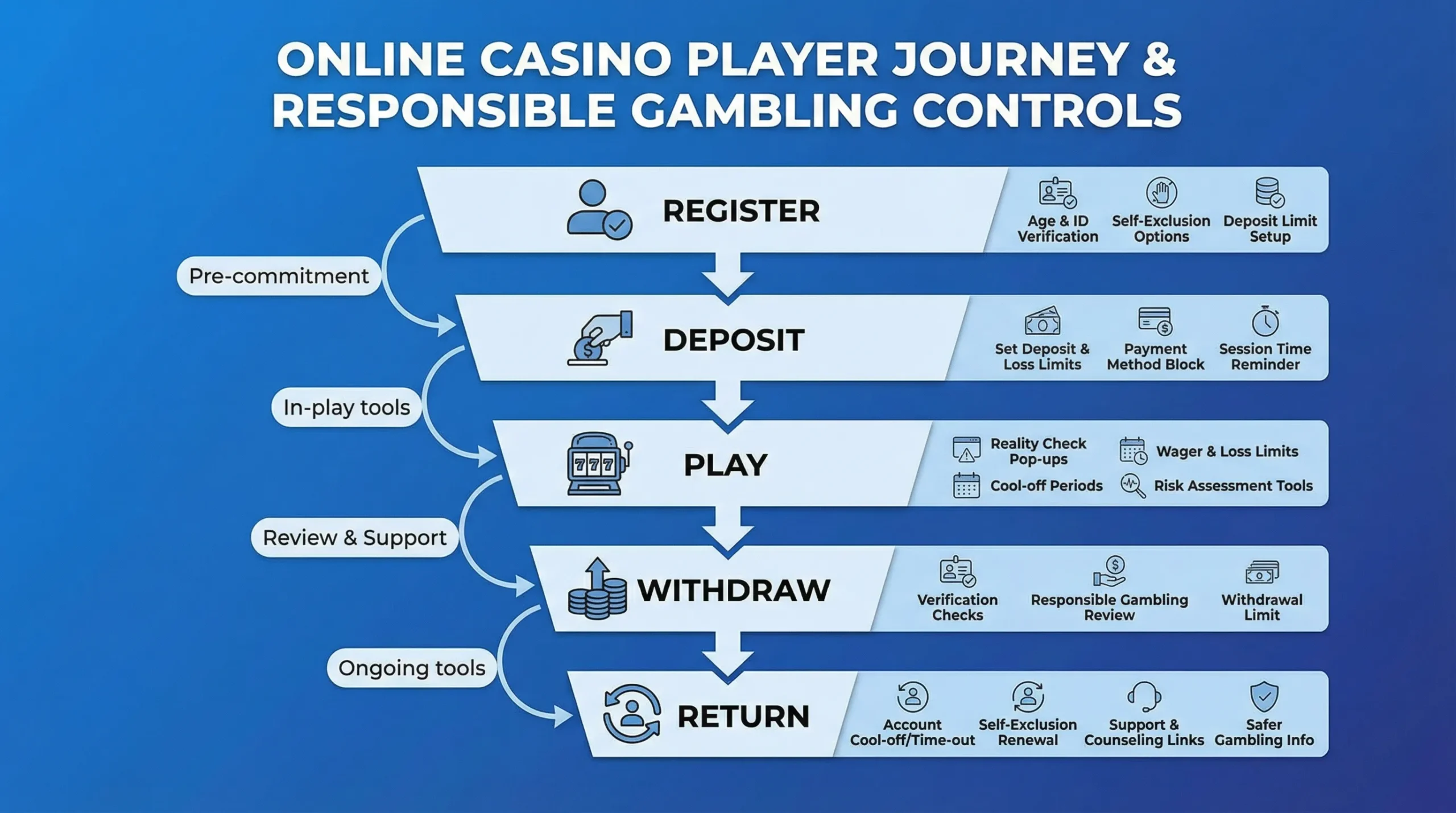
“By design” means responsible gambling (RG) is embedded into the same surfaces you already optimize: registration, cashier, bonuses, in-session UX, and lifecycle messaging.
In practice, it changes three things:
- Defaults and discovery: players can find and set limits early, not only after a problem.
- Closed-loop enforcement: a limit is not a suggestion, it is enforced across wallet, bonuses, and game sessions.
- Evidence and auditability: every intervention and player choice is logged with enough context to defend decisions.
If you are operating across multiple jurisdictions, “by design” also implies policy-as-code. The rules vary by market, but your implementation should be consistent and testable.
The 2026 pressure stack: why product teams are being pulled in
Even if your compliance team “owns” RG, the systems that make it real are product and platform systems:
- Faster rails and instant payouts raise the need for real-time guardrails, because time buffers disappear.
- Open banking and pay-by-bank can introduce affordability style signals and better identity assurance in some markets (used carefully and lawfully). If you are exploring open banking deposits, see Spinlab’s perspective on how open banking transforms casino deposits.
- Crypto rails can reduce chargebacks, but they also change player risk, particularly around speed, volatility, and self-custody withdrawals. RG controls must work for both fiat and crypto flows.
- Personalization and AI (recommendations, offers, VIP automation) increase the expectation that you can also personalize safety, not only monetization.
The takeaway: RG is now intertwined with your cashier orchestration, real-time analytics, bonus engine, and messaging stack.
The Responsible Gambling Pattern Library (ship-ready for 2026)
Below are 10 patterns that consistently show up in “good” RG implementations. The goal is not to copy paste every pattern, but to assemble a coherent set that fits your player mix, licensing footprint, and risk posture.
Pattern 1: Limit setting that is early, optional, and re-surfaceable
Most operators bury limits in settings. The better approach is to present limits as a normal part of setup, while keeping it friction-light.
Implementation notes:
- Offer deposit limits, loss limits, wager limits, and session time limits in one place.
- Ask at onboarding, but also re-surface after meaningful moments (first deposit, first withdrawal, big win, extended session).
- Keep copy neutral and practical (for example “Set your play budget”).
Key metric: limit adoption rate, and the percent of limit setters who remain active after 30 days.
If you want one high-leverage subcomponent, start with alert UX. Many teams get better results by improving the design, timing, and actions in alerts. Spinlab has a dedicated guide on designing loss-limit alerts that players don’t ignore.
Pattern 2: Reality checks that create a decision, not a notification
A “you have been playing for 60 minutes” toast is easy to dismiss and easy to ignore. A reality check should produce a micro-decision.
Better reality check template:
- State time and net result (when allowed): “60 minutes played. Net: -$42.”
- Offer 2 to 3 actions: “Take a break”, “Set a limit”, “Continue”.
- Require a confirmation click, not just a fade-out.
Key metric: break uptake rate, and session continuation rate after the prompt.
Pattern 3: Cool-off and self-exclusion that are truly enforced
Players and regulators will judge you by enforcement, not by whether the button exists.
Enforcement means:
- All entry points respect the state (web, PWA, mobile, API clients).
- Marketing suppression is automatic (email, SMS, push, affiliates where applicable).
- Withdrawals and remaining balances follow your jurisdictional policy consistently.
Operational note: treat self-exclusion as a state machine, not a boolean. You need “requested”, “confirmed”, “active”, “expired”, “revoked (if permitted)”, plus evidence logs.
Pattern 4: RG-aware cashier UX (especially for fast rails)
Many harm escalations start in the cashier. The 2026 standard is a cashier that can apply contextual friction without feeling broken.
Tactics that work:
- Show net spend today/week/month inside the deposit flow.
- Add “Set limit” as a secondary action near the deposit CTA, not hidden in settings.
- Use step-up checks for high-risk moments (rapid redeposits, late-night spikes, repeated failed deposits).
If you already do payment orchestration, RG becomes another routing input (not for “approval”, but for “allowed”). See Casino payment orchestration 101 for the broader orchestration model.
Pattern 5: Bonus guardrails that prevent “harm by promotion”
Bonuses and quests can unintentionally incentivize loss chasing and time-on-device. In 2026, the expectation is that promo tooling includes built-in RG controls.
Practical guardrails:
- Block or reduce bonus eligibility for players in cool-off, self-exclusion, or high-risk states.
- Avoid “just missed it” mechanics immediately after loss spikes.
- Add transparent wagering terms and enforce them consistently (clear terms also reduce payments disputes). Spinlab covers this angle in casino bonus terms that prevent abuse and chargebacks.
Key metric: promo-driven net revenue measured with RG guardrails as a constraint (more on measurement below).
Pattern 6: Risk scoring that is explainable and operational
A black-box “problem gambling score” that nobody trusts will get turned off the first time VIP complains.
A usable approach in production is a hybrid:
- Deterministic flags (for example rapid redeposits, large net loss in short window).
- A simple scoring model that weights multiple signals and updates in near real time.
Keep it explainable. Your backoffice should show “why” a player is flagged, with the top contributing events.
If you are already building risk-based monitoring for compliance, you can reuse the architecture patterns (event streams, queues, tuning). Related: AML for iGaming: risk-based monitoring that scales.
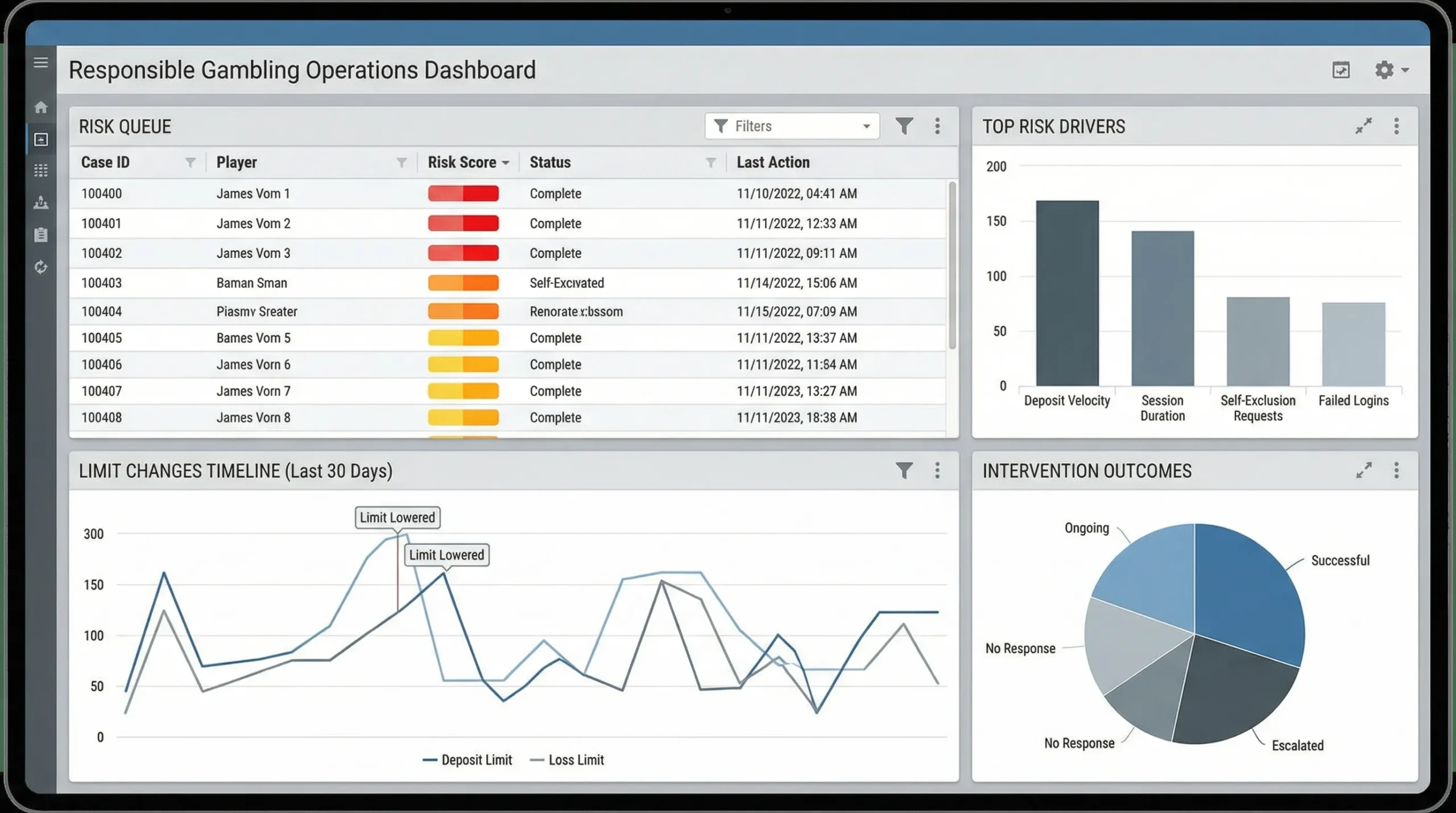
Pattern 7: Human-in-the-loop workflows (case queues with SLAs)
Some RG decisions should be automatic (limits, cool-offs). Others should be reviewed (VIP edge cases, affordability disputes, false positives).
A modern workflow includes:
- A case queue with priorities and SLA timers.
- Required evidence fields (session history, cashier events, comms, limit changes).
- Outcome codes that feed learning (false positive, coached, limited, excluded).
This is where a customizable backoffice matters. It is hard to run consistent interventions if reviewers are living in spreadsheets.
Pattern 8: Messaging that is timely, channel-aware, and provable
“Responsible gambling email flows” fail when they are generic or when they arrive at the wrong time.
Better 2026 pattern:
- Trigger messaging from events (limit hit, cool-off started, extended session, high-risk score).
- Use channel rules to avoid fatigue (quiet hours, caps, cool-down windows). Spinlab’s timing framework for engagement messaging is relevant here: in-game push notification timing rules.
- Log every message variant and delivery status for audits.
Key metric: action rate (limit set, break taken) rather than click rate.
Pattern 9: RG-safe personalization (what not to recommend)
Personalization is a double-edged sword. In 2026, a defensible system includes negative constraints.
Examples:
- If a player shows loss-chasing signals, do not recommend higher volatility games or escalating-stakes formats.
- Avoid “near miss” phrasing in push copy for at-risk segments.
- Apply cool-down windows after large loss events before sending any promotion.
This is easiest when your personalization is driven by a real-time analytics layer. Spinlab’s operators often start with real-time dashboards and graduate to action engines, see Real-time analytics in iGaming.
Pattern 10: Audit-grade logging and “prove it” exports
You need to prove:
- The player saw the tool.
- The player set the tool.
- The tool was enforced.
- You did not market to excluded players (where required).
A practical evidence schema includes event type, timestamp, player ID, jurisdiction, UI surface, old value, new value, actor (player, admin, system), and correlation IDs.
This is also a quality lever: the same logs help you debug false positives, missing enforcement, or broken state sync.
A quick mapping table: patterns, signals, and success metrics
Use this as a blueprint for your product spec and analytics instrumentation.
| Pattern | Primary surface | Common signals | Primary success metric | Guardrail metric |
|---|---|---|---|---|
| Limit setting | Onboarding, cashier, settings | Deposit frequency, net loss, session time | Limit adoption and adherence | Deposit conversion, churn |
| Reality checks | In-session overlay | Session duration, time of day | Break uptake | Session satisfaction (tickets, complaints) |
| Cool-off and self-exclusion | Settings, support, RG page | Player request, risk score threshold | Enforcement rate (zero violations) | Support load |
| RG-aware cashier | Deposit flow | Rapid redeposits, failed deposits, loss spikes | Reduced harmful spikes | Cashier abandonment |
| Bonus guardrails | Bonus engine, CRM | Risk state, limit states | Lower promo harm indicators | Promo ROI |
| Explainable risk scoring | Backoffice, automation | Multi-signal (payment, gameplay, time) | Precision of flagged cases | False positive rate |
| Case queues with SLAs | Backoffice | Flags, player contacts | Time-to-resolution | VIP churn |
| Event-triggered RG messaging | Email, SMS, push | Limit hits, long sessions | Action rate | Unsubscribe/opt-out |
| RG-safe personalization | Lobby, offers | Risk segments, volatility preferences | Lower risk escalation | Incremental NGR |
| Audit-grade logging | Platform-wide | All RG events | Audit pass rate | Storage and access compliance |
Architecture note: treat RG as a platform capability, not a page
If you are building or choosing an iGaming platform in 2026, RG “by design” typically requires:
- An event stream that captures cashier, gameplay, bonus, and messaging events.
- A decision layer (rules engine plus scoring) that can act in-session.
- A unified wallet and identity model so limits cannot be bypassed by rail switching.
- A backoffice that supports casework, overrides (where allowed), and immutable logs.
This is one reason many operators are consolidating tool sprawl into modular platforms instead of stitching together point solutions.
How to roll it out without killing revenue: practical sequencing
The biggest implementation mistake is shipping “hard” controls without measurement and UX iteration.
A safer sequencing looks like this:
Phase 1: Make it discoverable and measurable
Instrument events, add limit entry points, improve alert UX, and build the evidence log. If you want to test limits scientifically, Spinlab’s experiment blueprint on A/B testing deposit limits is a solid starting point.
Phase 2: Add enforcement and automation
Turn limits into platform rules. Add cool-offs, self-exclusion state enforcement, and marketing suppression.
Phase 3: Add real-time risk ops
Deploy explainable scoring, build the case queue, and operationalize a weekly review cadence. The goal is continuous tuning, not “set and forget”.
Frequently Asked Questions
What is “responsible gambling by design”? It is an approach where RG controls are embedded into core product flows (onboarding, cashier, gameplay, CRM) with enforceable rules and audit-grade logs, not just informational pages.
Which RG pattern should we implement first for fastest impact? Start with limit discovery plus better loss-limit alerts and reality checks, because they improve player control with minimal disruption, then add stricter enforcement once measurement is in place.
How do you measure RG success without relying on vague metrics? Use action metrics (limits set, breaks taken, cool-offs started) and enforcement metrics (violations should be zero), alongside guardrails like deposit conversion, churn, and complaint volume.
Do RG patterns differ for crypto casinos vs fiat casinos? The core patterns are the same, but crypto adds speed and self-custody complexity, so you typically need stronger real-time controls in the cashier and clearer handling of withdrawals and risk signals.
Can responsible gambling features reduce revenue? Poorly implemented controls can hurt conversion, but well-designed controls often reduce risky volatility, improve trust, and lower support and compliance costs, while keeping sustainable LTV.
Build responsible gambling into your platform (not around it)
If you are designing a 2026-ready online casino stack, responsible gambling cannot be bolted on at the end. You need limits, enforcement, messaging, analytics, and audit logs that work across fiat and crypto, games, and marketing.
Spinlab Studio builds an all-in-one, modular iGaming platform that’s designed for fast onboarding and global scale, with components operators typically need to operationalize RG alongside growth: real-time analytics, KYC/AML compliance foundations, fraud prevention, a configurable backoffice, and payment rails that support both crypto and fiat.
Explore the platform at spinlab.studio or book a walkthrough to review your current RG gaps and the product patterns that will close them.