

Moving a live-money casino to a new cloud region is one of the highest‑stakes changes you can make. Done right, players see faster loads, cashier approvals rise, and compliance risks drop. Done poorly, you can trigger session loss, duplicate wallet entries, and regulator headaches. Use this field-tested checklist to plan, execute, and verify a region migration with minimal downtime and maximum business upside.
When does a region migration make sense?
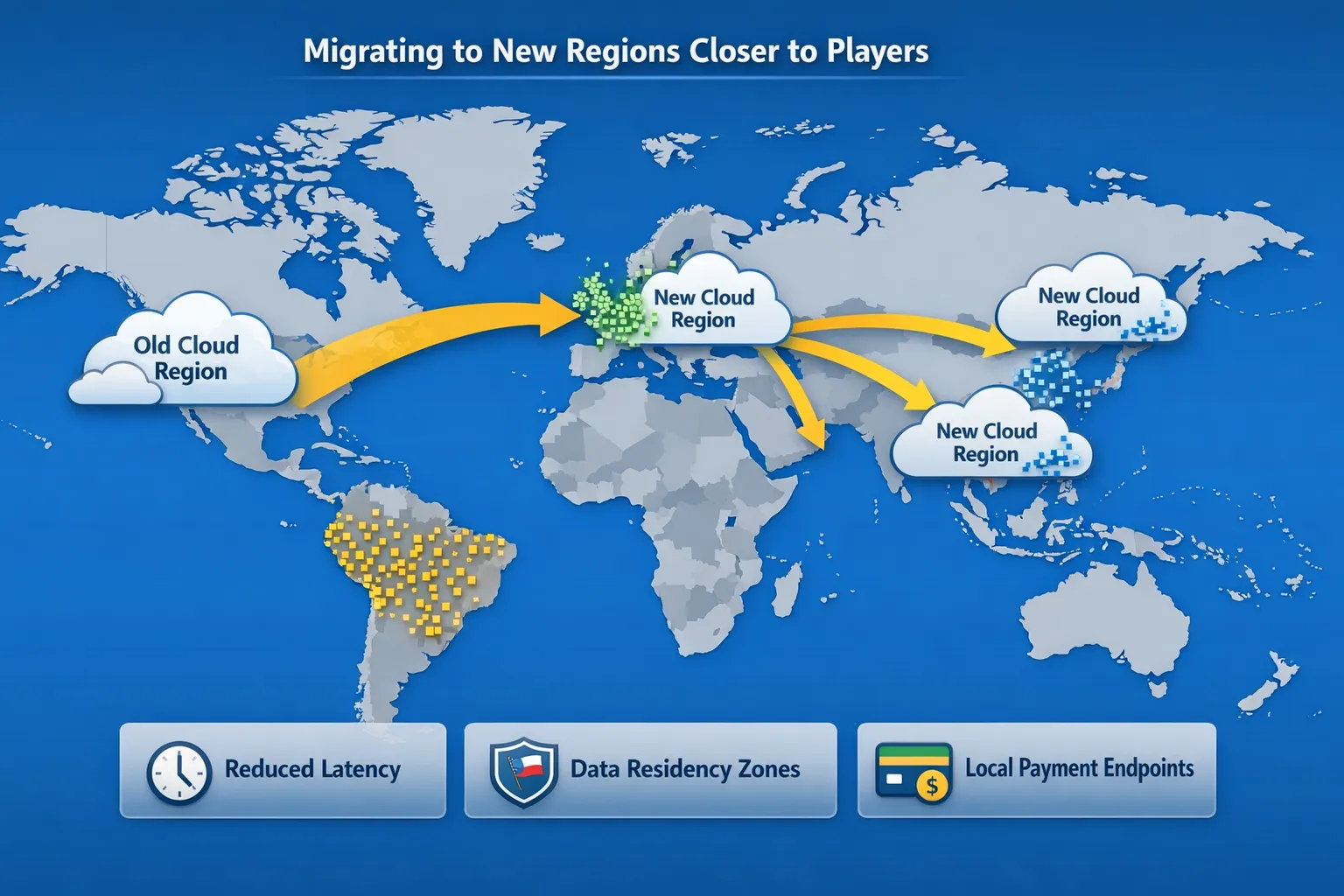
- You need data residency for a regulator or market launch, for example EU personal data must remain in the EEA.
- You want lower latency to a growing player base in a new geography.
- You are consolidating costs, negotiating new cloud commitments, or optimizing egress spend.
- You need better access to local payment rails and APMs.
- Your current region has capacity limits or compliance constraints.
If two or more apply, migration planning is worth the effort.
How to use this checklist
The checklist is organized by phases that reflect how successful operators approach live cutovers. Treat each item as a go or no go gate with proof.
- Strategy and compliance
- Architecture and networking
- Data and state migration
- Payments and cashier readiness
- Games and streaming
- Security and audits
- Observability and load testing
- Cutover and rollback
- Post‑migration validation
Where helpful, we reference independent guidance such as the AWS Well-Architected reliability pillar, Microsoft Azure’s reliability guidance, Google Cloud’s disaster recovery planning, EU guidance on international data transfers, UK Gambling Commission key events guidance, and PCI DSS v4.0.
Phase 1, Strategy and compliance groundwork
- Define player and business goals
- Target markets and languages, expected latency improvement, target approval rates for deposits and withdrawals, and SLA objectives.
- RTO and RPO by data class, for example wallet ledger RPO near zero, KYC document storage RPO under 15 minutes.
Acceptance proof, written objectives with baselines and targets signed off by product, risk, and engineering.
- Region selection and regulator impact
- Validate whether a move is a key event that must be reported to your regulator.
- Confirm data residency obligations and transfer mechanisms for cross-border data flows.
- Check test lab or certificate consequences if the hosting change is material.
Acceptance proof, legal memo plus regulator notifications submitted where required.
- Vendor and contract readiness
- Update DPAs and sub‑processor lists for the new region.
- Confirm SLAs and support hours for PSPs, KYC, AML, game providers, and CDNs in the target region.
Acceptance proof, executed contract amendments and written vendor confirmations.
Helpful resources, UK Gambling Commission key events guidance, EU guidance on international data transfers, PCI DSS v4.0 overview.
Phase 2, Architecture and networking blueprint
- VPC and subnet design
- Unique CIDRs to avoid peering conflicts, private endpoints to managed services, and route tables for isolation.
- Plan for fixed egress IPs used by PSPs and studios for allowlisting.
Acceptance proof, diagrams and Terraform manifests reviewed and tested in a staging account.
- Traffic management and CDN
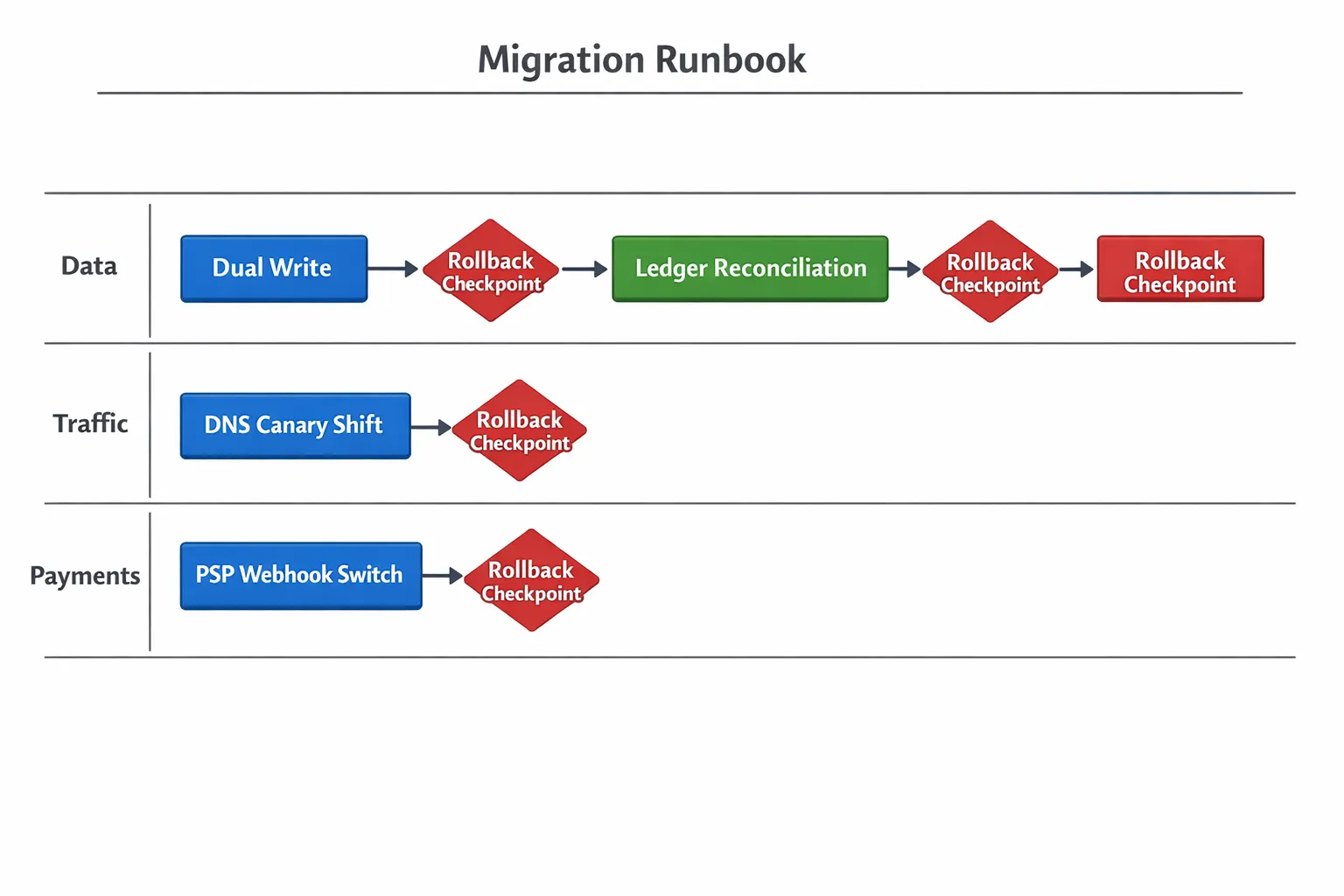
- DNS strategy with health checks, staged rollouts, and short TTLs during cutover.
- CDN edge configuration in the new geography, pre‑warmed caches for top assets.
Acceptance proof, dry run shows green health checks and successful synthetic journeys.
- Capacity and autoscaling
- Instance families, GPU needs for streaming, and pod scaling policies matched to traffic peaks.
Acceptance proof, load test reaches peak QPS with headroom and stable error rates.
Helpful resources, AWS Well‑Architected reliability pillar, Microsoft Azure Well‑Architected reliability, Google Cloud disaster recovery planning.
Phase 3, Data and state migration
Not all state is equal. Use the right pattern per state class.
| State class | Examples | Migration pattern | Typical RPO target |
|---|---|---|---|
| Financial ledger | wallet balances, bonus balances, comp points | Dual write with strong consistency, plus final delta reconciliation | Near zero |
| Session state | web sessions, game rounds in progress | Graceful drain and short TTL, optional dual read | Minutes |
| Reference data | game catalogs, feature flags, content | Bulk copy and checksum, read‑only freeze during cutover | Low |
| Documents | KYC files, SAR evidence | Encrypted bulk transfer, hash verification, staged bucket cutover | Low |
- Database replication
- Choose logical or physical replication aligned to your engine.
- Implement dual writes behind an idempotent write layer with unique request IDs.
- Build reconciliation reports for ledger tables that show net zero delta after cutover.
Acceptance proof, replication lag under targets and reconciliation reports show no imbalances.
- Event streams and analytics
- Mirror topics to the new region, preserve ordering for financial topics, and verify consumer offsets.
- Validate real‑time dashboards against a golden dataset before cutover.
Acceptance proof, mirrored topics pass checksum and dashboards match within defined tolerances.
For analytics design ideas, see Real‑Time Analytics in iGaming.
Phase 4, Payments and cashier readiness
- PSP and APM allowlists
- Register new static IPs, configure webhooks to the new endpoints, and set failover routing at BIN or APM level.
- Open banking and direct transfers
- Validate bank rails support in the target region and update redirect domains. Confirm instant pay‑in and payout availability.
Learn more in 7 Ways Open Banking Will Transform Casino Deposits and Direct Bank Transfer vs Open Banking.
- Crypto onramps and wallets
- Confirm RPC endpoints in region, rotate hot wallet keys if policy requires, and test onramp callbacks under load.
- PCI, fraud, and risk controls
- Validate PCI scope remains unchanged and WAF and 3DS flows function in region.
- Re‑train fraud models if they use IP geolocation or device fingerprints.
Acceptance proof, end‑to‑end cashier synthetic tests show time to credit within target and webhook reliability above threshold.
For cashier speed tactics, see Cashier Conversion Hacks and PCI DSS for iGaming.
Phase 5, Games, streaming, and vendors
- Game provider readiness
- Confirm region support, content availability by jurisdiction, and new IPs added to provider allowlists.
- Validate jackpot or shared liquidity integrations where applicable.
- Live casino streaming
- Choose streaming stack fit for the region. Validate bitrate ladders, startup time, and glass‑to‑glass latency.
See the benchmarks in WebRTC vs HLS for Live Casino Streaming.
- Aggregator reconciliation
- Play thousands of automated rounds in staging, collect RTP and error codes, and validate session recovery.
Acceptance proof, game catalogs match, RTP within expected variance, and startup time SLOs met in target markets.
Phase 6, Security, privacy, and audits
- Keys and secrets
- Generate region‑specific KMS keys, enforce least privilege IAM, and rotate credentials during cutover.
- PII protection and logging
- Verify encryption at rest and in transit, object‑level access policies for KYC storage, and audit log immutability for AML.
- Compliance evidence
- Update architecture descriptions, data maps, risk registers, and change control tickets with before and after states.
For KYC and AML operational pitfalls, review 10 Common KYC and AML Mistakes.
Acceptance proof, penetration test or vulnerability scan clean, and compliance pack assembled for regulator or bank partners.
Phase 7, Observability, SLOs, and load
- Monitoring and alerting
- Synthetic journeys from key cities, golden dashboards for deposits, withdrawals, game start, and bet settlement.
- Error budgets and SLOs published for the migration window.
- Load and failure testing
- Peak plus 30 percent load with soak tests. Test region failure and DNS failback. Validate no lost or duplicated financial events.
Acceptance proof, green synthetic checks and stable KPIs for at least 72 hours pre‑cutover.
Phase 8, Cutover and rollback
- Dry runs
- Rehearse the timeline in staging then production with a small percentage of traffic. Verify rollback steps in practice, not theory.
- Communications plan
- War‑room roster, escalation ladder, and status updates for VIP support, affiliates, and PSPs. Define a public status page message if needed.
- Execution and rollback criteria
- Preconditions met, freeze windows enforced, and hard rollback triggers defined, for example ledger mismatch over threshold, deposit approvals drop, glass‑to‑glass latency spike.
Acceptance proof, post‑cutover sign‑off from engineering, risk, and operations within the defined time box.
Phase 9, Post‑migration validation and optimization
- Reconciliation and QA
- Final ledger and bonus balance checks. Compare pre and post metrics by cohort and geography.
- Cost and performance tuning
- Review egress, CDN, and instance families. Optimize autoscaling and caching after observing real traffic.
- Documentation and training
- Update runbooks and on‑call guides. Archive the migration playbook for next time.
Acceptance proof, KPI review deck shows positive or neutral impact on conversion, latency, and support tickets.
A pragmatic two‑week test plan before cutover
Use this sprint to prove readiness and reduce unknowns.
- Week 1, End‑to‑end cashier and KYC flows in new region, automate 1,000 deposit and withdrawal journeys. Backfill and checksum KYC file store. Stage game catalog and run 50,000 auto rounds.
- Week 2, Dual write wallets for a subset of traffic, monitor reconciliation. Stress test streaming, measure startup time and rebuffer rate. Fail DNS to new region for 5 percent of traffic during off‑peak and monitor KPIs.
Common pitfalls to avoid
- Moving DNS first, then discovering PSP webhooks are still pointing to the old region.
- Missing allowlist updates with one game studio, which causes random 403 errors at go live.
- Forgetting to preserve idempotency keys, which leads to duplicate wallet writes during retries.
- Not pre‑warming the CDN for top game assets, which inflates first load time for new players.
- Underestimating regulator notifications or evidence required for a hosting change.
Quick acceptance checklist you can copy
- Strategy signed off, market goals, RTO and RPO targets, regulator notifications filed.
- Network ready, VPC and DNS staged, health checks green.
- Data ready, replication lag within target, dual write in place, reconciliation passing.
- Payments ready, PSP, APM, open banking, crypto onramp webhooks and allowlists updated.
- Games ready, catalogs and allowlists confirmed, latency and RTP checks passing.
- Security ready, keys rotated, IAM least privilege, WAF rules tuned.
- Observability ready, synthetic journeys from priority cities, alert thresholds tuned.
- Cutover ready, dry run complete, rollback scripted and tested, comms plan distributed.
- Post‑go validation, KPIs monitored, ledger reconciliation complete, cost tuning started.
What Spinlab can do for your region migration
Spinlab’s modular iGaming platform brings payments, KYC and AML, game aggregation, real‑time analytics, affiliate and bonus tooling, and crypto onramps into one stack. Operators use it to cut integration risk when moving regions because there are fewer vendors to rewire and a single backoffice to validate.
- Crypto and fiat cashier with multi‑currency support and custodial merchant wallets for safekeeping funds.
- KYC and AML compliance tooling plus advanced fraud prevention to stabilize approval rates post‑move.
- Seamless game aggregation and mobile‑optimized front ends so content and UX remain consistent in the new region.
- Open APIs and a customizable admin panel, which make dual write, canary releases, and dashboards straightforward.
- Real‑time analytics to confirm KPIs during and after cutover.
Spinlab is also known for fast onboarding and a Shopify‑like admin experience. Many teams use our platform to turn a risky multi‑vendor migration into a managed checklist with clear acceptance gates.
You can also learn from our operators in the wild, like the velocity patterns described in the Fullhouse scaling case study.
FAQ
How long does a typical region migration take for a mid‑size casino? Planning and vendor readiness often take 4 to 8 weeks. The technical build can run in parallel for 2 to 6 weeks, followed by a one to two week hardening period and a short cutover window. Lead times depend on regulator notifications and third‑party allowlists.
Can we do zero downtime? For the lobby and most microservices, yes. For wallets and cashier, aim for near zero through dual writes and idempotent operations. Plan a short maintenance banner if you must drain sessions or rotate keys.
Do we need to re‑certify games when the region changes? Usually no if the game binaries and math do not change, but some jurisdictions and studios treat a hosting move as a significant change. Confirm with your test lab and regulator.
What about cross‑border data transfer rules? If you store EU personal data, ensure compliant transfer mechanisms when data leaves the EEA and document your measures. Consider regionalized data stores for PII with tokenization across regions.
How do we validate no money was lost or duplicated? Maintain idempotency keys for every financial mutation, run pre and post cutover ledger reconciliation, and design automated delta checks that alert on any mismatch above a small threshold.
Do we need to re‑do PCI DSS after moving regions? A region move can change your scope or compensating controls. Update your data flow diagrams, perform a targeted risk assessment, and align with your QSA on any evidence updates.
Ready to de‑risk your move?
Get a region migration playbook tailored to your stack. Book a 30 minute call and we will map your data classes, vendors, and regulator requirements into a concrete runbook with acceptance tests. If you want the simplest path, Spinlab’s all‑in‑one iGaming platform, the market’s most affordable white label, reduces integration work and speeds up go live.
Start your plan today at spinlab.studio.