

Dormant casino accounts create a deceptively simple problem: a player stops using the site, but their money remains. For an online casino operator, that balance can still carry withdrawal rights, safeguarding obligations, fraud exposure and, in some jurisdictions, unclaimed property reporting duties. Marking an account inactive does not resolve those obligations.
The right approach separates account status from ownership of funds. Build a documented process that identifies inactivity, reconciles balances, contacts the owner and routes unresolved funds according to the applicable rules. Dormancy is an operational status, not automatic permission to recognize revenue.
Distinguish dormant casino accounts from unclaimed funds
An inactive account, a closed account and legally abandoned property are not interchangeable. Your platform should track them separately rather than treating them as one end-of-life status.
| Status | What it means operationally | What it does not establish |
|---|---|---|
| Inactive | No qualifying activity during a defined period | That the player has surrendered their balance |
| Dormant | The account meets your documented dormancy criteria | That fees or forfeiture are permitted |
| Restricted | Access or transactions are limited for a specific reason | That ownership of funds has changed |
| Closed | The account is no longer available for normal play | That all financial obligations are settled |
| Legally reportable as unclaimed | Applicable law requires reporting or remittance | That the operator may retain the funds |
Keep self-exclusion and compliance restrictions outside the ordinary inactivity lifecycle. A self-excluded customer may still need a safe way to recover funds without regaining access to gambling.
Account closure should therefore have its own financial checklist. A disabled login is not evidence that the wallet liability has been extinguished.
Establish the rules before choosing an inactivity period
There is no universal casino dormancy period. The relevant rules may depend on the licensed entity, operating market, player location, applicable property law and the nature of the balance. Contractual inactivity periods and statutory abandonment periods may also differ.
Create a jurisdiction-specific policy matrix approved by legal and compliance. At minimum, record:
- The legal entity holding the player obligation and the applicable market rules.
- The definition of qualifying activity and the event that starts each relevant clock.
- Required notices, delivery methods and waiting periods.
- Whether inactivity fees are permitted and what conditions apply.
- Reporting, remittance, recordkeeping and subsequent claim-handling requirements.
For Great Britain, check the applicable Gambling Commission licence conditions and codes of practice, including customer funds and fair-treatment requirements. Do not assume a clause in your terms overrides those obligations.
For US-connected balances, obtain advice on whether state unclaimed property rules apply to the specific obligation. The National Association of Unclaimed Property Administrators provides access to state programs, but classification, reporting deadlines and remittance instructions must be verified with the relevant authority.
Do not copy another operator's six-month or twelve-month threshold into your policy without establishing its legal basis. An offshore licence alone does not settle every potential unclaimed property question.
Define inactivity using evidence you can defend
Your iGaming platform should distinguish the last login from the last wager, deposit, withdrawal and authenticated customer contact. These events answer different questions and should not overwrite one another.
A login might reset a contractual inactivity timer if your terms say so. It does not necessarily reset a statutory unclaimed property period. Likewise, an automated bonus credit, internal adjustment or promotional email open should not automatically count as owner activity.
Maintain separate timestamps for each relevant event, together with its source and transaction or case identifier. Store event times consistently, such as in UTC, and retain the policy version used to calculate eligibility.
Also separate the financial components of each wallet: deposited cash, withdrawable winnings, restricted promotional value, unsettled wagers and pending payment transactions. A single headline balance is insufficient for deciding what can be paid, retained or reported.
Build a controlled dormant-account workflow
Use a repeatable workflow with explicit approvals and exception handling. Each stage should leave evidence that another team member can review without reconstructing the account manually.
Detect candidates without changing balances
Run an eligibility process against the approved rules. Its first output should be a candidate population, not an automatic deduction or account closure.
Route accounts with pending withdrawals, unresolved disputes, unsettled wagers or compliance restrictions into separate review queues. Preserve relevant deadlines even when another case prevents immediate payment; an internal hold does not necessarily stop a legal reporting clock.
Recheck eligibility immediately before any consequential action. A customer may have contacted support or requested a withdrawal since the candidate file was generated. An outdated export should never be the sole authority for moving funds.
Reconcile and classify every balance
Before contacting the player about an amount, reconcile the wallet to the underlying ledger. Check payment reversals, duplicate credits, failed withdrawals, provider settlements and unresolved adjustments.
Separate the amount owed to the player from promotional value that may expire under valid terms. Never assume that all winnings associated with a bonus can be removed. Their treatment depends on the promotion, the transaction history and applicable rules.
An auditable casino ledger makes it easier to trace the balance back to its source and record later corrections without erasing history.
Where a balance remains disputed, preserve the original records and document the reason for the exception. Do not silently net a disputed debt against another wallet or currency unless that treatment is legally and contractually supported.
Send service notices, not reactivation campaigns
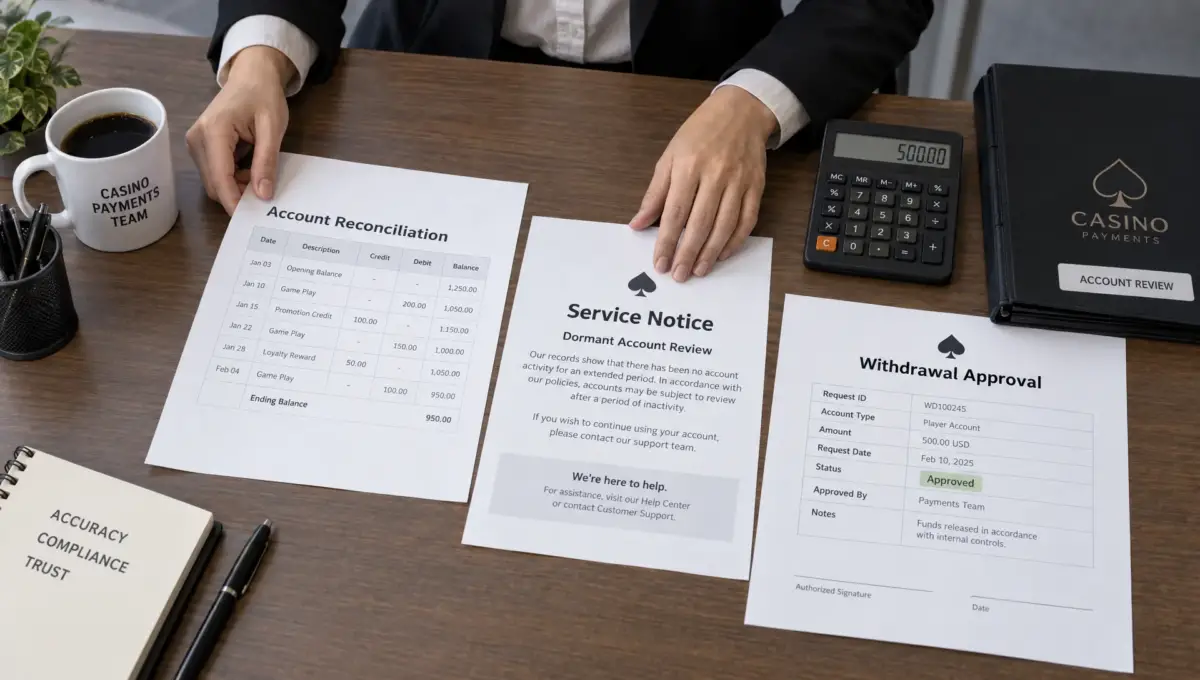
A dormancy notice should explain the account status, the relevant balance, the action available to the customer and any applicable deadline. Where fees or remittance are lawful possibilities, explain them accurately rather than relying on a vague reference to the terms.
Keep the message separate from marketing. A bonus offer or encouragement to wager can undermine the purpose of the notice, particularly for customers with marketing restrictions or safer-gambling flags.
A neutral message could say: “Our records show that your account has been inactive. Please sign in through our official website or contact support to review your remaining balance and available withdrawal options.” Add verified amounts and deadlines only when appropriate for that channel.
Log delivery attempts, bounces, returned mail and authenticated responses. An undelivered notice is evidence of an attempted contact, not proof that the owner abandoned the funds.
Provide a secure route to recover funds
Make withdrawal or balance recovery possible without requiring a new deposit or additional gambling. Account recovery should not become a retention funnel.
Use proportionate identity and ownership checks, together with any legally required due diligence. Requiring every returning customer to repeat every verification step can create unnecessary friction, but inactivity should not bypass security controls either.
If the original payment instrument has expired, provide an approved alternative through your payment procedures. Verify ownership of the destination and document why the original route could not be used.
For crypto payments, confirm the asset, network and destination address through an authenticated process. A payout to the wrong network may be irrecoverable. Do not convert a crypto balance into fiat merely to simplify dormant-account processing unless the applicable terms and legal framework support that treatment.
Where self-exclusion remains active, handle fund recovery through a non-gambling process. Returning money must not restore access to betting or promotional communications.
Apply the legally approved final outcome
Once required checks and notices are complete, route the balance to the appropriate outcome: payment to the verified owner, continued holding, lawful fee treatment or reporting and remittance to an authority.
Do not treat inactivity fees as a default monetization feature. Assess legality, fairness, disclosure, notice requirements and any applicable limits before charging them. Newly introduced terms do not automatically authorize deductions from existing balances.
If remittance is required, reconcile the submission to individual accounts and retain the authority's acknowledgement. Record when and on what basis the transfer legally discharges the operator's obligation.
Closure should follow a completed decision, not substitute for one. Keep a documented route for handling a customer who returns after closure or remittance, including directing them to the relevant authority where appropriate.
Keep dormant balances visible in the accounts
Dormant player balances should remain identifiable in financial reporting. An internal transfer to a “dormant funds” category generally changes classification, not ownership or the existence of a liability.
Finance should reconcile opening balances, newly dormant balances, customer repayments, approved adjustments, lawful deductions, remittances and closing balances. Keep a bridge back to account-level records so totals can be explained during an audit.
Do not release balances to income simply because they are old, small or expensive to return. Any derecognition requires a supportable accounting and legal basis. Management approval alone does not provide that basis.
For multi-currency wallets, retain the original asset or currency amount alongside the reporting-currency value. Apply the relevant accounting policy to valuation changes without rewriting what the customer is owed. A token balance worth very little today can change materially in value later.
Separate responsibility for approving a policy from permission to execute deductions or remittances. High-impact actions should require independent review and leave an audit trail.
Protect dormant wallets from takeover and operational errors
A long-unused account with a positive balance is an attractive takeover target. Treat a sudden password reset, changed contact details and new withdrawal destination as a combined risk signal, rather than three unrelated events.
Your account takeover prevention controls should cover the recovery process as well as ordinary login. Step-up authentication and manual review may be appropriate when ownership evidence or destination changes raise concerns.
Bulk dormancy processing introduces a different risk: a configuration error can affect thousands of accounts. Test rule changes against historical data, review a sample and compare expected totals before execution. Make financial actions safe to retry without duplicate deductions or payments.
Small crypto balances need explicit treatment too. Network fees exceeding the balance do not automatically authorize confiscation. Document any lawful alternatives, such as continued holding or another supported withdrawal route, rather than hiding those balances in an exception queue.
Retain evidence and monitor unresolved cases
Keep enough evidence to explain each decision: the applicable rule, relevant activity dates, balance calculation, notices, verification results, approvals and final disposition.
Dormancy is not a reason to retain every piece of customer data indefinitely. Where GDPR applies, its storage limitation principle requires a defensible retention approach, alongside applicable legal retention duties and legal holds. Account access, financial records and marketing data can have different retention requirements.
A useful operational dashboard should track:
- Dormant balances by entity, jurisdiction, asset and age band.
- Cases approaching notice, reporting or remittance deadlines.
- Outstanding balance discrepancies and their age.
- Customer repayment completion times and failed payouts.
- Exceptions without an assigned owner or next action date.
Avoid measuring success solely by how much liability disappears. Timely, accurate resolution is a better objective than reducing the dormant-balance total at any cost.
Frequently asked questions
How long before a casino account becomes dormant? There is no universal period. Define contractual inactivity according to applicable rules and track any statutory unclaimed property period separately. The events that start or reset those clocks may differ.
Can an operator keep money in dormant casino accounts? Inactivity alone does not transfer ownership to the operator. Continued holding, deductions, forfeiture or remittance each require their own legal and contractual basis. A clause in the terms is not sufficient if it conflicts with applicable law.
Should dormant accounts be deleted? Not automatically. You may disable normal access while retaining records needed for withdrawals, audits, legal obligations or disputes. Apply a documented retention schedule rather than treating closure as permission to delete everything.
What if the customer returns after funds have been remitted? Verify the customer's identity, locate the remittance record and follow the applicable claim process. Where the authority now holds the funds and the operator's obligation has been discharged, provide the information needed to pursue that claim.
Evaluate your platform against the workflow
Dormant-account management requires coordination between compliance, finance, support and payments. Before choosing a casino software provider, ask it to demonstrate how your approved rules would work across those teams.
Spinlab's modular iGaming platform brings together crypto and fiat payment support, KYC and AML capabilities, real-time analytics and a customizable backoffice. For a dormancy implementation, confirm the specific event tracking, approval controls, reporting exports and record-retention capabilities you require. Treat those as acceptance criteria to verify, not features to assume.
