

Casino marketing suppression rules for at-risk players must do more than remove an email address from the next campaign. They need to stop promotional contact, prevent inappropriate bonus offers and keep automated retention journeys from restarting while a player is being assessed or protected.
For online casino operators, the difficult part is enforcement across disconnected systems. A responsible gambling flag in the backoffice offers little protection if a scheduled SMS, VIP call or affiliate campaign still reaches the player. This guide sets out a practical control framework for marketing, compliance and engineering teams, with clear distinctions between regulatory requirements and recommended operating safeguards.
Define casino marketing suppression rules by player state
Marketing suppression is a restriction on promotional eligibility, not necessarily a restriction on account access. It should specify which communications and incentives are blocked, why the restriction exists and who can change it.
Separate two decisions: whether someone may receive a promotion and whether they may activate the associated incentive. Blocking an email does not prevent a player from redeeming a publicly available bonus code.
The following matrix is a recommended policy starting point. Map each rule to the applicable license, jurisdiction and player circumstances before implementation.
| Player state | Recommended promotional restriction | Review or release condition |
|---|---|---|
| Marketing objection or withdrawn consent | Stop marketing within the scope of the objection or withdrawal | A legally valid change in preference, without overriding other restrictions |
| Gambling timeout | Suppress gambling promotions and new incentive activation during the break | Timeout has ended and all remaining eligibility checks pass |
| Risk indicators awaiting assessment | Pause targeted promotions and retention incentives pending review | Documented assessment supports the next action |
| Strong indicators of gambling harm | Stop targeted promotions, VIP solicitation and take-up of new bonus offers | Responsible gambling review under applicable rules and policy |
| Active self-exclusion | Suppress gambling marketing and promotional enrollment | Applicable exclusion and return requirements are satisfied, with no automatic campaign restart |
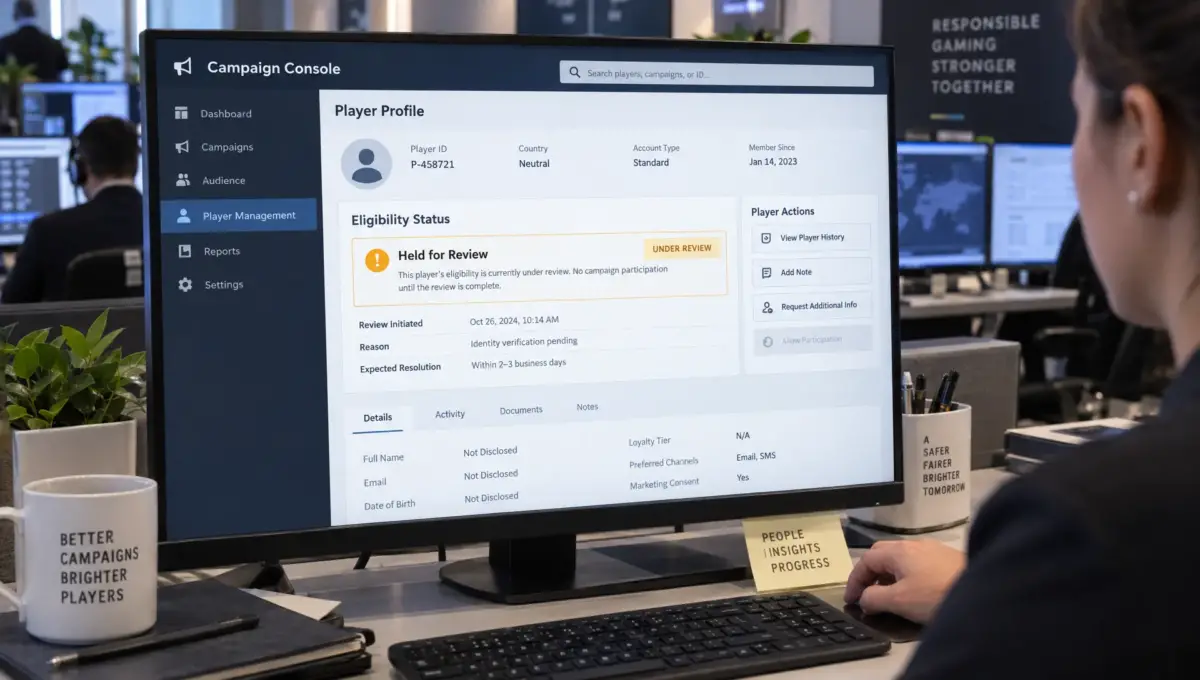
| Missing or stale eligibility status | Hold promotional delivery | A current, valid eligibility decision becomes available |
Keep these states distinct. An unsubscribe request, a temporary risk hold and self-exclusion have different meanings, even when they produce the same immediate result: no promotional send.
Establish the legal baseline first
For licensees within its scope, the UK Gambling Commission’s remote customer interaction requirement requires processes that prevent marketing and the take-up of new bonus offers where strong indicators of harm have been identified. Treat communication delivery and bonus activation as separate enforcement points.
Marketing permissions also have their own legal basis. The ICO’s guidance on the right to object explains that an objection to processing for direct marketing must be respected. Continued service communications do not create permission to resume promotions.
These are jurisdiction-specific examples, not a universal legal checklist. Compliance should document which obligations apply to each licensed operation, including any requirements governing timeouts, exclusion schemes, group brands and third-party marketing.
Choose risk triggers without confusing harm with fraud
Risk detection should combine behavior, account context and direct communication. Relevant signals can include rapid escalation in spending, repeated failed deposits, unusually prolonged play and messages describing distress or difficulty controlling gambling.
No single spending threshold reliably identifies harm across every player. A high deposit can mean different things depending on the customer’s history and circumstances. Conversely, a modest amount does not make an explicit disclosure of harm less significant.
Use documented triggers to initiate proportionate action. For example, a distress disclosure can warrant immediate promotional suppression and escalation rather than waiting for a scheduled scoring job. A weaker behavioral signal may trigger a temporary marketing hold while a trained reviewer assesses the context.
Do not classify responsible gambling restrictions as bonus abuse. Fraud controls investigate deception or misuse, while harm controls protect players. The distinction matters for communication tone, access permissions and case ownership. Spinlab’s guide to risk-based casino fraud checks covers the separate fraud workflow.
Likewise, do not turn vulnerability signals into commercial segments. A pattern suggesting loss-chasing should never become the trigger for a deposit match, cashback offer or VIP intervention designed to retain spending.
Enforce eligibility across the full marketing journey
A suppression list exported once each morning leaves gaps. A player can enter a campaign while eligible, disclose harm later and still receive a queued promotion that evening.
An iGaming platform therefore needs a reliable way to make the same eligibility decision available to campaign tools, bonus systems and customer-facing teams. The architecture can vary, but the outcome should not depend on which system initiated the promotion.
Use a shared eligibility decision
Maintain a central record or service containing the player identifier, restriction scope, reason category, effective time, review status and policy version. Distinguish an expiry time from permission to resume marketing: some restrictions require review even after a date has passed.
The decision should consider all relevant restrictions together. A player is not eligible simply because they have marketing consent if an active harm-related hold prohibits the promotion.
Resolve identities carefully. Verified links between accounts may support broader enforcement where policy and law permit it, but a shared IP address alone is not enough to treat a household as one person. Ambiguous matches should follow a documented review path.
Use Spinlab’s self-exclusion implementation guide for the wider account-level controls. Marketing suppression should consume that status, not maintain a competing version of it.
Check at enrollment, delivery and redemption
Check promotional eligibility when a player enters an audience and again immediately before a message is handed off for delivery. For scheduled campaigns, the earlier audience selection is not a substitute for the later check.
When a restriction arrives, remove the player from active promotional journeys, cancel pending messages where possible and prevent new enrollment. Some messages already handed to an external provider cannot be recalled. Record that limitation and minimize the gap between the final check and delivery.
Bonus eligibility needs its own check at activation or redemption, including offers reached through public pages, affiliate links and reusable codes. Do not assume that suppressing direct outreach closes these routes.
Handle previously awarded benefits under applicable rules and fair terms. A harm-related intervention should not become a pretext to confiscate funds, add wagering requirements or obstruct withdrawals.
Close the less visible channels
Email and SMS are only part of the control surface. Review push notifications, logged-in promotional banners, inbox messages, VIP call lists and outbound contact tasks. Staff should see a clear instruction not to solicit gambling, rather than a vague risk score they must interpret themselves.
For paid media, exclude affected known users from addressable audiences where technically and lawfully possible. Audience updates are not instantaneous, and suppression cannot guarantee that someone never sees a broad, untargeted advertisement.
Affiliates need contractual restrictions and operational processes for stopping identifiable targeted promotions. Avoid distributing an unrestricted customer list as a shortcut. Any identifier-sharing or audience-matching process needs privacy review, access controls and appropriate agreements.
Fail safely without blocking essential services
If the eligibility service is unavailable or its data is too old, the recommended default is to hold promotional activity. Do not let a missing risk response become permission to send.
That failure mode should not automatically block withdrawals, security notices or access to support. Keep promotional eligibility separate from the systems needed to protect funds and service the account.
Define the maximum acceptable age of an eligibility decision and the response to failed updates. Event-driven changes should be backed by reconciliation that detects mismatches between the central record, campaign systems and bonus engine.
A restriction should remain effective until a valid release event occurs. Replaying an old audience import or restoring a campaign backup must not overwrite a newer suppression state.
Separate protective messages from promotional messages
Suppressed players may still need account security alerts, withdrawal updates, complaint responses or responsible gambling communications. These messages should have a defined service or protective purpose and use an appropriate lawful basis.
A transactional label does not make promotional content acceptable. A withdrawal confirmation containing a reload offer is a mixed-purpose message. Remove the promotional component rather than using the service event to bypass suppression.
Protective communication should explain the action plainly and identify available support. Avoid urgency, loss-recovery language, celebratory gambling imagery and invitations to return to play. A request for information should not be bundled with a reward for completing it.
Classify templates before deployment and review reusable components such as footers, recommendation modules and banners. Otherwise, a compliant message body can acquire an inappropriate promotion through a shared template.
The same distinction applies to limit-related messaging. Spinlab’s guidance on designing loss-limit alerts is relevant to making protective notices understandable without turning them into another marketing touchpoint.
Make reinstatement a controlled decision
Suppression rules are incomplete without release rules. A player clicking an old email, logging in again or updating their profile should not silently remove a responsible gambling restriction.
Assign ownership of harm-related release decisions to an appropriately trained responsible gambling or compliance function. Marketing teams can manage preference changes, but they should not override a harm restriction to recover a campaign audience.
Record the evidence reviewed, the decision, its scope and the reviewer. If the restriction has a scheduled review date, reaching that date should trigger assessment rather than automatic promotional eligibility.
Self-exclusion requires its own process under the applicable regime. The end of a minimum exclusion period is not, by itself, a universal instruction to reopen an account or restart marketing.
After any valid release, recheck all remaining restrictions, including consent, objections, other exclusions and jurisdictional eligibility. Do not send the backlog of promotions missed during suppression. Future campaigns should evaluate the player afresh under current rules.
Protect suppression data from becoming a targeting asset
A suppression record may reveal sensitive information about a person’s circumstances. Give each system only what it needs to enforce the restriction.
A messaging provider may need a delivery prohibition or exclusion identifier. It generally does not need case notes explaining financial distress, conversations with support or the reasoning behind a harm assessment.
Avoid labels such as “problem gambler” in advertising exports. Hashed identifiers are not automatically anonymous, particularly where a recipient can match them to individuals. Assess the lawful basis, vendor terms and disclosure risks before using customer matching for exclusions.
Retain enough information to honor objections and demonstrate control, while applying a documented retention policy. Deleting every suppression record can cause previously restricted people to be reimported into marketing. Retaining detailed case histories indefinitely creates a different risk. Privacy and compliance teams should resolve that balance explicitly.
Test suppression as an operational control
A policy document does not demonstrate that campaigns are blocked. Test realistic changes in player status across every connected system, especially where a campaign and a restriction can happen almost simultaneously.
A minimum test suite should cover these scenarios:
- A player becomes restricted after audience selection but before scheduled delivery.
- A suppressed player attempts to activate a public bonus code or an affiliate offer.
- A VIP task remains open when the player’s eligibility changes.
- A delayed event, stale cache or provider outage prevents a fresh decision.
- An expired timeout coexists with another restriction that still prohibits marketing.
- A queued message contains promotional content inside a service template.
Use controlled test accounts and inspect downstream delivery records, not just the campaign tool’s suppression count. Include manual outreach in the test scope because a staff member’s spreadsheet can bypass otherwise sound automation.
For each promotional decision, retain proportionate evidence such as the player reference, campaign or offer identifier, decision time, rule version and outcome. Keep detailed responsible gambling notes in the case-management environment rather than duplicating them into marketing logs.
Useful control metrics include time from restriction to enforcement, prohibited sends, blocked bonus activations and unresolved downstream mismatches. Treat blocked activity as evidence that protection is working, not as lost revenue that teams should be rewarded for recovering.
Frequently asked questions
Does marketing consent allow promotions to an at-risk player? No. Consent does not override a separate legal, licensing or responsible gambling restriction. Promotional eligibility must satisfy all applicable conditions.
Should a timeout stop every account message? Not necessarily. A recommended policy is to suppress gambling promotions during the break while allowing necessary service and protective communications. The exact requirements depend on the applicable rules and the type of break.
Can suppressed players receive bonuses through public offers? Where take-up of new bonus offers must be prevented, suppressing messages alone is insufficient. Check eligibility at activation or redemption, including public codes and affiliate routes.
Can an operator guarantee that a self-excluded player never sees an advertisement? No. Operators should enforce required exclusions and use available controls for known, addressable audiences, but broad advertising and third-party delivery have limitations. Document those limitations rather than promising complete invisibility.
Evaluate platform controls before launch
Spinlab offers a modular casino platform with an affiliate and bonus engine, a customizable backoffice and open API integration. When assessing it for your operation, ask how your suppression policy would connect to campaign delivery, bonus activation and responsible gambling workflows.
Bring the rule matrix and test cases to a Spinlab platform discussion. Confirm the required integrations, decision timing, audit evidence and release permissions before treating the workflow as production-ready.
